
In the context of global efforts to achieve carbon peak and carbon neutrality, the integration of solar energy into power systems has gained significant momentum. Solar inverters play a pivotal role in converting direct current from photovoltaic panels into alternating current for grid integration. However, traditional solar inverters primarily operate in current-controlled modes, which heavily rely on grid voltage and frequency stability. This dependency can lead to issues such as anti-islanding protection activation during grid disturbances, disrupting power supply. To address this, voltage-controlled solar inverters without energy storage have emerged as a viable solution. These solar inverters must seamlessly transition between grid-connected and islanded modes to ensure continuous power delivery. In this paper, I explore multi-modal control strategies and smooth switching techniques for solar inverters, focusing on their application in distributed photovoltaic systems under the dual-carbon framework.
The operational modes of solar inverters are critical to their performance. In grid-connected scenarios, solar inverters typically employ current control, where the inverter’s output current is regulated to match grid requirements. The stability of these solar inverters depends on the grid’s voltage and frequency. If the grid experiences fluctuations, the solar inverter may switch to islanded operation, where it must maintain voltage and frequency stability independently. This transition is essential for solar inverters to function reliably in the absence of grid support. The multi-modal control of solar inverters involves dynamic adjustments to handle varying load conditions and grid faults. For instance, during grid-connected operation, solar inverters track power commands, while in islanded mode, they adopt voltage and frequency control to balance source-load power. This flexibility is key to enhancing the resilience of solar inverters in modern power systems.
The topology of solar inverters is designed to support these operational modes. A typical solar inverter consists of a front-end Boost converter and a rear-end inverter, often a three-level neutral-point-clamped type. This structure allows for decoupled control of DC-link voltage and output power. The Boost converter regulates the voltage from the solar panels, while the inverter manages the AC output. Solid-state switches are used to connect or disconnect the solar inverter from the grid, facilitating mode transitions. For example, during grid connection, the switch is closed, enabling current control. In islanded mode, the switch opens, and the solar inverter shifts to voltage control. This topology ensures that solar inverters can handle both grid-tied and standalone operations efficiently. The integration of LCL filters further improves output quality by reducing harmonics, which is crucial for the performance of solar inverters in sensitive applications.
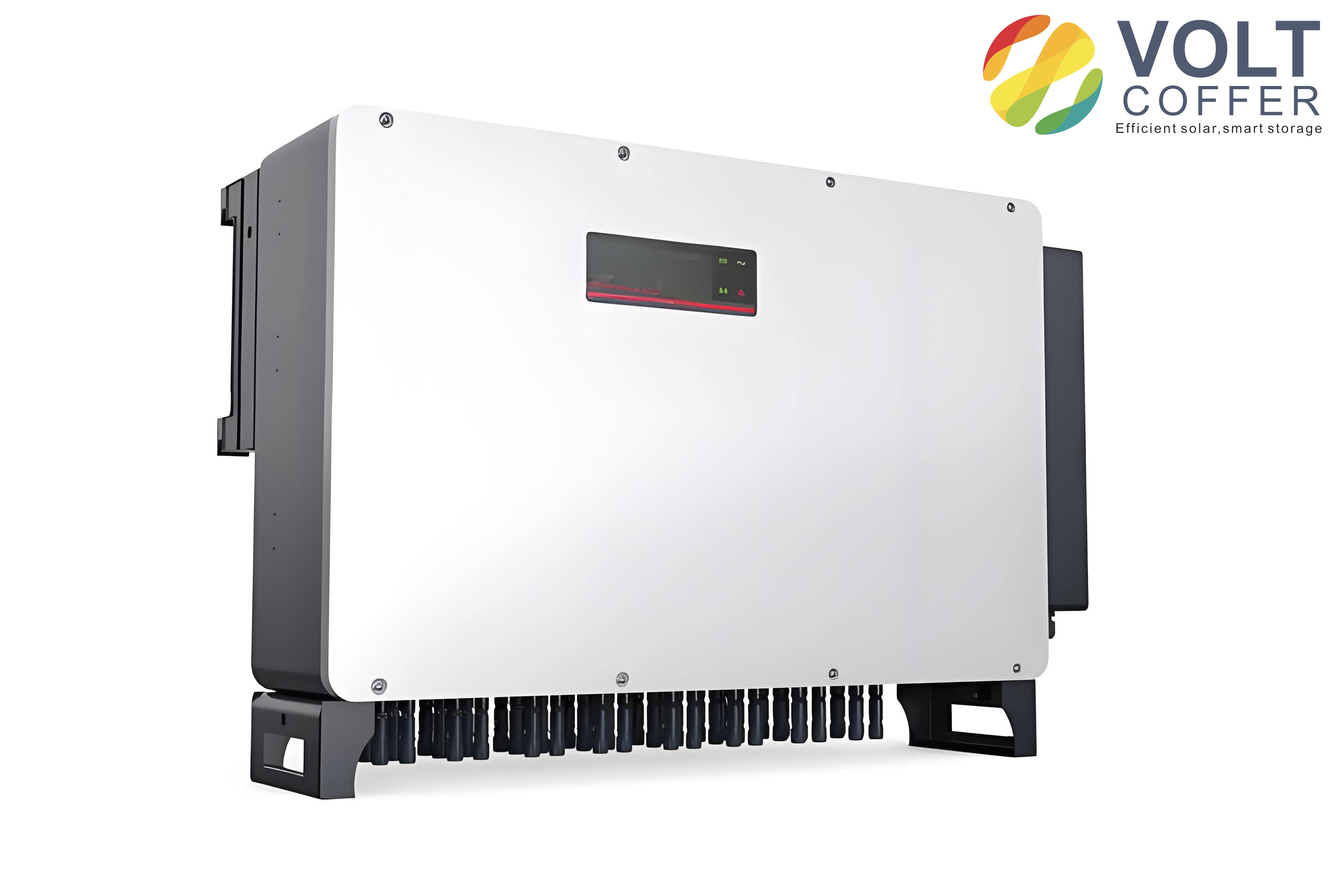
Multi-modal control strategies for solar inverters involve precise algorithms for grid-connected and islanded operations. In grid-connected mode, solar inverters use power tracking control, where the inverter follows power commands from the system. The active and reactive power outputs are calculated using dq-axis components in a rotating reference frame. The formulas for active power (P) and reactive power (Q) are given by:
$$ P = \frac{3}{2} u_{md} i_{md} $$
$$ Q = -\frac{3}{2} u_{md} i_{md} $$
where \( u_{md} \) and \( i_{md} \) represent the d-axis components of the inverter’s output voltage and current, respectively. Solar inverters maintain stability by ensuring power balance between input and output. If the solar inverter cannot meet the power command, it operates at the maximum power point, with the Boost converter adjusting the solar panel’s output. In islanded mode, solar inverters switch to constant voltage and frequency control. This mode requires the solar inverter to regulate the AC bus voltage and frequency without grid support. The power balance is achieved by adjusting the solar inverter’s output based on load demand. If the solar power exceeds the load, the DC-link voltage rises, and vice versa. Solar inverters use this voltage feedback to modulate the power output, ensuring stability in islanded conditions.
The seamless switching between grid-connected and islanded modes is a cornerstone of advanced solar inverter technology. When transitioning from grid-connected to islanded operation, solar inverters must quickly detect grid faults and initiate the switch. The solid-state switch opens, and the control mode changes from current control to voltage control. To prevent current surges, solar inverters employ initialization techniques, such as integral reset, to maintain current command continuity. The voltage outer loop continues to use the grid-connected current reference during the transition, ensuring smooth mode change. Conversely, when switching from islanded to grid-connected mode, solar inverters use pre-synchronization control. This involves matching the inverter’s output voltage and phase with the grid before closing the switch. Solar inverters adjust frequency and voltage based on the difference between the islanded voltage and grid voltage, minimizing inrush currents. The pre-synchronization process ensures that solar inverters can reconnect to the grid without disruptions, enhancing the reliability of solar power systems.
To validate these strategies, I conducted experiments using a simulation platform. The setup included a DC source emulating solar panels, a three-level solar inverter, and LCL filters. The solar inverter’s controller was implemented on a DSP28377 platform. Grid voltage and islanded voltage were set to 70V, with a current source voltage range of 70-80V. The power command for grid-connected operation was 210W, while the islanded mode frequency was 50Hz. Load resistance was 20Ω, and series resistance was 2.5Ω. The results demonstrated that solar inverters could smoothly transition between modes. During the switch from grid-connected to islanded mode, the solar inverter’s output power increased from 210W to 360W without significant voltage or current spikes. The DC-link voltage stabilized at 200V after a minor dip. In the reverse switch, the solar inverter maintained stable power output, and the pre-synchronization ensured seamless reconnection. These findings highlight the effectiveness of the proposed control strategies for solar inverters.
The experimental data can be summarized in the following table, which compares key parameters during mode transitions for solar inverters:
| Parameter | Grid-Connected Mode | Islanded Mode | Transition Notes |
|---|---|---|---|
| Output Power (W) | 210 | 360 | Stable increase during switch |
| DC-Link Voltage (V) | ~74 | 200 | Minor dip then stabilization |
| AC Voltage (V) | 70 | 70 | Maintained constant |
| Frequency (Hz) | 50 | 50 | No significant deviation |
In addition to power and voltage control, solar inverters must manage harmonic distortion and power quality. The use of LCL filters in solar inverters helps attenuate higher-order harmonics, ensuring compliance with grid standards. The transfer function of an LCL filter can be expressed as:
$$ H(s) = \frac{1}{L_1 L_2 C s^3 + (L_1 + L_2) s} $$
where \( L_1 \), \( L_2 \), and \( C \) represent the filter inductances and capacitance. Solar inverters leverage this to minimize output ripple, which is crucial for both grid-connected and islanded operations. Furthermore, solar inverters incorporate maximum power point tracking (MPPT) algorithms to optimize energy harvest from solar panels. In grid-connected mode, MPPT ensures that solar inverters extract the maximum available power, while in islanded mode, it adjusts to load demands. The Perturb and Observe method is commonly used in solar inverters, described by the equation:
$$ P_{pv} = V_{pv} \cdot I_{pv} $$
where \( P_{pv} \), \( V_{pv} \), and \( I_{pv} \) are the power, voltage, and current of the photovoltaic array, respectively. Solar inverters continuously perturb the operating point to track the maximum power, enhancing overall efficiency.
Another critical aspect is the fault ride-through capability of solar inverters. Under grid faults, solar inverters must remain connected or switch to islanded mode without causing instability. This involves advanced detection algorithms in solar inverters that monitor voltage sags, swells, and frequency deviations. For instance, solar inverters use phase-locked loops (PLL) to synchronize with the grid. The PLL output phase \( \theta \) is given by:
$$ \theta = \int \omega \, dt $$
where \( \omega \) is the angular frequency. Solar inverters adjust this frequency during pre-synchronization to match the grid phase. In islanded mode, solar inverters generate the phase internally, ensuring continuous operation. The robustness of these mechanisms in solar inverters is vital for distributed generation systems.
The control algorithms for solar inverters also include adaptive techniques to handle nonlinear loads. In islanded mode, solar inverters must supply power to varying loads, which can cause voltage distortion. Solar inverters employ voltage and current controllers with proportional-integral (PI) regulators. The voltage controller in solar inverters can be modeled as:
$$ G_v(s) = K_{pv} + \frac{K_{iv}}{s} $$
where \( K_{pv} \) and \( K_{iv} \) are the proportional and integral gains. Similarly, the current controller in solar inverters uses:
$$ G_i(s) = K_{pi} + \frac{K_{ii}}{s} $$
These controllers ensure that solar inverters maintain stable output under dynamic conditions. Additionally, solar inverters use droop control in islanded mode to share loads among multiple units, if applicable. The droop equations for active power (P) and frequency (f) in solar inverters are:
$$ f = f_0 – m_p P $$
$$ V = V_0 – n_q Q $$
where \( f_0 \) and \( V_0 \) are nominal frequency and voltage, and \( m_p \) and \( n_q \) are droop coefficients. This allows solar inverters to operate in parallel without communication, enhancing scalability.
To further illustrate the control strategies, consider the following table summarizing the key differences between grid-connected and islanded modes for solar inverters:
| Feature | Grid-Connected Solar Inverters | Islanded Solar Inverters |
|---|---|---|
| Control Mode | Current Control | Voltage and Frequency Control |
| Power Reference | Grid Power Command | Load Demand |
| Stability Mechanism | Grid Support | Local Voltage Regulation |
| Switching Action | Solid-State Switch Closed | Solid-State Switch Open |
| Typical Applications | Utility-Scale Solar Farms | Remote or Emergency Power |
In practical implementations, solar inverters face challenges such as parameter variations and environmental factors. For example, temperature changes can affect the efficiency of solar panels, indirectly impacting solar inverters. To compensate, solar inverters use adaptive control laws that update gains based on operating conditions. The mathematical representation for an adaptive controller in solar inverters might include:
$$ u(t) = K(t) e(t) $$
where \( u(t) \) is the control signal, \( K(t) \) is the adaptive gain, and \( e(t) \) is the error signal. Solar inverters with such capabilities can maintain performance across a wide range of scenarios, making them suitable for the dual-carbon goals.
Moreover, the integration of solar inverters into smart grids requires communication interfaces for monitoring and control. Solar inverters can exchange data with grid operators to optimize power flow and participate in demand response. Protocols like IEEE 1547 define standards for solar inverters, ensuring interoperability. In islanded mode, solar inverters may use local energy management systems to prioritize critical loads, further demonstrating their versatility.
Looking ahead, the development of solar inverters will likely focus on enhancing multi-modal functionality and reducing costs. Innovations in wide-bandgap semiconductors, such as silicon carbide and gallium nitride, are improving the efficiency and power density of solar inverters. These materials allow solar inverters to operate at higher frequencies, reducing the size of passive components. Additionally, artificial intelligence algorithms are being incorporated into solar inverters for predictive maintenance and fault detection, increasing reliability.
In conclusion, the multi-modal control and seamless switching techniques for solar inverters are essential for advancing renewable energy integration under the dual-carbon framework. Solar inverters that can efficiently transition between grid-connected and islanded modes contribute to grid stability and energy security. The strategies discussed, including power tracking, voltage control, and pre-synchronization, enable solar inverters to handle dynamic grid conditions. Experimental results confirm that solar inverters with these capabilities can achieve smooth mode transitions without significant power quality issues. As solar energy continues to expand, the role of solar inverters will become increasingly critical, driving further research and innovation in this field.