
In my work on renewable energy systems, I have focused extensively on photovoltaic (PV) technology, which is a cornerstone of modern solar systems. Constructing a solar system with real PV arrays can be prohibitively expensive, especially for power levels ranging from hundreds of watts to larger scales. This high cost stems from the significant variations in output power due to changing light intensity and temperature. To reduce investment and improve feasibility, developing accurate PV array models becomes crucial. These models simulate the characteristics, load capacity, and performance of PV arrays under different conditions, such as varying irradiance, ambient temperature, and array configurations. By using such models, I can drastically shorten research cycles, enhance efficiency, and increase the reliability of findings. Therefore, in my practical work, establishing a PV array model is indispensable. I have explored a method to simulate a practical PV array model within the PSCAD/EMTDC environment, which I will detail in this article.
The core of any solar system is the PV cell, which converts sunlight directly into electricity via the photovoltaic effect in semiconductor PN junctions. To understand its behavior, I start with the equivalent circuit of a PV cell. This circuit includes a current source representing photocurrent, a diode for the PN junction, and series and shunt resistances. For modeling purposes, I simplify this to derive a practical mathematical expression. The I-V characteristic equation is given by:
$$ I = I_{sc} \times [1 – B_1 \times (e^{V/(B_2 V_{oc})} – 1)] $$
Here, \( I \) is the output current, \( I_{sc} \) is the short-circuit current, \( V \) is the output voltage, \( V_{oc} \) is the open-circuit voltage, and \( B_1 \) and \( B_2 \) are coefficients determined from key operating points. At the maximum power point (MPP), where current is \( I_m \) and voltage is \( V_m \), approximations lead to:
$$ e^{V_m / (B_2 V_{oc})} – 1 \approx e^{V_m / (B_2 V_{oc})} $$
Solving this, I obtain:
$$ B_1 = \left(1 – \frac{I_m}{I_{sc}}\right) \times e^{V_m / (B_2 V_{oc})} $$
$$ B_2 = \left(\frac{V_m}{V_{oc}} – 1\right) \times \left[\ln\left(1 – \frac{I_m}{I_{sc}}\right)\right]^{-1} $$
These coefficients are constants for given cell parameters, allowing me to characterize the I-V curve. When environmental conditions change, the parameters update accordingly. For instance, at new irradiance \( S \) and temperature \( T \), the adjusted parameters are:
$$ \Delta T = T – T_{\text{ref}} $$
$$ \Delta S = \frac{S}{S_{\text{ref}}} – 1 $$
$$ I_{sc\text{-new}} = I_{sc} \left(\frac{S}{S_{\text{ref}}}\right)(1 + a \Delta T) $$
$$ I_{m\text{-new}} = I_{m} \left(\frac{S}{S_{\text{ref}}}\right)(1 + a \Delta T) $$
$$ V_{oc\text{-new}} = V_{oc} \left[(1 – c \Delta T) \ln(e + b \Delta S)\right] $$
$$ V_{m\text{-new}} = V_{m} \left[(1 – c \Delta T) \ln(e + b \Delta S)\right] $$
In these equations, \( T_{\text{ref}} \) and \( S_{\text{ref}} \) are reference values, and \( a \), \( b \), \( c \) are internal coefficients specific to the PV cell. This model captures the nonlinear output of a solar system under dynamic conditions.
To illustrate the output characteristics, I summarize key data in tables. Below is a table showing typical PV cell parameters under reference conditions (e.g., 25°C and 1000 W/m²):
| Parameter | Symbol | Typical Value |
|---|---|---|
| Short-circuit current | \( I_{sc} \) | 4.0 A |
| Open-circuit voltage | \( V_{oc} \) | 22.0 V |
| Maximum power point current | \( I_m \) | 3.5 A |
| Maximum power point voltage | \( V_m \) | 18.0 V |
| Maximum power | \( P_m \) | 63.0 W |
Another table highlights how output varies with irradiance at a constant temperature of 25°C:
| Irradiance (W/m²) | \( I_{sc} \) (A) | \( V_{oc} \) (V) | \( P_m \) (W) |
|---|---|---|---|
| 300 | 1.2 | 20.5 | 17.0 |
| 500 | 2.0 | 21.0 | 26.0 |
| 800 | 3.2 | 21.5 | 45.0 |
| 1000 | 4.0 | 22.0 | 63.0 |
Similarly, temperature effects at constant irradiance of 1000 W/m² are summarized:
| Temperature (°C) | \( I_{sc} \) (A) | \( V_{oc} \) (V) | \( P_m \) (W) |
|---|---|---|---|
| 15 | 3.9 | 22.5 | 65.0 |
| 25 | 4.0 | 22.0 | 63.0 |
| 35 | 4.1 | 21.5 | 60.0 |
| 50 | 4.2 | 20.5 | 55.0 |
These tables demonstrate the nonlinear behavior of a solar system, where power output peaks at specific voltages. The I-V and P-V curves are single-peaked, making maximum power point tracking (MPPT) essential for efficiency.
In my implementation of MPPT for a solar system, I use an improved perturb and observe method based on a threshold voltage. Traditional perturb and observe involves adjusting the operating voltage and comparing power outputs to climb toward the MPP. However, to enhance speed and accuracy, I add a voltage detection step. When the voltage \( V \) is near the MPP voltage \( V_m \), specifically when \( |V – V_m| \leq \text{th} \) (where th is a threshold), I reduce the perturbation step size. This approach allows larger steps away from the MPP for fast response and smaller steps near it to minimize oscillations and energy loss. The algorithm flow can be expressed logically: if the current power \( P_k \) is greater than the previous \( P_{k-1} \), continue the same voltage perturbation direction; otherwise, reverse it. Mathematically, this ensures that the solar system operates optimally under varying conditions.
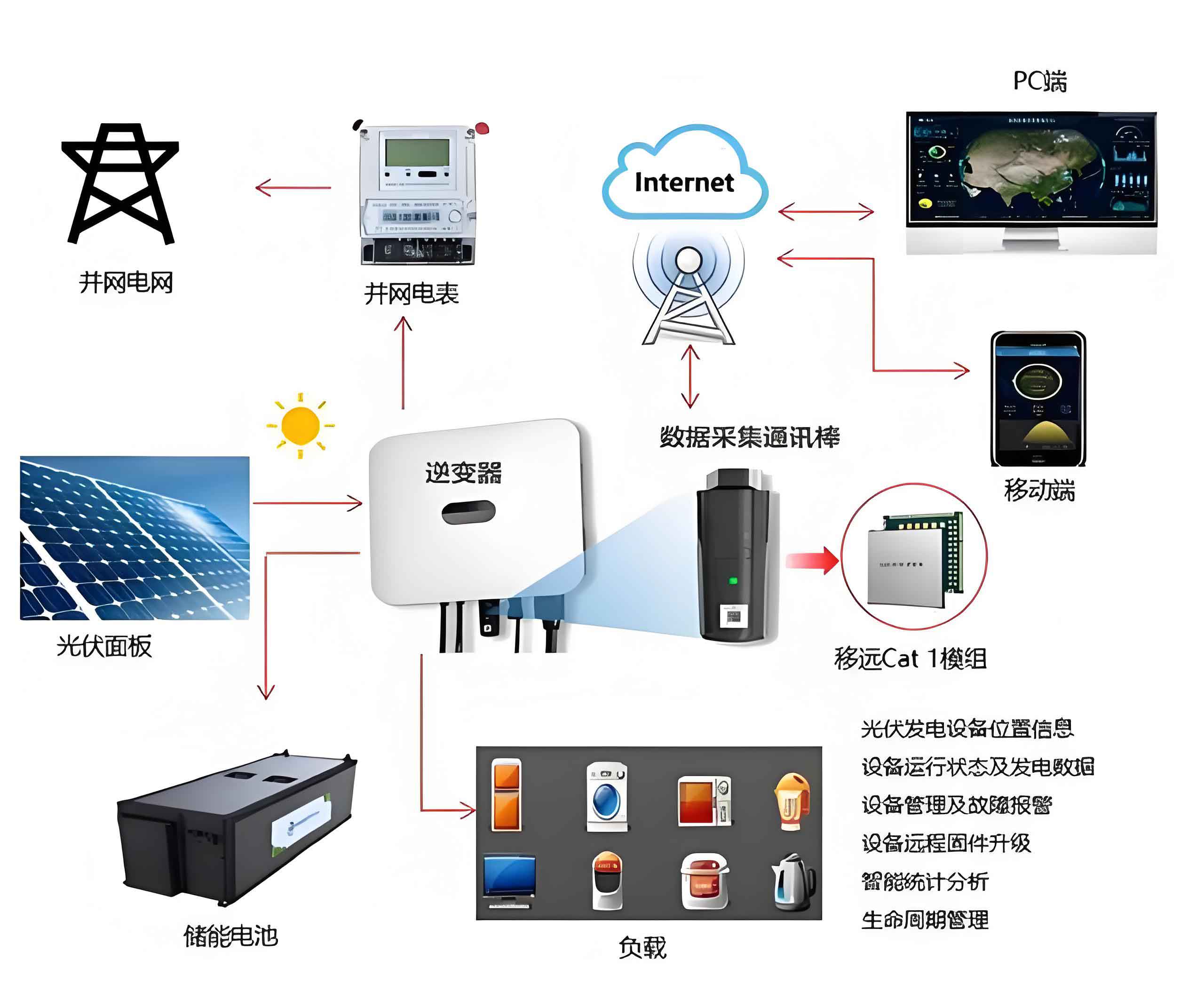
For grid-connected solar systems, I model a three-phase configuration common in larger installations. The system includes PV arrays, a DC bus, a voltage-source converter (VSC), filters, and the grid. Since PV cells produce DC power, an inverter converts it to AC for grid integration. The inverter also regulates voltage and improves power quality. In a grid-connected photovoltaic system (GCPS), the inverter connects to the grid via an inductor, as two voltage sources cannot be directly linked. The active and reactive power outputs are derived from the power flow equations:
$$ P = \frac{U_g \times U_s \times \sin \delta}{X_L} $$
$$ Q = \frac{U_g \times (U_c \times \cos \delta – U_s)}{X_L} $$
Here, \( U_g \) is the grid voltage, \( U_s \) is the inverter output voltage, \( \delta \) is the phase angle difference, \( X_L \) is the inductive reactance, and \( U_c \) is the voltage at the converter terminal. For small angles (\( \delta < 5^\circ \)), these simplify to:
$$ P \approx \frac{U_g \times U_s \times \delta}{X_L} $$
$$ Q \approx \frac{U_g \times (U_c – U_s)}{X_L} $$
To control this, I implement a decoupled dq-frame strategy. The outer loop manages power control, providing reference currents for the inner current control loop. The inverter dynamics in the dq-frame are:
$$ L \frac{di_d}{dt} + R i_d = v_{sd} – v_d – \omega L i_q $$
$$ L \frac{di_q}{dt} + R i_q = v_{sq} – v_q + \omega L i_d $$
From this, the control voltages are computed as:
$$ v_d = v_{sd} – \omega L i_q – \left(k_p + \frac{k_i}{s}\right)(i_{d\text{ref}} – i_d) $$
$$ v_q = v_{sq} + \omega L i_d – \left(k_p + \frac{k_i}{s}\right)(i_{q\text{ref}} – i_q) $$
These equations enable precise regulation of active and reactive power, ensuring the solar system injects high-quality power into the grid.
To validate the model, I conduct dynamic simulations in PSCAD/EMTDC. The simulation setup includes the PV array model, MPPT control module, VSC with space vector modulation (SVPWM), LC filters, resistive loads, and a grid represented by a voltage source. I program the MPPT algorithm in C, using pointers to store previous voltage and current values for comparison. The simulation tests response to abrupt irradiance changes. For example, irradiance jumps from 300 W/m² to 1000 W/m² at t = 4 s, then drops to 500 W/m² at t = 7 s. The results show that the PV output power quickly tracks the MPP under each condition. The voltage follows the reference \( V_{\text{ref}} \) with minor fluctuations, and the current adjusts accordingly. The power outputs align with expectations: around 170 W at 300 W/m², 260 W at 500 W/m², and 560 W at 1000 W/m². Reactive power remains stable with slight transients during changes. This demonstrates the robustness of the solar system model in maintaining efficiency under dynamic environments.
In my analysis, I further explore the impact of temperature variations on the solar system. For instance, if temperature rises from 25°C to 50°C at constant irradiance, the voltage decreases, reducing maximum power. The model accurately captures this, as shown in the tables earlier. To optimize performance, I consider factors like array sizing and MPPT tuning. For large-scale solar systems, these models help in design and operation, reducing reliance on physical prototypes.
Another aspect I investigate is the integration of energy storage with the solar system. By adding batteries, the system can buffer power fluctuations, enhancing grid stability. The model can be extended to include storage dynamics, but in this work, I focus on the PV and inverter components. The simulation results confirm that the MPPT method effectively maximizes energy harvest, which is critical for the economic viability of solar systems.
Furthermore, I examine the role of filters in the solar system. The LC filter attenuates harmonics from the inverter, ensuring compliance with grid standards. The filter design involves selecting inductance and capacitance values based on the switching frequency and grid requirements. In my simulation, I use typical values: L = 5 mH and C = 50 µF, which provide adequate filtering without excessive losses.
To summarize the simulation parameters, I present a comprehensive table:
| Component | Parameter | Value |
|---|---|---|
| PV Array | Rated power | 5 kW |
| PV Array | Reference irradiance \( S_{\text{ref}} \) | 1000 W/m² |
| PV Array | Reference temperature \( T_{\text{ref}} \) | 25°C |
| MPPT | Threshold voltage th | 0.5 V |
| MPPT | Perturbation step size (large/small) | 1.0 V / 0.2 V |
| Inverter | DC bus voltage | 400 V |
| Inverter | Switching frequency | 10 kHz |
| Filter | Inductance L | 5 mH |
| Filter | Capacitance C | 50 µF |
| Grid | Voltage \( U_g \) | 380 V (line-to-line) |
| Grid | Frequency | 50 Hz |
This table aids in replicating the solar system simulation for further research.
In conclusion, through detailed modeling and simulation, I have demonstrated the effectiveness of PV array models in solar systems. The mathematical framework captures nonlinearities due to irradiance and temperature, while the MPPT control ensures optimal power extraction. The grid-connected model with decoupled control facilitates stable integration. Simulations in PSCAD/EMTDC validate the dynamic performance, showing rapid tracking of maximum power points under changing conditions. This work underscores the importance of simulation tools in reducing costs and accelerating the development of efficient solar systems. Future directions could involve hybrid systems combining PV with wind or storage, but the core principles remain vital for advancing renewable energy adoption. Overall, this approach enhances the reliability and feasibility of solar systems in diverse applications.