
The integration of photovoltaic (PV) systems with proton exchange membrane (PEM) electrolyzers has emerged as a pivotal solution for sustainable hydrogen production. This study establishes an indirect coupling system comprising PV arrays, PEM electrolyzers, maximum power point tracking (MPPT) controllers, DC-DC converters, and batteries to address solar intermittency and enhance energy utilization. A dual closed-loop PI control strategy enables stable DC bus voltage regulation, ensuring continuous hydrogen production across varying irradiance conditions.
1. System Configuration and Mathematical Modeling
1.1 PV System Model
The single-diode PV cell model describes current-voltage characteristics:
$$ I = I_{ph} – I_o\left[\exp\left(\frac{U + IR_s}{a}\right) – 1\right] – \frac{U + IR_s}{R_{sh}} $$
where $I_{ph}$ represents photo-induced current calculated as:
$$ I_{ph} = \frac{G}{1000}[I_{sc} + K_0(T – T_{ref})] $$
| Parameter | Description | Value |
|---|---|---|
| $G$ | Solar irradiance (W/m²) | 200-1000 |
| $T_{ref}$ | Reference temperature | 298.15 K |
| $K_0$ | Temperature coefficient | 0.05%/K |
1.2 PEM Electrolyzer Model
The electrolyzer voltage comprises three components:
$$ U_{cell} = U_{ocv} + \eta_{act} + \eta_{ohm} $$
Where the activation overpotential follows Butler-Volmer kinetics:
$$ \eta_{act} = \frac{RT}{\alpha_{an}F}\sinh^{-1}\left(\frac{i}{2i_{0,an}}\right) + \frac{RT}{\alpha_{cat}F}\sinh^{-1}\left(\frac{i}{2i_{0,cat}}\right) $$
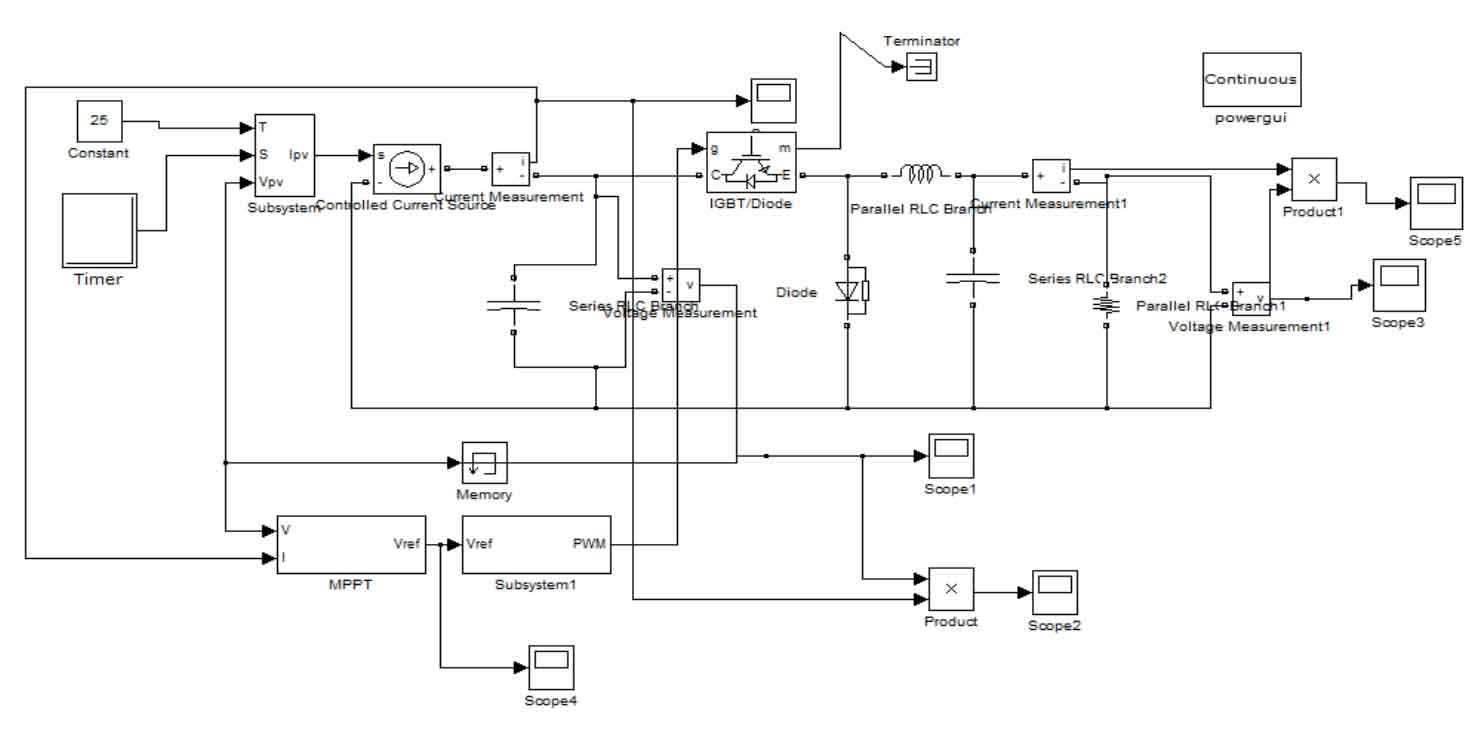
2. MPPT Implementation and Control Strategy
The incremental conductance MPPT algorithm demonstrates superior tracking accuracy compared to perturb & observe methods. Key implementation steps include:
$$ \frac{dP}{dV} = I + V\frac{dI}{dV} = 0 $$
| Condition | Action |
|---|---|
| $\frac{dI}{dV} > -\frac{I}{V}$ | Increase voltage |
| $\frac{dI}{dV} < -\frac{I}{V}$ | Decrease voltage |
The battery management system employs voltage-current dual-loop control:
$$ G_{v}(s) = K_{p,v} + \frac{K_{i,v}}{s} $$
$$ G_{i}(s) = K_{p,i} + \frac{K_{i,i}}{s} $$
3. Performance Comparison of Coupling Methods
Three configurations were evaluated under identical irradiance profiles:
| Configuration | Components | MPPT Utilization |
|---|---|---|
| Direct Coupling | PV + PEM | No |
| Optimized Coupling | PV + MPPT + PEM | Yes |
| Indirect Coupling | PV + MPPT + Battery + PEM | Yes |
3.1 Hydrogen Production Rates
The indirect coupling system maintains stable hydrogen output ($6.2\times10^{-5}$ mol/s) regardless of irradiance fluctuations, while optimized coupling shows variable production:
$$ \dot{n}_{H_2} = \frac{I}{2F} $$
| Irradiance (W/m²) | Direct (mol/s) | Optimized (mol/s) | Indirect (mol/s) |
|---|---|---|---|
| 200 | $8.14\times10^{-6}$ | $1.24\times10^{-4}$ | $6.20\times10^{-5}$ |
| 1000 | $4.07\times10^{-5}$ | $5.26\times10^{-4}$ | $6.20\times10^{-5}$ |
3.2 Energy Efficiency Analysis
System efficiencies are calculated as:
$$ \eta_{sys} = \eta_{PV} \times \eta_{transfer} \times \eta_{PEM} $$
Key findings:
| Metric | Direct | Optimized | Indirect |
|---|---|---|---|
| Max Transfer Efficiency | 5.89% | 94.34% | 91.48% |
| System Efficiency Range | 0.63-1.02% | 8.22-9.76% | 9.08-9.78% |
4. Conclusion
The indirect coupling configuration demonstrates superior comprehensive efficiency (9.78% peak) through battery-assisted power smoothing. While optimized coupling achieves higher instantaneous hydrogen production ($5.26\times10^{-4}$ mol/s at 1000 W/m²), its efficiency decreases by 15.8% across the irradiance spectrum due to voltage elevation effects. The integration of MPPT controllers improves energy harvesting by 89.7% compared to direct coupling, validating the critical role of power electronics in renewable hydrogen systems.