
Perovskite solar cells have revolutionized the photovoltaic landscape due to their exceptional optoelectronic properties and cost-effective fabrication processes. As researchers, we have focused on enhancing the efficiency of these devices, particularly bifacial perovskite solar cells, which capture light from both front and rear sides. However, a significant challenge lies in the inherent photon loss in bifacial configurations, primarily due to the absence of a reflective back electrode, leading to reduced short-circuit current density (Jsc). In this study, we address this issue by developing a strategy to control the crystallization of high-concentration precursors, enabling the fabrication of thick perovskite films that minimize photon loss while maintaining high performance. Through systematic investigation, we demonstrate that this approach not only improves Jsc but also enhances overall device stability, paving the way for more efficient bifacial perovskite solar cells.
The performance of bifacial perovskite solar cells is often limited by insufficient light absorption, especially for near-bandgap photons. Conventional monofacial perovskite solar cells benefit from reflective metal electrodes, but their bifacial counterparts replace these with transparent electrodes, resulting in a shorter effective optical path. To compensate, increasing the perovskite film thickness is a straightforward solution; however, this often leads to uncontrolled crystallization when using high-concentration precursors. We identified that a thickness of approximately 1320 nm is optimal for minimizing photon loss, as it extends the photon path length without introducing structural defects. Nonetheless, simply raising the precursor concentration does not guarantee better performance, as it can cause disordered crystallization and degrade film quality. Our research introduces a regulatory molecule, 1-ethyl-3-guanylthiourea hydrochloride (EGTHCl), which modulates the crystallization process by forming hydrogen bonds with perovskite components, promoting uniform nucleation and orderly grain growth. This method not only mitigates photon loss but also passivates defects, resulting in a record front-side Jsc of 25.01 mA cm−2 and a power conversion efficiency (PCE) of 23.4% for bifacial perovskite solar cells.
To understand the crystallization dynamics, we analyzed the film formation process using in situ UV-Vis absorption spectroscopy and grazing incidence X-ray diffraction (GIXRD). The introduction of EGTHCl significantly slowed the crystallization rate, extending the time from 8.7 seconds to 12.5 seconds, which allowed for more controlled grain growth. This regulation is critical for achieving high-quality thick films, as it reduces internal stress and minimizes voids. The following equation describes the relationship between film stress (σ) and crystallization time (t), where k is a constant related to the precursor composition: $$ \sigma = k \cdot \frac{1}{\sqrt{t}} $$ Our results show that EGTHCl-doped films exhibit a lower stress gradient, enhancing the mechanical stability of the perovskite layer. Additionally, we evaluated the optoelectronic properties using photoluminescence (PL) and time-resolved photoluminescence (TRPL) measurements, which revealed a reduction in non-radiative recombination and an extension of carrier lifetime. The trap density (Nt) was calculated using the space-charge-limited current (SCLC) method, with the formula: $$ N_t = \frac{2 \epsilon_0 \epsilon_r V_{TFL}}{q L^2} $$ where ε0 is the vacuum permittivity, εr is the relative permittivity, VTFL is the trap-filled limit voltage, q is the electron charge, and L is the film thickness. EGTHCl treatment reduced Nt from 1.2 × 10^16 cm−3 to 6.5 × 10^15 cm−3, indicating effective defect passivation.
We fabricated bifacial perovskite solar cells with the structure fluorine-doped tin oxide (FTO)/SnO2/perovskite/passivator/Spiro-OMeTAD/MoO3/indium tin oxide (ITO) to assess the impact of EGTHCl. The device performance was characterized under standard illumination conditions, and the results are summarized in Table 1. The champion device achieved a Voc of 1.145 V, Jsc of 25.01 mA cm−2, and PCE of 23.42%, representing a significant improvement over control devices. External quantum efficiency (EQE) measurements confirmed the enhanced photon utilization in the long-wavelength region, contributing to the higher Jsc. Furthermore, we investigated the bifacial factor, which reached 0.887 under rear-side illumination, demonstrating the versatility of these perovskite solar cells for various lighting conditions.
| Parameter | Control Device | EGTHCl-Optimized Device |
|---|---|---|
| Voc (V) | 1.140 | 1.145 |
| Jsc (mA cm−2) | 24.34 | 25.01 |
| Fill Factor (FF) | 0.789 | 0.818 |
| PCE (%) | 21.89 | 23.42 |
| Bifacial Factor | 0.850 | 0.887 |
The crystallization process was further elucidated through Fourier transform infrared spectroscopy (FTIR) and X-ray photoelectron spectroscopy (XPS), which revealed strong interactions between EGTHCl and perovskite components. Specifically, the guanidino and -NH2 groups in EGTHCl formed hydrogen bonds with formamidinium ions, stabilizing the precursor solution and guiding top-down grain growth. This mechanism is described by the following equation for the binding energy shift (ΔE) in XPS: $$ \Delta E = E_{\text{binding, optimized}} – E_{\text{binding, control}} $$ where a negative ΔE indicates stronger interactions, as observed for Pb 4f and I 3d peaks in EGTHCl-treated films. The improved crystallinity was confirmed by X-ray diffraction (XRD), showing narrower full width at half maximum (FWHM) values and higher peak intensities. Additionally, the absorption coefficient (α) was calculated using the Tauc plot method: $$ (\alpha h\nu)^2 = A (h\nu – E_g) $$ where hν is the photon energy, A is a constant, and Eg is the bandgap. Although Eg remained unchanged at approximately 1.55 eV, the absorption intensity increased due to better film quality.
To quantify the photon loss reduction, we modeled the optical path length (L_opt) in bifacial perovskite solar cells using the equation: $$ L_{\text{opt}} = \frac{1}{\alpha} \ln\left(\frac{1}{R}\right) $$ where R is the reflectance. For a 1320 nm thick film, L_opt was sufficient to capture most photons, minimizing losses compared to thinner films. We also evaluated the device stability under maximum power point (MPP) tracking, where the EGTHCl-optimized perovskite solar cells retained over 80% of their initial PCE after 2000 hours, outperforming control devices. The enhanced stability is attributed to reduced grain boundary stress and effective defect passivation, as summarized in Table 2, which compares key stability parameters.
| Parameter | Control Device | EGTHCl-Optimized Device |
|---|---|---|
| Trap Density (cm−3) | 1.2 × 10^16 | 6.5 × 10^15 |
| Carrier Lifetime (ns) | 125 | 198 |
| Stress Gradient (MPa/μm) | 0.15 | 0.08 |
| MPP Stability (T80, hours) | 300 | 2000 |
In bifacial illumination scenarios, the performance of perovskite solar cells was further enhanced. Under an albedo of 0.2, the device achieved a PCE of over 26%, highlighting the potential for real-world applications. The relationship between albedo (A) and output power density (P_out) can be expressed as: $$ P_{\text{out}} = P_{\text{front}} + A \cdot P_{\text{rear}} $$ where P_front and P_rear are the power densities from front and rear illumination, respectively. Our results demonstrate that optimizing thick film quality is crucial for maximizing the bifacial gain in perovskite solar cells.
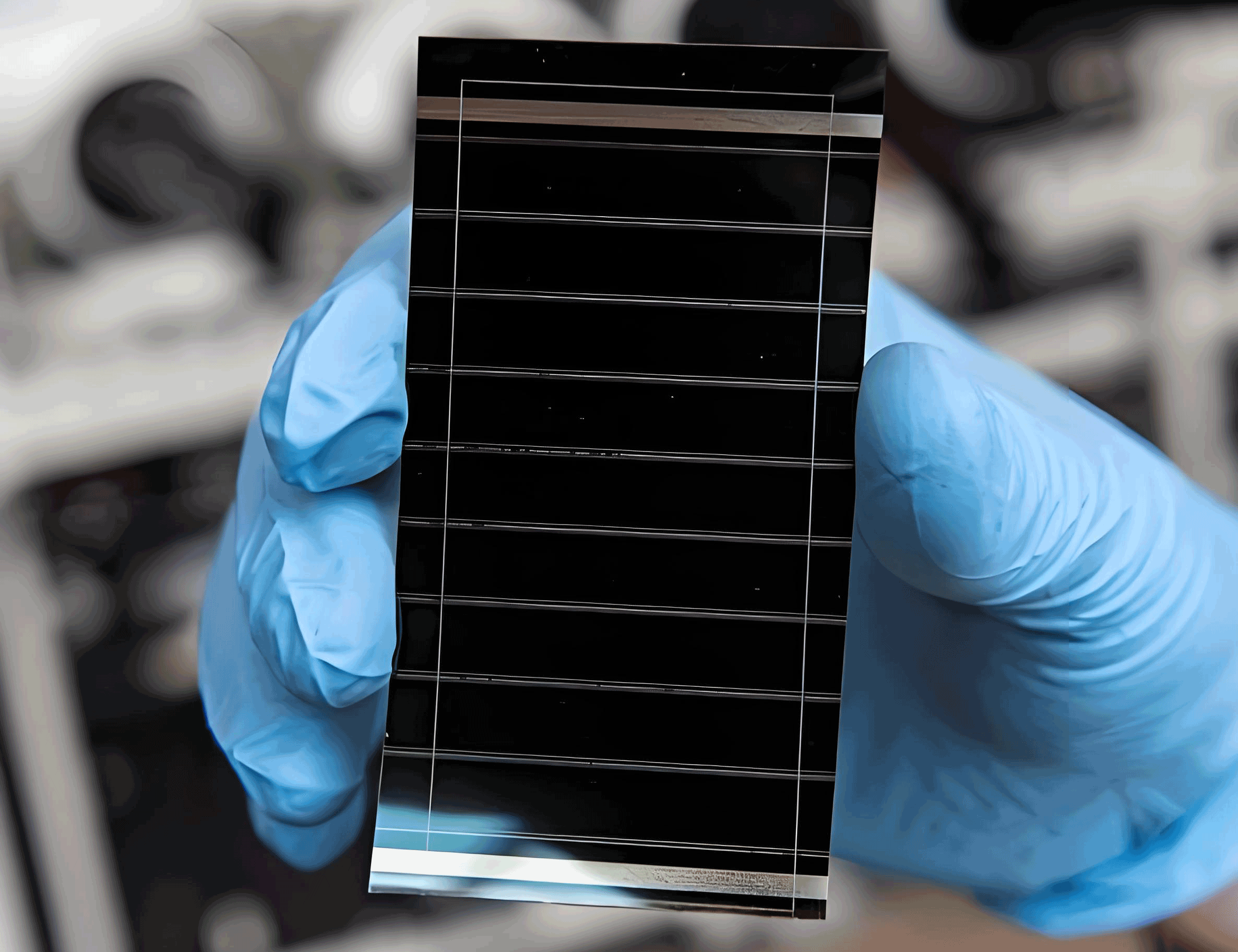
Further analysis using electrochemical impedance spectroscopy (EIS) and Mott-Schottky plots revealed improved charge transport and higher built-in potential in EGTHCl-optimized devices. The recombination resistance (R_rec) increased from 450 Ω to 620 Ω, while the transfer resistance (R_tr) decreased from 180 Ω to 120 Ω, indicating suppressed recombination and enhanced carrier extraction. The ideal factor (n) derived from light intensity-dependent Voc measurements decreased from 1.295 to 1.048, confirming reduced trap-assisted recombination. These improvements are essential for achieving high Jsc and FF in bifacial perovskite solar cells. Additionally, we explored the impact of film thickness on photon harvesting efficiency using a theoretical model based on the Beer-Lambert law: $$ I = I_0 e^{-\alpha d} $$ where I is the transmitted intensity, I0 is the incident intensity, and d is the film thickness. For d = 1320 nm, the absorption exceeds 95% for photons above the bandgap, effectively minimizing photon loss.
In conclusion, our work demonstrates that controlling high-concentration precursor crystallization is a viable strategy to minimize photon loss in bifacial perovskite solar cells. By incorporating EGTHCl as a growth regulator, we achieved uniform nucleation, reduced defect density, and enhanced film quality, leading to a record Jsc and excellent stability. This approach not only addresses the limitations of current bifacial perovskite solar cells but also provides insights into the crystallization dynamics of thick perovskite films. Future research will focus on scaling up this technology for module applications and further optimizing the bifacial performance under varying environmental conditions. The success of this method underscores the importance of material engineering in advancing perovskite solar cells towards commercial viability.