
The pursuit of high-performance energy storage solutions is paramount in addressing global energy crises and climate change. Lithium-ion batteries stand as a cornerstone technology due to their high energy density, long cycle life, and low self-discharge. However, practical limitations such as sluggish ion transport, interfacial degradation, and lithium dendrite growth hinder their full potential. Traditional optimization methods, including electrode engineering and electrolyte formulation, often involve static material modifications that may not adapt dynamically to operational conditions. In this context, magnetic field regulation emerges as a promising non-contact physical strategy, offering remote controllability and dynamic adjustment capabilities to enhance electrochemical performance. This article explores the advancements in magnetic field applications for lithium-ion batteries, focusing on structural design and ion transport mechanisms, while integrating insights from characterization and modeling.
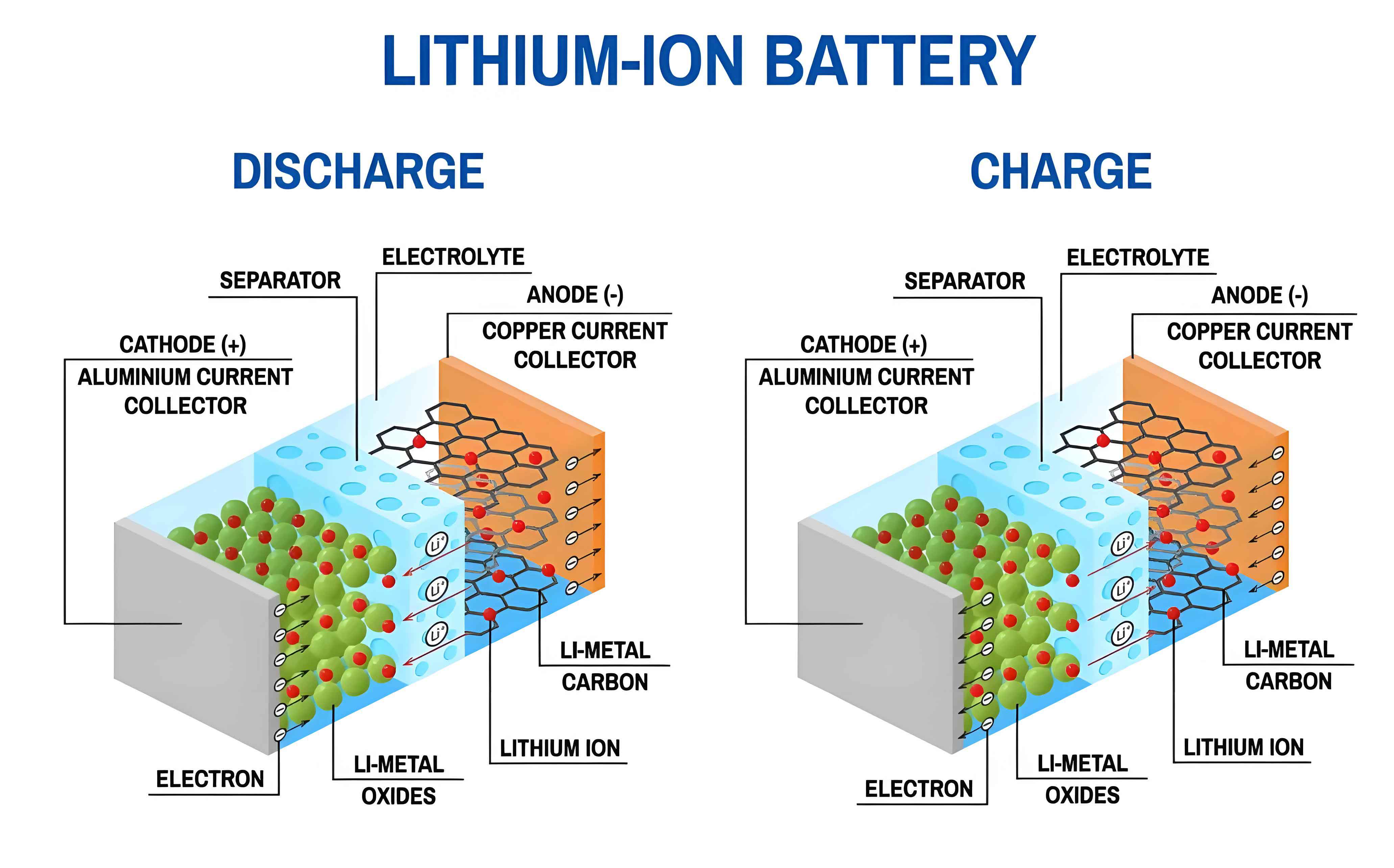
The efficiency of a lithium-ion battery heavily depends on ion diffusion kinetics within electrodes and at interfaces. In porous electrodes, tortuous pathways and anisotropic crystal structures can impede lithium-ion movement, leading to polarization and capacity fade. Magnetic fields, through interactions with magnetic moments and charged particles, can induce structural alignment and modulate ion trajectories. This regulation spans multiple scales: at the microscale, magnetic fields can reconstruct electron spin states to improve charge transfer; at the mesoscale, they enable oriented assembly of particles for optimized porosity; and at the macroscale, magnetohydrodynamic effects influence bulk ion distribution. By leveraging these mechanisms, magnetic field strategies aim to overcome bottlenecks in lithium-ion battery technology, paving the way for enhanced rate capability, cycle stability, and safety.
This review synthesizes current research into two primary directions: magnetic field-assisted structural design of battery components and contactless performance regulation via external or internal magnetic fields. We delve into specific mechanisms such as crystal orientation induction, pore architecture optimization, spin-state manipulation, and magnetohydrodynamic effects. Furthermore, we examine in situ characterization techniques and multiphysics modeling approaches that elucidate the underlying processes. The integration of tables and mathematical formulations will provide a concise summary of key findings. Ultimately, this comprehensive analysis highlights the transformative potential of magnetic field regulation in advancing lithium-ion battery systems, while identifying challenges and future research avenues.
Magnetic Field-Assisted Structural Design of Electrode Materials
The electrochemical performance of lithium-ion batteries is intrinsically linked to the structural attributes of electrode materials. Anisotropic crystal orientations and high-tortuosity pore networks can prolong lithium-ion diffusion paths, exacerbating concentration gradients and limiting rate capability. Magnetic field-assisted design strategies exploit the vector nature of magnetic fields to orchestrate ordered structures, thereby facilitating efficient ion transport. These approaches primarily focus on two aspects: inducing preferential crystal orientations to accelerate solid-state diffusion, and constructing aligned pore channels to enhance liquid-phase ion permeability. Both avenues contribute to improved kinetics and stability in lithium-ion battery operations.
Crystal Orientation Control via Magnetic Alignment
Magnetic fields can align crystalline particles along specific axes by leveraging magnetic anisotropy. In cathode materials like layered LiCoO2 or olivine LiFePO4, lithium-ion diffusion is highly directional; for instance, LiFePO4 exhibits one-dimensional tunnels along the b-axis. Applying a magnetic field during electrode processing can orient these crystals to minimize diffusion energy barriers. The alignment process depends on magnetic parameters such as field strength, direction, and duration. For example, a perpendicular magnetic field of 0.5 T can induce (003) plane alignment in LiCoO2, creating “lithium-poor regions” that favor ion intercalation. Similarly, in LiFePO4, alignment along the [010] direction via a 6 T field for 1 minute enhances lithium-ion diffusion coefficients by up to 88%. The effectiveness of magnetic orientation is governed by the coupling between crystal structure, diffusion pathways, and field parameters, as summarized in Table 1.
| Material | Magnetic Field Strength | Orientation Direction | Enhancement in Li+ Diffusion Coefficient | Key Mechanism |
|---|---|---|---|---|
| LiCoO2 | 0.5 T (perpendicular) | (003) plane | ~49% increase | Magnetic dipole alignment |
| LiFePO4 | 6 T (short pulse) | [010] axis | ~88% increase | Anisotropic magnetic susceptibility |
| LiNi0.6Mn0.2Co0.2O2 | 0.4 T (horizontal) | (003) plane | Improved rate capacity | Crystal lattice matching |
Beyond orientation, magnetic fields can also induce disorder in crystal phases. For instance, surface coating with Fe3O4 on LiMn1.5Ni0.5O4 creates local magnetic fields that promote spin-selective electron transfer, leading to a disordered phase transformation. This approach enhances cyclic stability without high-temperature treatment, showcasing a cost-effective structural modulation for lithium-ion battery cathodes.
Pore Structure Design Using Anisotropic Magnetic Particles
For non-magnetic but structurally anisotropic materials like graphite or MXenes, magnetic responsiveness can be imparted via magnetic coatings. Under an external magnetic field, these particles experience dipole-dipole interactions, leading to vertical alignment and the formation of low-tortuosity pore channels. This design optimizes lithium-ion transport paths in the electrolyte, improving reaction homogeneity and rate performance. For example, graphite flakes coated with a ferrofluid and subjected to a 0.05 T rotating field align vertically, increasing lithium-ion diffusion coefficients by up to 4.95 times. The relationship between flake inclination angle and capacity is linear, underscoring the importance of precise alignment.
In polymer-based solid electrolytes, magnetic orientation can create vertically aligned pores using magnetic mesoporous silica rods. This structure shortens lithium-ion diffusion distances, enhancing ionic conductivity and interface kinetics. The resulting composite electrolyte enables stable cycling in lithium metal batteries, demonstrating the versatility of magnetic pore design across different lithium-ion battery components. The governing equation for ion transport in aligned pores can be expressed using Fick’s first law, where the flux \( J \) is proportional to the concentration gradient \( \nabla c \):
$$ J = -D_{\text{eff}} \nabla c $$
Here, \( D_{\text{eff}} \) represents the effective diffusion coefficient, which increases with reduced tortuosity \( \tau \) according to \( D_{\text{eff}} = D_0 / \tau \), where \( D_0 \) is the intrinsic diffusion coefficient. Magnetic alignment minimizes \( \tau \), thereby boosting \( D_{\text{eff}} \).
| Material System | Magnetic Field Condition | Structural Outcome | Electrochemical Enhancement |
|---|---|---|---|
| Graphite flakes with ferrofluid | 0.05 T rotating field | Vertical alignment (85° incline) | 4.5× capacity at 2C rate |
| Ti3C2Tx MXene | Static magnetic field | Directional porosity | 90% capacity retention after 5000 cycles at 2 A/g |
| Polymer electrolyte with Fe3O4@mSiO2 | Magnetic orientation during curing | Vertically aligned channels | Stable Li plating for 1500 h |
Magnetic Field Regulation of Interface Evolution and Ion Transport
Interfacial phenomena critically influence the performance and longevity of lithium-ion batteries. Issues such as uneven lithium deposition, solid electrolyte interphase (SEI) instability, and concentration polarization often lead to dendrite growth and capacity degradation. Magnetic field regulation offers dynamic control over lithium-ion migration at interfaces, either through external fields applied to the entire cell or internal fields generated by embedded magnetic materials. These strategies aim to homogenize ion distribution, suppress dendritic growth, and enhance SEI properties, thereby addressing key challenges in lithium-ion battery operation.
External Magnetic Field Strategies
External magnetic fields provide a non-invasive means to modulate bulk ion behavior. The primary mechanisms include magnetohydrodynamic effects, spin-state reconstruction, and magnetic dipole ordering. In lithium metal batteries, the magnetohydrodynamic effect arises from the Lorentz force acting on moving ions: \( \mathbf{F} = q (\mathbf{v} \times \mathbf{B}) \), where \( q \) is the ion charge, \( \mathbf{v} \) is the velocity, and \( \mathbf{B} \) is the magnetic flux density. This force deflects lithium-ion trajectories, promoting uniform diffusion and inhibiting localized dendrite formation. When the magnetic field is parallel to the electric field, ions follow helical paths around nucleation sites, effectively smoothing deposition.
Spin-state manipulation is another avenue; for example, in cobalt sulfide-based electrodes, an external magnetic field can transition Co 3d electrons from low-spin to high-spin states, increasing unpaired electrons and enhancing polysulfide adsorption. This improves mixed electron-ion conduction in lithium-sulfur systems, which share similarities with lithium-ion battery chemistry. Additionally, weak magnetic fields (e.g., 3.95–39.5 mT) have been shown to reduce ohmic and polarization resistances in cylindrical lithium-ion batteries, likely due to magnetic dipole alignment within electrodes.
However, external fields may introduce competing effects. For instance, while magnetohydrodynamic effects enhance ion transport, they can also exacerbate anode polarization under certain conditions. Thus, optimizing field direction and strength is crucial. Studies indicate that fields above 0.8 T can transform dendritic lithium into spherical morphologies, as visualized via in situ microscopy. The interplay between field-induced ion redistribution and interfacial kinetics underscores the complexity of external magnetic regulation in lithium-ion batteries.
Internal Magnetic Field Strategies
Internal magnetic fields, generated by incorporating magnetic materials into battery components, enable localized regulation with minimal interference to non-target regions. This approach enhances selectivity and efficiency, particularly for high-current-density scenarios. Design strategies span magnetic electrodes, current collectors, interface layers, and functionalized separators, each contributing to improved lithium-ion transport and interface stability.
Magnetic electrodes, such as α-Fe2O3/nitrogen-doped carbon composites, exhibit remnant magnetization that sustains performance enhancements even after field removal. In Li3(V1-xFex)2(PO4)3 anodes, Fe doping induces magnetostriction—a strain response to magnetic fields—that expands lattice channels and facilitates lithium-ion diffusion at high rates. The strain \( \epsilon \) can be modeled as \( \epsilon = \lambda_s \cdot H \), where \( \lambda_s \) is the saturation magnetostriction coefficient and \( H \) is the magnetic field strength.
Magnetic current collectors, like cobalt-doped ZnO on copper foam, create micro-scale magnetic fields that guide lithium-ion deposition via magnetohydrodynamic effects, resulting in dense SEI layers and extended cycle life. Similarly, interface layers with γ-Fe2O3 or cobalt-coordinated polymers form magnetic SEIs that homogenize lithium-ion flux, suppressing dendrites. For separators, coatings with tannic acid-Co2+ complexes or Cu-Ni nanonecklaces generate anisotropic magnetic fields, selectively promoting LiF-rich SEI formation and uniform plating. Table 3 summarizes key internal magnetic field strategies and their impacts on lithium-ion battery performance.
| Component | Magnetic Material/Structure | Regulation Mechanism | Performance Outcome |
|---|---|---|---|
| Electrode | α-Fe2O3/NC composite | Remnant magnetization | Capacity boost from 80 to 150 mAh/g at 5 A/g |
| Current Collector | Co/ZnO on Cu foam | Local magnetohydrodynamic effect | Stable Li plating for 10,000 h |
| Interface Layer | γ-Fe2O3 coating | Magnetic SEI formation | Dense Li deposition, reduced dendrites |
| Separator | Tannic acid-Co2+ on PP | Ion selectivity and magnetohydrodynamic effect | 90% coulombic efficiency after 650 cycles |
The integration of internal magnetic fields addresses scalability challenges associated with external systems, offering a pathway for practical implementation in advanced lithium-ion battery designs.
Characterization and Modeling of Magnetic Field Regulation Mechanisms
Understanding the multifaceted effects of magnetic fields on lithium-ion batteries requires advanced characterization and computational modeling. In situ techniques provide real-time insights into structural and interfacial dynamics, while multiphysics simulations elucidate the coupling between magnetic, electric, and concentration fields. Together, these tools bridge experimental observations with theoretical frameworks, guiding the optimization of magnetic regulation strategies for lithium-ion battery enhancement.
In Situ Characterization Techniques
In situ methods enable direct visualization and analysis of magnetic field-induced changes during battery operation. Optical microscopy, for instance, captures the evolution of lithium deposition morphologies under magnetic fields. Studies show that at 10 mA/cm2, lithium ions form spherical aggregates due to magnetohydrodynamic effects, contrasting with dendritic growth in field-free conditions. This real-time observation confirms the role of magnetic fields in homogenizing deposition.
Spectroscopic techniques like in situ Fourier-transform infrared (FT-IR) and Raman spectroscopy reveal chemical transformations at interfaces. For magnetic SEI layers, FT-IR spectra indicate reduced electrolyte decomposition, while Raman spectra show stable organic functional groups during cycling, signifying enhanced interface stability. In situ X-ray photoelectron spectroscopy (XPS) further details SEI composition; under magnetic fields, SEI becomes enriched with LiF (up to 88.3% fluorine content), which favors high lithium-ion conductivity and dendrite suppression. These characterizations collectively demonstrate how magnetic fields modify interface chemistry and morphology in lithium-ion batteries.
Multiphysics Modeling Approaches
Computational models simulate the complex interactions between magnetic fields and electrochemical processes in lithium-ion batteries. Phase-field modeling, for example, tracks dendritic growth by coupling ion concentration \( c \) and electric potential \( \phi \). The governing equations include:
$$ \frac{\partial c}{\partial t} = \nabla \cdot (D \nabla c) + \nabla \cdot \left( \frac{Dc}{k_B T} q \nabla \phi \right) $$
where \( D \) is the diffusion coefficient, \( k_B \) is Boltzmann’s constant, \( T \) is temperature, and \( q \) is charge. Incorporating the Lorentz force term accounts for magnetic effects: \( \mathbf{F}_{\text{Lorentz}} = q (\mathbf{v} \times \mathbf{B}) \), which alters ion trajectories in simulations.
Finite element analysis using software like COMSOL Multiphysics predicts lithium-ion distribution and deposition patterns under various magnetic conditions. Simulations reveal that parallel magnetic fields induce spiral ion paths, leading to uniform plating, while perpendicular fields may have limited impact. Molecular dynamics simulations add atomic-scale insights, showing that magnetic fields weaken ion-pair interactions (e.g., Li+-PF6–) and strengthen solvent coordination, thereby enhancing mobility. These models validate that magnetic fields reduce local concentration gradients, a key factor in dendrite inhibition for lithium-ion batteries.
Additionally, computational fluid dynamics models assess three-dimensional magnetic field effects, demonstrating anisotropic magnetohydrodynamic flows that improve ion transport uniformity. Such multiphysics approaches provide a predictive toolkit for designing magnetic regulation protocols tailored to specific lithium-ion battery architectures.
Conclusions and Future Perspectives
Magnetic field regulation presents a versatile paradigm for advancing lithium-ion battery technology. Through structural design and interface modulation, magnetic strategies address core challenges like slow ion diffusion, dendritic growth, and SEI instability. Key mechanisms—including crystal orientation, pore alignment, spin-state reconstruction, and magnetohydrodynamic effects—have been experimentally validated across various lithium-ion battery systems. In situ characterization and multiphysics modeling further illuminate the dynamic processes underlying these improvements.
Despite progress, several challenges persist. First, the response to magnetic fields varies among materials, necessitating universal design principles. Future work should integrate multi-parameter optimization models that account for material properties, field conditions, and operational demands in lithium-ion batteries. Second, the interplay between magnetic effects and other physical fields (e.g., thermal, mechanical) requires deeper exploration to enable synergistic regulation in complex environments. Third, practical implementation must consider cost-effectiveness and electromagnetic compatibility; internal magnetic materials offer a promising direction but need optimization for long-term stability and integration.
Looking ahead, research should focus on developing adaptive magnetic systems that dynamically respond to battery state changes. Combining machine learning with multiphysics models could predict optimal field parameters in real-time. Moreover, expanding magnetic regulation to emerging battery chemistries, such as solid-state or lithium-sulfur systems, may unlock new performance frontiers. By bridging fundamental insights with engineering solutions, magnetic field regulation stands to play a pivotal role in the next generation of high-energy, durable lithium-ion batteries, contributing to a sustainable energy future.