
As a researcher in renewable energy systems, I have focused extensively on the challenges posed by high penetration of photovoltaic (PV) power generation in electrical grids. The inherent intermittency and volatility of solar energy necessitate robust control strategies for solar inverters to ensure grid stability. One critical aspect is the low voltage ride-through (LVRT) capability, which allows solar inverters to remain connected and support the grid during voltage sags. In this article, I will delve into the control mechanisms for solar inverters during LVRT events, with a particular emphasis on modified maximum power point tracking (MPPT) strategies and the integration of energy storage systems. The performance of solar inverters under fault conditions is paramount, and I will present simulation and experimental analyses to validate the proposed approaches.
The rapid expansion of solar power installations worldwide has highlighted the need for advanced grid-support functions in solar inverters. LVRT requirements, as stipulated in grid codes such as GB/T 19964-2024, mandate that solar inverters must not disconnect during voltage dips and should provide reactive power support to aid in voltage recovery. This is especially crucial for solar inverters in large-scale PV plants, where sudden disconnections can exacerbate grid instability. My work explores how solar inverters can be controlled to meet these demands while managing the excess energy generated during faults. I will discuss the topology of double-stage solar inverters, the design of control strategies, and the role of energy storage in enhancing LVRT performance.
Solar inverters are the interface between PV arrays and the grid, and their control during disturbances is a complex task. During a voltage sag, the power output from solar inverters is constrained, leading to an imbalance between the generated power and the power injected into the grid. This can cause a rise in DC-link voltage, potentially triggering protection mechanisms and disconnection. To address this, I have developed a control strategy that dynamically adjusts the operation of solar inverters based on the depth of the voltage dip. By modifying the MPPT algorithm and incorporating energy storage, solar inverters can maintain stability and provide essential grid services. In the following sections, I will detail the system configuration, control methodology, and experimental validation, emphasizing the importance of solar inverters in modern power systems.
Topology of Double-Stage Solar Inverters
Double-stage solar inverters are widely used in PV systems due to their ability to efficiently perform MPPT and inversion separately. The typical structure consists of a DC-DC boost converter followed by a DC-AC inverter. The boost converter handles the MPPT function, optimizing the power extraction from the PV panels, while the inverter converts the DC power to AC and manages grid synchronization. This topology allows for flexible control, making it suitable for implementing LVRT strategies. In my research, I have employed this configuration to test various control approaches for solar inverters under fault conditions.
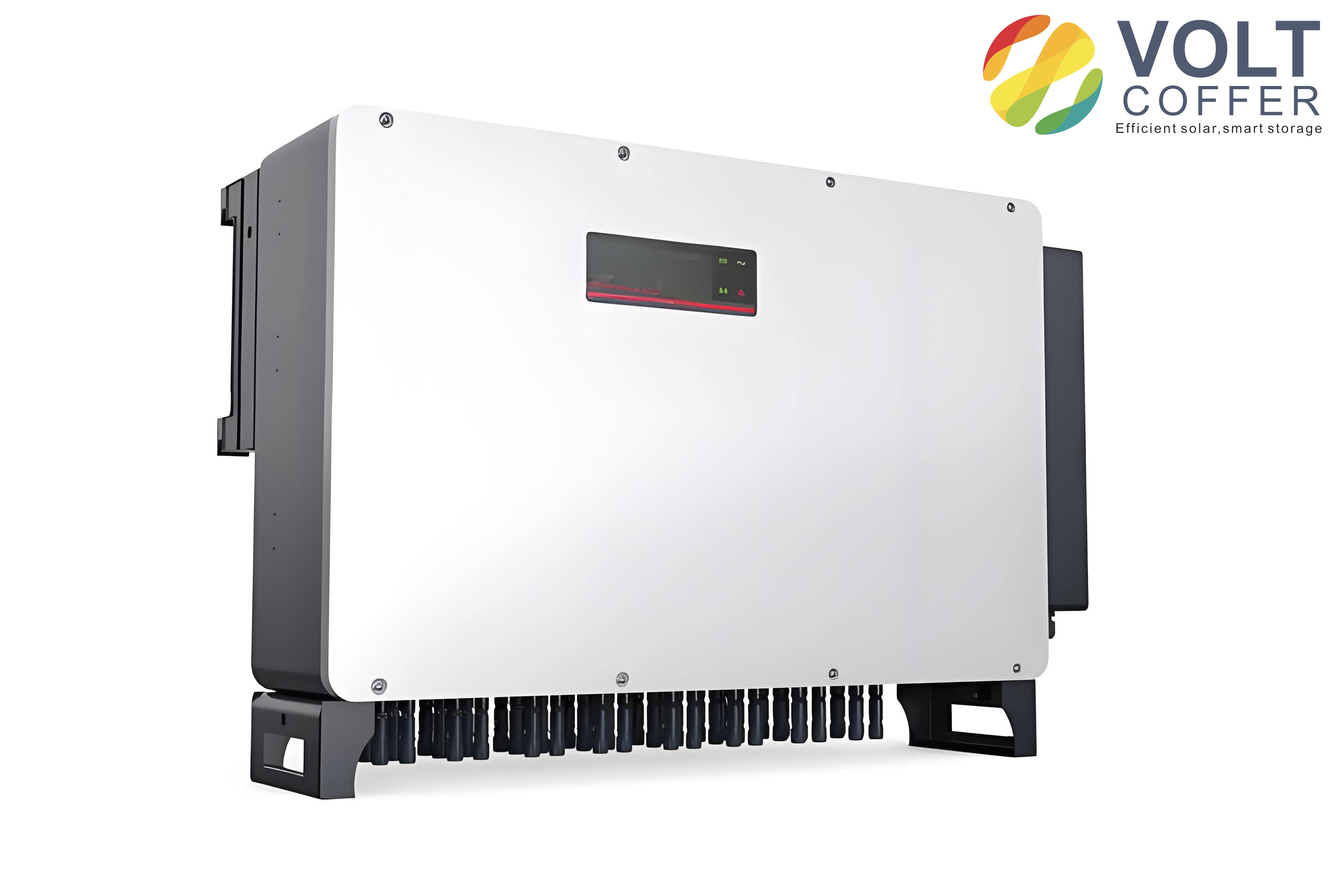
The DC-DC stage includes a boost circuit that steps up the PV voltage to the DC-link level, and an optional energy storage unit can be connected via another DC-DC converter to absorb excess power. The inverter stage utilizes pulse-width modulation (PWM) techniques to generate the AC output. During normal operation, solar inverters operate in MPPT mode to maximize energy harvest. However, during voltage sags, the control strategy must shift to prioritize grid support. The double-stage design enables this transition by decoupling the MPPT and inversion functions, which is essential for implementing the proposed LVRT control in solar inverters.
Control Strategy for Solar Inverters During LVRT
The control of solar inverters during LVRT events is based on a dual-loop structure, comprising an outer voltage loop and an inner current loop. In the dq-reference frame, the instantaneous active and reactive power outputs of the solar inverter are given by:
$$P = \frac{3}{2}(u_d i_d + u_q i_q)$$
$$Q = \frac{3}{2}(u_q i_d – u_d i_q)$$
where \(u_d\) and \(u_q\) are the d-axis and q-axis components of the grid voltage, and \(i_d\) and \(i_q\) are the corresponding current components. Typically, \(u_q\) is zero in a balanced grid, simplifying the power equations. The current loop uses PI controllers to regulate the d-axis and q-axis currents, with decoupling terms to account for cross-coupling effects. The control law for the inner loop can be expressed as:
$$u_d = K_p (i_d^* – i_d) + K_i \int (i_d^* – i_d) dt – \omega L i_q + e_d$$
$$u_q = K_p (i_q^* – i_q) + K_i \int (i_q^* – i_q) dt + \omega L i_d + e_q$$
where \(i_d^*\) and \(i_q^*\) are the reference currents, \(K_p\) and \(K_i\) are the PI gains, \(\omega\) is the grid angular frequency, \(L\) is the filter inductance, and \(e_d\) and \(e_q\) are the grid voltage components. Under normal conditions, solar inverters use this dual-loop control to maintain maximum power output. However, during a voltage sag, the control strategy switches to a single current-loop mode, where the reference currents are set based on the voltage dip depth to provide reactive power support.
For LVRT, the q-axis current reference \(i_q^*\) is determined according to the grid voltage magnitude \(U\) relative to the nominal value \(U_N\):
$$i_q^* =
\begin{cases}
0 & \text{if } 0.9 \leq U/U_N \leq 1 \\
K_q I_N (0.9 – U/U_N) & \text{if } 0.3 < U/U_N \leq 0.9 \\
I_N & \text{if } U/U_N \leq 0.3
\end{cases}$$
where \(K_q\) is a proportionality constant, and \(I_N\) is the nominal current. The d-axis current reference \(i_d^*\) is limited to ensure the total current does not exceed 1.1 times the rated value:
$$i_d^* = \sqrt{(1.1 I_N)^2 – (i_q^*)^2}$$
This approach allows solar inverters to inject reactive current during faults, supporting grid voltage recovery while limiting active power output to prevent overcurrent. The transition between normal and LVRT modes is seamless, ensuring that solar inverters remain connected and compliant with grid codes.
Modified MPPT Control for LVRT in Solar Inverters
In traditional solar inverters, the MPPT controller continuously adjusts the PV voltage to maximize power output. However, during a voltage sag, this can lead to an imbalance, as the reduced grid voltage limits the power that can be injected. To address this, I have developed a modified MPPT strategy that decouples the MPPT function from the LVRT control. When a voltage dip is detected, the MPPT output is held constant at the pre-fault maximum power point voltage, preventing unnecessary fluctuations in the PV voltage. This decoupling is achieved through a switching function \(S\) that disables the MPPT controller during LVRT:
$$S = \begin{cases}
1 & \text{if } U \geq 0.9 U_N \\
0 & \text{if } U < 0.9 U_N
\end{cases}$$
The PV voltage \(V_{pv}\) is then controlled based on \(S\) and the output of the LVRT controller. This ensures that when the grid voltage recovers, the solar inverter can quickly return to the maximum power point without the delay associated with re-tracking. The modified MPPT control enhances the stability of solar inverters during mode transitions and reduces stress on the DC-link capacitor.
For solar inverters equipped with energy storage, the traditional MPPT control can be maintained, as the storage system absorbs the excess power. The energy storage unit is connected to the DC-link via a bidirectional DC-DC converter, which regulates the DC-link voltage \(V_{dc}\) by charging or discharging the battery. The power balance on the DC-link is given by:
$$C V_{dc} \frac{dV_{dc}}{dt} = P_{pv} – P – P_{dc}$$
where \(P_{pv}\) is the PV power, \(P\) is the inverter output power, and \(P_{dc}\) is the power absorbed by the energy storage. During LVRT, \(P_{dc}\) is positive, stabilizing \(V_{dc}\) and allowing the solar inverter to continue operating in MPPT mode. This approach simplifies the control of solar inverters but adds cost and complexity due to the storage system.
Simulation Analysis of Solar Inverters Under LVRT
To validate the control strategies, I conducted simulations using MATLAB/Simulink for a three-phase grid-connected PV system. The solar inverter was rated at 20 kVA, with a DC-link voltage of 680 V and an AC voltage of 380 V. The PV array was modeled with standard parameters at 25°C and 1000 W/m² irradiation. A voltage sag to 35% of the nominal value was applied at t=0.5 s, lasting for 0.3 s. The simulation results demonstrated that the solar inverter successfully maintained connection and provided reactive power support during the fault.
The active and reactive power outputs, DC-link voltage, and grid currents were monitored. The solar inverter reduced its active power output and injected reactive current according to the voltage dip depth. The DC-link voltage increased but remained within safe limits, peaking at 1.2 per unit. The transition between control modes was smooth, with no significant current spikes. These results confirm the effectiveness of the proposed LVRT control for solar inverters, even without energy storage.
| Parameter | Value |
|---|---|
| Inverter Rated Power | 20 kVA |
| DC-Link Voltage | 680 V |
| Rated AC Voltage | 380 V |
| Filter Inductance | 5 mH |
| Filter Capacitance | 10 μF |
| Grid Frequency | 50 Hz |
| Switching Frequency | 20 kHz |
Experimental Validation of Solar Inverter LVRT Performance
I performed experiments on a 5 kVA solar inverter test bench to compare the modified MPPT strategy with the traditional approach using energy storage. The setup included a PV simulator, a grid emulator, and a battery storage system. Two scenarios were tested: one without energy storage using the modified MPPT control, and another with energy storage using traditional MPPT. The solar inverter was subjected to a voltage sag, and key parameters such as DC-link voltage and power output were recorded.
In the first scenario, the solar inverter operated with the modified MPPT control. During the voltage sag, the DC-link voltage rose to 1.1 per unit, but the inverter provided reactive support and stabilized without triggering protections. The transition back to normal operation was rapid, with the PV voltage returning to the maximum power point in 0.03 s. In the second scenario, with energy storage, the DC-link voltage was better controlled, peaking at only 1.06 per unit, but the mode transition took longer (0.06 s). The table below summarizes the experimental results, highlighting the trade-offs between the two approaches for solar inverters.
| Parameter | Modified MPPT | Traditional MPPT with Storage |
|---|---|---|
| Normal Active Power | 2 kW | 2 kW |
| DC-Link Voltage (p.u.) | 1.1 | 1.06 |
| Reactive Power During LVRT | 0.8 kvar | 0.8 kvar |
| Transition Recovery Time | 0.03 s | 0.06 s |
| Peak Active Power During Transition | 4 kW | 2.5 kW |
| Peak Reactive Power During Transition | 2.5 kvar | 1.4 kvar |
The experiments show that both strategies enable solar inverters to achieve LVRT, but the modified MPPT control offers faster recovery and lower cost, while energy storage provides better voltage stability. For solar inverters in cost-sensitive applications, the modified approach is advantageous, whereas in systems requiring high reliability, energy storage is preferable.
Conclusion
In conclusion, the low voltage ride-through capability of solar inverters is essential for grid stability in high-penetration PV systems. Through my research, I have demonstrated that modified MPPT control and energy storage integration can effectively enhance the LVRT performance of solar inverters. The proposed control strategies allow solar inverters to provide reactive power support during voltage sags and manage DC-link voltage fluctuations. Simulation and experimental results validate that solar inverters can meet grid code requirements with either approach, though the choice depends on specific system needs. Future work will focus on optimizing these strategies for larger-scale solar inverters and exploring hybrid systems that combine multiple energy sources. The continuous improvement of solar inverter technologies is crucial for the sustainable integration of solar power into modern grids.