
In recent years, perovskite solar cells have emerged as a promising photovoltaic technology due to their high power conversion efficiencies, tunable bandgaps, and cost-effective fabrication processes. However, the commercialization of perovskite solar cells is hindered by challenges related to long-term stability and environmental degradation. Printable mesoscopic perovskite solar cells (p-MPSCs) offer a viable pathway by employing carbon-based electrodes and scalable printing techniques, but further improvements in efficiency and stability are essential. In this study, we explore a low-dimensional structure strategy by incorporating tetra-n-butylammonium hexafluorophosphate (TP6) as an additive to form mixed-dimensional (2D/3D) perovskite phases. This approach aims to enhance the crystallinity, charge transport, and environmental resilience of perovskite solar cells, ultimately advancing their practical applications.
The fundamental operation of perovskite solar cells relies on the efficient absorption of light and separation of charge carriers within the perovskite layer. The general formula for a three-dimensional (3D) perovskite is ABX3, where A is an organic cation, B is a metal ion, and X is a halide. For instance, methylammonium lead iodide (MAPbI3) exhibits a bandgap of approximately 1.55 eV, making it suitable for solar energy conversion. The power conversion efficiency (PCE) of a perovskite solar cell can be expressed as:
$$PCE = \frac{J_{sc} \times V_{oc} \times FF}{P_{in}}$$
where \(J_{sc}\) is the short-circuit current density, \(V_{oc}\) is the open-circuit voltage, FF is the fill factor, and \(P_{in}\) is the incident light power. To optimize these parameters, we focus on modifying the perovskite layer with low-dimensional structures, which introduce quantum and dielectric confinement effects. The formation of 2D perovskites, such as those with Ruddlesden-Popper phases, can be described by the formula (A’)2An-1BnX3n+1, where A’ is a bulky organic cation. These structures enhance stability but often compromise charge transport due to their anisotropic nature. By creating 2D/3D mixed phases, we aim to balance efficiency and stability in perovskite solar cells.
Our experimental methodology involved the fabrication of p-MPSCs in ambient air conditions to simulate industrial scalability. The device structure comprised a fluorine-doped tin oxide (FTO) substrate, a compact TiO2 layer, mesoporous TiO2 (m-TiO2), mesoporous ZrO2 (m-ZrO2), and a carbon electrode. The perovskite precursor solution was prepared by dissolving methylammonium iodide (MAI), lead iodide (PbI2), and 5-ammonium valeric acid iodide (5-AVAI) in gamma-butyrolactone (GBL). TP6 was added at varying molar percentages relative to PbI2 (0%, 2.5%, 5.0%, 7.5%) to induce the formation of 2D/3D mixed phases. The devices were characterized using X-ray diffraction (XRD), UV-visible spectroscopy, photoluminescence (PL), time-resolved photoluminescence (TRPL), scanning electron microscopy (SEM), X-ray photoelectron spectroscopy (XPS), electrochemical impedance spectroscopy (EIS), and current-density-voltage (J-V) measurements.
The incorporation of TP6 significantly influenced the crystallization and morphology of the perovskite films. XRD analysis revealed distinct peaks corresponding to the 3D perovskite phase at angles of 14.1° and 28.4°, assigned to the (110) and (220) planes, respectively. For samples with TP6, an additional peak emerged at approximately 7.3°, indicative of a 2D perovskite phase. This confirms the successful formation of a mixed-dimensional structure. The crystallite size was estimated using the Scherrer equation:
$$D = \frac{K \lambda}{\beta \cos \theta}$$
where \(D\) is the crystallite size, \(K\) is the shape factor, \(\lambda\) is the X-ray wavelength, \(\beta\) is the full width at half maximum, and \(\theta\) is the Bragg angle. The addition of 5% TP6 resulted in a reduction in \(\beta\), suggesting improved crystallinity and larger grain sizes. SEM images further supported this, showing denser and more uniform perovskite films with reduced pinholes, which minimizes recombination sites in perovskite solar cells.
Optical properties were assessed through UV-visible absorption spectroscopy. The absorption spectra exhibited a broad range from 400 nm to 800 nm, with enhanced intensity in TP6-modified films, particularly at 5% concentration. This indicates better light harvesting, which contributes to higher \(J_{sc}\) in perovskite solar cells. The Tauc plot method was used to determine the bandgap:
$$(\alpha h\nu)^2 = A(h\nu – E_g)$$
where \(\alpha\) is the absorption coefficient, \(h\nu\) is the photon energy, \(A\) is a constant, and \(E_g\) is the bandgap. The bandgap remained around 1.55 eV for all samples, implying that TP6 does not alter the intrinsic optical properties but improves film quality.
Charge carrier dynamics were investigated using steady-state PL and TRPL. On glass/m-ZrO2 substrates, the PL intensity increased with TP6 addition, signifying suppressed non-radiative recombination. The TRPL decays were fitted with a bi-exponential function:
$$I(t) = A_1 e^{-t/\tau_1} + A_2 e^{-t/\tau_2}$$
where \(\tau_1\) and \(\tau_2\) represent fast and slow decay lifetimes, respectively. The average lifetime \(\tau_{avg}\) was calculated as:
$$\tau_{avg} = \frac{A_1 \tau_1^2 + A_2 \tau_2^2}{A_1 \tau_1 + A_2 \tau_2}$$
For films on glass/m-ZrO2, \(\tau_{avg}\) increased from 9.05 ns for the control to 16.12 ns for the 5% TP6 sample, demonstrating reduced trap-assisted recombination. On FTO/m-TiO2 substrates, \(\tau_{avg}\) decreased from 20.29 ns to 11.28 ns, indicating enhanced charge extraction at the electron transport layer interface. This dual effect underscores the role of TP6 in improving the interfacial properties of perovskite solar cells.
XPS analysis provided insights into the chemical interactions. The Pb 4f and I 3d core levels shifted to higher binding energies in TP6-modified films, suggesting strong coordination between TP6 and the perovskite lattice. Specifically, the Pb 4f7/2 peak shifted by 0.60 eV, and the I 3d5/2 peak by 0.40 eV. This interaction likely passivates surface defects, further enhancing the performance of perovskite solar cells.
The photovoltaic performance of the devices was evaluated under AM 1.5G illumination. The J-V curves revealed significant improvements in \(V_{oc}\), \(J_{sc}\), and FF with TP6 addition. The optimal concentration of 5% TP6 yielded a PCE of 15.58%, compared to 13.80% for the control. The external quantum efficiency (EQE) spectra showed higher values in the 550-750 nm range for TP6-based devices, consistent with the increased \(J_{sc}\). The integrated EQE current densities matched the J-V measurements within experimental error. Table 1 summarizes the photovoltaic parameters for different TP6 concentrations, highlighting the reproducibility of the results across multiple devices.
| TP6 Concentration (%) | \(V_{oc}\) (V) | \(J_{sc}\) (mA/cm²) | FF (%) | PCE (%) |
|---|---|---|---|---|
| 0 | 0.92 ± 0.01 | 23.84 ± 0.12 | 61.72 ± 0.84 | 13.54 ± 0.21 |
| 2.5 | 0.95 ± 0.01 | 24.04 ± 0.12 | 63.74 ± 1.12 | 14.49 ± 0.30 |
| 5.0 | 0.99 ± 0.01 | 24.26 ± 0.05 | 63.93 ± 0.78 | 15.39 ± 0.17 |
| 7.5 | 1.00 ± 0.01 | 24.15 ± 0.08 | 61.27 ± 1.14 | 14.72 ± 0.32 |
EIS measurements in the dark provided information on the charge transfer resistance (\(R_{ct}\)) and recombination processes. The Nyquist plots exhibited semicircles, where the diameter corresponds to \(R_{ct}\). The TP6-modified devices showed lower \(R_{ct}\) values, indicating facilitated charge transport and reduced recombination at the interfaces. The equivalent circuit model included a series resistance (\(R_s\)) and a constant phase element (CPE), with the impedance given by:
$$Z = R_s + \frac{R_{ct}}{1 + (j\omega R_{ct} CPE)^n}$$
where \(\omega\) is the angular frequency and \(n\) is the dispersion factor. The decrease in \(R_{ct}\) aligns with the improved FF and \(V_{oc}\) in perovskite solar cells.
Stability tests were conducted under controlled conditions to assess the long-term performance of the perovskite solar cells. Unencapsulated devices were stored in ambient air with 50% ± 5% relative humidity at room temperature for 90 days. The TP6-based devices retained over 93% of their initial PCE, whereas the control devices degraded to below 80%. This enhanced stability is attributed to the hydrophobic nature of the alkyl chains in TP6 and the formation of 2D perovskite phases, which act as barriers against moisture ingress. Additionally, thermal stability was evaluated by aging the films at 85°C in air. XRD patterns of TP6-modified samples showed minimal formation of PbI2 peaks even after 36 hours, unlike the control, which exhibited significant degradation. The water contact angle increased from 22.37° for the control to 54.98° for TP6 films, confirming improved hydrophobicity.
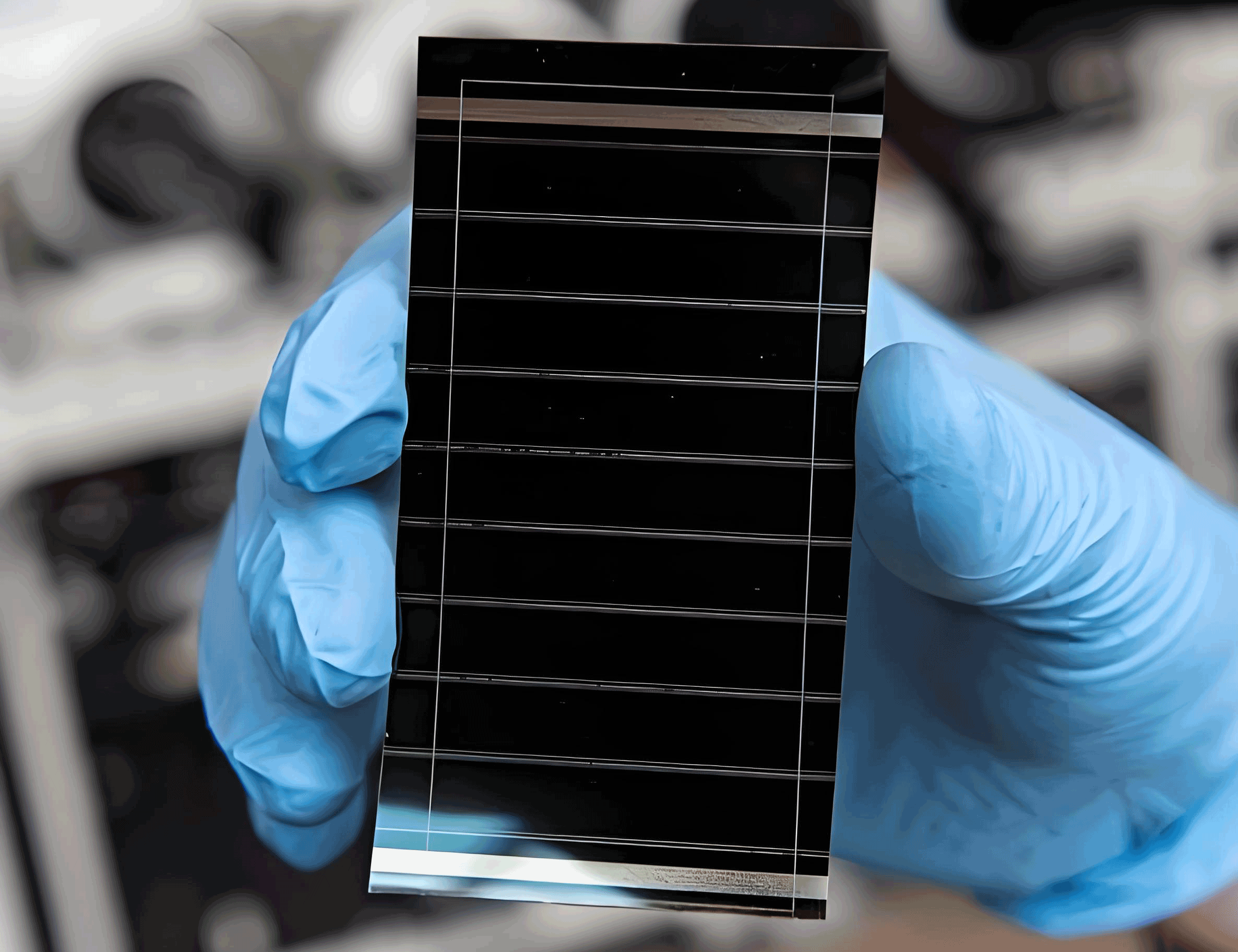
The charge extraction and recombination kinetics in perovskite solar cells can be modeled using the diode equation:
$$J = J_{ph} – J_0 \left( e^{\frac{q(V + J R_s)}{n k T}} – 1 \right) – \frac{V + J R_s}{R_{sh}}$$
where \(J_{ph}\) is the photocurrent density, \(J_0\) is the reverse saturation current density, \(n\) is the ideality factor, \(k\) is Boltzmann’s constant, \(T\) is the temperature, \(R_s\) is the series resistance, and \(R_{sh}\) is the shunt resistance. The addition of TP6 reduced \(J_0\) and \(R_s\), leading to higher \(V_{oc}\) and FF. This is consistent with the reduced non-radiative recombination observed in the PL studies.
Further analysis of the defect density was performed using the space-charge-limited current (SCLC) method. The trap-filled limit voltage (\(V_{TFL}\)) is related to the defect density (\(N_t\)) by:
$$V_{TFL} = \frac{e N_t L^2}{2 \varepsilon \varepsilon_0}$$
where \(e\) is the elementary charge, \(L\) is the film thickness, \(\varepsilon\) is the relative permittivity, and \(\varepsilon_0\) is the vacuum permittivity. The TP6-modified films exhibited lower \(V_{TFL}\), indicating a reduction in defect states, which is crucial for high-performance perovskite solar cells.
In conclusion, the integration of TP6 as an additive in printable mesoscopic perovskite solar cells facilitates the formation of 2D/3D mixed phases, resulting in superior crystallinity, enhanced charge transport, and remarkable stability. The optimized devices achieved a PCE of 15.58% with minimal hysteresis and maintained over 93% of their initial efficiency after 90 days in humid conditions. This low-dimensional strategy provides a scalable and cost-effective approach to advancing perovskite solar cells for commercial applications. Future work will focus on exploring other amphiphilic molecules and their synergies with different perovskite compositions to further push the boundaries of efficiency and durability in perovskite solar cells.
The potential of perovskite solar cells lies in their ability to combine high efficiency with low-cost manufacturing. Our findings demonstrate that additive engineering with low-dimensional structures is a powerful tool to address the stability issues without compromising performance. As research in perovskite solar cells progresses, such strategies will be pivotal in achieving the goal of sustainable and reliable photovoltaic technology.