
The global energy landscape, while still heavily reliant on fossil fuels, is undergoing a significant transformation towards decarbonization and clean energy. Central to this transition is the lithium-ion battery, prized for its high energy density, low self-discharge rate, and lack of memory effect. The application of lithium-ion batteries has expanded from consumer electronics to diverse sectors including electric vehicles, energy storage systems, and industrial equipment, creating a multifaceted market landscape. However, the increasing market demand and the pursuit of higher energy densities have brought safety concerns, particularly thermal runaway, into sharp focus.
During transportation, factors such as external impact, vibration, crush, low pressure, and high temperatures can all act as triggers for thermal runaway. The risk escalates with higher energy density and state of charge (SOC). Thermal runaway initiates a violent exothermic chain reaction, leading to fires, explosions, and the release of toxic gases, posing severe threats to the surrounding environment and personnel safety. Early warning systems are therefore critical for lithium-ion battery safety, enabling real-time monitoring of characteristic signals during the initial stages of failure to prevent catastrophic propagation. Transport packaging serves as the primary physical barrier protecting batteries from external damage. Common packaging forms include drums, boxes, and jerricans, with corrugated boxes being widely adopted due to green packaging principles and lower recycling costs. These are often designed with specialized partitions and load-bearing structures for specific battery shapes and sizes. Yet, traditional packaging primarily offers physical protection and lacks integrated monitoring and early warning capabilities for thermal runaway. While some transport modes like aircraft cargo holds may be equipped with smoke alarms, these are external to the packaging and typically only activate when the battery has already entered an uncontrollable state, leaving a minimal window for effective response.
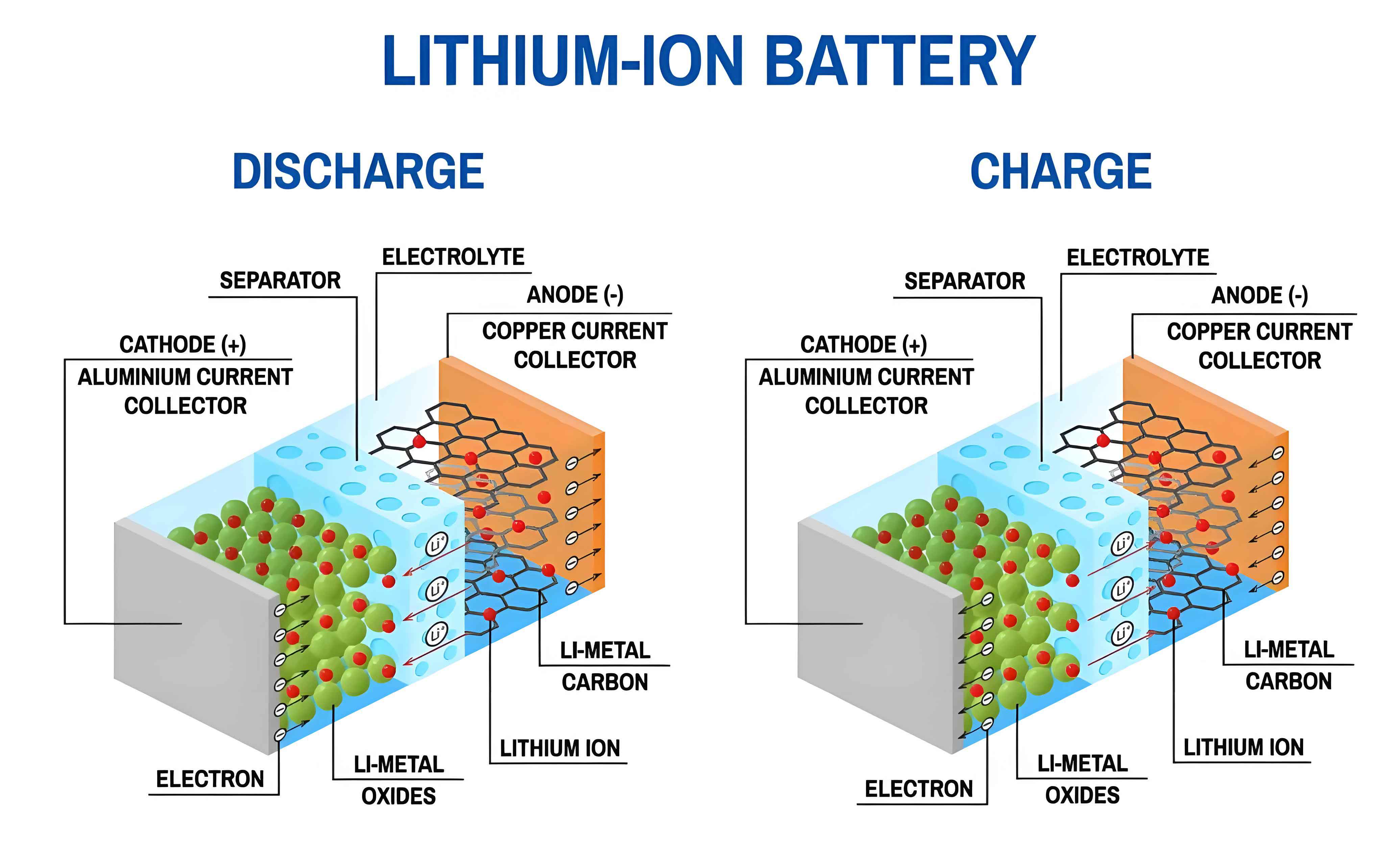
The thermal runaway process in lithium-ion batteries is complex and difficult to predict, making the study of its behavior essential for effective monitoring and warning. Abuse conditions are the primary triggers, generally categorized into three types: mechanical, electrical, and thermal abuse.
- Mechanical Abuse: This involves external forces like crushing, penetration, or collision that compromise the battery’s physical structure. This can lead to separator damage, internal short circuits (ISC), and electrolyte leakage. The short circuit generates significant heat, causing a rapid temperature rise and initiating a vicious cycle.
- Electrical Abuse: This refers to operating the battery outside its designed electrical limits, including overcharge, over-discharge, and external short circuits. Overcharge is considered particularly hazardous, accelerating side reactions and leading to continuous increases in voltage and temperature, ultimately resulting in runaway, fire, or explosion. Over-discharge can cause copper dendrites to grow and pierce the separator, inducing an internal short circuit and local heat accumulation. External short circuits generate intense heat from instantaneous high current, triggering chain reactions like electrolyte decomposition and separator meltdown.
- Thermal Abuse: This occurs when external high temperatures or internal heat accumulation raise the cell temperature beyond a safe threshold, initiating irreversible exothermic reactions. It can occur independently (e.g., exposure to fire) or as a subsequent stage following mechanical or electrical abuse, where localized overheating spreads throughout the cell.
The progression of thermal runaway is distinctly stage-wise, typically divided into the initial stage, the thermal runaway stage, and the fire/explosion stage, each accompanied by specific physico-chemical changes.
In the initial stage, side reactions like electrolyte decomposition and solid electrolyte interphase (SEI) layer breakdown release heat and gas, causing a gradual temperature rise and increased internal pressure. Abnormal voltage and internal resistance fluctuations may occur, and cell expansion leads to stress redistribution. As the temperature climbs to approximately 130–200°C, the safety vent opens to release high-temperature flammable gases (H2, CO, CH4, etc.) to alleviate pressure. At this point, the electrode structure begins to collapse, inflicting irreversible damage on the battery, accompanied by significant energy release and a marked increase in fire risk.
If not suppressed, the battery enters the fire and explosion stage. Temperature continues to rise, and electrolyte and electrode materials decompose violently, releasing combustibles. The ejected gases can ignite upon contact with high temperature or an open flame, initiating a fire. In a confined environment, accumulated flammable gases can reach explosive limits, leading to an explosion if an ignition source is present. The battery continues to burn until the active materials are depleted. Cells without safety vents are more prone to rapidly progress directly to violent burning and explosion after thermal runaway initiation.
To address the risk of thermal runaway during lithium-ion battery use, various early warning technologies based on different physical parameters have been developed. These methods rely on sensors to collect state information from inside or outside the battery, analyzing changes in key parameters to identify potential risks in advance. Common approaches include electrical, thermal, mechanical, gas, acoustic, and optical warning technologies, which exhibit complementarity and potential for fusion. Their key characteristics are summarized in the table below.
| Warning Method | Monitoring Parameters | Sensing Devices | Key Principle & Example |
|---|---|---|---|
| Electrical | Electrochemical Impedance, Internal Potential, Current/Voltage | Online Electrochemical Impedance Spectroscopy (EIS), Reference Electrode, Flexible Galvanometer | Monitors changes in electrochemical characteristics. E.g., detecting a sudden drop in internal resistance can signal an internal short circuit. The relationship between voltage (V) and state of charge (SOC) can be modeled as: $$V(t) = OCV(SOC(t)) + I(t)R_{int} + V_{polarization}(t)$$ where an anomalous deviation indicates potential failure. |
| Thermal | Temperature, Heat Flux | Thermocouple, Thermistor, Fiber Bragg Grating (FBG), Heat Flux Sensor | Detects abnormal heat generation. The temperature rise can be modeled by the heat generation equation: $$\rho C_p \frac{\partial T}{\partial t} = \nabla \cdot (k \nabla T) + \dot{q}_{gen}$$ where a rapid increase in the heat generation rate $\dot{q}_{gen}$ serves as an early indicator. |
| Mechanical | Strain, Pressure | Strain Gauge, FBG, Pressure Sensing Film | Senses structural deformation or gas pressure build-up. Strain ($\epsilon$) or pressure ($P$) exceeding a threshold ($\epsilon_{th}$, $P_{th}$) provides warning: $$\epsilon > \epsilon_{th} \quad \text{or} \quad \frac{dP}{dt} > \left(\frac{dP}{dt}\right)_{th}$$ |
| Gas | Gas Concentration (H2, CO, CO2, VOCs), Smoke | Gas Sensor, Optical Fiber Sensor, Mass Spectrometer, Laser Smoke Detector | Detects characteristic gases released from side reactions. Early warning is triggered when gas concentration $C_g$ surpasses a threshold $C_{th}$: $$C_g(t) > C_{th}$$ For example, H2 or CO concentration rising above a few hundred ppm can be an early sign. |
| Acoustic | Ultrasonic Signal, Acoustic Emission | Ultrasonic Probe, Microphone | Listens for sounds from internal structural changes or micro-cracks. Anomalies in acoustic signal features (e.g., amplitude $A$, frequency $f$) from a baseline indicate stress. |
| Optical | Image (Deformation, Smoke) | Camera | Uses computer vision to identify visible external abnormalities like swelling or smoke emission. |
Electrical methods offer high sensitivity and real-time capability but are heavily reliant on complex algorithms and are susceptible to interference from temperature and SOC. Their requirement for direct connection to cell internals often involves structural modification, increasing cost and integration difficulty, which limits their application in transport scenarios.
Thermal methods are fundamental, yet surface temperature measurements suffer from response lag, failing to reflect internal anomalies early. Internal temperature monitoring can compromise structural integrity and is prone to environmental interference, increasing false alarm risks.
Mechanical methods, while sensitive and proactive, face challenges in sensor deployment, structural invasiveness, and environmental complexity, affecting stability. Pressure sensors also struggle with long-term stability in complex gas environments.
Gas warning methods are fast and sensitive but vulnerable to environmental interference, have high equipment costs, and involve complex sensor arrangements, hindering large-scale deployment.
Acoustic methods are non-contact and sensitive but highly susceptible to ambient noise, require baseline models that need re-calibration with environmental changes, and have complex deployment requirements.
Optical methods are sensitive to lighting conditions and obstructions, leading to potential false alarms, and require specific installation spaces and fields of view, limiting reliability in complex environments.
Integrating a thermal runaway monitoring and early warning system into transport packaging for lithium-ion batteries requires careful consideration of battery structure, sensor deployment, power supply conditions, and regulatory restrictions on electronic components for different transport modes. The adaptability of existing warning methods varies significantly across transport scenarios and battery structures.
The following table analyzes the adaptability of different warning methods, considering key constraints such as the need for internal electrical connection (for electrical methods), electromagnetic compatibility (EMC) and power restrictions in air transport, sensitivity to vibration (for acoustic methods), and the feasibility of sensor integration within various packaging and battery types (cylindrical, prismatic, pouch, module).
| Warning Method | Road Transport | Air Transport | Rail Transport | Maritime Transport | Key Constraints & Notes |
|---|---|---|---|---|---|
| Electrical | Not Adaptable | Not Adaptable | Not Adaptable | Not Adaptable | Requires internal cell/module connection and external power. Contradicts transport regulations requiring batteries to be non-operational. Strict EMC rules in aviation. |
| Thermal | Adaptable | Difficult to Adapt | Adaptable | Adaptable | Low-power sensors (thermocouple, FBG) are suitable. Aviation faces stringent electronic device certification (EMC, environmental). |
| Mechanical | Difficult to Adapt | Difficult to Adapt | Difficult to Adapt | Not Adaptable | Use of passive sensors may be permitted but vibration causes false alarms. Cost and maintenance complexity are deterrents. Corrosion concerns in maritime. |
| Gas | Difficult to Adapt | Not Adaptable | Difficult to Adapt | Difficult to Adapt | Fast gas dispersion and environmental interference in road/rail. Requires power/calibration. Strict electrical safety/EMC rules prohibit use in air transport. |
| Acoustic | Not Adaptable | Not Adaptable | Difficult to Adapt | Difficult to Adapt | Extremely sensitive to ambient noise (road vibration). Lack of mature application cases and validation data. Wave propagation issues in sealed holds. |
| Optical | Adaptable | Difficult to Adapt | Adaptable | Adaptable | Suitable for auxiliary monitoring in large containers. Requires stable view, space, and power/communication. Strict cargo hold safety rules limit internal use in aviation. |
Different lithium-ion battery types also present varying integration challenges. Pouch cells, due to their flexible structure, are more suitable for mechanical and gas warning but less so for rigid or contact sensors. Cylindrical cells, with their stable structure, better accommodate thermal or acoustic sensors. Module-level batteries offer the most space and best adaptability for integrating multiple sensor types.
Current protective strategies for lithium-ion battery transport packaging primarily rely on passive designs using materials like nanofibers, aerogels, or phase change materials for thermal isolation or heat dissipation. While effective in slowing thermal propagation after an event, they lack the ability to monitor the battery’s state or provide an early warning during the latent phase. In contrast, active monitoring technologies show greater potential but remain in early stages for commercial transport packaging. Mature monitoring technologies from related fields like hazardous materials transportation and cold chain logistics offer valuable insights.
In hazardous chemicals transport, IoT-based systems monitor parameters like pressure, level, temperature, and gas concentration in tankers in real-time. Data is transmitted wirelessly to onboard units for processing, alarm triggering, and remote reporting. This establishes a complete “physical signal acquisition – local data processing – remote alarm linkage” chain, providing a reference for lithium-ion battery packaging. Their multi-parameter collaborative detection approach is key to capturing the coupled early features (slight temperature rise, gas release) of lithium-ion battery thermal runaway.
Cold chain logistics employs low-power, low-cost embedded monitoring. Time-Temperature Indicators (TTIs) are passive smart labels that visually record cumulative temperature exposure history. While TTIs record rather than warn in real-time, their mechanism and requirements for miniaturization and passive operation align well with packaging constraints for lithium-ion batteries. Integrated transport boxes with embedded temperature and gas (e.g., ammonia) sensors, independent power, and modular design demonstrate a feasible path for building self-contained monitoring units for batteries, incorporating thermal and gas sensing modules.
The integration of Artificial Intelligence (AI) is showing promise for early warning in dangerous goods transport. Systems using AI to analyze real-time sensor data (temperature, pressure) can detect anomalies. AI-powered image recognition systems are also being certified for early smoke detection in ship holds. These applications demonstrate AI’s capability to identify early risk indicators, offering an innovative direction for multi-modal data fusion in lithium-ion battery monitoring.
Given the limitations of single-parameter detection and the varied adaptability across transport modes, the future lies in building an intelligent, integrated monitoring and early warning system embedded within the transport packaging itself. Such a system should be designed with a focus on structural integration, international regulation compliance, and edge intelligence. A proposed framework consists of four core functional modules:
- Multi-Parameter Sensing Unit: Deployed inside the packaging structure using miniaturized, low-power, high-adaptability sensors (e.g., thermal, strain, gas) to collect real-time data. Sensors can be non-invasively embedded in inner walls, pallets, or cushioning materials.
- Edge Computing & Control Module: Based on low-power MCUs or edge AI chips, this module performs local feature extraction, trend analysis, and incipient fault judgment. It can be configured with flexible thresholds and warning strategies based on transport environment requirements.
- Local Response & Alert Module: Triggers appropriate responses upon detecting a risk, such as audible/visual alarms, color-changing labels (inspired by TTIs), or wireless signals. Responses can be tiered based on transport mode (e.g., non-interfering alerts for aviation).
- Remote Communication & Data Upload Module: Employs low-power communication technologies (LPWAN, NB-IoT, satellite SBD) to upload key anomaly data to logistics or safety supervision platforms, ensuring compliance with international dangerous goods transport regulations.
The entire system must be designed for robustness against vibration, shock, moisture, and must meet electromagnetic compatibility standards. This integrated “smart packaging” concept provides a viable technical pathway toward safer transportation of lithium-ion batteries across diverse scenarios.
In conclusion, the thermal runaway risk of lithium-ion batteries during transportation necessitates advanced monitoring and early warning solutions. While individual sensing technologies have been developed, they face challenges in response lag, deployment feasibility, and reliability when considered in isolation for the complex transport environment. The future direction involves the evolution of these technologies toward miniaturization, intelligence, and standardization. By fusing lightweight AI models, flexible embedded sensors, and low-power communication within a structurally integrated, regulation-compliant packaging system, a more agile and reliable safety response mechanism can be achieved. Promoting multi-dimensional validation and standardization of such systems will be crucial for their transition to widespread application, ultimately supporting the safe and sustainable development of the global green energy logistics ecosystem.