
The pursuit of accurate and reliable energy storage technology is a cornerstone for achieving carbon neutrality and enabling a sustainable circular economy. Among various energy storage devices, the lithium-ion battery stands out due to its high energy density and long cycle life. Accurate and real-time estimation of the State of Health (SOH) for lithium-ion batteries is of paramount importance for preventing failures, optimizing energy management, extending service life, and ensuring the stable operation of power systems. The SOH quantifies the degree of aging and performance degradation of a lithium-ion battery, commonly defined by the loss of maximum usable capacity or the increase in internal resistance. This work focuses on the capacity-based SOH definition:
$$
\text{SOH} = \frac{Q_{\text{charge}}}{Q_{\text{rated}}} \times 100\%
$$
where $Q_{\text{charge}}$ represents the current maximum charge capacity, and $Q_{\text{rated}}$ is the nominal or initial rated capacity of the lithium-ion battery.
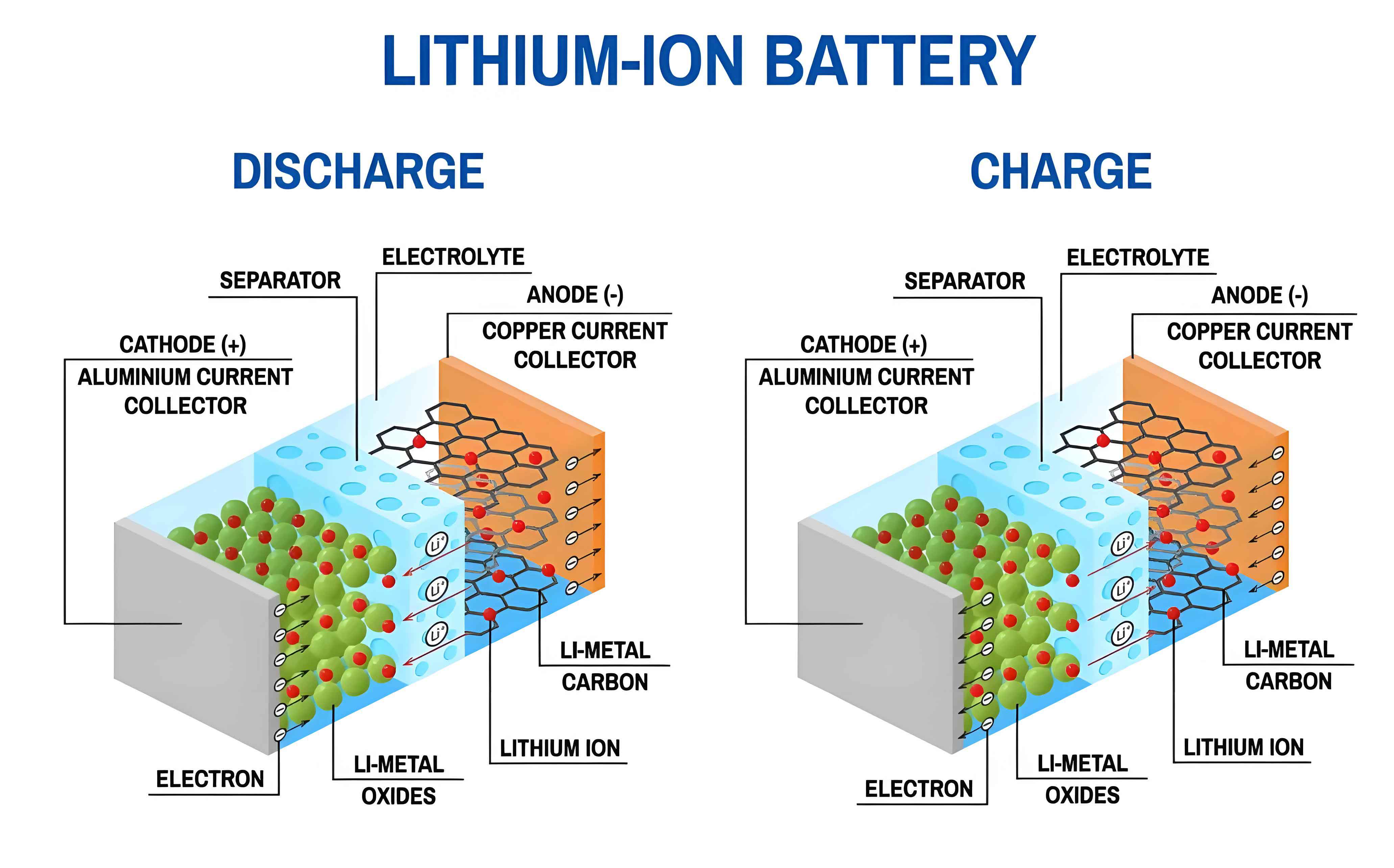
Existing methods for lithium-ion battery SOH estimation are broadly categorized into model-driven and data-driven approaches. Model-driven methods, such as electrochemical impedance spectroscopy and equivalent circuit models, rely on precise mathematical descriptions of the internal physico-chemical processes of the lithium-ion battery. However, their practical application is often hindered by computational complexity, sensitivity to uncertain operating conditions, and the challenge of coupling external environmental variables with internal dynamics. In contrast, data-driven methods circumvent the need for explicit physical models by leveraging machine learning and statistical techniques to discover complex, non-linear mappings between easily measurable operational data and the SOH of the lithium-ion battery. The efficacy of a data-driven approach critically depends on two factors: the quality of the extracted health features and the capability of the estimation model.
Traditional feature extraction for lithium-ion battery SOH often relies on direct measurements like voltage, current, and temperature. Incremental Capacity (IC) and Differential Voltage (DV) analyses are advanced techniques that transform the flat voltage plateaus during charging into more discernible peaks and valleys, revealing subtle changes related to phase transitions and degradation mechanisms within the lithium-ion battery. However, these methods primarily focus on capacity and voltage differentials, potentially overlooking the energetic aspects of the charging process. The degradation of a lithium-ion battery also manifests in changes in energy efficiency and the dynamics of energy acceptance. To address this gap, this work proposes a novel Incremental Energy (IE) analysis method. By analyzing the rate of energy input with respect to voltage, the IE curve provides a complementary perspective that is sensitive to changes in the internal resistance and reaction kinetics of the aging lithium-ion battery. The area under the IE curve, termed the Incremental Energy Area (IEA), serves as a robust health indicator, capturing integrated information over the entire charging voltage range.
Further analysis of experimental data from cycling tests on lithium-ion batteries reveals strong correlations between SOH and several other features. The Pearson correlation coefficient is used to quantify these relationships. For instance, the constant-voltage (CV) charging duration exhibits a strong negative correlation with the SOH of the lithium-ion battery, as increased internal resistance prolongs the CV phase. Based on this analysis, the most salient features are combined to form the IEA-T health indicator, where ‘T’ represents the CV charging time. This combined feature set provides a more comprehensive descriptor of the lithium-ion battery’s aging state.
On the modeling front, deep learning architectures have shown exceptional promise for lithium-ion battery SOH estimation due to their ability to model complex, sequential data. The Convolutional Neural Network (CNN) excels at extracting local patterns and spatial features from structured data. When dealing with time-series data from a lithium-ion battery, the Bidirectional Long Short-Term Memory (BiLSTM) network is particularly powerful. Unlike standard LSTM, BiLSTM processes sequence data in both forward and backward directions, enabling it to capture richer contextual dependencies and long-term trends in the degradation trajectory of the lithium-ion battery. A hybrid CNN-BiLSTM model leverages the strengths of both: the CNN layers extract high-level features from the input sequences, and the BiLSTM layers model the temporal evolution of these features.
To further enhance the estimation performance for lithium-ion batteries, two advanced components are integrated into the CNN-BiLSTM framework: the Distance Intersection over Union Loss (DIoUloss) function and the Simple, Parameter-free Attention Module (SimAM). The DIoUloss function, originally designed for object detection, is adapted for regression tasks. It improves upon standard loss functions like Mean Squared Error (MSE) by considering not only the difference between predicted and true values but also the distance between their centers of distribution, leading to faster and more stable convergence during the training of models for lithium-ion battery SOH estimation. The SimAM mechanism is a lightweight, parameter-free attention module that can be seamlessly inserted into CNN architectures. It assigns an importance weight to each neuron in a feature map based on neuroscience theories, allowing the model to focus on more informative features related to the degradation of the lithium-ion battery without adding computational parameters. The fusion of these components results in the proposed CNN-BiLSTM-SimAM model.
The complete framework for lithium-ion battery SOH estimation is summarized in the following major steps:
- Data Collection & Feature Extraction: Operate lithium-ion batteries under standardized cycling protocols (e.g., Constant Current-Constant Voltage charge, Constant Current discharge). Record time-series data including voltage (V), current (I), and temperature. From the charge curves, calculate the energy input and subsequently derive the Incremental Energy (IE) curve. Extract the IEA and the CV charging time (T) to form the IEA-T health feature vector for each cycle.
- Data Preprocessing: Normalize the extracted feature sequences to a standard range (e.g., [0, 1]) to ensure stable and efficient model training for the lithium-ion battery data.
- Model Construction & Training:
- Input the normalized IEA-T sequence into the CNN layers for local feature extraction.
- Process the CNN’s output feature maps through the SimAM module to obtain attention-weighted features.
- Feed the weighted features into the BiLSTM layers to capture bidirectional temporal dependencies.
- The final output layer produces the estimated SOH value for the lithium-ion battery.
- Train the model by minimizing the DIoUloss between the predicted SOH and the true SOH (calculated from measured capacity fade).
- Estimation & Evaluation: Use the trained CNN-BiLSTM-SimAM model to estimate the SOH of lithium-ion batteries on unseen test data. Evaluate performance using standard metrics: Mean Absolute Percentage Error (MAPE), Root Mean Square Error (RMSE), and the Coefficient of Determination ($R^2$).
The effectiveness of the proposed method is validated using publicly available lithium-ion battery aging datasets. Two cells (Cell A and Cell B) were cycled under different charge rates until end-of-life. The details of the datasets are as follows:
| Dataset | Charge Current (mA) | Cut-off Current (mA) | Discharge Cut-off Voltage (V) | Total Cycles |
|---|---|---|---|---|
| Cell A | 500 | 48 | 3.0 | 1001 |
| Cell B | 1250 | 48 | 3.0 | 1007 |
The correlation analysis between candidate features and the actual SOH of the lithium-ion battery confirmed the high relevance of the selected IEA-T features.
| Feature | Description | Correlation with SOH |
|---|---|---|
| IEA | Incremental Energy Area | 0.9995 |
| T | Constant-Voltage Charging Time | -0.9878 |
| ∫ I dt | Time Integral of Charge Current | -0.9701 |
| ∫ Temp dt | Time Integral of Temperature | 0.6857 |
The architecture and key hyperparameters of the proposed CNN-BiLSTM-SimAM model for lithium-ion battery SOH estimation are detailed below.
| Module | Parameter | Value/Setting |
|---|---|---|
| Input | Features | IEA, CV Charging Time (T) |
| Sequence Length | 15 cycles | |
| CNN | Kernel Size / Number | 8 / 32 |
| Pooling Window | 2 | |
| Stride | 1 | |
| SimAM | Type | Parameter-free 3D Attention |
| BiLSTM | Units (Forward/Backward) | 128 / 128 |
| Training | Loss Function | DIoUloss |
| Batch Size / Epochs | 8 / 100 |
The performance of the proposed model is rigorously compared against several established data-driven methods for lithium-ion battery SOH estimation, including Gated Recurrent Unit (GRU), Support Vector Regression (SVR), CNN-LSTM, and the baseline CNN-BiLSTM (without SimAM and DIoUloss). The results consistently demonstrate the superiority of the CNN-BiLSTM-SimAM model across both lithium-ion battery datasets.
| Dataset | Model | MAPE (%) | RMSE | $R^2$ | Inference Time (s) |
|---|---|---|---|---|---|
| Cell A | GRU | 1.4865 | 0.0147 | 0.8436 | 0.72 |
| SVR | 1.2779 | 0.0133 | 0.8723 | 0.78 | |
| CNN-LSTM | 1.1816 | 0.0127 | 0.8841 | 1.37 | |
| CNN-BiLSTM | 1.0398 | 0.0100 | 0.9280 | 2.05 | |
| CNN-BiLSTM-SimAM (No DIoU) | 0.9113 | 0.0089 | 0.9425 | 2.14 | |
| Proposed: CNN-BiLSTM-SimAM | 0.6770 | 0.0072 | 0.9627 | 2.37 | |
| Cell B | GRU | 3.4366 | 0.0268 | 0.9194 | 0.65 |
| SVR | 3.3174 | 0.0244 | 0.9328 | 0.76 | |
| CNN-LSTM | 2.0334 | 0.0180 | 0.9636 | 1.13 | |
| CNN-BiLSTM | 1.6585 | 0.0139 | 0.9784 | 2.11 | |
| CNN-BiLSTM-SimAM (No DIoU) | 1.2355 | 0.0105 | 0.9876 | 2.21 | |
| Proposed: CNN-BiLSTM-SimAM | 1.1153 | 0.0088 | 0.9913 | 2.35 |
The ablation study clearly shows the incremental benefit of each component in the proposed framework for lithium-ion battery SOH estimation. Integrating the SimAM mechanism into the CNN-BiLSTM model (CNN-BiLSTM-SimAM-None DIoUloss) already improves performance by allowing the model to focus on the most relevant degradation features within the lithium-ion battery data. The subsequent incorporation of the DIoUloss function (full CNN-BiLSTM-SimAM model) further enhances the training dynamics, leading to the lowest MAPE and RMSE, and the highest $R^2$ values. The $R^2$ scores above 0.96 and RMSE values below 0.020 across different lithium-ion battery cycling conditions attest to the model’s high accuracy and excellent explanatory power. The modest increase in inference time is a reasonable trade-off for the significant gain in estimation precision, which is critical for reliable health management of lithium-ion batteries.
The superior performance of the CNN-BiLSTM-SimAM model for lithium-ion battery SOH estimation can be attributed to its synergistic architecture. The CNN-BiLSTM backbone effectively captures both the local patterns in the IEA-T features and their long-term temporal progression. The SimAM mechanism acts as an intelligent filter, dynamically highlighting the most salient features indicative of the lithium-ion battery’s aging state without increasing model complexity. The DIoUloss function optimizes the training process more effectively than conventional loss functions, guiding the model to converge to a solution that minimizes both the magnitude and the distributional discrepancy of the estimation error. This comprehensive approach enables the model to characterize the intricate, non-linear capacity fade trajectory of a lithium-ion battery with high fidelity.
In conclusion, this work presents a novel and robust data-driven framework for accurate State of Health estimation of lithium-ion batteries. The primary contributions are twofold. First, we introduce the Incremental Energy Area-Time (IEA-T) health feature, derived from a proposed Incremental Energy analysis, which provides a richer descriptor of the lithium-ion battery’s degradation by incorporating energetic aspects alongside temporal information. Second, we develop an advanced CNN-BiLSTM-SimAM estimation model enhanced with a DIoUloss function. This model synergistically combines spatial feature extraction, bidirectional temporal modeling, parameter-free attention, and an advanced loss function to achieve highly accurate SOH estimates. Experimental validation on lithium-ion battery aging datasets under different operating conditions confirms that the proposed method outperforms several benchmark algorithms, offering superior accuracy (high $R^2$, low RMSE/MAPE) and robustness. This framework represents a significant step towards more reliable and precise health management for lithium-ion battery systems in real-world applications such as electric vehicles and grid storage. Future work will explore the adaptation of this framework for online, real-time SOH estimation and its extension to prognostics for predicting the remaining useful life of lithium-ion batteries.