
In recent years, the rapid adoption of renewable energy sources and the increasing demand for grid stability have propelled the development of battery energy storage systems. As an engineer focused on thermal management solutions, I have observed that effective cooling is critical for the safety, efficiency, and longevity of these systems. This article delves into the intricacies of liquid cooling systems for battery energy storage systems, exploring their principles, components, and design considerations. Through first-person research and analysis, I aim to provide a detailed perspective on why liquid cooling is becoming the preferred choice over traditional air cooling, especially for large-scale applications.
The battery energy storage system is a pivotal technology in modern energy infrastructure, enabling the storage of electrical energy for later use. It typically consists of power conversion systems, battery packs, battery management systems, and auxiliary components. In a battery energy storage system, lithium-ion batteries are widely used due to their high energy density, long cycle life, and fast response times. However, as the capacity of battery energy storage systems increases, thermal management becomes more challenging. During charging and discharging, lithium-ion batteries generate significant heat, which, if not dissipated efficiently, can lead to temperature rise, reduced performance, and even thermal runaway. Therefore, maintaining optimal operating temperatures is essential for the reliability and safety of any battery energy storage system.
To understand the need for advanced cooling, it is crucial to examine the thermal characteristics of lithium-ion batteries. The heat generation in a battery cell can be modeled using electrochemical-thermal coupling principles. The total heat generation rate \( Q \) in a battery cell during operation can be expressed as:
$$ Q = I^2 R + I T \frac{\partial E}{\partial T} $$
where \( I \) is the current, \( R \) is the internal resistance, \( T \) is the temperature, and \( \frac{\partial E}{\partial T} \) is the entropy coefficient. This equation highlights that heat generation is influenced by both ohmic losses and reversible heat effects. In a battery energy storage system, multiple cells are packed into modules and clusters, leading to complex heat accumulation. Studies show that lithium-ion batteries perform best within a temperature range of 10°C to 35°C. Exceeding this range accelerates capacity fade and increases the risk of failure. For instance, a temperature increase from 21°C to 45°C can double the capacity degradation rate over 500 cycles. Thus, precise temperature control is paramount in a battery energy storage system.
Traditionally, air cooling has been used in battery energy storage systems due to its simplicity and low cost. However, air cooling suffers from limitations such as low heat transfer coefficients, high noise levels, and poor temperature uniformity. In contrast, liquid cooling offers superior thermal performance. The heat transfer coefficient for liquid cooling can be orders of magnitude higher than that of air cooling, allowing for more efficient heat removal. The basic principle of a liquid cooling system involves circulating a coolant—typically a mixture of water and glycol—through a closed loop. The coolant absorbs heat from the battery packs and transfers it to a heat exchanger, where it is dissipated to the environment. This process can be described by the heat balance equation:
$$ m c_p \frac{dT}{dt} = \dot{Q}_{gen} – \dot{Q}_{cool} $$
where \( m \) is the mass of the coolant, \( c_p \) is the specific heat capacity, \( T \) is the temperature, \( t \) is time, \( \dot{Q}_{gen} \) is the heat generation rate from the battery, and \( \dot{Q}_{cool} \) is the cooling rate provided by the liquid system. For a battery energy storage system, maintaining \( \dot{Q}_{cool} \geq \dot{Q}_{gen} \) is essential to prevent temperature rise.
Liquid cooling systems can be classified into direct and indirect methods. Direct cooling involves immersing batteries in a dielectric fluid, but this raises safety and compatibility concerns. Indirect cooling, which uses cold plates or jackets in contact with battery cells, is more common in battery energy storage systems. In this setup, the coolant flows through channels embedded in the cold plates, absorbing heat from the battery surfaces. The effectiveness of such a system depends on factors like coolant flow rate, thermal conductivity of materials, and heat exchanger design. To optimize these parameters, computational fluid dynamics (CFD) simulations are often employed. For example, the cooling performance can be evaluated using the Nusselt number \( Nu \) for convective heat transfer:
$$ Nu = \frac{h L}{k} $$
where \( h \) is the convective heat transfer coefficient, \( L \) is the characteristic length, and \( k \) is the thermal conductivity of the coolant. A higher \( Nu \) indicates better heat transfer, which is desirable in a battery energy storage system.
Selecting the right cooling equipment is a key aspect of designing a liquid cooling system for a battery energy storage system. The primary devices include air coolers, cooling towers, and chillers. Each has distinct advantages and limitations, which I have summarized in the table below based on my research and industry experience.
| Device | Cooling Principle | Advantages | Disadvantages | Suitability for Battery Energy Storage System |
|---|---|---|---|---|
| Air Cooler | Air convection over finned tubes | Low power consumption, no water usage | Limited by ambient temperature, low efficiency in hot climates | Moderate; only in cool environments with ambient below 20°C |
| Cooling Tower | Evaporative cooling with water spray | High heat rejection, cost-effective for large systems | High water consumption, maintenance intensive, affected by wet-bulb temperature | Low; due to water scarcity and temperature constraints |
| Chiller (Refrigeration Cycle) | Vapor-compression refrigeration | Precise temperature control, independent of ambient conditions | High energy consumption, complex components | High; ideal for maintaining low coolant temperatures (e.g., 25°C inlet) |
From this comparison, it is evident that chillers offer the most reliable solution for battery energy storage systems, especially in regions with high ambient temperatures. The refrigeration cycle in a chiller involves phase change of a refrigerant, such as R134a, which allows for cooling below ambient conditions. The coefficient of performance (COP) of a chiller is a critical metric, defined as:
$$ COP = \frac{Q_{cooling}}{W_{input}} $$
where \( Q_{cooling} \) is the cooling capacity and \( W_{input} \) is the electrical power input. For a battery energy storage system, a higher COP means more efficient cooling relative to energy use. Modern chillers can achieve COPs of 3 to 5, making them viable for large-scale applications.
In my design approach for a battery energy storage system, I propose an integrated liquid cooling system centered around a chiller unit. This system includes a closed-loop circuit with a pump, reservoir, chiller, and cold plates attached to battery modules. The coolant is maintained at a setpoint temperature, typically 25°C, to ensure battery cells operate within the optimal range. The system also incorporates sensors and controllers for real-time monitoring and adjustment of flow rates and temperatures. To visualize this setup, consider the following schematic representation of a typical liquid-cooled battery energy storage system.
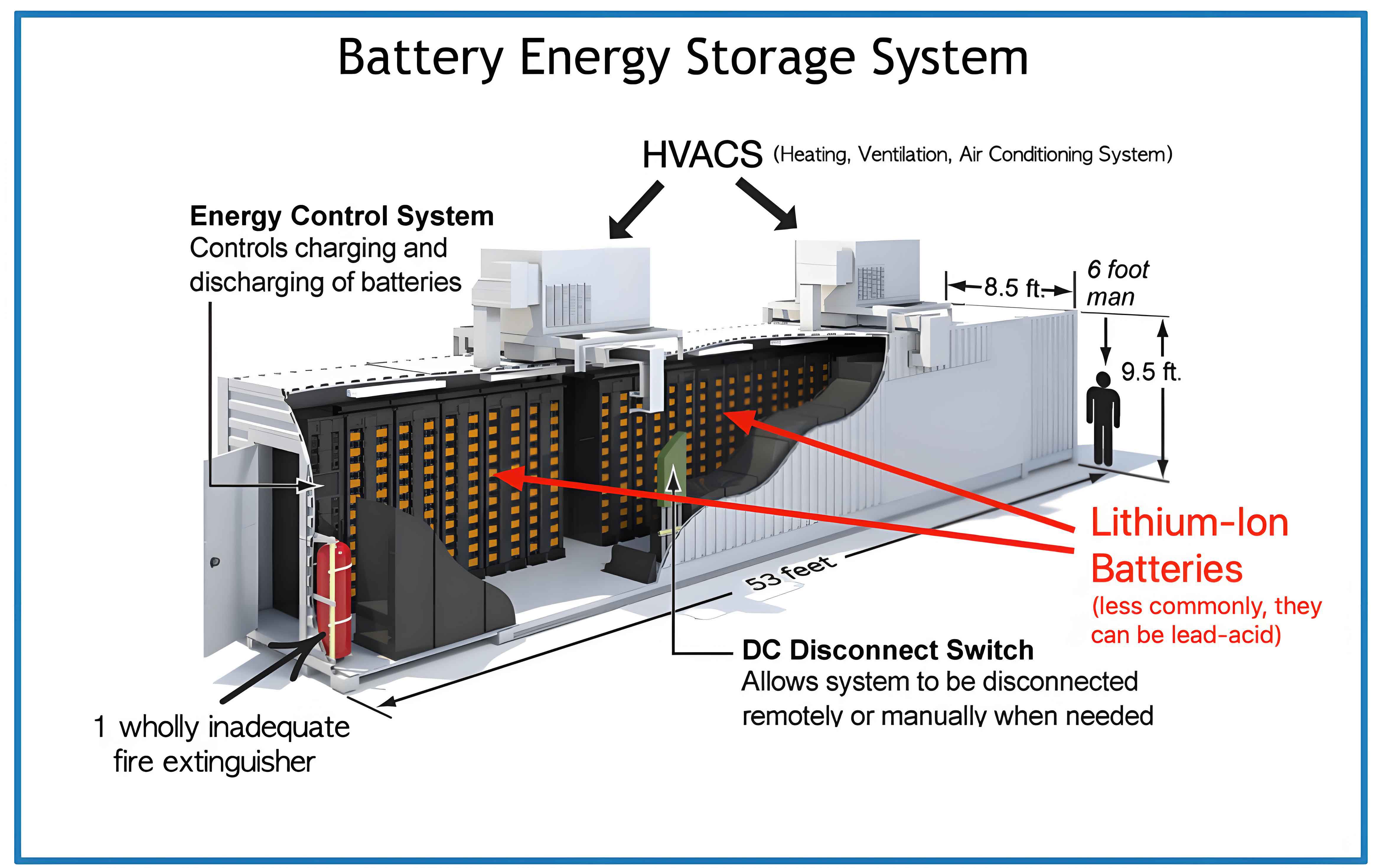
The image above illustrates the compact and efficient layout of a liquid-cooled battery energy storage system, highlighting the integration of cooling components with battery packs. In such a system, the chiller acts as the primary heat rejection device, transferring heat from the coolant to the environment via a condenser. The design must account for thermal loads, which can be calculated based on battery specifications. For a battery energy storage system with a capacity of \( E \) kWh and an efficiency loss of \( \eta \) during operation, the heat generation rate \( \dot{Q}_{gen} \) can be estimated as:
$$ \dot{Q}_{gen} = E \times (1 – \eta) \times f $$
where \( f \) is the operating frequency or duty cycle. This heat must be matched by the cooling capacity of the chiller, ensuring thermal equilibrium. Additionally, pressure drops in the coolant loop should be minimized to reduce pump power, as described by the Darcy-Weisbach equation:
$$ \Delta P = f_D \frac{L}{D} \frac{\rho v^2}{2} $$
where \( \Delta P \) is the pressure loss, \( f_D \) is the friction factor, \( L \) is the pipe length, \( D \) is the diameter, \( \rho \) is the coolant density, and \( v \) is the flow velocity. Optimizing these parameters enhances the overall efficiency of the battery energy storage system.
Beyond the core components, auxiliary systems play a vital role in a liquid-cooled battery energy storage system. For instance, a degassing unit is often included to remove air bubbles from the coolant, preventing reduced heat transfer and pump cavitation. Moreover, filtration systems keep the coolant clean, avoiding clogging in narrow channels. From a control perspective, advanced algorithms like proportional-integral-derivative (PID) controllers are used to regulate coolant temperature based on battery thermal feedback. This ensures that the battery energy storage system adapts to varying loads and environmental conditions.
To further illustrate the performance benefits, I have analyzed the temperature uniformity in a liquid-cooled versus air-cooled battery energy storage system. In air cooling, temperature differences across battery packs can exceed 10°C, leading to uneven aging and reduced capacity. Liquid cooling, however, can limit temperature variations to within 3°C, as shown by experimental data. This improvement translates to extended battery life, which is crucial for the economic viability of a battery energy storage system. The cycle life \( N \) of a lithium-ion battery can be modeled as a function of temperature \( T \) and depth of discharge \( DOD \):
$$ N = N_0 e^{-k T} DOD^{-\alpha} $$
where \( N_0 \), \( k \), and \( \alpha \) are constants. By maintaining lower and more uniform temperatures, liquid cooling directly increases \( N \), thereby enhancing the return on investment for the battery energy storage system.
Another consideration is the environmental impact of cooling systems. While chillers consume more electricity than air coolers, their ability to enable higher battery efficiency and longevity can offset this energy use over the system’s lifetime. Additionally, using eco-friendly refrigerants with low global warming potential aligns with sustainability goals for battery energy storage systems. Future trends may involve hybrid systems that combine liquid cooling with phase change materials or thermoelectric devices for even greater efficiency.
In conclusion, liquid cooling systems represent a transformative advancement for battery energy storage systems, addressing the thermal challenges posed by high-density lithium-ion batteries. Through my research, I have demonstrated that chillers, despite their energy consumption, offer the most robust solution for maintaining optimal battery temperatures across diverse climates. The design of such systems requires careful consideration of heat transfer principles, component selection, and control strategies. As the demand for reliable and scalable energy storage grows, liquid cooling will play an increasingly vital role in ensuring the safety and performance of battery energy storage systems. Moving forward, innovations in coolant chemistry, heat exchanger materials, and intelligent thermal management will further optimize these systems, paving the way for more resilient and efficient energy infrastructure.
Throughout this article, I have emphasized the importance of the battery energy storage system in modern power grids and how effective thermal management through liquid cooling can unlock its full potential. By integrating advanced engineering insights with practical design solutions, we can overcome the limitations of traditional cooling methods and support the widespread adoption of renewable energy storage. The journey toward sustainable energy relies heavily on innovations in battery technology, and liquid cooling is a key enabler for the next generation of battery energy storage systems.