
The global imperative for sustainable energy solutions has catapulted electrochemical energy storage to the forefront of scientific and industrial research. Among the various technologies, the li ion battery stands as a preeminent power source, particularly for the rapidly expanding electric vehicle (EV) market. Its superiority over traditional lead-acid and nickel-metal hydride systems lies in its exceptional combination of high energy density, long cycle life, and relatively low self-discharge. The performance, cost, and safety profile of a li ion battery are intrinsically tied to the properties of its constituent materials, with the cathode playing a disproportionately critical role, often accounting for a significant portion of both the cost and the performance limitations.
While layered oxides like LiCoO₂ and high-nickel NCM (Nickel-Cobalt-Manganese) materials offer high energy density, they are often plagued by thermal instability, high cost, and resource scarcity. In this landscape, lithium iron phosphate (LiFePO₄ or LFP), with its olivine-type crystal structure, has emerged as a formidable candidate. Its compelling advantages include exceptional structural and thermal stability, abundant and low-cost raw materials (iron and phosphorus), environmental benignity, and a flat operating voltage plateau. However, its commercial journey was initially hindered by two intrinsic drawbacks: low electronic conductivity (≈10⁻⁹ S cm⁻¹) and slow lithium-ion diffusion (≈10⁻¹⁴ cm² s⁻¹). Decades of intensive research have been dedicated to overcoming these hurdles, primarily through nanostructuring, conductive coating, and strategic ion doping. This article, from my perspective as a researcher in the field, aims to provide a comprehensive review of LiFePO₄ as a cathode material for li ion battery systems. I will delve into its fundamental working principles, crystal structure, synthesis pathways, and the pivotal modification strategies that have transformed it from a laboratory curiosity to a mainstream powerhouse. The discussion will be enriched with comparative tables and fundamental equations to crystallize the key concepts.
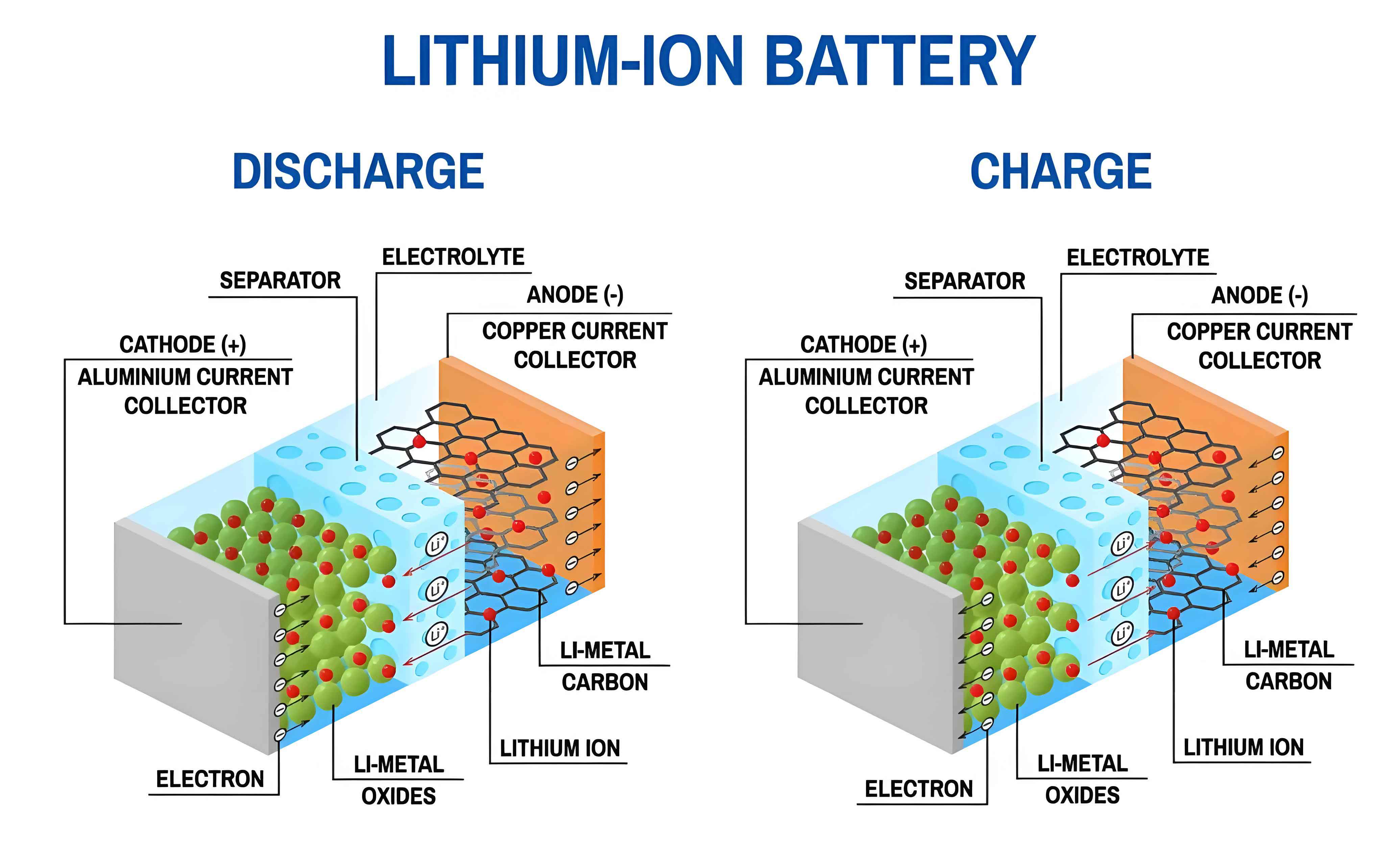
The operational mechanism of a li ion battery based on LiFePO₄ is elegantly described by the “rocking-chair” model, involving the reversible extraction and insertion of lithium ions coupled with redox reactions. During charging, Li⁺ ions are deintercalated from the LiFePO₄ cathode, travel through the electrolyte, permeate the separator, and are subsequently intercalated into the anode material (e.g., graphite). To maintain charge neutrality, an equivalent number of electrons flow through the external circuit from the cathode to the anode. The discharge process is precisely the reverse. The electrochemical reactions for a cell with LiFePO₄ cathode and graphite anode are as follows:
Cathode (Positive Electrode):
$$ \text{LiFePO}_4 \rightleftharpoons \text{Li}_{1-x}\text{FePO}_4 + x\text{Li}^+ + x e^- $$
Anode (Negative Electrode):
$$ x\text{Li}^+ + x e^- + \text{C}_6 \rightleftharpoons \text{Li}_x\text{C}_6 $$
Overall Cell Reaction:
$$ \text{LiFePO}_4 + \text{C}_6 \rightleftharpoons \text{Li}_{1-x}\text{FePO}_4 + \text{Li}_x\text{C}_6 $$
A critical feature of this two-phase reaction between LiFePO₄ (lithiated phase) and FePO₄ (delithiated phase) is the minimal change in the host crystal lattice volume (<2%). This negligible strain is the primary origin of the outstanding cycle life, often exceeding thousands of cycles, which is a hallmark of a well-designed li ion battery using this chemistry.
The remarkable stability of LiFePO₄ is rooted in its unique olivine crystal structure (orthorhombic, space group *Pnma*). The framework consists of corner-shared FeO₆ octahedra forming layers in the *bc*-plane. These layers are bridged by LiO₆ octahedra that form continuous one-dimensional channels along the *b*-axis, which are the primary pathways for Li⁺ migration. The structure is further stabilized by strong covalent P–O bonds within the PO₄ tetrahedra, which separate the FeO₆ layers. While this robust bonding grants excellent thermal and chemical stability, it also electronically isolates the FeO₆ octahedra, leading to poor intrinsic electronic conductivity. Furthermore, the one-dimensional nature of the Li⁺ diffusion channels can lead to bottlenecks if the particles are large or poorly oriented.
The synthesis of LiFePO₄ powder with controlled morphology, particle size, and purity is paramount for achieving high electrochemical performance in a li ion battery. Various methods have been developed, each with distinct advantages and trade-offs concerning cost, scalability, and product characteristics.
| Method | Principle & Procedure | Advantages | Disadvantages | Typical Electrochemical Outcome |
|---|---|---|---|---|
| High-Temperature Solid-State Reaction | Mechanical mixing of Li, Fe, and P precursors (e.g., Li₂CO₃, FeC₂O₄·2H₂O, NH₄H₂PO₄) followed by high-temperature calcination (≥600°C) under inert atmosphere. | Simple, scalable, industry-friendly; high crystallinity. | Long processing time; large, irregular particles; requires extensive grinding; possible iron oxidation (Fe²⁺ → Fe³⁺). | Moderate rate capability; capacity highly dependent on final particle size and carbon coating quality. |
| Carbothermal Reduction (CTR) | A variant of solid-state method using Fe³⁺ precursors (e.g., Fe₂O₃) and a carbon source (e.g., sucrose) which acts as both reducing agent (Fe³⁺ → Fe²⁺) and conductive coating. | Uses cheaper Fe³⁺ sources; in-situ carbon coating; good control over reduction process. | Requires precise control of carbon content and heating profile to avoid over-reduction or residual carbon. | Generally good rate performance due to integrated carbon network; high tap density possible. |
| Hydrothermal/Solvothermal | Reaction in an aqueous or organic solvent medium within a sealed autoclave at elevated temperature (120-200°C) and autogenous pressure. | Low temperature; fine, homogeneous particles; good control over morphology (nanoplates, rods); high purity. | Batch process; requires post-annealing for carbon coating; potential scalability challenges; control of stoichiometry can be tricky. | Excellent rate capability due to nano-sized particles; may have lower tap density. |
| Sol-Gel | Formation of a molecularly mixed gel from precursors (e.g., nitrates, acetates) using a chelating agent (e.g., citric acid), followed by drying and calcination. | Excellent chemical homogeneity at molecular level; low calcination temperature; suitable for doping. | Long processing time; expensive organic precursors; significant volume shrinkage. | Very good electrochemical performance due to homogeneity; facilitates uniform coating/doping. |
The performance of a li ion battery is ultimately limited by the slowest process, be it electron transport or ion diffusion. For pristine LiFePO₄, both are deficient. Therefore, material modification is not merely beneficial but essential. The two most potent and widely researched strategies are surface coating (or compositing) and bulk ion doping.
1. Conductive Surface Coating: This strategy addresses the poor electronic conductivity by creating a percolating network of electrons on the surface of each LiFePO₄ particle. The coating layer also suppresses particle growth during sintering and can protect the surface from side reactions with the electrolyte. Carbon coating, via the pyrolysis of organic precursors, is the most ubiquitous and successful technique. The carbon source and coating morphology are critical. A thin, uniform, and continuous amorphous carbon layer is ideal. Excessive carbon, while improving conductivity, dilutes the active material mass, reducing the volumetric and gravimetric energy density of the final li ion battery.
| Coating Material | Function & Mechanism | Key Benefits | Considerations |
|---|---|---|---|
| Amorphous Carbon (e.g., from sucrose, glucose, citric acid, polymers) | Provides a conductive web connecting LiFePO₄ particles; confines particle growth. | Dramatically improves electronic conductivity; simple and low-cost; versatile precursors. | Optimal thickness is crucial (~2-5 nm); too much carbon reduces energy density. |
| Graphene / Reduced Graphene Oxide (rGO) | Wraps particles in a highly conductive, flexible, two-dimensional sheet, forming a 3D electron highway. | Exceptional electronic conductivity; enhances mechanical integrity; facilitates ion access. | Dispersion and intimate contact with LFP are challenging; cost is higher. |
| Carbon Nanotubes (CNTs) / Nanofibers (CNFs) | Act as 1D conductive wires that bridge particles, creating long-range conductive pathways. | Excellent electronic conduction; can improve tensile strength of electrode. | Similar dispersion challenges as graphene; potential entanglement issues. |
| Metal Oxides/Nitrides/Phosphates (e.g., ZnO, Li₃PO₄, TiN) | Some provide limited conductivity; others act as protective barriers against HF attack from electrolyte. | Enhances surface stability; can improve high-temperature and cycling performance. | Often used in combination with carbon; conductivity enhancement is usually inferior to carbon. |
The effective electronic conductivity (σ_eff) of a coated composite can be modeled considering the percolation of the conductive phase:
$$ \sigma_{\text{eff}} \propto (p – p_c)^t $$
where \( p \) is the volume fraction of the conductive coating, \( p_c \) is the percolation threshold, and \( t \) is a critical exponent. The goal is to achieve \( p > p_c \) with minimal total coating.
2. Ion Doping: While coating improves electron transfer *between* particles, doping aims to enhance the intrinsic ionic and electronic conductivity *within* the LiFePO₄ lattice itself. This is achieved by substituting a small fraction of host cations (Li⁺ or Fe²⁺) with foreign cations of different valence or size. The introduced aliovalent ions create charge carriers (electron holes or lithium vacancies) and/or strain the lattice to widen the lithium diffusion channels.
Supervalent Cation Doping (e.g., Mg²⁺, Zn²⁺, Al³⁺, Zr⁴⁺, Nb⁵⁺ at Li-site): Doping at the lithium site with a cation of higher valence (e.g., Nb⁵⁺ replacing Li⁺) creates lithium vacancies to maintain charge neutrality. These vacancies facilitate Li⁺ hopping, effectively increasing the lithium-ion diffusion coefficient (D_Li). The relationship can be inferred from the defect chemistry. For example, Nb doping can be represented as:
$$ \text{Nb}_2\text{O}_5 \xrightarrow{\text{LiFePO}_4} 2\text{Nb}_{\text{Li}}^\bullet + 5\text{O}_\text{O}^x + 4\text{h}^\bullet + 2\text{V}_{\text{Li}}’ $$
where \(\text{Nb}_{\text{Li}}^\bullet\) is a Nb ion on a Li site with an effective positive charge, \(\text{V}_{\text{Li}}’\) is a lithium vacancy (negative effective charge), and \(\text{h}^\bullet\) is an electron hole, which enhances p-type electronic conductivity.
Doping at Fe-site: Doping with cations like Mn²⁺, Co²⁺, or Ni²⁺ at the Fe-site primarily modifies the redox potential and can improve electronic conductivity by creating mixed-valence states or altering the band structure. However, it may also impact the structural stability.
The lithium-ion diffusion coefficient is a key parameter, often determined from cyclic voltammetry or galvanostatic intermittent titration technique (GITT) using equations like the following (for GITT):
$$ D_{\text{Li}^+} = \frac{4}{\pi \tau} \left( \frac{n_m V_m}{A S} \right)^2 \left( \frac{\Delta E_s}{\Delta E_\tau} \right)^2 $$
where \( \tau \) is the constant current pulse time, \( n_m \), \( V_m \), \( A \), and \( S \) are molar number, molar volume, electrode area, and slope of the voltage vs. square root of time plot, respectively. \( \Delta E_s \) and \( \Delta E_\tau \) are voltage changes. Effective doping can increase \( D_{\text{Li}^+} \) by 1-2 orders of magnitude.
| Doping Ion & Site | Proposed Mechanism | Key Observed Improvements |
|---|---|---|
| Nb⁵⁺ @ Li-site | Creates Li vacancies (V_Li’) and electron holes (h•), enhancing both Li⁺ diffusion and electronic conductivity. | Increased D_Li; improved rate capability (e.g., high capacity at 10C). |
| Mg²⁺ @ Li-site | Induces lattice distortion, potentially widening Li migration channels; may also create Li vacancies. | Better cycling stability; improved low-temperature performance. |
| Zr⁴⁺ @ Li-site | Similar to Nb⁵⁺, creates V_Li’ and h•; stabilizes the crystal structure. | Enhanced high-rate performance and cycle life. |
| Co²⁺ @ Fe-site | Alters electronic band structure; may improve intrinsic electronic conduction. | Moderate improvement in conductivity; can be used in co-doping strategies. |
| F⁻ @ O-site (Anionic) | Substitutes for O²⁻, may strengthen P-O bonds or create defects that facilitate Li⁺ motion. | Reported improvements in cycling stability; mechanism is less clear than cation doping. |
The most advanced LiFePO₄ materials in contemporary li ion battery research and production rarely rely on a single modification technique. The state-of-the-art involves synergistic “coating-doping” or “multi-doping” strategies. For instance, synthesizing Nb-doped LiFePO₆ nanoparticles with a conformal graphene coating combines the benefits of enhanced bulk ion transport, superior inter-particle electron conduction, and mechanical robustness. Another promising avenue is the development of LiFePO₄ composites with mixed polyanions (e.g., borates, silicates) or gradient doping profiles, which aim to further elevate the operating voltage and energy density while retaining the inherent safety.
Looking forward, the research trajectory for LiFePO₄ cathode materials is oriented towards pushing the boundaries of performance to meet the ever-increasing demands of next-generation li ion battery applications. Key focal points include: (1) Advanced Morphology Engineering: Precise control over particle size, shape (e.g., porous microspheres, single-crystal morphologies), and orientation to maximize tap density (for high volumetric energy density) and minimize ionic diffusion paths simultaneously. (2) Atomic-Level Understanding of Interfaces: Employing advanced characterization tools (in-situ TEM, XAS, NMR) to fundamentally understand the dynamic evolution of the cathode-electrolyte interphase (CEI) and the effects of doping/coating at the atomic scale. This knowledge will guide the rational design of more stable interfaces. (3) Sustainable and Scalable Synthesis: Developing low-energy, aqueous-based, or continuous flow synthesis processes that minimize environmental footprint and cost, crucial for massive-scale production for grid storage. (4) Exploration of New Li-Metal Phosphates: Extending the olivine knowledge to higher-voltage systems like lithium manganese phosphate (LiMnPO₄) or mixed-metal phosphates (LiMnxFe1-xPO₄), using LiFePO₄ modification strategies as a blueprint to overcome their typically poorer conductivity.
In conclusion, LiFePO₄ has undergone a remarkable transformation, catalyzed by persistent and insightful materials engineering. From its initial status as an insulating material, it has become a cornerstone of safe, durable, and cost-effective energy storage. The synergistic application of nanoscale carbon coatings and strategic ion doping has successfully unlocked its theoretical potential, making it a dominant and enduring chemistry in the li ion battery ecosystem. As research continues to refine these techniques and explore new frontiers, LiFePO₄-based batteries are poised to play an even more critical role in powering our sustainable electric future, from vehicles to vast renewable energy grids.