
Perovskite solar cells have emerged as a promising photovoltaic technology due to their high power conversion efficiencies, which approach 26% for lead-based materials like CH₃NH₃PbI₃ and HC(NH₂)₂PbI₃. However, the toxicity of lead and the instability of organic cations such as methylammonium (MA⁺) and formamidinium (FA⁺) pose significant challenges for commercial applications. To address these issues, lead-free metal halide double perovskites with the general formula A₂M⁺M³⁺X₆, where A = Cs⁺, M⁺ = Cu⁺, Ag⁺, Au⁺, M³⁺ = Bi³⁺, and X = Cl⁻, Br⁻, I⁻, have been developed. These materials offer enhanced stability, non-toxicity, and suitable optoelectronic properties, making them attractive candidates for environmentally friendly perovskite solar cells. Among them, bismuth-based compounds like Cs₂AgBiI₆, Cs₂AuBiCl₆, Cs₂CuBiBr₆, and Cs₂AgBiBr₆ exhibit excellent photovoltaic characteristics, including appropriate bandgaps and high absorption coefficients. This article employs first-principles calculations and equivalent optical admittance methods to analyze the structural, electronic, optical, and device performance of these four lead-free double perovskites in perovskite solar cell configurations.
The double perovskite crystal structure adopts a cubic lattice with space group Fm3̄m, where A-site cations (e.g., Cs⁺) occupy the corners, M⁺ and M³⁺ cations alternate at the body-center positions, and X anions form octahedra around the metal cations. The stability of these structures is assessed using tolerance factors. The Goldschmidt tolerance factor (t) is given by:
$$ t = \frac{R_A + R_X}{\sqrt{2} \left( \frac{R_{M^+} + R_{M^{3+}}}{2} + R_X \right)} $$
where R_i denotes the ionic radius of species i. For stable perovskites, t typically ranges from 0.8 to 1.0. Additionally, the modified tolerance factor (τ) provides a more accurate stability prediction:
$$ \tau = \frac{2 R_X}{R_{M^+} + R_{M^{3+}}} – \frac{n_A \left( n_A – \frac{2 R_A}{R_{M^+} + R_{M^{3+}}} \right)}{\ln \left( \frac{2 R_A}{R_{M^+} + R_{M^{3+}}} \right)} $$
where n_A is the oxidation state of A (n_A = 1 for Cs⁺). Calculated values of t and τ for the four double perovskites are summarized in Table 1, confirming their thermodynamic stability.
| Material | Lattice Parameter (nm) | t | τ | Bandgap (eV) |
|---|---|---|---|---|
| Cs₂AgBiI₆ | 1.223 | 0.877 | 4.183 | 1.34 |
| Cs₂AuBiCl₆ | 1.092 | 0.867 | 3.998 | 1.43 |
| Cs₂CuBiBr₆ | 1.117 | 0.950 | 4.014 | 1.56 |
| Cs₂AgBiBr₆ | 1.146 | 0.890 | 3.962 | 2.06 |
First-principles calculations based on density functional theory (DFT) were performed to optimize the crystal structures and compute electronic properties. The generalized gradient approximation (GGA) with Perdew-Burke-Ernzerhof (PBE) functional was used for structural optimization, while hybrid Heyd-Scuseria-Ernzerhof (HSE) functional with spin-orbit coupling (SOC) was employed for accurate bandgap and optical property calculations. The k-point meshes were chosen as 15×15×15 for PBE-GGA and 5×5×5 for HSE+SOC, ensuring convergence. The energy cutoff was set to 400 eV, with force convergence criteria below 0.1 eV/nm.
The band structures and density of states (DOS) reveal that all four double perovskites are indirect bandgap semiconductors, with the conduction band minimum (CBM) at the L-point and valence band maximum (VBM) at the X-point of the Brillouin zone. The projected DOS indicates that the VBM is primarily composed of X p-orbitals (I-5p, Cl-3p, Br-4p) hybridized with M d-orbitals (Ag-4d, Au-5d, Cu-3d), while the CBM is dominated by Bi-6p and X p-orbitals. The calculated bandgaps are 1.34 eV for Cs₂AgBiI₆, 1.43 eV for Cs₂AuBiCl₆, 1.56 eV for Cs₂CuBiBr₆, and 2.06 eV for Cs₂AgBiBr₆, which are close to the optimal range for solar absorption (1.4–1.6 eV) except for Cs₂AgBiBr₆. The effective masses of electrons (m_e*) and holes (m_h*) were derived from the band curvature near the CBM and VBM using:
$$ m^* = \hbar^2 \left( \frac{\partial^2 E(k)}{\partial k^2} \right)^{-1} $$
where ħ is the reduced Planck’s constant and E(k) is the energy dispersion. The results, listed in Table 2, show relatively small effective masses, facilitating efficient charge carrier transport in perovskite solar cells.
| Material | m_e* / m₀ | m_h* / m₀ (L→W) | m_h* / m₀ (L→Γ) | m_h* / m₀ (W→Γ) | m_h* / m₀ (X→Γ) |
|---|---|---|---|---|---|
| Cs₂AgBiI₆ | 0.227 | 0.278 | -0.279 | -0.185 | |
| Cs₂AuBiCl₆ | 0.338 | 0.288 | -0.237 | -0.157 | |
| Cs₂CuBiBr₆ | 0.316 | 0.406 | -0.283 | -0.192 | |
| Cs₂AgBiBr₆ | 0.328 | 0.386 | -0.277 | -0.188 |
Optical properties were evaluated by computing the absorption coefficient α(λ) using the HSE+SOC method. The absorption coefficient is related to the imaginary part of the dielectric function and is given by:
$$ \alpha(\lambda) = \frac{4\pi k(\lambda)}{\lambda} $$
where k(λ) is the extinction coefficient. All four materials exhibit high absorption coefficients (~10⁵ cm⁻¹) in the visible spectrum, comparable to lead-based perovskites like FAPbI₃. This indicates strong light-harvesting capabilities, essential for high-performance perovskite solar cells.
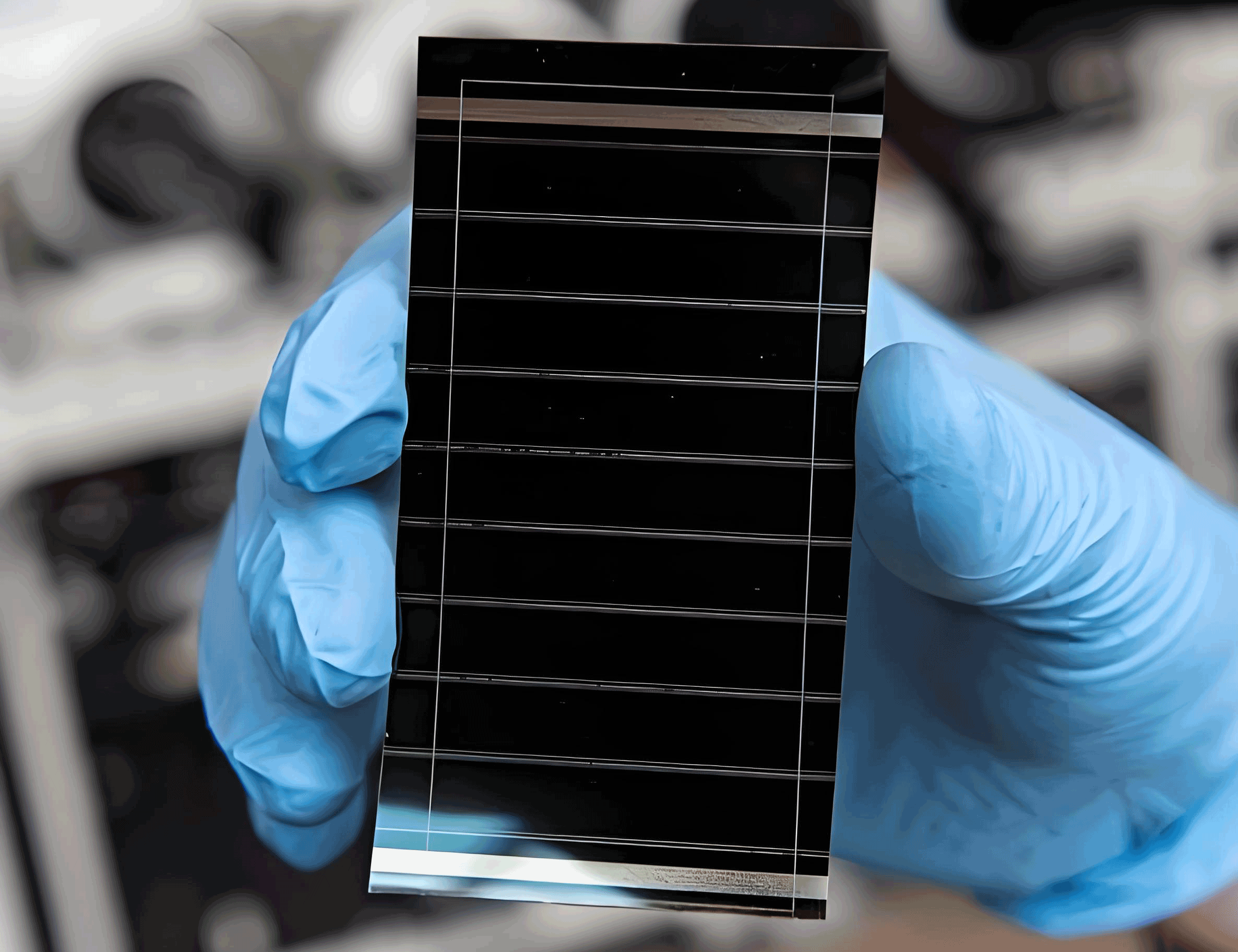
To assess the performance of these double perovskites in photovoltaic devices, a layered perovskite solar cell structure was modeled: FTO/c-TiO₂/Cs₂MBiX₆/spiro-OMeTAD/Au. The equivalent optical admittance method was employed to simulate light propagation and carrier generation. The absorption rate A(λ) in the perovskite layer is calculated as:
$$ A(\lambda) = 1 – \sum_i \left[ R_i(\lambda) + T_i(\lambda) \right] $$
where R_i(λ) and T_i(λ) are the reflectance and transmittance at each interface, respectively. The carrier collection efficiency H(λ) depends on the absorption coefficient and layer thickness L_c:
$$ H(\lambda) = 1 – e^{-\alpha(\lambda) L_c} $$
For a typical perovskite solar cell, L_c is set to 0.6 μm. The external quantum efficiency (EQE) is then derived as:
$$ Q(\lambda) = A(\lambda) H(\lambda) $$
The short-circuit current density J_sc is obtained by integrating the EQE over the solar spectrum:
$$ J_{sc} = \frac{e}{hc} \int_{\lambda_{\text{min}}}^{\lambda_{\text{max}}} Q(\lambda) S(\lambda) \lambda d\lambda $$
where e is the elementary charge, h is Planck’s constant, c is the speed of light, and S(λ) is the AM1.5G solar irradiance. The current-density-voltage (J-V) characteristics follow the diode equation:
$$ J(V) = J_{sc} – J_s \left[ \exp \left( \frac{eV}{k_B T} \right) – 1 \right] $$
where J_s is the reverse saturation current density, k_B is Boltzmann’s constant, and T is the operating temperature (300 K). The open-circuit voltage V_oc is given by:
$$ V_{oc} = \frac{k_B T}{e} \ln \left( \frac{J_{sc}}{J_s} + 1 \right) $$
The reverse saturation current density J_s is calculated as:
$$ J_s = e \int_0^{\infty} \frac{2\pi E^2}{h^3 c^2} Q(\lambda) \left[ \exp \left( \frac{E}{k_B T} \right) – 1 \right]^{-1} dE $$
where E is the photon energy. The fill factor (FF) and power conversion efficiency (η) are determined from the J-V curve:
$$ \text{FF} = \frac{J_{mp} V_{mp}}{J_{sc} V_{oc}} $$
$$ \eta = \frac{\text{FF} \times J_{sc} V_{oc}}{P_{\text{sun}}} $$
with P_sun = 100 mW/cm².
The calculated performance parameters for the four double perovskite solar cells are summarized in Table 3. Cs₂CuBiBr₆ achieves the highest efficiency of 21.3%, attributed to its optimal bandgap and high absorption. Cs₂AgBiI₆ and Cs₂AuBiCl₆ show efficiencies of 19.3% and 16.6%, respectively, while Cs₂AgBiBr₆ has a lower efficiency of 10.9% due to its wider bandgap. The ideal Shockley-Queisser (SQ) limits for V_oc are also provided, with voltage losses (V_loss) resulting from non-radiative recombination.
| Material | J_sc (mA/cm²) | V_oc (V) | V_oc,SQ (V) | V_loss (V) | FF (%) | η (%) |
|---|---|---|---|---|---|---|
| Cs₂AgBiI₆ | 27.6 | 0.83 | 1.08 | 0.25 | 86.4 | 19.3 |
| Cs₂AuBiCl₆ | 26.0 | 0.87 | 1.17 | 0.38 | 86.3 | 16.6 |
| Cs₂CuBiBr₆ | 22.2 | 1.08 | 1.29 | 0.21 | 88.8 | 21.3 |
| Cs₂AgBiBr₆ | 10.9 | 1.10 | 1.75 | 0.65 | 88.4 | 10.9 |
The variation of J_sc with perovskite layer thickness (0.1–1.0 μm) was analyzed. For all materials, J_sc saturates beyond 0.5 μm, indicating that thicker layers do not significantly improve current collection due to limited carrier diffusion lengths. This highlights the importance of optimizing the absorber thickness in perovskite solar cell design.
In conclusion, lead-free double perovskites Cs₂AgBiI₆, Cs₂AuBiCl₆, Cs₂CuBiBr₆, and Cs₂AgBiBr₆ exhibit excellent stability, suitable bandgaps, and high optical absorption, making them promising for perovskite solar cell applications. Theoretical simulations demonstrate that Cs₂CuBiBr₆-based devices achieve the highest efficiency of 21.3%, outperforming other compositions. These findings provide valuable insights for developing efficient and environmentally friendly perovskite solar cells, paving the way for future experimental validation and commercialization.