
The global push towards renewable energy has catalyzed the rapid and widespread adoption of photovoltaic power generation, particularly in the commercial and industrial sectors. As nations strive to meet ambitious “dual-carbon” targets amidst ever-growing energy demands, a series of supportive policies have been enacted to encourage the deployment of clean energy systems. Concurrently, rising industrial electricity prices in various regions have further accelerated the expansion of the distributed photovoltaic market. Industry data reveals a remarkable surge in new installations. This explosive growth, while leveling off domestically, continues to present significant opportunities overseas. To capture greater market share, reducing the overall cost of solar panels through decreased component prices and increased production scale is imperative. Fundamental cost reduction necessitates upgrades in manufacturing processes, improvements in equipment productivity, lower maintenance costs, and the elimination of non-value-added time. In the quest for faster, more reliable production methods, laser welding has emerged as a highly promising direction for interconnecting solar panel junction boxes.
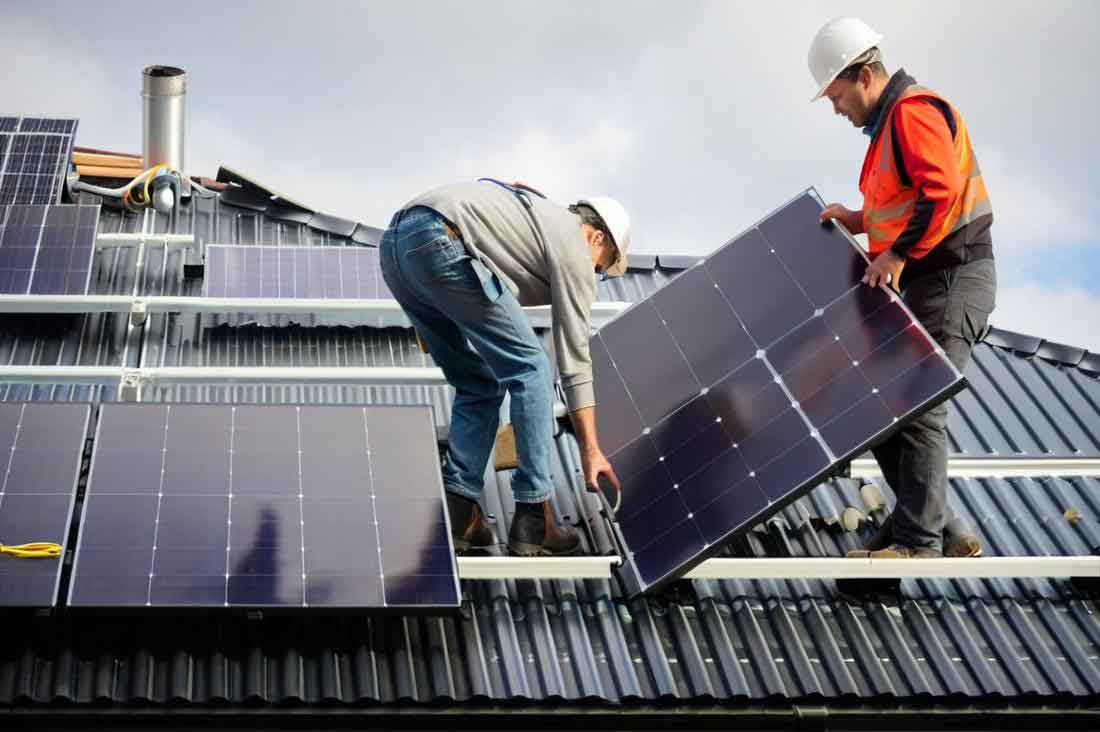
Historically, the welding of interconnects (typically tinned copper ribbons) to the busbars within a solar panel junction box has been dominated by thermal compression bonding, often referred to as hot-bar or soldering iron welding. This method, whether manual or automated, relies on applying heat and pressure to melt pre-applied solder (on the ribbon or added during the process) and form a connection between the ribbon and the contact pad.
While automated hot-bar systems offer improved precision and consistency over manual operations, they suffer from inherent limitations. The requirement for prolonged heating and cooling cycles directly impacts the cycle time (CT) for each solar panel. Physical contact between the hot tool and the component risks mechanical damage, introduces residual thermal stress, and can cause undesirable thermal deformation. Furthermore, solder residue tends to adhere to the heating element, necessitating frequent cleaning to prevent contamination of the solar panel surface. To achieve optimal throughput, traditional systems often require multiple independent welding heads operating simultaneously, driving up structural complexity and cost.
The pursuit of a superior joining method to overcome these defects has led to the exploration of technologies like laser, electromagnetic, and ultrasonic welding. Among these, laser welding has demonstrated significant practical advantages for solar panel junction box applications, characterized by its high speed, exceptional precision, and consistent quality, positioning it as a key technology for next-generation solar panel manufacturing.
Technical Requirements and Equipment Architecture for Laser Welding
The implementation of laser welding for solar panel interconnects must meet stringent client specifications. These include precise alignment to the junction box location, accurate positioning of the weld points within the box, control over the weld nugget geometry and surface quality, and, most critically, achieving a pull force strength that exceeds industry standards, typically measured by a destructive or non-destructive pull test. The visual quality is also assessed, with requirements for a smooth, consistent weld surface free from spatter, discoloration, or excessive depression.
A typical laser welding system for this application is an integrated assembly comprising several key subsystems:
- Control System: The central brain coordinating all motions, laser parameters, and safety interlocks.
- Laser Source: Commonly a fiber laser (e.g., 1030-1090 nm wavelength) with power output ranging from 500W to 2000W, often operating in continuous-wave (CW) or modulated mode.
- Beam Delivery & Scanning: Consisting of optical fibers, collimators, and a high-speed galvanometer scanner (“galvo”) with an F-theta lens. This subsystem directs and focuses the laser beam with micron-level accuracy.
- Thermal Management System: Cools the laser source, optics, and sometimes the workpiece to ensure stability.
- Machine Vision Module: Includes cameras and lighting for pre-weld alignment (correcting for solar panel placement variance) and post-weld inspection.
- Product Handling & Positioning: A conveyor and precision stages that locate and secure the solar panel during the welding process.
- Fume Extraction: Removes particulates and gases generated during welding to maintain a clean environment and protect optics.
The operational sequence involves the solar panel being conveyed into position, visually located, compensated for positional error, followed by the galvo scanner rapidly steering the laser beam to create all required welds in sequence or simultaneously, culminating in a final quality inspection before the panel exits.
Feasibility Analysis and Experimental Investigation
The fundamental feasibility of laser welding for solar panel interconnects rests on the excellent absorption of near-infrared laser radiation by metals. The copper ribbon and underlying silver or tin-plated busbar material can be efficiently melted by a concentrated laser spot. A key advantage is the non-contact nature of the process and the extremely localized heat input, which minimizes thermal stress on the sensitive silicon cells encapsulated within the solar panel.
With a galvo scanner, the laser spot can cover a wide field (e.g., 170mm diameter), enabling the welding of both interconnects within a single junction box without mechanical movement of the welding head, drastically reducing process time. Theoretical calculations suggested a single interconnect weld time of approximately 0.3s, with a total cycle time for a multi-box solar panel potentially under 12 seconds, outperforming traditional hot-bar systems.
However, initial practical tests with a 1500W single-mode laser revealed a critical challenge: intermittent occurrence of “cold welds” or insufficient fusion. Visually, these defective welds were often indistinguishable from perfect ones. Only through a peel test (using a tool to pry the ribbon) could the lack of bonding at the interface be detected. A perfect weld would result in ribbon or substrate failure before the bond interface failed.
This problem pointed towards inconsistencies in energy delivery at the interface. The core challenge in laser welding is to deliver sufficient energy density to achieve full penetration and melting at the ribbon-busbar interface without causing surface ablation or excessive heat spread. The energy input per unit area is governed by several interacting parameters. The fundamental energy relationship can be expressed as:
$$ E = \frac{P \cdot V}{A} \cdot n $$
Where:
- $E$ is the effective energy density ($J/mm^2$)
- $P$ is the laser power (W or kW)
- $V$ is the scanning speed (mm/s), inversely related to exposure time
- $A$ is the effective laser spot area ($mm^2$)
- $n$ is the number of overlapping weld passes or pulses
The thickness of the interconnect ribbon ($t$) is a fixed parameter defined by the solar panel design. Increasing the number of passes ($n$) improves reliability but adversely affects CT. A Design of Experiments (DOE) was conducted, systematically varying power ($P$) and scanning frequency (which relates to $V$). The results were summarized in the following table:
| Laser Power (W) | Scan Frequency (Hz) | Visual Quality | Pull Test Result | Failure Mode |
|---|---|---|---|---|
| 700 | 10000 | Good, slight discoloration | Inconsistent | Intermittent interfacial failure (Cold Weld) |
| 900 | 12000 | Good, smooth surface | Consistently High | Ribbon or substrate failure |
| 1100 | 12000 | Darkened, slightly rough | High | Ribbon or substrate failure |
| 1300 | 10000 | Blackened, spatter present | High but with surface defects | Ribbon or substrate failure |
The DOE identified a stable processing window around $900 \pm 200$ W at a scan frequency of 12000 Hz. However, sporadic cold welds persisted. The root cause was theorized to be related to depth of focus (DOF). As the laser melts material and creates a keyhole or melt pool, the effective working plane descends. If this descent exceeds the laser system’s limited DOF, the energy density at the bottom of the weld (the critical interface) drops below the melting threshold, leading to a cold weld. The DOF is intrinsically linked to the beam quality and optical setup. The focused spot diameter ($d$) and the depth of focus (often defined as the Rayleigh range, $z_R$) are given by:
$$ d = \frac{4 \lambda M^2 f}{\pi D} $$
$$ z_R \propto \frac{d^2}{\lambda M^2} $$
Where:
- $\lambda$ is the laser wavelength
- $M^2$ is the beam quality factor ($M^2 \ge 1$)
- $f$ is the focal length of the F-theta lens
- $D$ is the beam diameter at the focusing lens
To increase process stability, a larger $z_R$ (greater tolerance to focal plane variation) is desirable. Since $M^2$ is difficult to modify on a given laser, and $\lambda$ is fixed, the practical solution was to adjust the optical system. Using a laser source with a smaller core diameter ($D$) or employing an F-theta lens with a longer focal length ($f$) can produce a larger spot size ($d$), which in turn increases $z_R$. While a larger spot reduces peak power density, it can be compensated for by adjusting power ($P$). This change makes the welding process more forgiving to the natural variations in solar panel flatness, ribbon thickness, and fixture positioning.
The final, optimized process involves a multi-faceted approach to quality assurance: precise pre-weld vision alignment to ensure correct beam placement, real-time monitoring of process emissions or back-reflection to detect anomalies during welding, and post-weld vision inspection to check for gross defects. Any solar panel failing these checks is automatically rejected.
Systematic Comparison and Performance Summary
The transition from thermal compression bonding to laser welding represents a significant technological leap for solar panel assembly. The following table provides a comprehensive comparison of the two methodologies.
| Feature | Thermal Compression (Hot-Bar) Welding | Laser Welding |
|---|---|---|
| Principle | Conductive heating via physical contact. | Non-contact energy transfer via photon absorption. |
| Heat Input | High, diffuse, slower heating/cooling. | Low, highly localized, rapid heating/cooling. |
| Cycle Time | Slower (limited by thermal mass transfer). | Faster (beam scanning in milliseconds). Target CT ~12s/panel. |
| Mechanical Stress | High (physical pressure applied). | Negligible (no contact force). |
| Thermal Stress on Solar Panel | Higher risk due to larger heat-affected zone. | Minimized, reducing cell micro-crack risk. |
| Tool Wear & Maintenance | High (solder buildup, tip degradation). | Very Low (no contact, optics are protected). |
| Process Flexibility | Low (dedicated tooling per ribbon type). | High (weld pattern easily reprogrammed). |
| Solder Consumption | Requires additional solder paste/wire. | Uses pre-tinned ribbon; no added solder. |
| Key Quality Challenge | Consistent solder wetting, void formation. | Achieving consistent penetration without cold welds. |
The quality of the laser weld in a solar panel is paramount for long-term reliability. It can be quantitatively assessed through mechanical testing. The ultimate shear strength ($\tau_{weld}$) of a single weld nugget is a function of the fused area and the material strength:
$$ F_{max} = \tau_{weld} \cdot A_{nugget} $$
Where $A_{nugget}$ is the cross-sectional area of the metallurgical bond. For a typical interconnect ribbon (e.g., 6mm x 0.2mm), multiple weld points are used to ensure the total bonded area meets the required pull force specification (often >50N per interconnect). The primary welding defects and their mitigation strategies are summarized below:
| Defect | Possible Causes | Corrective Actions |
|---|---|---|
| Cold Weld / Lack of Fusion | Insufficient energy density at interface; excessive focal plane deviation; surface contamination. | Increase power ($P$) or decrease scan speed ($V$); optimize depth of focus ($z_R$) via optics; ensure clean ribbon and busbar surfaces. |
| Surface Ablation / Burning | Excessive energy density; power ($P$) too high; spot size ($d$) too small. | Reduce $P$; increase spot size $d$ (e.g., by defocusing slightly); use pulsed mode to control peak power. |
| Porosity | Entrapment of gas or volatiles from coatings; unstable keyhole collapse. | Optimize power profile (ramp down at end); ensure proper surface preparation; adjust shielding gas flow if used. |
| Inconsistent Weld Size | Variations in beam quality, focus position, or material reflectivity. | Implement real-time monitoring (e.g., photodiodes); use wobble or spiral scanning patterns to average out variations; maintain stable laser and optical system temperature. |
Conclusion and Future Outlook
Laser welding stands as a transformative technology for the interconnection of junction boxes in solar panel manufacturing. It directly addresses the critical industry needs for higher throughput, improved reliability, and reduced operational cost. By eliminating physical contact and concentrating thermal input, it minimizes mechanical and thermal stress on the delicate photovoltaic cells, potentially enhancing the long-term yield and durability of the solar panel. The non-contact nature and software-defined flexibility of the laser process also pave the way for easier adaptation to new solar panel designs and form factors.
The successful implementation hinges on a deep understanding of the interplay between laser parameters (power, speed, frequency), optical characteristics (spot size, depth of focus), and material properties. As demonstrated, optimizing the depth of focus is crucial for achieving robust process windows that can tolerate the inherent variations in industrial-scale solar panel production. When coupled with advanced machine vision for precise alignment and integrated process monitoring, laser welding systems can deliver consistently high-quality welds at cycle times superior to traditional methods.
The ongoing evolution of laser sources, including high-brightness multi-beam and blue wavelength lasers (with higher absorption in copper), promises even greater speed and efficiency gains. As the renewable energy sector continues to expand, the adoption of advanced manufacturing technologies like laser welding will be instrumental in driving down the levelized cost of electricity (LCOE) from solar panels, solidifying solar power’s role in the global energy landscape.