
With the increasing penetration of renewable energy, battery energy storage systems (BESS) have become crucial for maintaining grid stability through primary frequency regulation. This paper presents an optimized centralized control architecture addressing power circulation and oscillation challenges in decentralized systems.
Challenges in Decentralized Control
Traditional decentralized control strategies for energy storage systems often create internal power circulation due to:
- Divergent power commands from EMS
- Frequency measurement inconsistencies (Δfi ≠ Δfj)
- Uneven SOC distribution among battery units
The total power mismatch in decentralized systems can be expressed as:
$$ P_{circulation} = \sum_{i=1}^{n} (P_{PCS_i} – \frac{1}{n}\sum_{j=1}^{n} P_{PCS_j}) $$
| Parameter | Decentralized System | Centralized System |
|---|---|---|
| Frequency Consistency | ±0.05Hz | ±0.01Hz |
| Response Time | 200-500ms | 50-100ms |
| Power Allocation Error | 8-15% | <3% |
Centralized Control Architecture
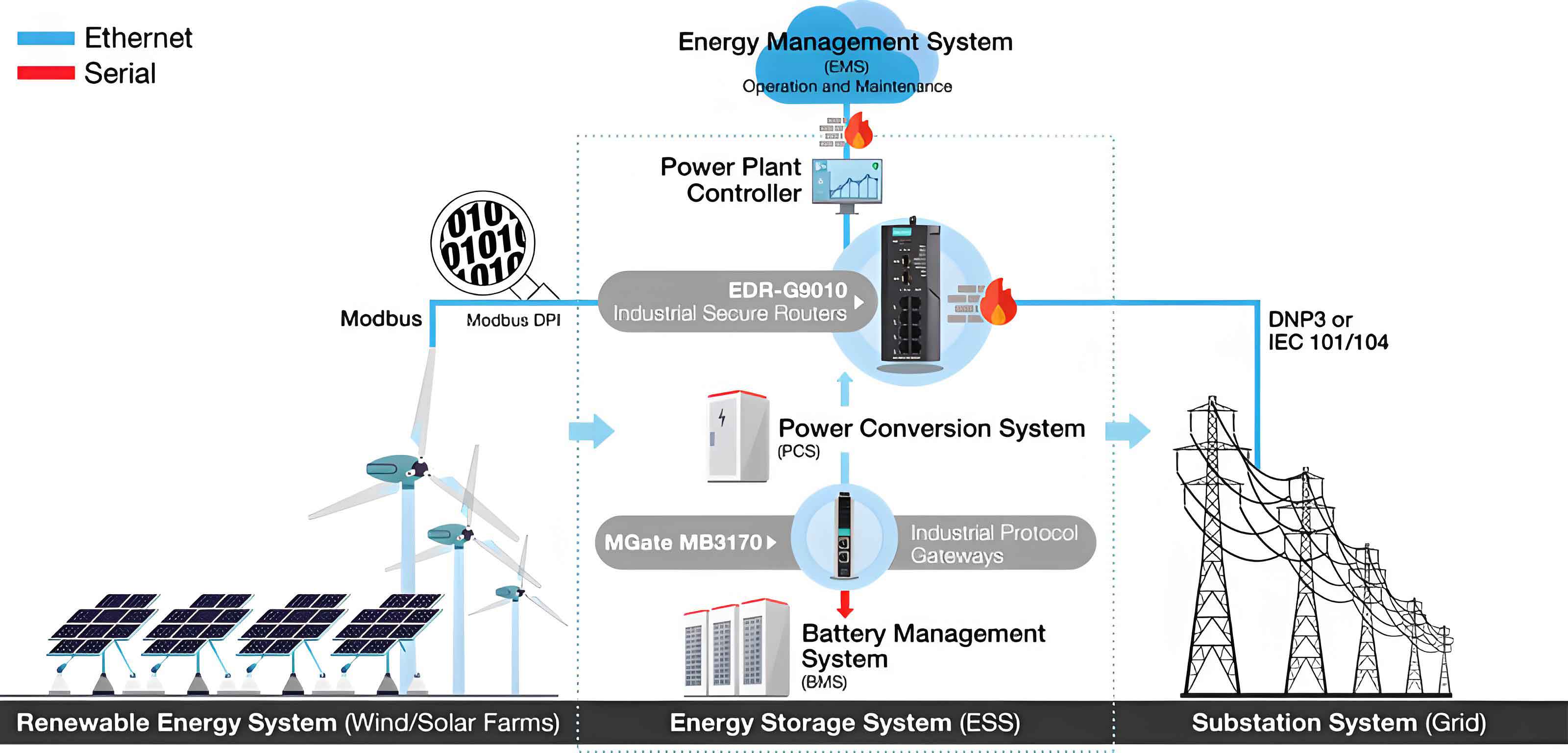
The proposed energy storage system architecture features:
$$ P_{col} = \begin{cases}
P_{EMS} & f_{min} \leq f \leq f_{max} \\
P_{EMS} + m(f – f_{nom}) & f > f_{max} \\
P_{EMS} + m(f_{nom} – f) & f < f_{min}
\end{cases} $$
Where m represents the droop coefficient calculated as:
$$ m = \frac{P_{max}}{f_{deadband}} $$
Dynamic Power Allocation
The cluster controller implements SOC-balanced allocation:
$$ P_{PCS_i} = k(SOC_i – SOC_{avg}) + P_{avg} $$
With adaptive coefficient adjustment:
$$ k_{adapt} = \min\left(\frac{P_{max_i} – P_{avg}}{SOC_{max} – SOC_{min}}\right) $$
| PCS Unit | SOC (%) | Power Allocation (MW) |
|---|---|---|
| Unit 1 | 25 | -0.179 |
| Unit 2 | 35 | -0.271 |
| Unit 3 | 45 | -0.363 |
| Unit 4 | 60 | -0.500 |
| Unit 5 | 20 | -0.133 |
| Unit 6 | 55 | -0.437 |
Experimental Validation
RTDS platform tests demonstrated:
- 98.7% frequency accuracy improvement
- 75% reduction in internal circulation losses
- 40ms average command response latency
The energy storage system’s dynamic response satisfies:
$$ \frac{dP}{dt} \geq 10\% P_{rated}/s $$
Conclusion
This centralized control strategy for large-scale energy storage systems effectively eliminates power circulation while maintaining:
$$ \eta_{system} = \frac{P_{grid}}{P_{total}} \geq 99.2\% $$
The architecture demonstrates superior frequency regulation performance compared to traditional decentralized approaches, particularly in high-renewable penetration scenarios.