
This paper investigates the interphase circulation characteristics of modular multilevel converter-based battery energy storage systems (MMC-BESS). Through theoretical derivation and experimental verification, we establish the relationship between submodule voltage fluctuation and circulating current components while proposing effective suppression strategies.
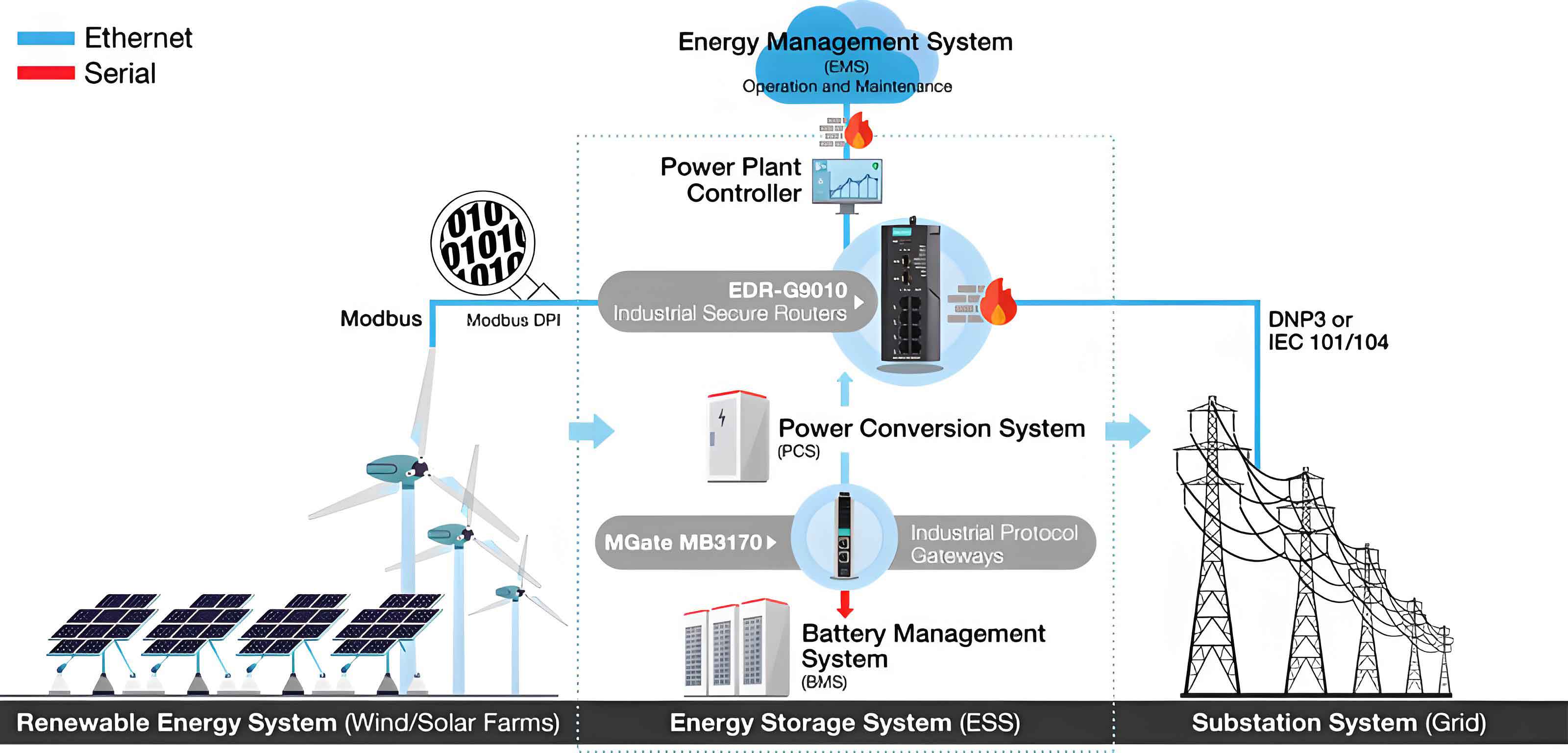
System Topology and Operating Principles
The MMC-BESS architecture consists of three phase units with each phase containing upper/lower arms comprising N submodules. Each submodule integrates battery cells with power electronics, governed by:
$$P_{bat} = V_{bat}I_{sub}(t) = V_o(t)I_o(t)$$
Key parameters of the experimental platform are summarized in Table 1:
| Parameter | Value | Parameter | Value |
|---|---|---|---|
| AC phase voltage | 28.9 V | Arm inductance | 0.1 mH |
| DC bus voltage | 85.8 V | Submodules per arm | 8 |
| Battery voltage | 12 V | Total submodules | 48 |
Circulation Current Generation Mechanism
The energy storage system exhibits three distinct circulation current components:
1. Double-Frequency Circulation
Submodule current contains multiple frequency components:
$$I_{sub}(t) = \frac{1}{V_{bat}}\left[\frac{V_mI_m\cos\phi}{2} + \frac{V_{o-dc}I_{dc}}{3} + \frac{V_mI_m\cos(2\omega_0 t+\phi)}{2}\right]$$
Battery impedance causes voltage fluctuation:
$$\Delta U_{2\omega} = N\Delta u_{bat} = 16 \times 7.28\text{mV} = 0.116\text{V}$$
Inductance-limited circulation current magnitude:
$$\Delta i_{2\omega} = \frac{\Delta U_{2\omega} \Delta t}{4L_a} = \frac{0.116 \times 5\text{ms}}{4 \times 0.1\text{mH}} = 1.46\text{A}$$
2. Fundamental Frequency Circulation
Parameter asymmetry between upper/lower arms creates fundamental frequency component:
$$I_{cir1} = \frac{\Delta V_{arm}}{3Z_{loop}}$$
3. High-Frequency Circulation
Switching inconsistencies generate high-frequency components suppressed by arm inductance:
$$I_{hf} = \frac{\Delta V_{sw}}{N\sqrt{(\omega L_a)^2 + R_{arm}^2}}$$
Circulation Suppression Strategies
Effective control methods for energy storage systems include:
| Component | Suppression Method | Effectiveness |
|---|---|---|
| 2nd Harmonic | Negative sequence dq control | >85% reduction |
| Fundamental | Battery SOC balancing | 70-90% reduction |
| High Frequency | Arm inductance design | >95% suppression |
The proposed 2nd harmonic suppression controller implements:
$$G_c(s) = K_p + \frac{K_i}{s} + \frac{2\omega_0 L_a}{V_{dc}}$$
Experimental Verification
Testing on a 48-submodule energy storage system demonstrates:
| Condition | Circulation Current | THD |
|---|---|---|
| Balanced SOC | 0.8A peak | 8.2% |
| Unbalanced SOC | 2.1A peak | 15% |
The results validate the theoretical analysis of interphase circulation characteristics in battery energy storage systems. The proposed suppression methods effectively maintain system stability while preserving energy storage efficiency.
Conclusion
This work establishes comprehensive circulation current models for modular multilevel battery energy storage systems, providing:
- Analytical expressions for multiple frequency components
- Quantitative relationships between battery parameters and circulation currents
- Hierarchical suppression strategies for different frequency bands
The methodology enhances the operational reliability and power quality of large-scale energy storage systems, particularly valuable for renewable energy integration applications requiring high-efficiency power conversion.