
In recent years, perovskite solar cells have emerged as a promising photovoltaic technology due to their high efficiency, low cost, and simple fabrication processes. As a researcher in the field of materials science, I have focused on optimizing the interfaces within these devices to address critical issues such as non-radiative recombination and environmental instability. The performance of perovskite solar cells is highly dependent on the quality of the interfaces between the perovskite layer and the charge transport layers. Defects at these interfaces can lead to significant energy losses, reducing the overall efficiency of the perovskite solar cell. In this comprehensive study, I explore the use of interface modification strategies, specifically with tetrabutylammonium iodide (TBAI), to enhance the properties of perovskite films and improve the performance of perovskite solar cells. Through detailed experimental design and characterization, I demonstrate that interface engineering can effectively passivate defects, optimize energy level alignment, and increase the stability of perovskite solar cells. This work not only provides insights into the fundamental mechanisms of interface effects but also offers a practical approach for advancing perovskite solar cell technology. The integration of such前沿 research into educational experiments can help students understand the importance of interface design in real-world applications of perovskite solar cells.
The working principle of a perovskite solar cell involves the absorption of light by the perovskite material, leading to the generation of electron-hole pairs. These charge carriers are then separated and collected at the electrodes through the electron transport layer (ETL) and hole transport layer (HTL). However, interfaces between these layers often contain defects that act as recombination centers, limiting the open-circuit voltage (VOC) and fill factor (FF) of the perovskite solar cell. The non-radiative recombination losses at interfaces can be described by the following equation:
$$V_{OC} = V_{OC,rad} – \frac{k_B T}{e} \ln(\text{EQE}_{EL})$$
where \(V_{OC,rad}\) is the radiative recombination limit of the open-circuit voltage, \(k_B\) is the Boltzmann constant, \(T\) is the temperature, \(e\) is the electron charge, and \(\text{EQE}_{EL}\) is the external quantum efficiency for electroluminescence. This equation highlights how interface defects reduce \(V_{OC}\) in perovskite solar cells. By passivating these defects, we can minimize non-radiative recombination and improve the performance of perovskite solar cells. Additionally, interface modification can enhance the stability of perovskite solar cells by forming protective layers that prevent moisture ingress, a common degradation pathway for perovskite materials.
In this experiment, I designed a comprehensive study to investigate the impact of TBAI interface treatment on perovskite solar cells. The perovskite solar cell structure used in this work consists of ITO/SnO2/perovskite/Spiro-OMeTAD/Au, where the perovskite layer is Cs0.05(FA0.85MA0.15)0.95Pb(I0.85Br0.15)3. The TBAI solution was applied as a post-treatment on the perovskite film to form a low-dimensional perovskite interface layer. This approach is simple and reproducible, making it suitable for educational purposes while demonstrating advanced concepts in perovskite solar cell research. The experimental procedures include film deposition, device assembly, and various characterization techniques such as X-ray diffraction (XRD), scanning electron microscopy (SEM), UV-visible spectroscopy, photoluminescence (PL) spectroscopy, water contact angle measurements, current-density voltage (J-V) testing, and electrochemical impedance spectroscopy (EIS). Through these methods, I aim to provide a holistic understanding of how interface design influences the properties and performance of perovskite solar cells.
The materials used in this study were purchased from commercial suppliers and used without further purification. Key reagents included indium tin oxide (ITO) glass, tin oxide (SnO2) colloidal solution, lead iodide (PbI2), formamidinium iodide (FAI), methylammonium bromide (MABr), cesium iodide (CsI), Spiro-OMeTAD, and TBAI. All solvents were of analytical grade. The instruments employed for characterization included an XRD diffractometer, SEM, UV-vis spectrophotometer, PL spectrometer, contact angle goniometer, solar simulator, and EIS setup. The fabrication of perovskite solar cells was carried out in a controlled environment to ensure reproducibility and accuracy. The detailed steps are as follows: First, the ITO substrates were cleaned and treated with UV-ozone. Then, the SnO2 ETL was spin-coated and annealed. The perovskite precursor solution was prepared by dissolving the respective salts in a mixture of dimethylformamide (DMF) and dimethyl sulfoxide (DMSO), and spin-coated onto the SnO2 layer with a chlorobenzene anti-solvent treatment. For the TBAI-modified samples, the TBAI solution in isopropanol was spin-coated on the perovskite film after annealing, followed by a brief heat treatment. Finally, the Spiro-OMeTAD HTL and gold electrodes were deposited to complete the perovskite solar cell devices.
The characterization results revealed significant improvements in the TBAI-treated perovskite solar cells compared to the control devices. The XRD patterns showed that the TBAI treatment led to the formation of low-dimensional perovskite phases, as indicated by new diffraction peaks at low angles, while reducing the presence of residual PbI2. This transformation passivates surface defects and enhances the crystallinity of the perovskite film. The SEM images demonstrated larger grain sizes and a more uniform morphology in the TBAI-treated films, which correlates with reduced grain boundary defects and improved charge transport in the perovskite solar cell. The UV-vis absorption spectra showed increased light absorption in the visible range for the modified films, contributing to higher short-circuit current density (JSC) in the perovskite solar cell. The PL intensity was significantly enhanced after TBAI treatment, indicating a reduction in non-radiative recombination centers, which is crucial for achieving high VOC in perovskite solar cells. Furthermore, water contact angle measurements confirmed that the TBAI interface layer increased the hydrophobicity of the perovskite film, improving the stability of the perovskite solar cell against moisture-induced degradation.
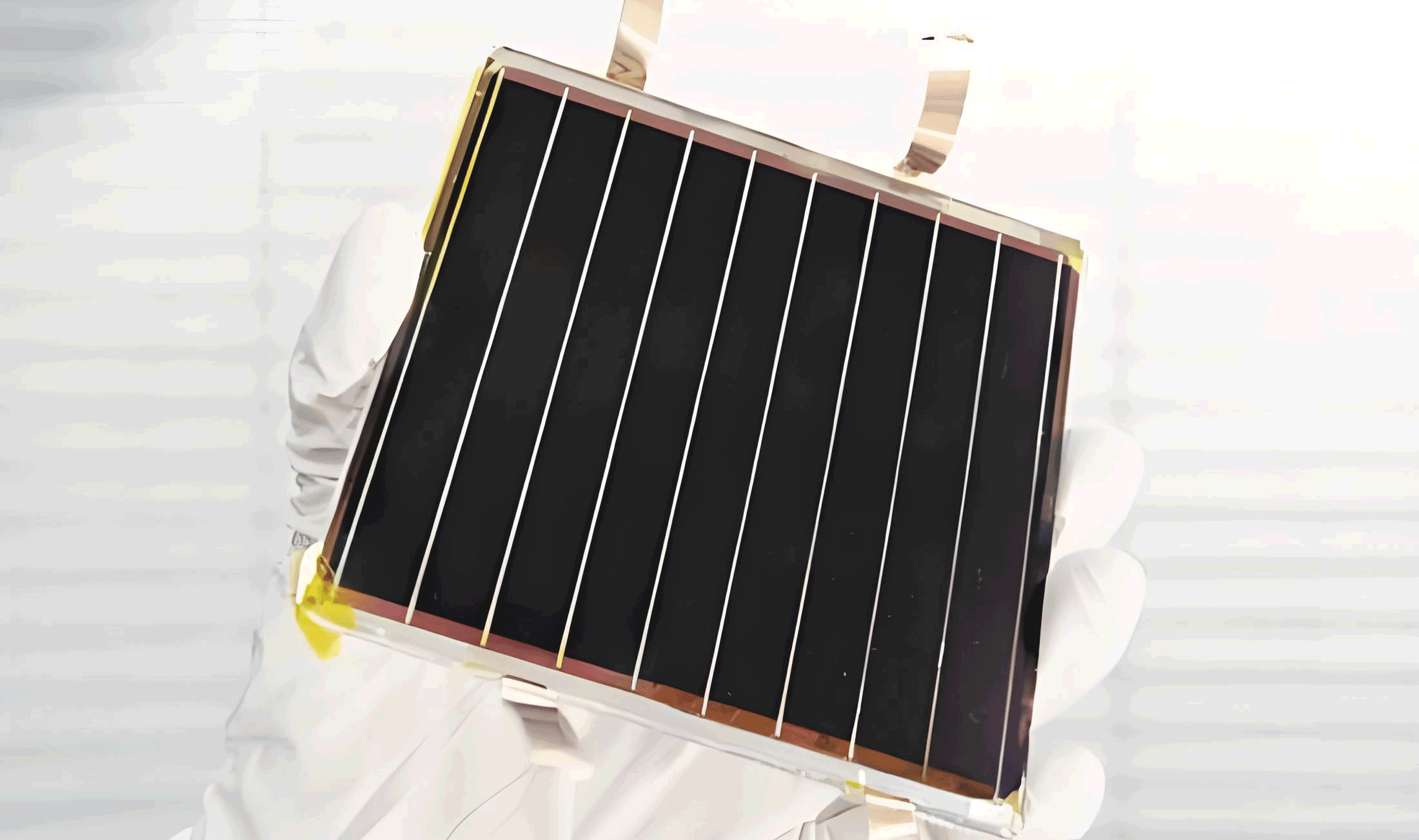
The performance of the perovskite solar cells was evaluated using J-V measurements under standard illumination conditions. The control devices exhibited a power conversion efficiency (PCE) of 15.61%, with a VOC of 1.03 V, JSC of 19.97 mA/cm2, and FF of 75.86%. In contrast, the TBAI-treated perovskite solar cells achieved a PCE of 17.32%, with a VOC of 1.08 V, JSC of 20.39 mA/cm2, and FF of 79.02%. This improvement is attributed to the effective passivation of interface defects and optimized energy level alignment, which reduce recombination losses in the perovskite solar cell. The EIS analysis supported these findings, showing a lower charge transfer resistance and higher recombination resistance in the TBAI-modified devices, indicating facilitated charge extraction and suppressed non-radiative recombination in the perovskite solar cell. The following table summarizes the key parameters of the perovskite solar cells before and after interface modification:
| Parameter | Control Perovskite Solar Cell | TBAI-Treated Perovskite Solar Cell |
|---|---|---|
| PCE (%) | 15.61 | 17.32 |
| VOC (V) | 1.03 | 1.08 |
| JSC (mA/cm2) | 19.97 | 20.39 |
| FF (%) | 75.86 | 79.02 |
| Recombination Resistance (Ω) | ~500 | ~800 |
To further analyze the interface effects, I considered the energy level diagram of the perovskite solar cell. The conduction band minimum (CBM) and valence band maximum (VBM) of the perovskite layer play a critical role in charge separation. The interface modification with TBAI can tune these energy levels, reducing the energy offset between the perovskite and charge transport layers. This alignment minimizes interface recombination and enhances the built-in electric field, leading to improved VOC and FF in the perovskite solar cell. The relationship between interface properties and device performance can be modeled using the diode equation for perovskite solar cells:
$$J = J_{ph} – J_0 \left( \exp\left(\frac{e(V + J R_s)}{n k_B T}\right) – 1 \right) – \frac{V + J R_s}{R_{sh}}$$
where \(J\) is the current density, \(J_{ph}\) is the photocurrent density, \(J_0\) is the reverse saturation current density, \(V\) is the voltage, \(R_s\) is the series resistance, \(R_{sh}\) is the shunt resistance, and \(n\) is the ideality factor. For the TBAI-treated perovskite solar cell, the reduced \(J_0\) and increased \(R_{sh}\) indicate lower recombination and better interface quality, contributing to the higher efficiency observed.
In addition to the electrical properties, the stability of the perovskite solar cell was assessed through environmental testing. The TBAI-treated films showed delayed degradation when exposed to moisture, as evidenced by slower color changes in water immersion tests. This enhanced stability is crucial for the practical application of perovskite solar cells in real-world conditions. The formation of a low-dimensional perovskite interface layer acts as a barrier against water penetration, protecting the bulk perovskite material. This finding underscores the importance of interface design not only for efficiency but also for the longevity of perovskite solar cells.
In conclusion, this comprehensive experimental design demonstrates that interface modification with TBAI significantly improves the performance and stability of perovskite solar cells. By passivating defects, optimizing energy levels, and enhancing hydrophobicity, the TBAI treatment leads to higher PCE, VOC, JSC, and FF in perovskite solar cells. The integration of such interface engineering strategies into educational experiments provides students with hands-on experience in advanced photovoltaic research, fostering a deeper understanding of the factors that influence perovskite solar cell performance. Future work could explore other interface materials and their effects on the long-term stability and scalability of perovskite solar cells, further advancing this promising technology. Through continued innovation in interface design, perovskite solar cells have the potential to become a dominant player in the renewable energy landscape.
The experimental approach described here not only highlights the scientific principles but also emphasizes the practical skills required for fabricating and characterizing perovskite solar cells. Students engaging in this experiment will learn to synthesize perovskite films, assemble devices, and analyze data using various techniques, all while gaining insights into the critical role of interfaces in perovskite solar cells. This holistic learning experience prepares the next generation of researchers to tackle challenges in solar energy and contribute to the development of efficient and stable perovskite solar cells. As the field evolves, interface design will remain a key area of focus for optimizing perovskite solar cells, and educational initiatives like this one play a vital role in driving innovation forward.