
As a critical component in renewable energy integration, the performance and stability of solar inverters are paramount for reliable power grid operation. However, asymmetric faults in the grid often lead to voltage imbalances, adversely affecting the output and system stability of solar inverters. These imbalances, characterized by negative sequence voltages, can result in increased losses, harmonic distortions, and reduced power quality. To address these challenges, I propose an intelligent voltage control strategy for solar inverters that integrates minimum negative sequence voltage control, maximum positive sequence voltage control, and minimum zero-sequence voltage control. This approach aims to optimize the voltage support capability of solar inverters under asymmetric fault conditions, thereby enhancing overall system resilience. The strategy is designed to mitigate negative sequence voltages while maintaining three-phase voltage balance, ensuring efficient operation of solar inverters in adverse environments.
The structure of a typical solar inverter includes a DC input section, maximum power point tracking (MPPT) module, DC-DC converter, inverter core, transformer, filter, control circuit, and protection mechanisms. These components work in tandem to convert DC power from photovoltaic panels into three-phase AC power. In asymmetric fault scenarios, the inverter must manage unbalanced currents and voltages to prevent equipment damage and maintain grid stability. The proposed control strategy leverages the inherent capabilities of solar inverters to inject controlled currents that compensate for voltage imbalances at the public coupling point (PCC). By dynamically adjusting the positive, negative, and zero-sequence components, the strategy ensures that solar inverters operate within safe current limits while minimizing negative sequence voltages.
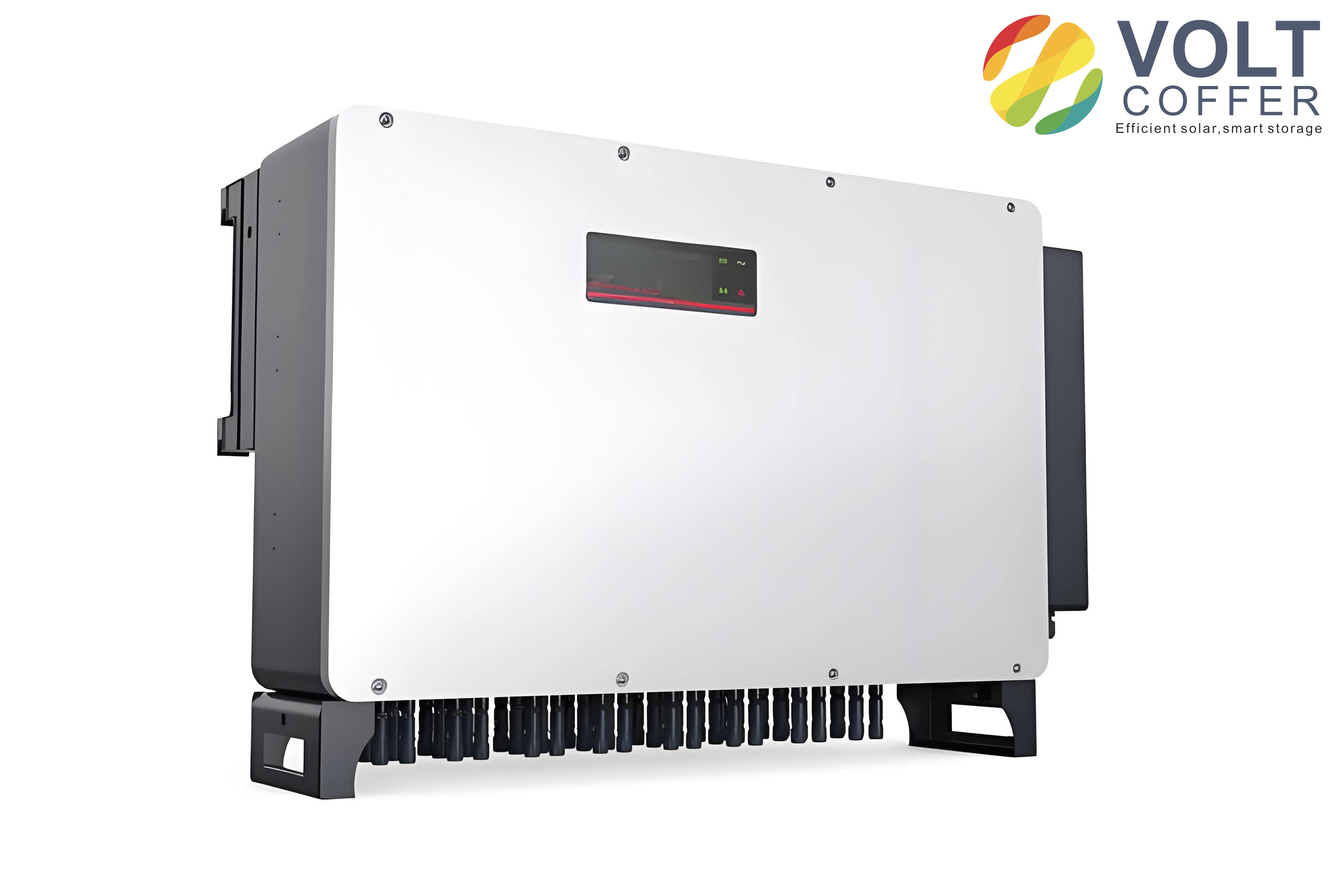
Voltage support control in solar inverters involves injecting positive and reactive currents to induce voltage drops across grid impedances, which compensates for PCC voltage deviations. The fundamental equations for positive, negative, and zero-sequence voltages at the PCC are given by:
$$V^+ = \sqrt{(v^+_\alpha)^2 + (v^+_\beta)^2}$$
$$V^- = \sqrt{(v^-_\alpha)^2 + (v^-_\beta)^2}$$
$$V^0 = \sqrt{(v^0)^2 + (v^0_\perp)^2}$$
where \(V^+\), \(V^-\), and \(V^0\) represent the magnitudes of positive, negative, and zero-sequence voltages, respectively, and \(v^+_\alpha\), \(v^+_\beta\), \(v^-_\alpha\), \(v^-_\beta\), \(v^0\), and \(v^0_\perp\) are the corresponding components in the αβ0 coordinate system. The three-phase currents can be expressed as:
$$I_a = \sqrt{(I^+)^2 + (I^-)^2 + (I^0)^2 + 2I^+ I^- \cos(\theta^+ – \theta^-) + 2I^- I^0 \cos(\theta^- – \theta^0) + 2I^0 I^+ \cos(\theta^0 – \theta^+)}$$
$$I_b = \sqrt{(I^+)^2 + (I^-)^2 + (I^0)^2 + 2I^+ I^- \cos(\theta^+ – \theta^- + 120^\circ) + 2I^- I^0 \cos(\theta^- – \theta^0 + 120^\circ) + 2I^0 I^+ \cos(\theta^0 – \theta^+ + 120^\circ)}$$
$$I_c = \sqrt{(I^+)^2 + (I^-)^2 + (I^0)^2 + 2I^+ I^- \cos(\theta^+ – \theta^- – 120^\circ) + 2I^- I^0 \cos(\theta^- – \theta^0 – 120^\circ) + 2I^0 I^+ \cos(\theta^0 – \theta^+ – 120^\circ)}$$
$$I_n = 3I^0$$
Here, \(I_a\), \(I_b\), and \(I_c\) denote the phase currents, \(I^+\), \(I^-\), and \(I^0\) are the sequence currents, and \(\theta^+\), \(\theta^-\), and \(\theta^0\) are their initial phases. The neutral current \(I_n\) is directly related to the zero-sequence current. The maximum positive sequence voltage control strategy focuses on restoring the positive sequence voltage to its maximum value post-fault, subject to current constraints. The optimization problem is formulated as:
$$\max V^+(I^+_P, I^+_Q) \quad \text{subject to} \quad \max\{I_a, I_b, I_c, I_n\} \leq I_{\text{lim}}$$
where \(I^+_P\) and \(I^+_Q\) are the positive sequence active and reactive currents, and \(I_{\text{lim}}\) is the safety current threshold. Using the Lagrange multiplier method, the optimal positive sequence currents are derived as:
$$I^+_{P,\text{best}} = \frac{R_g}{R_g^2 + (\phi L_g)^2} I_{\text{lim}}$$
$$I^+_{Q,\text{best}} = \frac{\phi L_g}{R_g^2 + (\phi L_g)^2} I_{\text{lim}}$$
In these equations, \(R_g\) and \(L_g\) represent the grid’s equivalent resistance and inductance, and \(\phi\) is the grid voltage angular frequency. Similarly, the minimum negative sequence voltage control aims to reduce negative sequence voltages, with the model:
$$\min V^-(I^-_P, I^-_Q) \quad \text{subject to} \quad \max\{I_a, I_b, I_c, I_n\} \leq I_{\text{lim}}$$
The optimal negative sequence currents are:
$$I^-_{P,\text{min}} = -\frac{R_g}{R_g^2 + (\phi L_g)^2} I_{\text{lim}}$$
$$I^-_{Q,\text{min}} = \frac{\phi L_g}{R_g^2 + (\phi L_g)^2} I_{\text{lim}}$$
For zero-sequence voltage minimization, the strategy is:
$$\min V^0(I^0_P, I^0_Q) \quad \text{subject to} \quad \max\{I_a, I_b, I_c, I_n\} \leq I_{\text{lim}}$$
Yielding the optimal zero-sequence currents:
$$I^0_{P,\text{min}} = -\frac{R_g}{R_g^2 + (\phi L_g)^2} \frac{I_{\text{lim}}}{3}$$
$$I^0_{Q,\text{min}} = \frac{\phi L_g}{R_g^2 + (\phi L_g)^2} \frac{I_{\text{lim}}}{3}$$
These individual strategies are integrated into a comprehensive voltage control framework for solar inverters. The combined objective function minimizes the overall voltage unbalance \(u\), defined as the sum of negative and zero-sequence unbalance degrees:
$$\min u = u^- + u^0 \quad \text{subject to} \quad \max\{I_a, I_b, I_c, I_n\} \leq I_{\text{lim}}$$
To simplify this constrained optimization, the Hessian matrix is employed to transform it into an equality-constrained problem. The Hessian \(H\) for the sequence components is diagonal and symmetric:
$$H = \begin{bmatrix} H^+ & 0 & 0 \\ 0 & H^- & 0 \\ 0 & 0 & H^0 \end{bmatrix}$$
with eigenvalues \(\lambda^+_1, \lambda^+_2\) for \(H^+\), \(\lambda^-_1, \lambda^-_2\) for \(H^-\), and \(\lambda^0_1, \lambda^0_2\) for \(H^0\). The determinant is \( |H| = \lambda^+_1 \lambda^+_2 \cdot \lambda^-_1 \lambda^-_2 \cdot \lambda^0_1 \lambda^0_2 \). The simplified model becomes:
$$\max (I^+ + I^- + 4I^0) \quad \text{subject to} \quad \max\{I_a, I_b, I_c, I_n\} = I_{\text{lim}}$$
Considering grid balance, zero-sequence current injection is prioritized, with the constraint:
$$V^0 = -4 \sqrt{(R_g)^2 + (\phi L_g)^2} \cdot I^0 + V^0_g \geq 0 \quad \text{and} \quad I_n = 3I^0 \leq I_{\text{lim}}$$
where \(V^0_g\) is the grid zero-sequence voltage. This reduces the problem to:
$$\max (I^+ + I^-) \quad \text{subject to} \quad \max\{I_a, I_b, I_c, I_n\} = I_{\text{lim}}$$
The solution involves identifying Type I points (maximum objective function on current amplitude curves) and Type II points (intersections in the first quadrant). For Type I points, if the maximum lies in the first quadrant, it is selected; otherwise, the closest point on the axes is chosen. Type II points are found by solving equations like \(I_a^2 – I_{\text{lim}}^2 = 0\) and \(I_b^2 – I_{\text{lim}}^2 = 0\), retaining only non-negative real solutions. The workflow for the solar inverter control strategy includes calculating PCC voltage magnitudes and phase differences, estimating zero-sequence voltages and currents, computing Type I and II points, verifying current constraints, and deriving optimal sequence currents for reference in αβ0 coordinates.
To validate the proposed strategy, simulations were conducted using MATLAB/Simulink, comparing it with a model predictive control based on LC filter (MPC-LC) approach. The system parameters included a DC side voltage of 700 V, grid voltage of 2200 V, grid frequency of 50 Hz, switching frequency of 10 kHz, rated power of 32 kVA, inverter inductance of 7.5 mH, grid-side inductance of 3 mH, neutral inductance of 0.3 mH, filter capacitance of 2 μF, damping resistance of 0.3 Ω, and current safety threshold of 68 A. Grid impedance and inductance were set to 2 Ω and 3 mH, respectively. Asymmetric faults were configured with maximum output currents of 48 A for faults A-C and 20 A for fault D, as summarized in Table 1.
| Parameter | Fault A | Fault B | Fault C | Fault D |
|---|---|---|---|---|
| Positive Sequence Voltage Phase (°) | 0 | 0 | 0 | 30 |
| Positive Sequence Voltage Magnitude (V) | 226.4 | 226.4 | 226.4 | 181.3 |
| Negative Sequence Voltage Phase (°) | 30 | 30 | 30 | -60 |
| Negative Sequence Voltage Magnitude (V) | 61.3 | 61.3 | 61.3 | 103.9 |
| Zero-Sequence Voltage Phase (°) | -60 | -60 | 130 | -60 |
| Zero-Sequence Voltage Magnitude (V) | 30.5 | 117.8 | 61.2 | 103.9 |
Under fault A, the proposed strategy for solar inverters reduced the negative sequence voltage from 61.3 V to approximately 10 V and zero-sequence voltage to near 0 V, with an unbalance degree of 0.02, compared to higher values in MPC-LC. For fault B, similar reductions were observed, with unbalance dropping to 0.05. The PCC voltages and grid currents demonstrated improved stability, as the solar inverters injected optimal sequence currents to mitigate imbalances. In faults C and D, the negative sequence voltages were suppressed below 50 V, and zero-sequence voltages approached 0 V, with unbalance degrees of 0.18 and 0.22, respectively. Although these unbalance levels remain elevated due to severe single-phase voltage sags, the strategy consistently outperformed MPC-LC by maintaining higher positive sequence voltages and better current distribution. The effectiveness of the solar inverter control is further highlighted in Table 2, which compares voltage unbalance degrees with recent methods.
| Method | Fault A | Fault B | Fault C | Fault D |
|---|---|---|---|---|
| Proposed Strategy | 0.02 | 0.05 | 0.18 | 0.22 |
| Reference Method 1 | 0.09 | 0.11 | 0.25 | 0.30 |
| Reference Method 2 | 0.05 | 0.09 | 0.22 | 0.27 |
| Reference Method 3 | 0.04 | 0.08 | 0.24 | 0.25 |
The mathematical formulation for the solar inverter control strategy involves solving the current constraints and objective functions efficiently. For instance, the three-phase current equations can be linearized for real-time implementation in solar inverters. The optimal current injections are derived as:
$$I^+_{\text{opt}} = \frac{V^+_{\text{ref}} – V^+_g}{Z_g} \quad \text{and} \quad I^-_{\text{opt}} = \frac{V^-_{\text{ref}} – V^-_g}{Z_g}$$
where \(V^+_{\text{ref}}\) and \(V^-_{\text{ref}}\) are reference voltages, \(V^+_g\) and \(V^-_g\) are grid voltages, and \(Z_g = R_g + j\phi L_g\) is the grid impedance. The zero-sequence current is controlled similarly to ensure \(V^0 \approx 0\). The overall control law for solar inverters can be expressed in state-space form:
$$\dot{x} = A x + B u \quad \text{with} \quad y = C x + D u$$
where \(x\) represents the state variables (e.g., currents and voltages), \(u\) is the control input (e.g., PWM signals), and \(y\) is the output. The matrices \(A\), \(B\), \(C\), and \(D\) are derived from the solar inverter dynamics. The integration of multiple control strategies ensures that solar inverters adapt to varying fault conditions, providing robust voltage support.
In conclusion, the intelligent voltage control strategy for solar inverters effectively suppresses negative sequence voltages under asymmetric faults, enhances positive sequence voltages, and reduces voltage unbalance. By combining minimum negative sequence, maximum positive sequence, and minimum zero-sequence controls, solar inverters achieve superior performance compared to conventional methods. Future work could focus on incorporating dynamic reactive compensation and virtual synchronous generator techniques to improve adaptability in severe fault scenarios. This approach underscores the critical role of advanced control strategies in optimizing the operation of solar inverters within modern power systems.