
In the context of global energy transition, the penetration of distributed photovoltaic (PV) systems in distribution networks continues to rise. However, the inherent volatility and reverse power flow characteristics of PV generation lead to power quality issues such as voltage fluctuations and three-phase imbalances in distribution networks. Traditional voltage regulation equipment, including on-load tap changers (OLTCs) and capacitor banks, often fails to meet the rapid response requirements. As the critical interface between PV systems and the grid, solar inverters possess significant potential for flexible regulation, including reactive power compensation and harmonic mitigation. Yet, their control strategies have not fully leveraged their active voltage support capabilities. This article analyzes intelligent optimization control and innovative voltage regulation applications for solar inverters in future distribution networks, ensuring the effective advancement of related work.
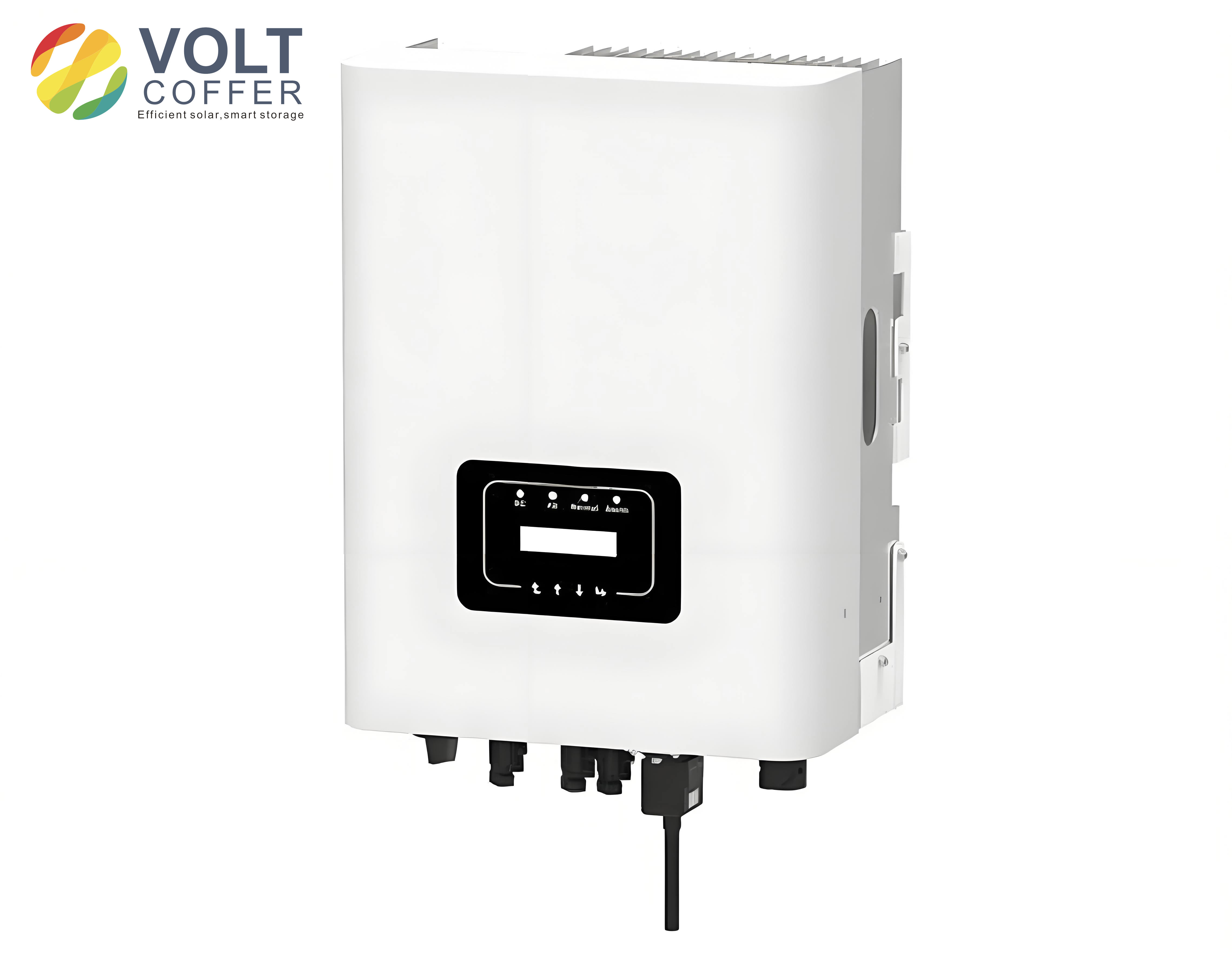
The operation of a solar inverter involves converting direct current (DC) generated by solar panels into alternating current (AC) for residential or industrial use and grid integration. Key processes include: solar panels absorbing sunlight to produce DC electricity; DC input entering the inverter through filtering and stabilization circuits to ensure current stability; internal power semiconductor devices converting DC to pulsating AC via high-frequency switching, typically using pulse-width modulation (PWM) to generate a near-sinusoidal AC waveform; and output filtering circuits further smoothing the waveform to align with grid and load requirements. Modern solar inverters incorporate maximum power point tracking (MPPT) to dynamically adjust operating conditions, ensuring optimal energy output efficiency from solar panels. Additionally, solar inverters feature protective functions against overvoltage, overcurrent, and short circuits, enhancing system safety.
Intelligent optimization control algorithms for solar inverters aim to improve efficiency, stability, and reliability by addressing the complex and variable operating environments of PV systems. Common algorithms include fuzzy logic control, neural network control, and genetic algorithms. Fuzzy logic control, based on fuzzy set theory, handles uncertainties and nonlinearities in PV systems using empirical rules without requiring precise mathematical models. Neural network control leverages self-learning and adaptive capabilities, training on extensive data to model complex input-output relationships for precise inverter control. Genetic algorithms emulate biological evolution through selection, crossover, and mutation to optimize control parameters, thereby enhancing PV system efficiency. These algorithms are often combined in practice to exploit their respective strengths, facilitating efficient and stable operation of solar inverters and advancing the PV industry.
Table 1 summarizes key intelligent optimization control algorithms for solar inverters, highlighting their principles and applications.
| Algorithm | Principle | Application in Solar Inverters |
|---|---|---|
| Fuzzy Logic Control | Uses linguistic variables and rule-based systems to handle imprecision | MPPT under varying environmental conditions |
| Neural Network Control | Employs layered networks for pattern recognition and prediction | Adaptive control for inverter output regulation |
| Genetic Algorithm | Optimizes parameters via evolutionary operations | Efficiency maximization in inverter operation |
The efficiency of a solar inverter can be modeled mathematically. For instance, the output power $$P_{\text{out}}$$ of a solar inverter is given by:
$$P_{\text{out}} = \eta \cdot P_{\text{in}}$$
where $$P_{\text{in}}$$ is the input DC power and $$\eta$$ is the inverter efficiency, which depends on factors like switching losses and thermal performance. Advanced modulation techniques, such as space vector PWM (SVPWM), improve efficiency by reducing harmonic distortion and losses.
In distribution networks, voltage regulation can be achieved by adjusting the output of solar inverters. For instance, when grid voltage rises excessively, reducing the active power output from solar inverters can mitigate line voltage increases. This is because excessive active power contributes to higher line voltages, and curtailing it controls power losses and voltage rise. For example, during periods of high solar irradiance and substantial PV generation, if grid voltage exceeds permissible limits, algorithms can lower the MPPT efficiency of solar inverters to reduce active power output. Conversely, when distribution voltage is too low, increasing the active power output from solar inverters can elevate line voltage levels, enhancing the grid’s power supply capacity. However, this approach must balance PV generation capabilities with grid demand; excessive active power curtailment reduces PV utilization, while over-injection compromises grid stability. Thus, real-time monitoring and control of solar inverters are essential for maintaining distribution voltage stability.
Reactive power control via solar inverters offers another effective method for voltage regulation. As distributed PV sources proliferate, voltage distribution characteristics in grids change, leading to voltage limit violations. By precisely controlling reactive power, solar inverters can flexibly regulate grid voltage. For example, when node voltage fluctuates, solar inverters adjust their reactive power output based on real-time measurements: absorbing reactive power to lower voltage during overvoltage conditions and injecting reactive power to raise voltage during undervoltage conditions. This method provides rapid response, avoids the need for additional compensation devices, reduces costs, and integrates with smart algorithms and communication technologies for coordinated control with grid dispatch centers. Dispatch centers can optimize reactive power output from multiple solar inverters based on overall grid conditions, enhancing voltage regulation efficacy and operational efficiency.
The reactive power $$Q$$ injected or absorbed by a solar inverter relates to voltage regulation through the equation:
$$\Delta V = \frac{X \cdot Q}{V}$$
where $$\Delta V$$ is the voltage change, $$X$$ is the line reactance, and $$V$$ is the nominal voltage. This demonstrates how solar inverters can influence grid voltage dynamically.
Multi-inverter协同 control involves deploying multiple solar inverters at different locations, sharing information via communication networks for coordinated action. A control center collects real-time data on inverter status and grid voltage, formulating strategies to coordinate active and reactive power outputs. For instance, if voltage in a specific area becomes too high, the control center can direct local solar inverters to collectively reduce active power output and absorb reactive power, thereby lowering voltage. Conversely, during low voltage conditions, solar inverters can increase both active and reactive power outputs. This协同 approach also enables power optimization across PV plants, improving overall voltage regulation.
Integrating energy storage systems with solar inverters combines their advantages for voltage regulation. Energy storage systems store and release energy, acting as buffers during voltage fluctuations. When PV generation exceeds load demand, causing voltage rise, solar inverters can divert excess energy to storage systems, reducing grid voltage and minimizing energy waste. For example, during peak sunlight hours, storage systems absorb surplus energy. During low voltage conditions, storage systems discharge energy via solar inverters to boost voltage. Additionally, energy storage complements active and reactive power control of solar inverters by providing fast response to compensate for inverter delays and assisting in reactive compensation, thereby enhancing voltage regulation capabilities to address the intermittency and volatility of solar energy.
For intelligent optimization control of solar inverters, MPPT optimization is crucial. Environmental factors like irradiance and temperature cause the maximum power point of PV cells to shift continuously. Traditional MPPT algorithms may not track the real-time maximum power point quickly and accurately. Advanced algorithms, such as adaptive fuzzy control, automatically adjust parameters based on environmental changes, improving tracking precision and speed. Multi-peak MPPT technology ensures global maximum power point identification under partial shading conditions, avoiding local optima. These optimizations significantly enhance the efficiency of solar inverters, increasing overall PV system energy yield.
Inverter efficiency optimization involves hardware and software improvements. Hardware-wise, adopting new power semiconductor devices like silicon carbide (SiC) offers low conduction resistance and high switching speed, reducing energy losses during inverter operation. Software-wise, optimizing modulation strategies, such as using SVPWM instead of traditional sinusoidal PWM (SPWM), better utilizes DC link voltage, improving output voltage quality and inverter efficiency. Proper thermal management design ensures stable operation in high-efficiency ranges under varying conditions, further boosting overall performance.
Communication and协同 control are vital for future grids with numerous solar inverters. Establishing high-speed, reliable communication networks—e.g., power line communication (PLC) or wireless—enables real-time data exchange among solar inverters and with grid dispatch centers. Using this data, distributed协同 control strategies allow solar inverters to autonomously adjust power output and power quality based on grid demands and operational states. For instance, during grid power fluctuations, solar inverters can协同 respond rapidly to regulate power, enhancing grid stability and reliability.
Table 2 outlines key voltage regulation strategies involving solar inverters, detailing their mechanisms and benefits.
| Strategy | Mechanism | Benefits |
|---|---|---|
| Active Power Control | Adjusts active power output based on voltage levels | Mitigates voltage rise/drop, balances power flow |
| Reactive Power Control | Injects/absorbs reactive power to regulate voltage | Fast response, cost-effective, no extra hardware |
| Multi-Inverter协同 | Coordinates multiple inverters via communication | Enhanced regulation, optimized power distribution |
| Energy Storage Integration | Combines inverters with storage for buffering | Handles intermittency, improves stability |
For voltage regulation innovation, reactive power control via solar inverters addresses voltage fluctuations caused by PV intermittency. By regulating reactive power output based on real-time voltage and power factor parameters, solar inverters can inject or absorb reactive power to maintain voltage within limits. Intelligent reactive control strategies automate this process, eliminating the need for additional compensation devices and reducing costs while improving system economy and reliability.
Energy storage system joint regulation combines storage with solar inverters to smooth PV power fluctuations and enhance voltage stability. When PV generation is surplus, storage systems store excess energy; during deficits or voltage issues, they discharge to stabilize voltage. Joint control models allocate charging and discharging power based on real-time grid needs and storage status. For example, storage systems discharge during peak demand to alleviate grid stress and charge during high irradiance to optimize energy use. This approach effectively mitigates PV power volatility and strengthens grid voltage stability.
Big data and artificial intelligence (AI)-based voltage regulation leverage extensive grid operational data—such as voltage, current, and power—collected and analyzed using big data techniques to build voltage prediction models. AI algorithms, including neural networks and genetic algorithms, enable real-time monitoring and intelligent control of grid voltage. When voltage fluctuations are predicted, preemptive measures—like adjusting solar inverter output or controlling storage system charge/discharge—are implemented. This intelligent approach enhances the accuracy and timeliness of voltage regulation, adapting to complex grid environments and improving overall performance.
The integration of solar inverters with AI can be modeled using a neural network for voltage prediction:
$$V_{\text{pred}} = f_{\text{NN}}(I, P, Q, \theta)$$
where $$V_{\text{pred}}$$ is the predicted voltage, $$I$$ is current, $$P$$ is active power, $$Q$$ is reactive power, and $$\theta$$ represents other parameters. This facilitates proactive control of solar inverters.
In conclusion, intelligent optimization control and voltage regulation technologies for solar inverters are pivotal for efficient renewable energy utilization and smart grid development. Through continuous innovation and practical application, these advancements can contribute to a cleaner, low-carbon, secure, and efficient energy system, supporting global sustainable development. Solar inverters, as key components, will play an increasingly vital role in future energy landscapes.