
As a key enabler for achieving global carbon neutrality goals, renewable energy sources like wind and solar power face challenges due to their intermittent and unpredictable nature. This necessitates the development of efficient battery energy storage system (BESS) technologies to support renewable integration. We focus on sodium-ion batteries (SIBs) as a promising alternative to lithium-ion batteries, given their abundant resources, enhanced safety, superior performance across temperature ranges, high-rate capability, and lower maintenance costs. This article presents our comprehensive research on integrated technologies for novel sodium-ion battery energy storage system, covering thermal management, power converter design, monitoring strategies, and real-world application in a 2.5 MW/10 MWh BESS.
The growing demand for electrochemical energy storage has highlighted limitations in lithium resources, such as uneven global distribution and supply chain vulnerabilities. Sodium-ion batteries offer a viable solution, leveraging sodium’s natural abundance—approximately 1,000 times more prevalent than lithium in the Earth’s crust—to reduce costs and enhance sustainability. Our work addresses critical aspects of SIB-based BESS, including thermal behavior, system topology, and control algorithms, to ensure reliability and efficiency in grid-scale applications.
In this study, we begin by analyzing the thermal dynamics of SIBs during charge and discharge cycles. Our tests reveal that SIBs exhibit minimal temperature rise during charging but significant heating during discharging, with temperature increases varying by ambient conditions. For instance, at -30°C, the discharge temperature rise reaches 23.4°C, while at 25°C, it is only 11.2°C. This underscores the need for effective thermal management in a battery energy storage system. We compare air cooling and liquid cooling methods, demonstrating that liquid cooling provides superior voltage and temperature consistency, with voltage deviations below 43 mV and temperature differences within 4°C during operation. Based on these findings, we design a non-contact liquid cooling system using multi-channel flat tubes, which minimizes temperature gradients to within 3°C in module-level simulations.
Next, we explore power conversion system (PCS) technologies tailored for SIBs. Traditional centralized PCS topologies often lead to imbalances in battery clusters, exacerbating inconsistencies. To overcome this, we propose an intelligent string-type BESS architecture, where each battery cluster is paired with a dedicated PCS. This approach decouples clusters, enabling individualized management and reducing losses from circulating currents. Our PCS design incorporates a configurable circuit for wide voltage input ranges (e.g., 2.0–3.8 V per cell), utilizing an LLC resonant converter to enhance efficiency, reduce voltage ripple, and improve response times. Key performance metrics, such as total harmonic distortion below 5% and efficiency over 94%, meet industry standards, as summarized in Table 1.
| Parameter | Requirement | Test Result |
|---|---|---|
| Three-phase Voltage Unbalance | Complies with GB/T 15543-2008 | Met |
| Total Harmonic Distortion | Complies with GB/T 14549-1993 | Met |
| Voltage Deviation | Within -10% to +15% | Met |
| Rectification and Inversion Efficiency | ≥ 94% | ≥ 94% |
| DC Component | ≤ 0.5% of rated output current | Met |
| Voltage Fluctuation and Flicker | Complies with GB/T 12326-2008 | Met |
| Current Stability and Ripple | Stability ≤ ±5%, ripple ≤ 5% | Met |
For monitoring and control, we develop advanced algorithms to estimate system capacity and coordinate power among multiple strings. The open-circuit voltage (OCV) versus state of charge (SOC) curve for SIBs shows a linear increase during charging, unlike the flat plateau in lithium iron phosphate batteries. This characteristic allows for precise SOC estimation. We propose a machine learning-based capacity estimation method that accounts for cell inconsistencies by extracting features from charge curves, such as voltage and temperature parameters. The distance correlation coefficient is used to evaluate feature relevance:
$$ dCor(X,Y) = \frac{dCov(X,Y)}{\sqrt{dVar(X) \cdot dVar(Y)}} $$
where \( X \) represents the feature matrix and \( Y \) the battery pack capacity. A Gaussian process regression model maps these features to capacity, improving estimation accuracy under varying temperatures and rates.
Additionally, we introduce a power coordination control strategy based on SOC for multi-string BESS. This method allocates power dynamically to each PCS, considering SOC levels and remaining power, to balance charge-discharge characteristics and enhance consistency. For example, if one cluster has a lower SOC, it receives more charging power, while higher-SOC clusters discharge more. This approach mitigates the “bucket effect” and optimizes overall system performance. Our energy management system employs a decentralized architecture with local monitors for real-time data processing, reducing network load and increasing reliability.
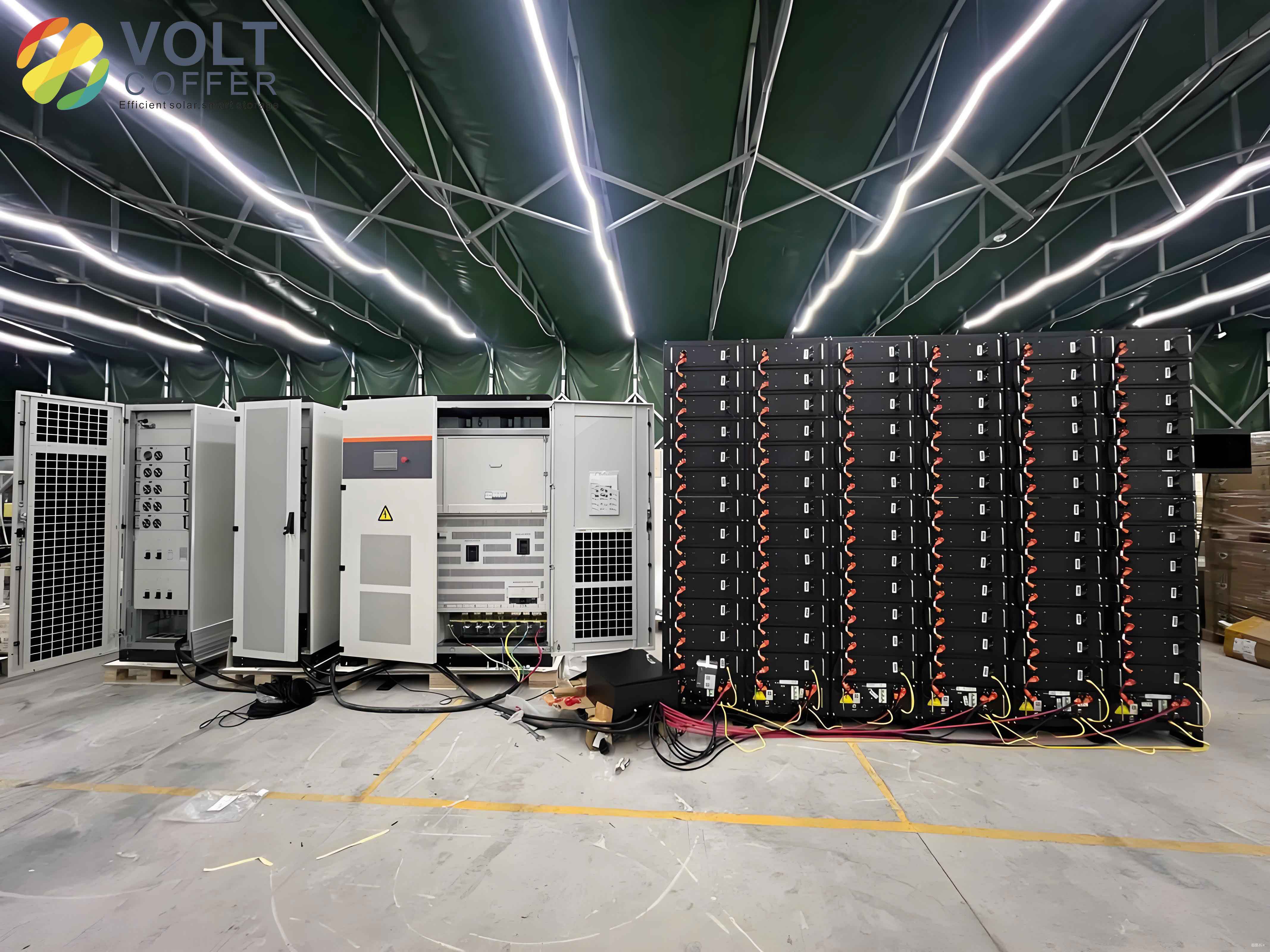
To validate our integrated technologies, we deploy a 2.5 MW/10 MWh sodium-ion battery energy storage system, comprising two 1.25 MW/5 MWh subsystems. Each subsystem includes 44 battery strings, with each string consisting of a battery cluster (1P260S configuration) and a PCS module. The system uses 88 PCS units in parallel groups, connected to 88 sodium-ion battery clusters, as illustrated in the electrical layout. Key system parameters are listed in Table 2.
| Parameter | Value | Parameter | Value |
|---|---|---|---|
| Rated Charging Time (hours) | 4 | Battery Cluster Discharge Cut-off Voltage (V) | 611 |
| Rated Discharging Time (hours) | 4 | Energy Conversion Efficiency at Rated Power (%) | ≥ 90 |
| Rated Charging Power at 4-hour Rate (MW) | 2.5 | Charge-Discharge Response Time (s) | < 0.5 |
| Rated Discharging Power at 4-hour Rate (MW) | 2.5 | Charge-Discharge Regulation Time (s) | < 0.5 |
| Rated Charging Energy at 4-hour Rate (MWh) | 10 | Charge-Discharge Transition Time (s) | < 1 |
| Rated Discharging Energy at 4-hour Rate (MWh) | 10 | Operating Temperature Range (°C) | 15–35 |
| Battery System Nominal Voltage (V) | 780 | Rated Output Power (MW) | 2.5 |
| Cell Charging Cut-off Voltage (V) | 3.75 | Rated AC Current (A) | 3788 |
| Cell Discharging Cut-off Voltage (V) | 2.35 | Power Factor | ±0.95 |
| Battery Cluster Charging Cut-off Voltage (V) | 975 | Total Harmonic Distortion at Full Load (%) | < 5 |
We conduct performance tests on individual intelligent string branches, measuring energy efficiency and voltage consistency. Results show DC and AC energy efficiencies above 90%, with voltage deviations below 46 mV during discharge, confirming the effectiveness of our topology. Static tests on battery cabins, PCS cabins, and fire protection systems all meet requirements, as do grid-connection tests for power quality, fault ride-through, and frequency response. The system has been successfully commissioned and operates reliably, demonstrating the practicality of our sodium-ion BESS solutions.
In terms of thermal management, our liquid cooling system uses multi-channel flat tubes arranged around battery modules to maximize heat exchange in compact spaces. Computational fluid dynamics simulations confirm temperature uniformity within 3°C across modules, critical for longevity and safety in a battery energy storage system. The cooling plate design minimizes flow resistance and ensures even distribution, with inlet-to-outlet temperature rises of about 2.4°C. This approach outperforms air cooling, which exhibited voltage deviations up to 92 mV and temperature differences of 6°C in our comparative tests.
For the PCS, our design addresses wide voltage input ranges (2.0–3.8 V per cell) by incorporating a selectable circuit configuration that reduces bus voltage fluctuations and switching losses. The LLC topology enhances efficiency, with tests showing over 94% efficiency in both rectification and inversion modes. The PCS supports rapid response, with charge-discharge transition times under 1 second, making it suitable for dynamic grid applications. Table 3 summarizes the performance of intelligent string branches, highlighting high efficiency and consistency.
| Parameter | Test Result | Parameter | Test Result |
|---|---|---|---|
| DC Charging Energy (kWh) | 134.69 | AC Energy Efficiency (%) | 92.46 |
| DC Discharging Energy (kWh) | 130.73 | Max Voltage Deviation During Charging (mV) | 44 |
| AC Charging Energy (kWh) | 138.22 | Max Voltage Deviation Coefficient During Charging (%) | 1.7371 |
| AC Discharging Energy (kWh) | 127.80 | Max Voltage Deviation During Discharging (mV) | 46 |
| DC Energy Efficiency (%) | 97.06 | Max Voltage Deviation Coefficient During Discharging (%) | 1.9339 |
Our capacity estimation method leverages machine learning to handle cell inconsistencies. We extract features from charge curves, such as voltage slopes and temperature profiles, and use distance correlation to select relevant features. The Gaussian process regression model is trained on data from various temperatures and rates, achieving accurate capacity predictions. This is vital for maintaining the health of a battery energy storage system, as it allows for proactive management and reduces degradation.
The power coordination control algorithm dynamically allocates power based on real-time SOC readings. For example, if the total demanded power is P_total, the first allocation assigns power proportionally to each cluster’s SOC, and the second allocation adjusts for remaining power to ensure balanced operation. This method improves overall efficiency and extends battery life by preventing overstress on individual strings.
In the deployed 2.5 MW/10 MWh BESS, we performed extensive tests, including static checks and grid-compliance trials. All components, from battery management systems to fire safety, passed validation. Grid-connection tests covered voltage adaptability, frequency response, and active power control, with results satisfying standards like automatic generation control (AGC) and automatic voltage control (AVC). The system’s ability to maintain operation during faults underscores its robustness for large-scale energy storage.
In conclusion, our integrated technologies for sodium-ion battery energy storage system demonstrate significant advancements in thermal management, power conversion, and intelligent control. The liquid cooling system ensures temperature uniformity, the string-type topology enhances efficiency and reliability, and the monitoring algorithms optimize performance. Applied to a 2.5 MW/10 MWh BESS, these innovations have proven effective in real-world scenarios, supporting the transition to sustainable energy systems. Future work will focus on scaling these solutions and further reducing costs for broader adoption.