
The large-scale integration of renewable energy sources, particularly photovoltaic (PV) systems, represents a fundamental shift in modern power systems. The utility interactive inverter serves as the critical interface, converting the DC output from solar panels into grid-compliant AC power. However, the shift from traditional, stiff grid connections dominated by large synchronous generators to networks with high penetration of inverter-based resources (IBRs) like the utility interactive inverter introduces new stability challenges. These challenges become acutely pronounced when these resources are connected to weak grids.
Traditionally, the concept of an infinite bus implied a voltage source with constant amplitude and frequency, unaffected by the connection of any load or generator. In contrast, a weak grid is characterized by non-negligible grid impedance, often inductive due to long transmission lines or the presence of isolation transformers. The strength of the grid at the Point of Common Coupling (PCC) is commonly quantified by the Short-Circuit Ratio (SCR). A lower SCR indicates a weaker grid. When operating in such conditions, the dynamic interaction between the control loops of the utility interactive inverter—especially its Phase-Locked Loop (PLL)—and the grid impedance can lead to instability, manifesting as sustained oscillations in voltage and current, sub-synchronous resonance, or even disconnection.
The core issue lies in the inherent characteristics of the standard PLL used for grid synchronization. Unlike a synchronous machine which possesses natural rotational inertia and damping, a conventional PLL-based utility interactive inverter offers very low inertia and damping. In a weak grid scenario, the PLL’s effort to track the PCC voltage—which is now influenced by the inverter’s own output current—creates a negative feedback path that can destabilize the system. My research focuses on addressing this critical vulnerability by fundamentally augmenting the PLL’s dynamics. I propose a novel Inertial Phase-Locked Loop (IPLL) structure designed to inject virtual inertia and damping into the synchronization mechanism of the utility interactive inverter, thereby significantly enhancing its stability margin in weak and very weak grid environments.
System Configuration and Conventional Synchronization
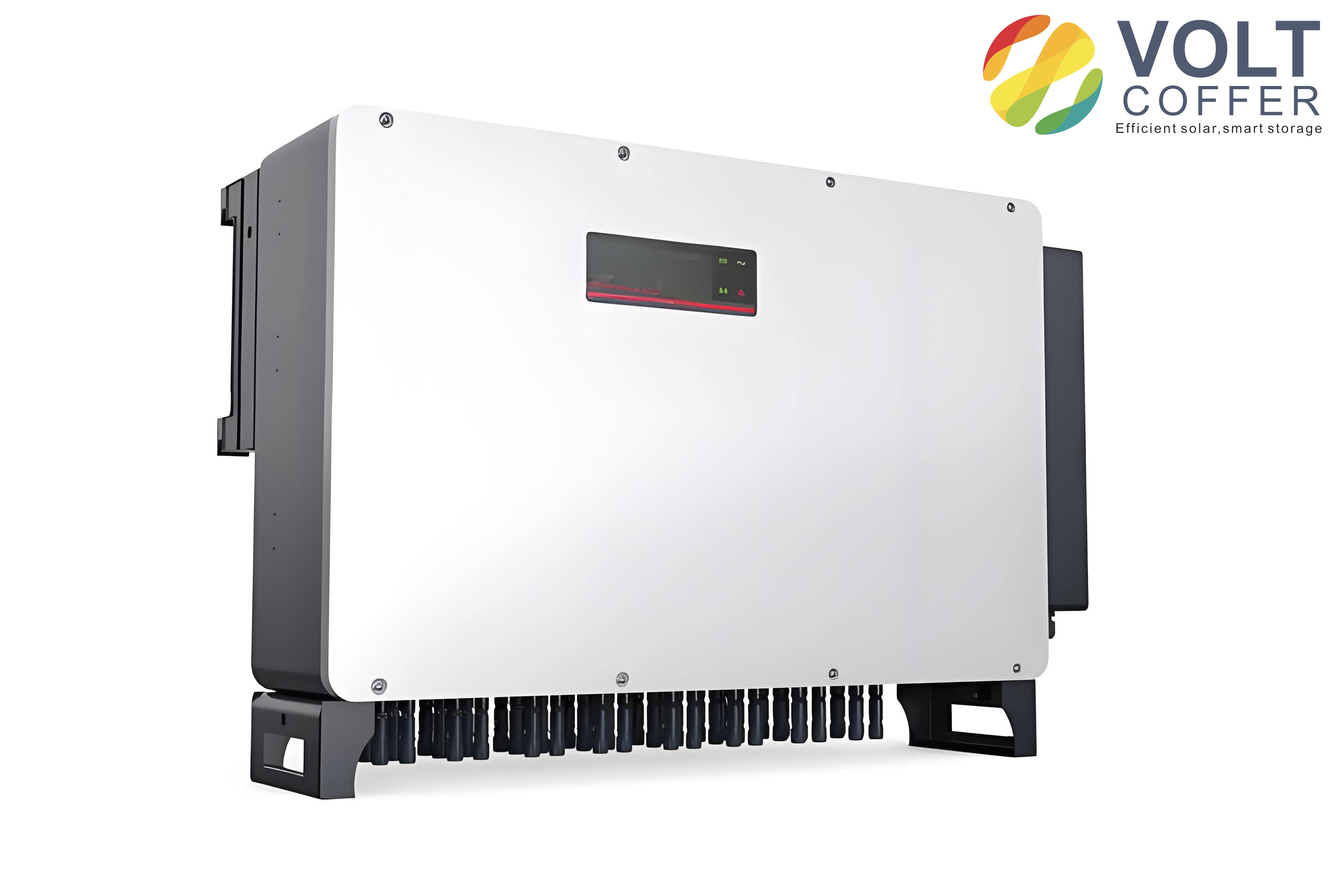
The standard topology for a three-phase grid-connected system centered on a utility interactive inverter is shown below. The DC source, representing the PV array output, is inverted to AC, filtered through an LC filter, and connected to the grid at the PCC. The grid impedance, primarily inductive (Lg), is the parameter that defines grid strength.
The control architecture for such a utility interactive inverter typically includes an outer DC-link voltage or power control loop, an inner current control loop, and the indispensable PLL for synchronization. The PLL’s primary function is to accurately extract the phase angle θ of the PCC voltage vector to enable Park transformations (abc to dq) for current control. The conventional Synchronous Reference Frame PLL (SRF-PLL) structure is a feedback system that drives the quadrature-axis (q-axis) component of the PCC voltage to zero, aligning the d-axis of the controller’s reference frame with the voltage vector.
The coordinate transformations are essential for the control of the utility interactive inverter. The transformation from three-phase (a, b, c) to two-phase stationary (α, β) coordinates (Clarke transformation) is given by:
$$
\begin{bmatrix}
v_{\alpha} \\
v_{\beta}
\end{bmatrix}
= \frac{2}{3}
\begin{bmatrix}
1 & -\frac{1}{2} & -\frac{1}{2} \\
0 & \frac{\sqrt{3}}{2} & -\frac{\sqrt{3}}{2}
\end{bmatrix}
\begin{bmatrix}
v_{a} \\
v_{b} \\
v_{c}
\end{bmatrix}
$$
The subsequent transformation from stationary (α, β) to synchronous rotating (d, q) coordinates (Park transformation) uses the angle θ estimated by the PLL:
$$
\begin{bmatrix}
v_{d} \\
v_{q}
\end{bmatrix}
=
\begin{bmatrix}
\cos\theta & \sin\theta \\
-\sin\theta & \cos\theta
\end{bmatrix}
\begin{bmatrix}
v_{\alpha} \\
v_{\beta}
\end{bmatrix}
$$
In a stable, ideal grid condition, the PLL ensures vq = 0. However, its standard proportional-integral (PI) controller offers limited ability to manage the energy exchange and damping during disturbances in a weak grid, making the utility interactive inverter prone to oscillations.
Proposed Inertial Phase-Locked Loop (IPLL): Concept and Design
To mitigate the low-inertia instability, I developed an Inertial Phase-Locked Loop (IPLL). The core idea is to embed inertial and damping characteristics, akin to those of a synchronous machine, directly into the phase-locking mechanism. The proposed IPLL structure introduces two new control parameters: an inertia time constant Tp and a damping gain Tk.
The mathematical model of the IPLL reveals its dynamic superiority. The transfer function from the measured vq to the internal frequency estimate ω1 is a first-order lag system:
$$
G_T(s) = \frac{\omega_1(s)}{v_q(s)} = \frac{T_k}{s + T_k T_p}
$$
This is fundamentally different from the conventional PI-based PLL. The parameter Tp acts as a virtual inertia, determining how sluggishly the estimated frequency responds to changes in vq. The parameter Tk influences the damping and the speed of the response. The unit step response of this transfer function clearly demonstrates the effect:
| Control Parameter | Effect on Step Response |
|---|---|
| Increasing Tk | Reduces rise time, faster response. |
| Increasing Tp | Reduces steady-state gain and overshoot, increases damping. |
A key feature of the IPLL is its steady-state behavior. Unlike a conventional PLL which forces vq to zero, the IPLL allows a non-zero steady-state vq that is proportional to the difference between the estimated internal frequency ω1 and the nominal grid frequency ωn:
$$
v_q = T_p (\omega_n – \omega_1)
$$
This relationship introduces a “droop” characteristic in the synchronization mechanism. The final output phase angle θ for the utility interactive inverter is not simply the integral of ω1 but includes a corrective angle Δθ derived from the arcsin of the normalized vq:
$$
\theta = \theta_1 + \Delta\theta = \int \omega_1 dt + \arcsin\left(\frac{T_p(\omega_n – \omega_1)}{V_1}\right)
$$
where V1 is the magnitude of the PCC voltage. This architecture effectively increases the phase margin and damping of the synchronization loop, making the overall system of the utility interactive inverter more robust.
Comparative Analysis: Stability in Weak Grids
To rigorously evaluate the performance of the IPLL, I conducted a comparative stability analysis against the conventional SRF-PLL under varying grid strengths. The system under study is a 100 kW three-phase utility interactive inverter with an LC filter. The key parameters for the simulation are summarized below:
| Parameter | Symbol | Value |
|---|---|---|
| Rated Power | Prated | 100 kW |
| DC-Link Voltage | Udc | 700 V |
| Filter Inductance | Lf | 0.03 mH |
| Grid Voltage (L-L RMS) | Ug | 310.27 V |
| Grid Impedance (for SCR=9) | Lg | 0.5 mH |
The Short-Circuit Ratio (SCR) is calculated as:
$$
SCR = \frac{S_{ac}}{P_{rated}} = \frac{3U_g^2}{2\omega L_g P_{rated}}
$$
where Sac is the short-circuit capacity at the PCC. The grid strength is varied by changing Lg. Typically, an SCR below 3 is considered a weak grid, and below 2 an extremely weak grid.
The first test scenario involves a transition from a strong grid (SCR=9) to a weak grid (SCR=3) at t=0.4 s. The dynamic response of the d-axis current (id) and voltage (vd) is critical for power transfer stability in the utility interactive inverter.
| Synchronization Method | Oscillation Amplitude | Settling Time | Observation |
|---|---|---|---|
| Conventional PLL | Large | Long, sustained oscillations | System exhibits poor damping and low inertia. |
| Proposed IPLL | Significantly reduced | Short, rapid decay | System demonstrates high damping and virtual inertia. |
A more stressful test was performed by intentionally reducing the bandwidth of the current control loop, which generally degrades stability. Even under this degraded condition, the utility interactive inverter equipped with the IPLL showed a markedly faster recovery and smaller oscillations compared to the one using the conventional PLL. This confirms that the stability enhancement stems from the IPLL’s inherent properties and not merely from aggressive current control.
The ultimate test involves an extreme transition to a very weak grid (SCR=2). The results were decisive:
- With Conventional PLL: The system became unstable. The voltage and current waveforms were severely distorted, indicating a loss of synchronism for the utility interactive inverter.
- With Proposed IPLL: The system experienced a brief, well-damped transient and then regained stable operation. The utility interactive inverter maintained synchronization and continued to deliver power smoothly.
The closed-loop transfer function of the IPLL, considering the PCC voltage magnitude V1, can be expressed as:
$$
T_{IPLL}(s) = \frac{V_1 H_{IPLL}(s)}{1 + V_1 H_{IPLL}(s)}, \quad \text{where} \quad H_{IPLL}(s) = \frac{T_k}{s(s + T_k T_p)}
$$
This second-order system, with its tunable inertia (Tp) and damping-related (Tk) parameters, provides the necessary flexibility to shape the synchronization dynamics optimally for the utility interactive inverter operating in weak grids.
Experimental Validation and Performance Confirmation
To move beyond simulation and validate the practical feasibility of the IPLL, I implemented the control strategy on a hardware-in-the-loop (HIL) platform using RT-LAB. The experimental setup mirrored the 100 kW utility interactive inverter system parameters used in the simulation. The objective was to capture the real-time dynamic behavior during a grid strength disturbance.
The experiment replicated the severe grid transition from SCR=9 to SCR=2. The captured waveforms of three-phase voltages and currents provide conclusive evidence:
| Test Case | Voltage Waveform Quality | Current Waveform Quality | System Status Post-Disturbance |
|---|---|---|---|
| Conventional PLL | Severe and prolonged distortion, large oscillations. | Unstable, oscillatory, slow recovery. | Marginally stable after a long transient; poor robustness. |
| Proposed IPLL | Minor, quickly damped distortion. | Fast settling, minimal oscillation. | Rapidly stable; demonstrates high robustness and superior disturbance rejection. |
The experimental results unequivocally demonstrate that the inertial characteristics introduced by the IPLL are effective in a real-time control environment. The utility interactive inverter with IPLL exhibits a fundamentally stronger and more predictable response to grid disturbances. The reduction in oscillation magnitude and duration directly translates to lower mechanical and electrical stress on system components and a higher probability of remaining grid-connected during fault recovery or other network events—a crucial requirement for modern power systems.
Conclusion
The transition towards renewable energy necessitates that the utility interactive inverter evolves from a simple grid-following device to a robust grid-supporting asset. Stability under weak grid conditions is a paramount challenge that conventional synchronization techniques struggle to address due to their inherent lack of inertia and damping.
This work has presented a novel Inertial Phase-Locked Loop (IPLL) strategy specifically designed to overcome this limitation. By ingeniously incorporating virtual inertia and damping parameters (Tp and Tk) into the phase-tracking loop, the proposed IPLL endows the utility interactive inverter with dynamic characteristics that are analogous to, and beneficial for, the stability of a weak grid. The mathematical modeling, detailed simulation studies under progressively weaker grid scenarios (SCR=3 and SCR=2), and final experimental validation on an HIL platform collectively confirm the efficacy of the approach.
The IPLL-enabled utility interactive inverter demonstrates significantly reduced oscillatory response, faster settling times, and maintained stability in extremely weak grids where conventional PLLs fail. This enhancement in robustness and disturbance rejection capability is achieved without the need for additional hardware or complex wide-area measurements, making it a practical and highly effective solution for ensuring the reliable integration of photovoltaic and other inverter-based generation into the evolving power network.