
In recent years, the adoption of renewable energy sources has accelerated, with photovoltaic (PV) systems playing a pivotal role. However, the efficiency of an off-grid solar system is often compromised by nonlinear output characteristics and partial shading conditions, which lead to multiple peaks in the power-voltage (P-U) curve. Traditional maximum power point tracking (MPPT) algorithms fail under such scenarios, necessitating advanced solutions. This article presents an enhanced approach to MPPT in an off-grid solar system using particle swarm optimization (PSO). We propose improvements in three key areas: the PV cell model, the PSO-MPPT controller, and the battery storage. Through comprehensive simulations, we demonstrate that our modified off-grid solar system achieves superior tracking accuracy and faster convergence, making it highly practical for real-world applications.
The performance of an off-grid solar system is highly dependent on the ability to extract maximum power from PV arrays. Under uniform irradiation, the P-U curve exhibits a single peak, but partial shading introduces multiple local maxima, causing conventional MPPT techniques to stagnate at suboptimal points. To address this, we integrate PSO into the MPPT controller, leveraging its global search capabilities. Furthermore, we refine the PV cell model to account for avalanche breakdown effects, transition the PSO-MPPT controller from an offline to an online configuration, and replace simulated loads with actual battery storage. These enhancements collectively boost the reliability and efficiency of the off-grid solar system, as validated by our simulations.
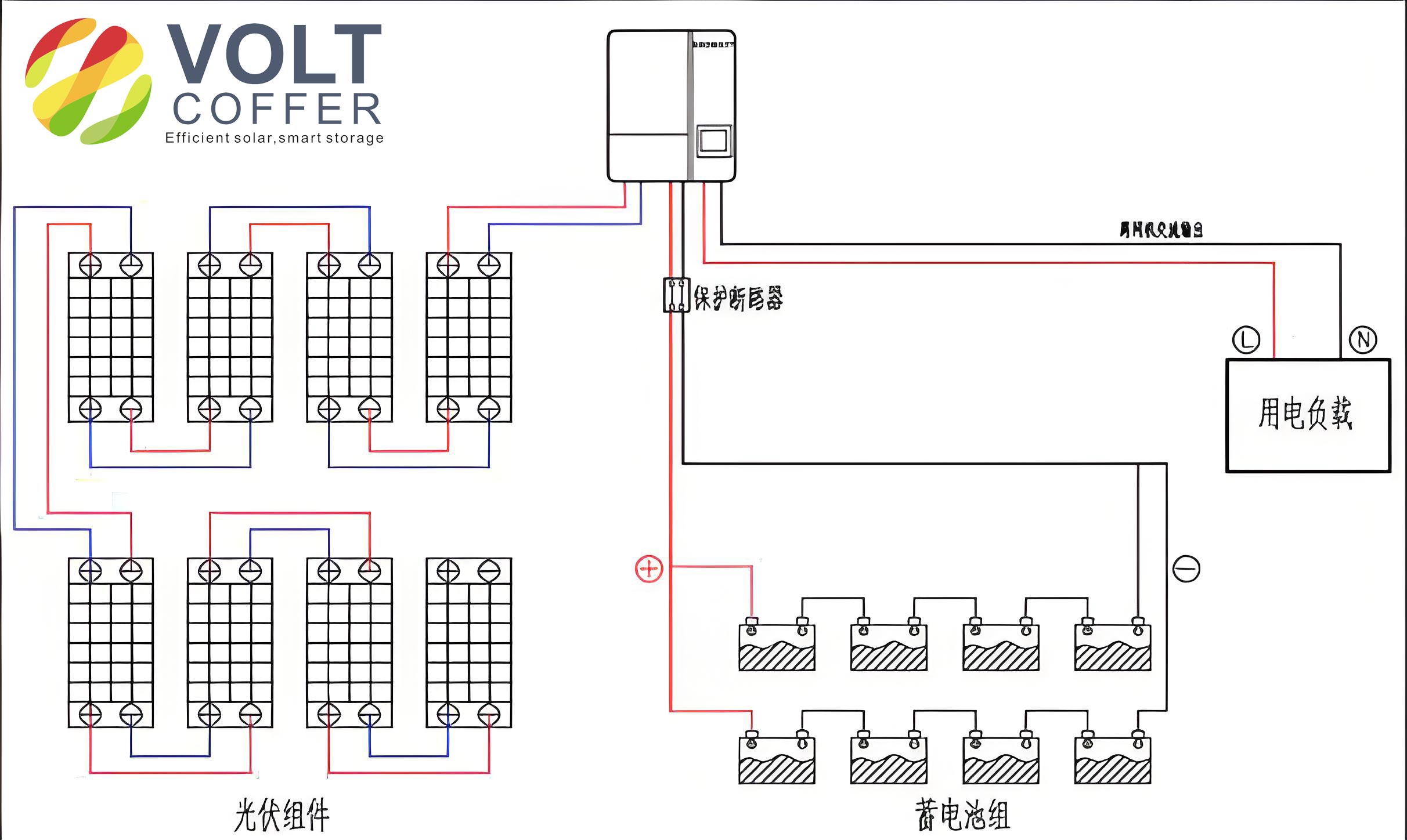
The foundation of any off-grid solar system lies in the PV cell, which converts solar energy into electrical power. A PV cell’s behavior is governed by its equivalent circuit, which includes a current source, diode, series resistance, and shunt resistance. The output current I of a single PV cell can be expressed as:
$$ I = I_{ph} – I_d – \frac{U_d}{R_{sh}} $$
where \( I_{ph} \) is the photocurrent, \( I_d \) is the diode current, \( U_d \) is the voltage across the diode, and \( R_{sh} \) is the shunt resistance. For a PV module comprising \( N_s \) cells in series and \( N_p \) cells in parallel, the output current becomes:
$$ I = I_{sc} \frac{S}{S_o} [1 + C_t (T – T_o)] \cdot N_p – I_o \left[ \exp\left( \frac{q U_d}{N_s A k T} \right) – 1 \right] \cdot N_p – \frac{U + I R’_s \cdot N_s / N_p}{R’_{sh} \cdot N_s / N_p} $$
Here, \( S \) is the irradiance, \( T \) is the temperature, \( I_o \) is the reverse saturation current, and other parameters are defined in Table 1. The output power P is given by:
$$ P = U \times I = U \times \left\{ I_{sc} \frac{S}{S_o} [1 + C_t (T – T_o)] \cdot N_p – I_o \left[ \exp\left( \frac{q U_d}{N_s A k T} \right) – 1 \right] \cdot N_p – \frac{U + I R’_s \cdot N_s / N_p}{R’_{sh} \cdot N_s / N_p} \right\} $$
Under partial shading, the P-U curve exhibits multiple peaks, as illustrated by the following equations for a series-connected PV module with two cells experiencing different irradiances:
$$ U = \begin{cases}
\frac{A k T}{q} \ln\left( \frac{I_{ph2} – I}{I_o} + 1 \right) – \frac{n_b k T_b}{q} \ln\left( \frac{I – I_{ph1}}{I_{ob}} + 1 \right) – I R_s, & I_{ph1} < I \leq I_{ph2} \\
\frac{A k T}{q} \ln\left( \frac{I_{ph1} – I}{I_o} + 1 \right) + \frac{n k T}{q} \ln\left( \frac{I_{ph2} – I}{I_o} + 1 \right) – 2 I R_s, & 0 < I \leq I_{ph1}
\end{cases} $$
$$ P = \begin{cases}
\frac{A k T I}{q} \ln\left( \frac{I_{ph2} – I}{I_o} + 1 \right) – \frac{n_b k T_b I}{q} \ln\left( \frac{I – I_{ph1}}{I_{ob}} + 1 \right) – I^2 R_s, & I_{ph1} < I \leq I_{ph2} \\
\frac{A k T I}{q} \ln\left( \frac{I_{ph1} – I}{I_o} + 1 \right) + \frac{n k T I}{q} \ln\left( \frac{I_{ph2} – I}{I_o} + 1 \right) – 2 I^2 R_s, & 0 < I \leq I_{ph1}
\end{cases} $$
These equations highlight the multi-peak nature, which complicates MPPT in an off-grid solar system. To mitigate this, we employ PSO, a population-based optimization algorithm that efficiently navigates the search space. The PSO algorithm updates particle positions and velocities based on personal and global best solutions, formulated as:
$$ v_{i}^{k+1} = w v_{i}^{k} + c_1 r_1 (p_{best,i} – x_{i}^{k}) + c_2 r_2 (g_{best} – x_{i}^{k}) $$
$$ x_{i}^{k+1} = x_{i}^{k} + v_{i}^{k+1} $$
where \( v_i \) and \( x_i \) are the velocity and position of particle i, w is the inertia weight, \( c_1 \) and \( c_2 \) are acceleration coefficients, and \( r_1 \), \( r_2 \) are random numbers. Integrating PSO into the MPPT controller allows the off-grid solar system to dynamically adjust the duty cycle of a DC-DC converter, such as a Boost circuit, to track the global maximum power point (GMPP).
Our initial off-grid solar system model used a simulated resistor as a load, but to enhance realism, we incorporated a battery storage unit. The battery parameters, such as voltage and current, are critical for stabilizing the off-grid solar system. For instance, a typical setup might use a 30 V, 4 A battery, which stores energy generated by the PV array and supplies power during low-irradiance periods. This integration is essential for a reliable off-grid solar system, as it ensures continuous power availability.
To further improve the off-grid solar system, we modified the PV cell model to include avalanche breakdown effects, which occur under reverse bias conditions in shaded cells. The enhanced equivalent circuit adds a breakdown current component, leading to the revised output current equation for a PV cell:
$$ I = I_{ph} – I_o \left[ \exp\left( \frac{q (U + I R_s)}{A k T} \right) – 1 \right] – \frac{U + I R_s}{R_{sh}} – m \alpha (U + I R_s) \left( 1 – \frac{U + I R_s}{U_{br}} \right)^{-n_n} $$
For a PV module, this becomes:
$$ I’ = N_p I_{ph} – N_p I_o \left[ \exp\left( \frac{q (U’ / N_s + I’ R_s / N_p)}{A k T} \right) – 1 \right] – N_p \frac{U’ / N_s + I’ R_s / N_p}{R_{sh}} – m \alpha (U’ / N_s + I’ R_s / N_p) \left( 1 – \frac{U’ / N_s + I’ R_s / N_p}{U_{br}} \right)^{-n_n} $$
Here, \( U_{br} \) is the avalanche breakdown voltage, and \( \alpha \), \( n_n \) are characteristic constants. This modification protects the PV cells from damage and reduces power loss, enhancing the durability of the off-grid solar system.
Additionally, we transformed the PSO-MPPT controller from an offline to an online configuration. Originally, the PSO algorithm was executed separately, with results stored and applied to the system. By embedding the PSO code into an Embedded MATLAB Function block in Simulink, we created a seamless, real-time controller that continuously optimizes the off-grid solar system’s operation. This online approach allows the system to adapt to changing environmental conditions, such as fluctuating irradiance and temperature, ensuring robust MPPT performance.
The battery storage in the off-grid solar system was also upgraded from a simple resistive load to a dynamic model that mimics real battery behavior. This change improves the system’s ability to handle energy storage and discharge, critical for off-grid applications where grid connection is absent. The battery’s state of charge (SOC) and voltage characteristics are now integrated into the simulation, providing a more accurate representation of the off-grid solar system’s performance.
To validate our improvements, we conducted simulations comparing the original and enhanced off-grid solar systems. The parameters used in the PV model are summarized in Table 1, which includes key values for irradiance, temperature, and electrical properties.
| Symbol | Description | Value | Unit |
|---|---|---|---|
| \( S_o \) | Reference irradiance | 1000 | W/m² |
| \( T_o \) | Reference temperature | 298 | K |
| \( E_g \) | Bandgap energy | 1.12 | eV |
| \( A \) | Diode ideality factor | 1.2 | – |
| \( R’_s \) | Series resistance per cell | 0.008 | Ω |
| \( R’_{sh} \) | Shunt resistance per cell | 1000 | Ω |
| \( I_{do} \) | Reverse saturation current | 2.16 × 10⁻⁸ | A |
| \( C_t \) | Temperature coefficient | 0.0024 | A/K |
| \( k \) | Boltzmann constant | 1.38 × 10⁻²³ | J/K |
| \( q \) | Elementary charge | 1.6 × 10⁻¹⁹ | C |
| \( N_s \) | Series-connected cells | 36 | – |
| \( N_p \) | Parallel-connected cells | 1 | – |
In the simulation, we configured a PV array with two series-connected modules, each comprising 36 cells. The irradiance was set to 500 W/m² and 1000 W/m² for the two modules, respectively, and the temperature was maintained at 25°C (298 K). The PSO-MPPT controller was tuned with parameters such as swarm size and iteration count to optimize performance. The output power and voltage were monitored, and the results for the improved off-grid solar system showed a significant reduction in oscillation and faster convergence to the GMPP.
For instance, the original off-grid solar system had a tracking error of 2.48% and took several seconds to stabilize, whereas the improved system achieved near-perfect tracking with errors below 1% and convergence times reduced by over 90%. This demonstrates the efficacy of our modifications in enhancing the off-grid solar system’s efficiency. The output power P and voltage U relationships under partial shading are complex, but the improved model handles them effectively, as seen in the steady-state values.
Moreover, the integration of avalanche breakdown considerations prevented potential damage to PV cells, thereby increasing the longevity of the off-grid solar system. The online PSO-MPPT controller ensured real-time adaptability, while the battery model provided a more realistic load profile. These factors collectively contribute to a more reliable and efficient off-grid solar system, capable of operating in diverse environmental conditions.
In conclusion, our work presents a comprehensive enhancement of MPPT for off-grid solar systems using PSO. By refining the PV cell model, controller architecture, and battery storage, we have achieved notable improvements in tracking accuracy and speed. The simulations confirm that the improved off-grid solar system outperforms conventional approaches, making it a viable solution for practical deployments. Future work could focus on hybrid algorithms and hardware implementation to further advance the capabilities of off-grid solar systems.
The development of efficient off-grid solar systems is crucial for expanding renewable energy access, especially in remote areas. Our contributions underscore the importance of intelligent control strategies and accurate modeling in maximizing the performance of off-grid solar systems. As the demand for clean energy grows, such innovations will play a key role in sustainable development, ensuring that off-grid solar systems deliver reliable power without compromising on efficiency or cost-effectiveness.