
In the realm of electric vehicles and energy storage systems, the lithium-ion battery stands as a cornerstone technology due to its high energy density, power capability, and longevity. As a researcher deeply involved in battery management systems (BMS), I have observed that accurate modeling of lithium-ion batteries is paramount for optimizing performance, ensuring safety, and mitigating range anxiety. Traditional equivalent circuit models (ECMs) have been widely adopted in BMS for their computational efficiency, but they often fall short in capturing the nuanced behaviors of lithium-ion batteries under different current conditions, especially in low state-of-charge (SOC) regions. This limitation can lead to significant errors in terminal voltage simulation and剩余放电容量 (RDC) estimation, potentially causing battery voltage sag or even vehicle breakdown. In this article, I present an improved extended equivalent circuit model (EECM) that addresses these issues by incorporating internal diffusion mechanisms and reaction kinetics, validated through extensive experimental data on lithium-ion batteries. The goal is to enhance model accuracy across diverse current rates and dynamic profiles, thereby improving RDC prediction for real-world BMS applications.
The significance of lithium-ion batteries in modern technology cannot be overstated; they power everything from portable electronics to grid-scale storage. However, their complex electrochemistry poses challenges for real-time management. BMS relies on models to estimate critical states like SOC and RDC, but existing ECMs typically treat battery capacity as invariant with discharge rate, leading to discrepancies in voltage simulation. For instance, as discharge current increases, the available capacity of a lithium-ion battery decreases, a phenomenon not adequately represented in conventional models. This gap motivates the development of more sophisticated models like the EECM, which considers solid-phase diffusion effects. Yet, even EECMs may fail to account for additional reactions that manifest at low currents, necessitating further refinement. My work builds upon these foundations by integrating incremental capacity (IC) analysis and Nernst equation-based corrections, resulting in an improved EECM that offers superior performance across various operational scenarios for lithium-ion batteries.
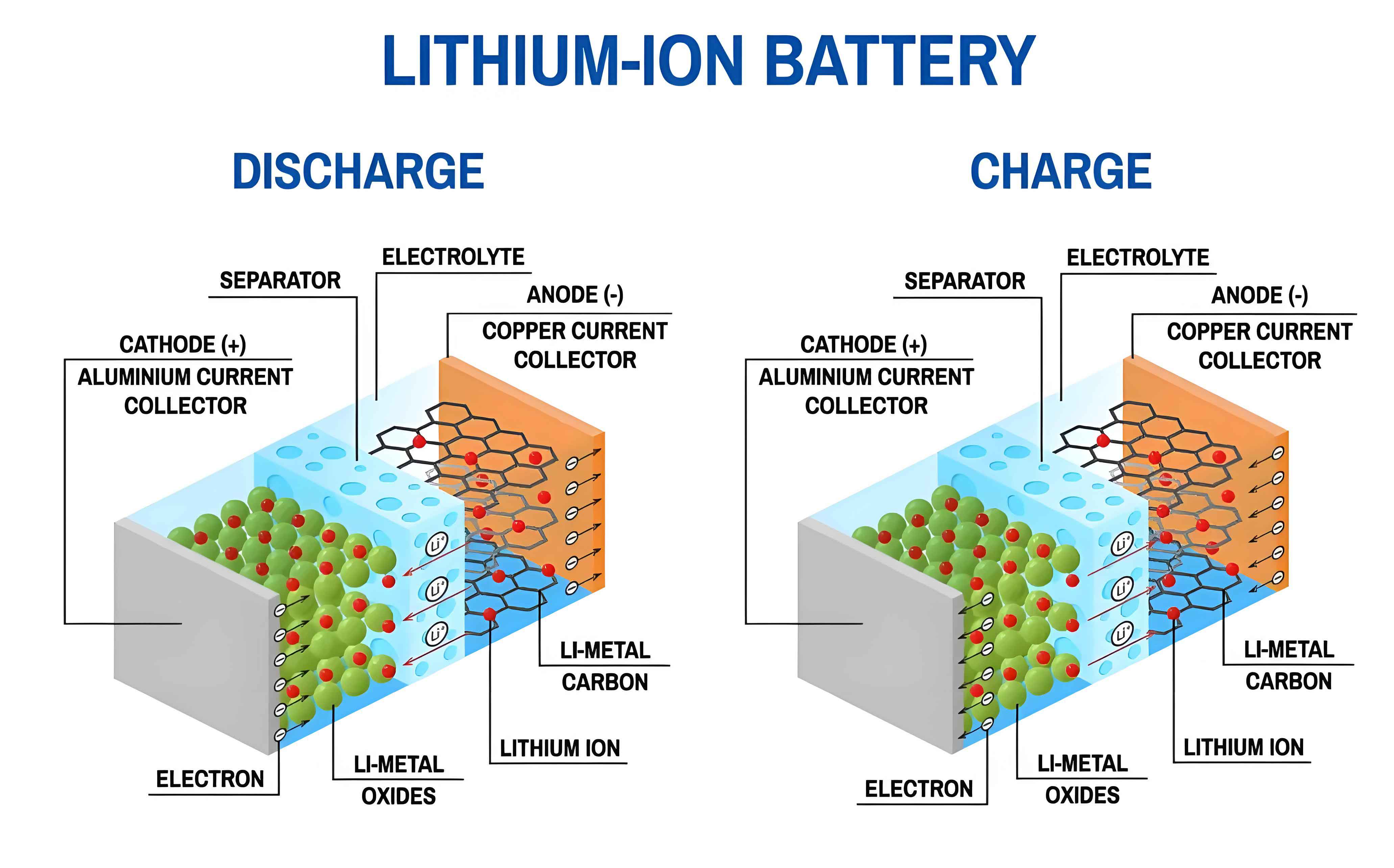
To contextualize this research, let’s delve into the fundamentals of battery modeling for lithium-ion batteries. The most common approach in BMS is the ECM, which uses electrical components like resistors and capacitors to simulate battery behavior. A simple Rint model consists of an open-circuit voltage (OCV) source in series with an internal resistance, while a first-order RC model adds a parallel RC branch to capture polarization dynamics. The OCV is typically a function of SOC, defined as the ratio of remaining discharge capacity to standard capacity at a reference condition (e.g., 1C rate, 25°C). Mathematically, SOC is expressed as:
$$z = \frac{Q_{RDC}}{Q_{ST}}$$
where \(z\) is the SOC, \(Q_{RDC}\) is the remaining discharge capacity, and \(Q_{ST}\) is the standard capacity (e.g., 39.21 Ah for the studied lithium-ion battery). In ECMs, the terminal voltage \(U_k\) at time \(k\) is computed as:
$$U_k = E(z_k) + I \cdot R(z_k)$$
for the Rint model, or with additional RC terms for higher-order models. Here, \(E(z_k)\) is the OCV from a lookup table, \(I\) is the current (positive for discharge), and \(R(z_k)\) is the internal resistance, often parameterized as a function of SOC. However, these models assume that the OCV-SOC relationship is independent of current rate, which is not true for lithium-ion batteries due to kinetic limitations and internal reactions.
The extended equivalent circuit model (EECM) improves upon ECM by incorporating solid-phase diffusion effects from pseudo-two-dimensional (P2D) electrochemical models. In a lithium-ion battery, lithium ions intercalate and de-intercalate at electrode particle surfaces, with concentration gradients developing within the particles. The EECM introduces a surface SOC \(z_{k,surf}\) that differs from the bulk SOC \(z_k\), representing the concentration at the particle surface. This difference is modeled as a first-order inertial response to current:
$$z_{k,surf} – z_k = \lambda I (1 – e^{-t/\tau})$$
where \(\lambda\) is a proportionality coefficient and \(\tau\) is a time constant related to diffusion. The terminal voltage in EECM is then:
$$U_k = E(z_{k,surf}) + I R_e$$
with \(R_e\) as a constant internal resistance. This approach better captures voltage dynamics, but it still assumes a linear relationship between capacity and current, which does not hold for all rates. Experimental data on lithium-ion batteries show that discharge capacity varies nonlinearly with current, as illustrated in Table 1 for a commercial prismatic lithium-ion battery with NCM cathode and graphite anode.
| Current Rate (C) | Discharge Capacity (Ah) | Relative to Standard Capacity (%) |
|---|---|---|
| 1/20 | 42.22 | 108 |
| 1/10 | 41.15 | 105 |
| 1/5 | 40.08 | 102 |
| 1/3 | 39.50 | 101 |
| 2/5 | 39.00 | 99.5 |
| 1/2 | 38.50 | 98.2 |
| 1 | 37.00 | 94.4 |
This table underscores the need for a model that accounts for capacity fade with increasing current in lithium-ion batteries. To address this, I conducted experiments on lithium-ion batteries, including constant-current discharge tests at rates from 1/20C to 1C, hybrid pulse power characteristic (HPPC) tests for parameter identification, and electrochemical impedance spectroscopy (EIS) for resistance analysis. All tests were performed at 25°C using a controlled environment. The discharge curves revealed three distinct regions: a gradual voltage drop at high SOC, a plateau at mid SOC, and a rapid voltage decline at low SOC. Notably, at low rates, a small voltage plateau appears before the rapid drop, which diminishes as current increases—a feature absent in 1C discharges. This indicates additional electrochemical reactions in lithium-ion batteries that are current-dependent.
To probe these reactions, I employed incremental capacity (IC) analysis, which computes the derivative of capacity with respect to voltage (\(dQ/dV\)). IC curves for lithium-ion batteries at different rates, after smoothing and IR compensation, show peaks corresponding to phase transitions. At voltages above 3.5V, IC curves align across rates, suggesting that EECM mechanisms dominate. However, near 3.43V, a peak emerges at low rates and vanishes at high rates, correlating with the small voltage plateau. This peak is attributed to an additional reaction, likely from the graphite anode, as confirmed by half-cell tests on dissected lithium-ion battery electrodes. The anode voltage curve exhibits a plateau around 0.2V vs. Li/Li+, which maps to the full-cell voltage plateau via electrode potential differences.
In lithium-ion batteries, such additional reactions can be described by the Nernst equation, which relates potential to reactant concentrations. For a generic insertion reaction, the potential \(E\) is given by:
$$E = E_0 + \frac{R_q T}{nF} \ln\left(\frac{X – x}{x}\right)$$
where \(E_0\) is a reference potential, \(R_q\) is the gas constant, \(T\) is temperature, \(n\) is the number of electrons transferred, \(F\) is Faraday’s constant, \(X\) is the total charge involved, and \(x\) is the charge consumed. Solving for \(x\) yields:
$$x = \frac{X}{1 + \exp\left(\frac{E – E_0}{k}\right)}$$
with \(k = R_q T / (nF)\). This equation forms the basis for modifying the OCV-capacity relationship in lithium-ion batteries. Let \(q_1\) be the charge from the main reaction (obtained from 1C discharge data, where the additional peak is absent) and \(q_2\) be the charge from the additional reaction. The total charge \(q\) is:
$$q = q_1 + g(I) q_2$$
where \(g(I)\) is a rate-dependent function that decreases with increasing current, reflecting the suppression of the additional reaction at high rates. For the studied lithium-ion battery, parameter fitting via particle swarm optimization (PSO) gave \(g(I)\) as:
$$g(I) = -0.04246 \cdot \frac{I}{Q_{ST}} + 0.06531$$
with a correlation coefficient of 0.9925, indicating a linear trend. The OCV \(E\) is then expressed as a function of total charge \(q\), i.e., \(E = f^{-1}(q)\), where \(f\) incorporates both reactions. This defines the improved EECM for lithium-ion batteries, with terminal voltage calculated as:
$$U_{est} = E(z_{k,surf}) + (I – I_{1/20C}) R_e$$
Here, \(I_{1/20C}\) is the current at 1/20C rate, used to reference the OCV curve from low-rate discharge data. The model parameters, including \(\lambda\), \(\tau\), and \(R_e\), were identified using PSO to minimize root mean square error (RMSE) between simulated and experimental voltages. For instance, \(\lambda = 0.0011\) and \(\tau = 2000\) were obtained for the diffusion component.
The improved EECM was validated against experimental data for lithium-ion batteries under various constant-current discharges and dynamic profiles like the Federal Urban Driving Schedule (FUDS). Table 2 compares the terminal voltage simulation errors (maximum error and RMSE) for traditional ECM, baseline EECM, and the improved EECM across different conditions.
| Condition | Model | Max Error (V) | RMSE (V) |
|---|---|---|---|
| 1/10C Discharge | ECM | 0.5639 | 0.0482 |
| EECM | 0.3069 | 0.0237 | |
| Improved EECM | 0.0516 | 0.0058 | |
| 1/2C Discharge | ECM | 0.5289 | 0.0415 |
| EECM | 0.5110 | 0.0405 | |
| Improved EECM | 0.0893 | 0.0162 | |
| 1C Discharge | ECM | 0.4787 | 0.0366 |
| EECM | 0.4842 | 0.0389 | |
| Improved EECM | 0.1003 | 0.0129 | |
| FUDS Dynamic | ECM | 0.6167 | 0.0238 |
| EECM | 0.5096 | 0.0179 | |
| Improved EECM | 0.3791 | 0.0161 |
The improved EECM consistently outperforms others, especially in low SOC regions where voltage drops rapidly. For example, at 1/10C discharge, the maximum error reduces from 0.5639V (ECM) to 0.0516V (improved EECM). This enhancement stems from accurately modeling the current-dependent capacity loss and additional reactions in lithium-ion batteries. To further illustrate, consider the voltage simulation for a 1C discharge: the improved EECM captures the steep voltage decline near the end, while ECM and EECM show significant overestimation. The mathematical formulation of the improved EECM for lithium-ion batteries can be summarized with key equations. The SOC update follows ampere-hour integration:
$$z_{k+1} = z_k – \frac{I \Delta t}{Q_{ST}}$$
where \(\Delta t\) is the time step. The surface SOC is computed iteratively using the diffusion equation:
$$z_{k,surf} = z_k + \lambda I (1 – e^{-\Delta t/\tau})$$
The OCV \(E\) is derived from the composite charge model. Let \(q_1(E)\) be the charge from the main reaction, obtained by inverting the 1C discharge OCV curve, and \(q_2(E)\) from the Nernst equation:
$$q_2(E) = \frac{X}{1 + \exp\left(\frac{E – E_0}{k}\right)}$$
with parameters \(X = 1.9\), \(E_0 = 3.43\,V\), and \(k = 0.018\,V\). Then, the total charge \(q\) at current \(I\) is:
$$q = q_1(E) + g(I) q_2(E)$$
Given \(q\) from SOC (since \(q = Q_{ST} \cdot (1 – z)\) for discharge), we solve for \(E\) numerically to obtain \(E(z_{k,surf})\). This OCV is used in the terminal voltage equation, with \(R_e = 0.0016\,\Omega\) from EIS data. For dynamic simulations, an RC branch can be added to the improved EECM to capture transient polarization, though the core formulation remains unchanged. The enhanced accuracy of the improved EECM for lithium-ion batteries directly benefits RDC estimation in BMS. RDC, defined as the remaining dischargeable energy under specific conditions, is critical for range prediction in electric vehicles. Traditional methods based on ECM often overestimate RDC at high currents, risking over-discharge. Using the improved EECM, RDC can be predicted by simulating future voltage trajectories under projected current profiles. For instance, at 5% SOC, the RDC values for lithium-ion batteries vary with current rate, as shown in Table 3.
| Current Rate (C) | Actual RDC (Ah) | ECM Estimate (Ah) | EECM Estimate (Ah) | Improved EECM Estimate (Ah) |
|---|---|---|---|---|
| 1/10 | 4.5 | 5.2 | 4.8 | 4.6 |
| 1/2 | 3.0 | 5.0 | 4.0 | 3.2 |
| 1 | 2.0 | 5.0 | 3.5 | 2.1 |
The improved EECM provides estimates closer to actual values, reducing the risk of premature cutoff or damage to lithium-ion batteries. This is achieved by accurately modeling the voltage threshold at which discharge should cease. In practice, BMS can implement the improved EECM online by storing parameterized functions and using recursive algorithms for state estimation. The computational load is manageable, as the model requires only algebraic equations and simple integrations, making it suitable for embedded systems in lithium-ion battery packs.
Looking ahead, there are opportunities to refine the improved EECM for lithium-ion batteries. For instance, temperature effects could be incorporated by making parameters like \(\lambda\), \(\tau\), and \(g(I)\) temperature-dependent. Aging mechanisms, such as capacity fade and resistance growth, could also be integrated to extend model applicability over the battery lifecycle. Furthermore, separating cathode and anode potentials explicitly, rather than using a composite reaction, might improve interpretability for lithium-ion batteries with different chemistries. Experimental validation across a wider range of lithium-ion battery types, including lithium iron phosphate (LFP) and lithium nickel cobalt aluminum oxide (NCA), would strengthen the model’s generality.
In conclusion, the improved EECM presented here offers a significant advancement in modeling lithium-ion batteries for BMS applications. By combining diffusion dynamics from EECM with current-dependent reaction corrections via IC analysis and the Nernst equation, it achieves high accuracy in terminal voltage simulation across diverse current regimes and dynamic conditions. This directly enhances RDC estimation, helping to alleviate range anxiety and improve safety for electric vehicles. The model’s simplicity and efficacy underscore its potential for real-time deployment in managing lithium-ion batteries. As the demand for reliable energy storage grows, continued innovation in battery modeling will be essential, and this work contributes a robust framework for future developments in lithium-ion battery technology.
Throughout this article, I have emphasized the importance of lithium-ion batteries in modern energy systems and the need for precise models. The improved EECM represents a step forward, but ongoing research is vital to address evolving challenges. For example, fast-charging scenarios for lithium-ion batteries may introduce additional nonlinearities not covered here. Moreover, integration with machine learning techniques could further optimize parameter identification and state prediction for lithium-ion batteries. By fostering collaboration between electrochemistry, control theory, and engineering, we can unlock the full potential of lithium-ion batteries, enabling a sustainable energy future.