
In modern power systems, the integration of renewable energy sources, particularly photovoltaic (PV) systems, has become increasingly prevalent. As a critical component, solar inverters convert DC power from PV panels into AC power for grid injection. However, the operational stability of solar inverters is often challenged by grid disturbances, such as voltage imbalances caused by faults, unbalanced loads, or transmission line issues. Under unbalanced grid voltage conditions, conventional control strategies for solar inverters may lead to degraded performance, including distorted output currents, power oscillations, and reduced reliability. In this paper, I address these challenges by proposing an enhanced control method for solar inverters, building upon traditional approaches to ensure robust operation in unbalanced environments. My focus is on developing a controller that can dynamically track frequency variations and provide zero-error current control without the need for complex sequence decomposition, thereby improving the dynamic response and reliability of solar inverters.
The widespread adoption of solar inverters in grid-connected PV systems necessitates advanced control techniques to handle grid anomalies. Voltage imbalances introduce negative-sequence components in the grid, which cause double-frequency oscillations in the output power and currents of solar inverters. Traditional control methods, such as proportional-integral (PI) regulators in synchronous rotating frames, struggle to mitigate these oscillations due to their limited ability to track alternating quantities. While strategies like positive and negative sequence control (PNSC) or balanced positive-sequence control (BPSC) have been explored, they often involve intricate reference calculations or sequence separation, leading to delays and reduced dynamic performance. Proportional resonant (PR) controllers offer improved tracking but face practical limitations in digital implementation due to sensitivity to frequency deviations. In this work, I introduce a proportional-integral reduced-order resonant (PIROR) controller that combines the simplicity of PI control with a resonant环节 tailored for unbalanced conditions. This approach aims to enhance the performance of solar inverters without adding computational complexity, making it suitable for real-world applications.
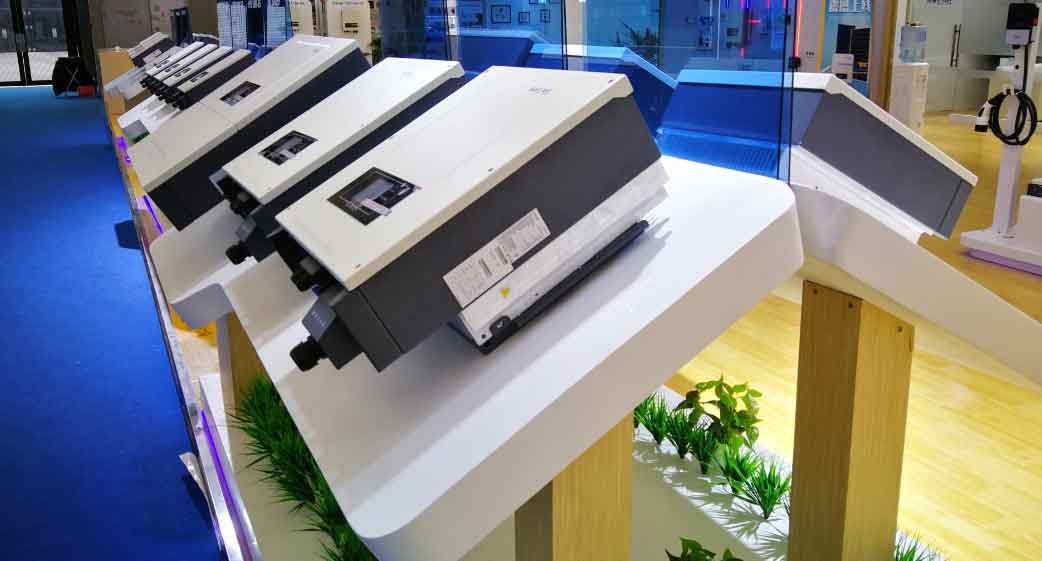
To understand the impact of unbalanced grid voltage on solar inverters, I first establish a mathematical model. Consider a three-phase grid-connected solar inverter system, where the inverter is typically a voltage-source converter with an L filter on the AC side. Under balanced conditions, the grid voltages are sinusoidal and symmetric. However, during imbalances, the voltages can be decomposed into positive-sequence and negative-sequence components. In the stationary αβ-frame, the grid voltage during a fault can be expressed as:
$$U_{f\alpha\beta} = U^+_{f\alpha\beta} + U^-_{f\alpha\beta} = U^+_{fdq^+} e^{+j\omega t} + U^-_{fdq^-} e^{-j\omega t}$$
Here, \(U^+_{f\alpha\beta}\) and \(U^-_{f\alpha\beta}\) represent the positive- and negative-sequence components, respectively, \(\omega\) is the grid angular frequency, and \(t\) denotes time. In the positive synchronous dq-frame, this translates to a DC component from the positive sequence and a double-frequency AC component from the negative sequence:
$$U_{fdq^+} = U^+_{fdq^+} + U^-_{fdq^+} = U^+_{fdq^+} + U^-_{fdq^-} e^{-2j\omega t}$$
The dynamics of the solar inverter in the dq-frame can be described by:
$$\begin{cases}
U^+_{fdq^+} = L \frac{dI^+_{fdq^+}}{dt} + j\omega L I^+_{fdq^+} + E^+_{fdq^+} \\
U^-_{fdq^-} = L \frac{dI^-_{fdq^-}}{dt} – j\omega L I^-_{fdq^-} + E^-_{fdq^-}
\end{cases}$$
where \(L\) is the filter inductance, \(I\) denotes the current, and \(E\) represents the grid back-emf. The output complex power of the solar inverter under unbalanced conditions is given by:
$$S = P + jQ = 1.5 \cdot U \cdot I^* = 1.5 \left( U^+_{fdq^+} e^{j\omega t} + U^-_{fdq^-} e^{-j\omega t} \right) \left( I^+_{fdq^+} e^{j\omega t} + I^-_{fdq^-} e^{-j\omega t} \right)^*$$
Expanding this, the active and reactive powers exhibit double-frequency oscillations:
$$\begin{cases}
P = P_0 + P_{c2} \cos(2\omega t) + P_{s2} \sin(2\omega t) \\
Q = Q_0 + Q_{c2} \cos(2\omega t) + Q_{s2} \sin(2\omega t)
\end{cases}$$
Here, \(P_0\) and \(Q_0\) are the DC components, while \(P_{c2}\), \(P_{s2}\), \(Q_{c2}\), and \(Q_{s2}\) are the double-frequency harmonic components. These oscillations can lead to current distortion and voltage ripple in the DC link of solar inverters, compromising system performance. Therefore, effective control strategies are essential to suppress these oscillations and maintain the reliability of solar inverters.
Traditional control methods for solar inverters often rely on PI regulators in dual dq-frames. While PI controllers are simple and effective for DC reference tracking, they introduce steady-state errors for AC components under unbalanced conditions. The transfer function of a PI controller is:
$$G_{\text{PI}}(s) = K_p + \frac{K_I}{s}$$
where \(K_p\) and \(K_I\) are the proportional and integral gains. At the fundamental frequency \(\omega_0\), the gain is finite, leading to amplitude and phase errors. To address this, proportional resonant (PR) controllers have been proposed, with a transfer function:
$$G_{\text{PR}}(s) = K_p + \frac{K_R s}{s^2 + \omega_0^2}$$
PR controllers provide infinite gain at the resonant frequency \(\omega_0\), enabling zero-error tracking of sinusoidal signals. However, in practical implementations for solar inverters, frequency deviations can degrade performance due to the narrow bandwidth of the resonant peak. Moreover, digital realization of PR controllers requires careful discretization, which adds complexity.
In this paper, I propose a modified controller termed the proportional-integral reduced-order resonant (PIROR) controller for solar inverters. This controller integrates a reduced-order resonant环节 into a standard PI structure, offering a balance between simplicity and performance. The transfer function is:
$$G_{\text{PIROR}}(s) = K_p + \frac{K_I}{s} + \frac{K_R}{s – j\omega_0}$$
Here, the term \(\frac{K_R}{s – j\omega_0}\) is a first-order generalized integrator that selectively amplifies the negative-sequence component at frequency \(\omega_0\). Compared to the second-order resonant环节 in PR controllers, this reduced-order approach simplifies implementation while maintaining high gain at the target frequency. To enhance robustness against grid frequency variations, I introduce a frequency adaptation mechanism. Let \(\Delta \omega = \omega_f – \omega_{f0}\) represent the frequency deviation, where \(\omega_f\) is the actual grid frequency and \(\omega_{f0}\) is the nominal frequency. The modified resonant term becomes:
$$H'(s) = \frac{k \Delta \omega}{s – j\omega_0 + \Delta \omega}$$
where \(k > 1\) is a gain coefficient that adjusts the bandwidth. This extension broadens the high-gain frequency range, allowing the solar inverter to maintain precise control even under frequency fluctuations. The PIROR controller operates in the positive dq-frame without requiring sequence separation of currents, thus avoiding delays associated with decomposition algorithms. The control law for the current loop is:
$$U^{\text{con}}_{dq^+} = \left( K_p + \frac{K_I}{s} + K_R H'(s) \right) \left( I^*_{dq} – I_{dq} \right)$$
where \(U^{\text{con}}_{dq^+}\) is the control voltage, \(I^*_{dq}\) is the current reference, and \(I_{dq}\) is the measured current. The reference currents are computed based on power requirements. For instance, to suppress active power oscillations, the positive- and negative-sequence current references can be derived as:
$$\begin{cases}
I^{+*}_{d^+} = \frac{2}{3} \left( \frac{E^+_{d^+} P_0}{m} + \frac{E^+_{q^+} Q_0}{n} \right) \\
I^{+*}_{q^+} = \frac{2}{3} \left( \frac{E^+_{q^+} P_0}{m} – \frac{E^+_{d^+} Q_0}{n} \right) \\
I^{-*}_{d^-} = \frac{2}{3} \left( -\frac{E^-_{d^-} P_0}{m} + \frac{E^-_{q^-} Q_0}{n} \right) \\
I^{-*}_{q^-} = \frac{2}{3} \left( -\frac{E^-_{q^-} P_0}{m} – \frac{E^-_{d^-} Q_0}{n} \right)
\end{cases}$$
with \(m = E^{+2}_{d^+} + E^{+2}_{q^+} – E^{-2}_{d^-} – E^{-2}_{q^-}\) and \(n = E^{+2}_{d^+} + E^{+2}_{q^+} + E^{-2}_{d^-} + E^{-2}_{q^-}\). These references are then combined and transformed into the positive dq-frame for the PIROR controller. Decoupling and feedforward terms are added to improve dynamic response:
$$\begin{cases}
U^*_{d^+}(s) = U^{\text{con}}_{d^+} – j\omega L I_{q^+} + E_{d^+} \\
U^*_{q^+}(s) = U^{\text{con}}_{q^+} + j\omega L I_{d^+} + E_{q^+}
\end{cases}$$
The overall control structure for the solar inverter is illustrated in a block diagram, integrating the PIROR controller, reference generation, and modulation stages. This design ensures that solar inverters can quickly adapt to grid imbalances while maintaining stable operation.
To validate the proposed PIROR controller for solar inverters, I conducted simulation studies using MATLAB/Simulink. The solar inverter system was modeled as a three-phase voltage-source converter with a boost stage on the DC side. Key parameters are summarized in Table 1.
| Parameter | Value |
|---|---|
| Rated Power | 10 kW |
| Grid Frequency | 50 Hz |
| DC Link Voltage | 300 V |
| DC Capacitance | 1000 µF |
| AC Filter Inductance | 3 mH |
| Switching Frequency | 6 kHz |
| Controller Gains (Kp/KR/KI) | 6/30/70 |
The solar inverter was set to deliver 6 kW of active power and 6 kvar of reactive power to the grid. To simulate an unbalanced condition, a voltage dip of 70% was applied to phase A at t = 1.06 s, while phases B and C remained unchanged. I compared the performance of three controllers: traditional PI, PR, and the proposed PIROR controller. The metrics evaluated included DC link voltage stability, output current quality, and power oscillation suppression.
Under the voltage dip, the solar inverter experienced negative-sequence currents, leading to double-frequency oscillations in the DC link voltage and output power. With the traditional PI controller, the response showed significant delays and prolonged oscillations in active power, as depicted in Figure 1a. This is due to the time required for sequence decomposition in the dual dq-frame implementation. The PR controller, as shown in Figure 1b, offered faster tracking and better suppression of power oscillations, but its performance could degrade if grid frequency deviated from 50 Hz. In contrast, the PIROR controller, illustrated in Figure 1c, demonstrated rapid attenuation of oscillations and maintained stable power output with minimal transient disturbance. The DC link voltage ripple was also reduced, highlighting the effectiveness of the resonant环节 in handling unbalanced conditions for solar inverters.
The simulation results confirm that the PIROR controller enhances the dynamic performance of solar inverters under unbalanced grid voltage. By incorporating frequency adaptation, it ensures robustness against frequency variations, which is common in real-world grids. Moreover, the elimination of sequence separation reduces computational burden and improves response speed, making it a practical solution for solar inverter applications.
In conclusion, I have presented an improved control strategy for solar inverters operating under unbalanced grid voltage conditions. The proposed PIROR controller combines proportional-integral action with a reduced-order resonant环节 to achieve zero-error current control without the need for positive- and negative-sequence decomposition. This approach addresses the limitations of traditional PI and PR controllers, offering enhanced dynamic response and reliability for solar inverters. Simulation studies validate the effectiveness of the controller in suppressing power oscillations and maintaining stability during voltage dips. Future work could focus on hardware implementation and testing under various grid disturbances to further optimize the controller for commercial solar inverters. The integration of such advanced control methods will be crucial for ensuring the resilience of PV systems in evolving power networks.
The development of robust control strategies for solar inverters is essential as renewable energy penetration increases. Grid imbalances pose significant challenges, but with controllers like PIROR, solar inverters can continue to operate efficiently and contribute to grid stability. I believe that this research provides a valuable step forward in the design of next-generation solar inverters, paving the way for more reliable and adaptive power conversion systems.
To further elaborate on the mathematical foundations, consider the discretization of the PIROR controller for digital implementation in solar inverters. Using Tustin transformation, the continuous-time transfer function can be converted to a discrete form. For the resonant term \(H'(s)\), the discrete equivalent is derived as follows. Let \(T_s\) be the sampling period. Then:
$$s = \frac{2}{T_s} \frac{z – 1}{z + 1}$$
Applying this to \(H'(s) = \frac{k \Delta \omega}{s – j\omega_0 + \Delta \omega}\), we obtain a difference equation that can be programmed into a digital signal processor. For instance, the control voltage updates in the dq-frame are given by:
$$U^{\text{con}}_d(k) = \frac{1}{1 + a} \left[ a \left( I^*_d(k) + I^*_d(k-1) \right) + (1 + a) U^{\text{con}}_q(k-1) – b \left( U^{\text{con}}_q(k) + U^{\text{con}}_q(k-1) \right) \right]$$
$$U^{\text{con}}_q(k) = \frac{1}{1 + a} \left[ a \left( I^*_q(k) + I^*_q(k-1) \right) + (1 + a) U^{\text{con}}_d(k-1) + b \left( U^{\text{con}}_d(k) + U^{\text{con}}_d(k-1) \right) \right]$$
where \(a = \omega_c T_s / 2\) and \(b = \omega T_s / 2\), with \(\omega_c\) as a cutoff frequency. This discretization ensures that the PIROR controller can be efficiently executed in real-time for solar inverters.
Additionally, the impact of controller gains on solar inverter performance is critical. Through parametric analysis, I observed that increasing \(K_R\) enhances the suppression of negative-sequence currents but may lead to instability if too high. A trade-off exists between response speed and damping. Table 2 summarizes typical gain ranges for solar inverters based on simulation tuning.
| Gain | Range | Effect |
|---|---|---|
| Kp | 5–10 | Improves transient response |
| KI | 50–100 | Reduces steady-state error |
| KR | 20–40 | Enhances harmonic rejection |
| k | 1.5–3 | Adjusts frequency adaptation bandwidth |
These guidelines assist in tuning solar inverters for optimal performance under unbalanced conditions. Furthermore, the scalability of the PIROR controller makes it applicable to various solar inverter topologies, including single-stage and multi-stage systems.
In terms of practical implementation, solar inverters equipped with the PIROR controller can be deployed in distributed generation systems to enhance grid support functions. For example, during voltage sags, the controller can prioritize reactive power injection to aid voltage recovery, while still managing active power flow. This flexibility is vital for modern solar inverters that participate in grid services like frequency regulation and fault ride-through.
To summarize, the PIROR controller represents a significant advancement in the control of solar inverters under unbalanced grid voltage. Its design simplicity, combined with adaptive features, addresses key challenges in power quality and system stability. As solar energy continues to grow, such innovations will be instrumental in ensuring that solar inverters operate reliably and contribute to a sustainable power infrastructure.