
In the rapidly evolving landscape of renewable energy integration, solar power generation has emerged as a pivotal contributor to global electricity grids. Among various technologies, high-power solar inverters play a critical role in converting direct current (DC) from photovoltaic (PV) arrays into alternating current (AC) for grid connection. As the penetration of solar energy increases, ensuring grid stability during disturbances, such as voltage sags, becomes paramount. This article presents a comprehensive approach to achieving low voltage ride-through (LVRT) capability in high-power solar inverters, leveraging DC bus voltage control for maximum power point tracking (MPPT) and dynamic response to grid faults. The focus is on a control strategy that enhances the resilience of solar inverters, allowing them to remain connected during voltage dips while providing reactive power support and ensuring rapid power recovery. Throughout this discussion, the term “solar inverters” will be emphasized to underscore their centrality in modern PV systems.
The integration of large-scale solar farms into power grids introduces challenges related to voltage stability and fault ride-through. Unlike traditional generators, solar inverters are power electronic devices with no inherent inertia, making them sensitive to grid voltage fluctuations. During voltage sags, if solar inverters disconnect abruptly, it can exacerbate grid instability, leading to cascading failures. Therefore, grid codes, such as those outlined by the State Grid Corporation of China (Q/GDW 617-2011), mandate that high-power solar inverters possess LVRT capability. This requires solar inverters to stay connected during voltage dips, provide reactive current support, and restore active power swiftly after fault clearance. Our work addresses these requirements through a novel control scheme based on DC bus voltage manipulation, which not only facilitates efficient MPPT but also enables seamless transition between normal operation and LVRT modes. The effectiveness of this strategy is validated through experimental results on a 500 kW solar inverter prototype.
To contextualize this research, it is essential to understand the LVRT requirements for solar inverters. According to grid standards, solar inverters must remain connected when the grid voltage drops to a certain level, as illustrated in a typical LVRT curve. For instance, during a voltage dip to 20% of the nominal voltage, solar inverters should stay online for at least 1 second. Moreover, during the dip, solar inverters must inject reactive current into the grid to support voltage recovery. The required reactive current magnitude is often proportional to the voltage dip depth, with a common formula being: $$I_q > 1.6 \times (0.9 – U_d^* / U_d) \times I_{rated}$$ where $I_q$ is the reactive current, $U_d^*$ is the actual grid voltage during the dip, $U_d$ is the nominal voltage, and $I_{rated}$ is the rated current of the solar inverter. Additionally, after voltage recovery, the active power output of solar inverters must ramp up at a rate of at least 30% of the rated power per second. These stringent demands necessitate robust control algorithms for solar inverters, which we have developed using DC bus voltage as a key control variable.
The design of high-power solar inverters typically involves a three-phase full-bridge topology with LC filters, as shown in the system structure. In our implementation, the solar inverter operates without a DC-DC converter, directly interfacing with the PV array at a DC voltage range of 450–800 V. The AC output is connected to a 270 V line-to-line grid. Control of such solar inverters is achieved through a dual-loop proportional-integral (PI) regulator scheme for current tracking, coupled with an outer voltage loop for DC bus regulation. The core control diagram can be summarized as follows: the grid voltage is transformed into a synchronous reference frame (dq-frame), where the d-axis represents the active current component and the q-axis represents the reactive component. The reference values for these currents are derived from MPPT and LVRT logic, respectively. The PI controllers generate modulation signals for pulse-width modulation (PWM) to drive the insulated-gate bipolar transistors (IGBTs). This framework ensures that solar inverters maintain high power quality and grid synchronization under varying conditions.
One of the key innovations in our approach is the MPPT strategy based on DC bus voltage control. Traditional MPPT methods for solar inverters, such as perturb-and-observe or incremental conductance, directly adjust the grid current reference to track the maximum power point of the PV array. However, these methods can lead to DC bus voltage collapse during rapid changes in irradiance, causing instability. In contrast, our method perturbs the DC bus voltage reference and uses a PI regulator to adjust the grid current reference accordingly. This allows solar inverters to maintain stable operation even under fluctuating sunlight, as the DC bus voltage is inherently linked to the PV array’s power characteristics. The power-voltage (P-V) curve of a typical PV array shows a unique maximum power point (MPP), where the derivative of power with respect to voltage is zero: $$\frac{dP}{dV} = 0$$ By controlling the DC bus voltage around this point, solar inverters can achieve efficient MPPT with minimal oscillations. Moreover, this strategy facilitates quick adaptation during LVRT events, as the DC bus voltage reference can be dynamically modified to manage power flow.
To elaborate, the DC bus voltage control loop operates by comparing the measured DC voltage $U_{dc}$ with a reference value $U_{dc,ref}$. The error is processed by a PI controller to produce the d-axis current reference $I_{d,ref}$ for the grid current. Simultaneously, the q-axis current reference $I_{q,ref}$ is set based on reactive power requirements. The control equations can be expressed as: $$I_{d,ref} = K_{p,v} (U_{dc,ref} – U_{dc}) + K_{i,v} \int (U_{dc,ref} – U_{dc}) dt$$ $$I_{q,ref} = f(U_{dip})$$ where $K_{p,v}$ and $K_{i,v}$ are PI gains, and $f(U_{dip})$ is a function of the grid voltage dip depth. This integrated approach ensures that solar inverters prioritize stability during faults while maximizing energy harvest during normal operation. The table below summarizes the key parameters of our solar inverter system, highlighting the design specifications that enable this control strategy.
| Parameter | Value | Description |
|---|---|---|
| Rated Power | 500 kW | Maximum output power of the solar inverter |
| DC Voltage Range | 450–800 V | Input voltage from the PV array |
| AC Grid Voltage | 270 V (line-to-line) | Grid connection voltage |
| Switching Frequency | 3 kHz | PWM frequency for IGBTs |
| Filter Inductance (L) | 0.5 mH | Inductance in the LC filter |
| Filter Capacitance (C) | 50 μF | Capacitance in the LC filter |
| MPPT Efficiency | >99% | Static tracking efficiency under stable conditions |
The implementation of LVRT in solar inverters involves several critical steps: grid voltage detection, reactive current support, and post-fault power recovery. For grid voltage detection, solar inverters must quickly identify both balanced and unbalanced voltage dips. Balanced dips, where all three phases drop equally, can be detected using positive-sequence voltage components. However, unbalanced dips, where one or two phases are affected, require more sophisticated methods. We employ a virtual three-phase construction technique for single-phase voltages, which rapidly estimates the instantaneous amplitude of each phase. For a given phase voltage $U_A$, the virtual three-phase set is created as: $$U_{A,virtual} = U_A$$ $$U_{B,virtual} = U_A(t – T/6)$$ $$U_{C,virtual} = -U_{A,virtual} – U_{B,virtual}$$ where $T$ is the grid period. This allows solar inverters to compute the positive-sequence voltage and determine the dip depth within milliseconds, enabling timely response.
During voltage dips, solar inverters must provide reactive current support as per grid codes. For balanced dips, the reactive current reference is calculated using the formula mentioned earlier. For unbalanced dips, the reactive current is adjusted based on the deepest phase voltage dip to ensure adequate support. The total current output of solar inverters is limited by the inverter’s thermal ratings, so the active current must be reduced to accommodate reactive injection. This is governed by: $$I_{inv,d} < \sqrt{I_{max}^2 – I_{inv,q}^2}$$ where $I_{inv,d}$ is the active current, $I_{inv,q}$ is the reactive current, and $I_{max}$ is the maximum allowable current for the solar inverter. Our control strategy dynamically adjusts these currents using the dq-frame PI regulators, ensuring that solar inverters remain within safe operating limits while meeting grid requirements.
After the grid voltage recovers, solar inverters must restore active power quickly. The LVRT standard specifies a minimum recovery rate of 30% rated power per second. Our DC bus voltage control strategy facilitates this by allowing a fast transition from the LVRT mode to MPPT mode. During the dip, the DC bus voltage rises due to reduced power output, approaching the open-circuit voltage of the PV array. At fault clearance, we set a fixed DC bus voltage reference at 85% of the open-circuit voltage, which corresponds to a point near the MPP on the P-V curve. This forces the solar inverter to rapidly increase power output, after which the normal perturbative MPPT resumes for fine-tuning. The power recovery process can be modeled as: $$P_{recovery}(t) = P_{initial} + k \cdot t$$ where $k$ is the recovery rate, ensured to be above the required threshold. This approach has been proven effective in experiments, with solar inverters achieving recovery rates exceeding 90% per second.
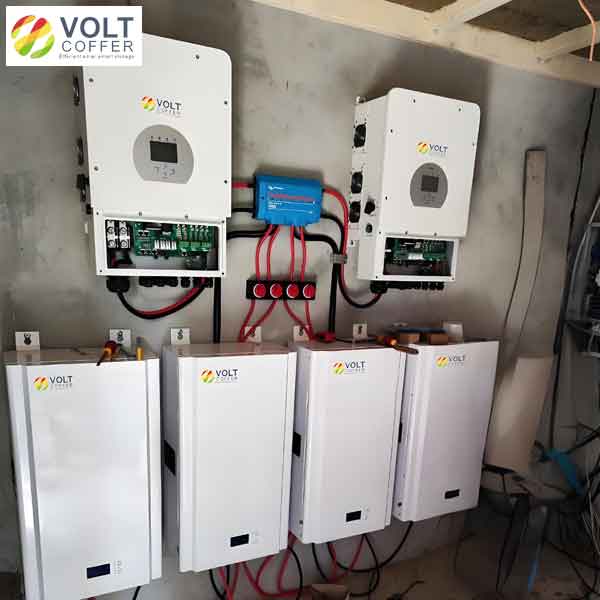
Experimental validation was conducted on a 500 kW solar inverter testbed, using a PV simulator and grid emulator to replicate various operating conditions. The results demonstrate the efficacy of our control strategy for both MPPT and LVRT. Under stable irradiance, the solar inverter achieved a static MPPT efficiency of over 99.3%, with DC bus voltage fluctuations within ±10 V. During dynamic irradiance changes, such as a rapid drop from 100% to 30% rated power, the solar inverter maintained a dynamic MPPT efficiency above 98.8%, avoiding voltage collapse. For LVRT tests, balanced voltage dips to 20% were applied, and the solar inverter responded within 30 ms, injecting reactive current as required. The post-dip power recovery rate was measured at over 90% per second, surpassing grid standards. Unbalanced dips were also tested, and the virtual construction method enabled accurate detection and response, with reactive current tailored to the deepest phase dip. The table below summarizes key experimental outcomes, highlighting the performance of solar inverters under different scenarios.
| Test Scenario | Metric | Value | Comments |
|---|---|---|---|
| Stable MPPT | Efficiency | 99.3% | Under constant irradiance |
| Dynamic MPPT | Efficiency | 98.8% | During irradiance swings |
| Balanced LVRT | Reaction Time | <30 ms | Time to inject reactive current |
| Balanced LVRT | Power Recovery Rate | >90%/s | After voltage recovery |
| Unbalanced LVRT | Detection Accuracy | High | Via virtual construction method |
| Overall Stability | DC Bus Voltage | 450–800 V | Within operating range |
The control strategy for solar inverters also involves mathematical modeling to ensure stability. The system can be represented in state-space form, with states including the DC bus voltage, grid currents, and filter dynamics. For instance, the DC bus voltage dynamics are given by: $$C_{dc} \frac{dU_{dc}}{dt} = I_{pv} – I_{inv}$$ where $C_{dc}$ is the DC-link capacitance, $I_{pv}$ is the PV array current, and $I_{inv}$ is the inverter input current. The grid current dynamics in the dq-frame are: $$L \frac{dI_d}{dt} = U_d – R I_d + \omega L I_q$$ $$L \frac{dI_q}{dt} = U_q – R I_q – \omega L I_d$$ where $L$ and $R$ are the filter inductance and resistance, $\omega$ is the grid frequency, and $U_d$ and $U_q$ are the inverter output voltages. By designing PI controllers with appropriate gains, solar inverters can achieve robust performance across operating points. The use of DC bus voltage control adds an integral action that enhances disturbance rejection, crucial for LVRT scenarios.
Furthermore, the integration of solar inverters into smart grids requires compliance with evolving standards. Our approach aligns with international guidelines, such as IEEE 1547 and IEC 61727, which emphasize fault ride-through capabilities for distributed energy resources. The flexibility of the DC bus voltage control allows solar inverters to adapt to different grid codes by simply tuning the reference values and PI parameters. For example, in regions with stricter reactive power requirements, the function $f(U_{dip})$ can be modified to increase reactive current injection. This adaptability makes solar inverters based on this strategy suitable for global deployment, contributing to grid resilience in diverse environments.
In conclusion, the implementation of LVRT in high-power solar inverters through DC bus voltage control offers a robust solution for grid integration of solar energy. By perturbing the DC bus voltage for MPPT, solar inverters achieve high efficiency and stability, even under rapid irradiance changes. The virtual three-phase construction method enables accurate detection of unbalanced voltage dips, ensuring timely reactive support. During LVRT events, solar inverters dynamically adjust active and reactive currents to remain within limits, and post-fault power recovery is accelerated through fixed voltage reference switching. Experimental results on a 500 kW platform validate the strategy, with solar inverters meeting all grid code requirements for LVRT. This work underscores the importance of advanced control algorithms in enhancing the functionality of solar inverters, paving the way for higher penetration of renewable energy into power systems. Future research could explore the integration of energy storage with solar inverters to further improve LVRT performance, but the current approach already represents a significant advancement in solar inverter technology.
To summarize the key equations and relationships discussed, below is a list of critical formulas used in the control of solar inverters for LVRT:
- Reactive current requirement: $$I_q > 1.6 \times (0.9 – U_d^* / U_d) \times I_{rated}$$
- Current limit constraint: $$I_{inv,d} < \sqrt{I_{max}^2 – I_{inv,q}^2}$$
- DC bus voltage dynamics: $$C_{dc} \frac{dU_{dc}}{dt} = I_{pv} – I_{inv}$$
- Grid current dynamics in dq-frame: $$L \frac{dI_d}{dt} = U_d – R I_d + \omega L I_q$$ $$L \frac{dI_q}{dt} = U_q – R I_q – \omega L I_d$$
- Virtual phase construction: $$U_{B,virtual} = U_A(t – T/6)$$ $$U_{C,virtual} = -U_{A,virtual} – U_{B,virtual}$$
These formulas, combined with the tabulated parameters and results, provide a comprehensive framework for understanding and implementing LVRT in solar inverters. The repeated emphasis on solar inverters throughout this article highlights their central role in modern energy systems, and the proposed control strategy ensures they can meet the challenges of grid stability in the era of renewable energy.