
In recent years, the integration of renewable energy sources into the power grid has become crucial for achieving sustainable energy goals. As a key interface, the grid-connected inverter plays a vital role in converting and injecting power from sources like photovoltaics and wind turbines into the grid. However, the increased penetration of power electronic devices has led to frequent oscillation incidents due to interactions between inverters and the grid. To address these stability challenges, precise impedance modeling of the on-grid inverter is essential. In this paper, we focus on the single-phase grid-connected inverter and investigate its impedance characteristics, particularly under weak grid conditions where frequency coupling effects become significant. We aim to develop a comprehensive model that accounts for the influence of the phase-locked loop (PLL) and provides insights into system stability. This work is structured to first establish the mathematical foundation, then derive the impedance model, analyze frequency coupling mechanisms, and validate the findings through simulations. Throughout this discussion, the term on-grid inverter will be frequently referenced to emphasize its central role in modern power systems.
The core of our analysis is the LCL-type single-phase grid-connected inverter, which offers superior filtering capabilities but introduces complexity in control and stability. The basic structure consists of a DC source, an inverter bridge, an LCL filter, and a grid connection point. Control strategies typically involve dual current loops to regulate the grid current and damp resonances. In this context, we consider a system where the inverter is connected to a grid with impedance, making it a weak grid scenario. The figure below illustrates a typical on-grid inverter setup, which will be referenced in our modeling.
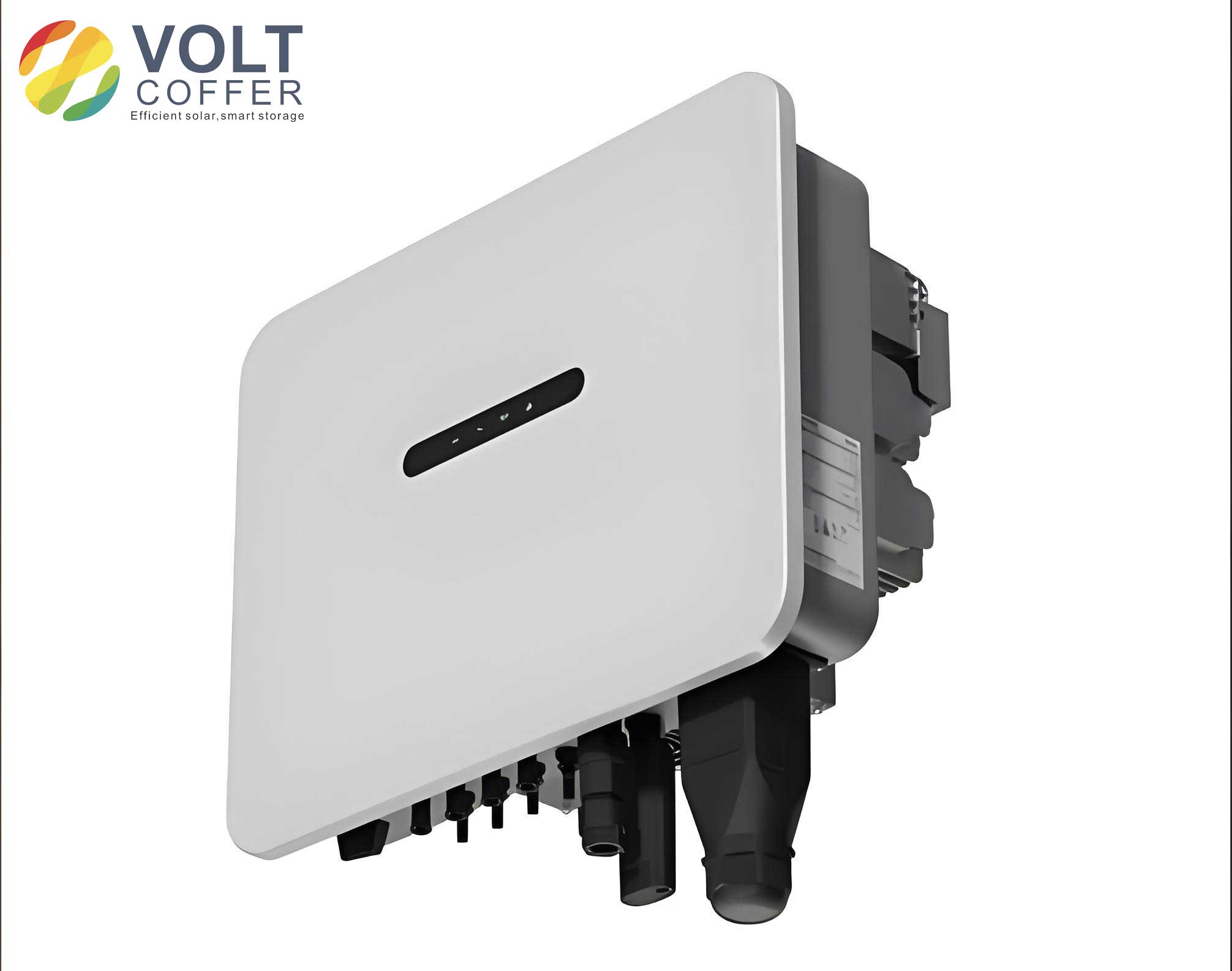
The on-grid inverter’s performance is heavily influenced by control loops, especially the PLL, which synchronizes the inverter with the grid voltage. Understanding these interactions is key to preventing oscillations and ensuring reliable operation of the on-grid inverter in renewable energy applications.
To begin, we establish the mathematical model of the LCL-type grid-connected inverter. The system can be represented by its circuit equations and control block diagram. The inverter output current \(i_g(s)\) in the Laplace domain, without considering PLL effects, is given by:
$$ i_g(s) = \frac{1}{H_2} \cdot \frac{T(s)}{1 + T(s)} i_{ref} – Y_{con}(s) V_{pcc}(s) $$
where \(T(s)\) and \(Y_{con}(s)\) are transfer functions defined as:
$$ T(s) = \frac{H_2 K_{PWM} G_i(s)}{s^3 L_1 L_2 C + s^2 L_2 C H_1 K_{PWM} + s (L_1 + L_2)} $$
$$ Y_{con}(s) = \frac{s^2 L_1 C + s C H_1 K_{PWM} + 1}{s^3 L_1 L_2 C + s^2 L_2 C H_1 K_{PWM} + s (L_1 + L_2) + H_2 K_{PWM} G_i(s)} $$
Here, \(G_i(s)\) is the PI controller for the current loop, \(K_{PWM}\) is the gain of the PWM modulator, \(H_1\) and \(H_2\) are feedback coefficients, and \(L_1\), \(L_2\), and \(C\) are the filter components. This model forms the basis for analyzing the on-grid inverter’s behavior, but it neglects the impact of the PLL, which becomes critical in weak grids. To accurately represent the on-grid inverter, we must incorporate the PLL dynamics.
The PLL is responsible for tracking the grid voltage phase and ensuring proper synchronization. In a single-phase on-grid inverter, a quadrature generation unit is used to create orthogonal components for the PLL. When a disturbance voltage at frequency \(f_p\) is superimposed on the grid voltage at frequency \(f_0\), the PLL output phase angle deviates by \(\Delta \theta\). This deviation affects the reference current and, consequently, the inverter output. By representing signals as complex vectors, we can analyze the frequency components introduced by the PLL. The PCC voltage in the time domain is:
$$ V_{pcc}(t) = V_0 \cos(2\pi f_0 t) + V_p \cos(2\pi f_p t + \phi_p) $$
After quadrature processing, the complex vector in the stationary frame is:
$$ V_{\alpha\beta}(t) = V_0 e^{j\omega_0 t} + V_p^+ e^{j\omega_p t} $$
where \(V_p^+ = V_p e^{+j\phi_p}\) and \(\omega_0 = 2\pi f_0\), \(\omega_p = 2\pi f_p\). Transforming to the synchronous frame (based on the PLL output) and linearizing, we obtain the small-signal model:
$$ \Delta V_{dq}^C \approx -jV_0 \Delta \theta(t) + V_p^+ e^{j(\omega_p – \omega_0)t} $$
The PLL control loop relates the phase deviation to the q-axis voltage disturbance. The transfer function from the disturbance voltage to the phase deviation is:
$$ \Delta \theta(t) = \frac{H_{pll}(t)}{1 + V_0 H_{pll}(t)} V_{pq}^S(t) $$
where \(H_{pll}(s) = \frac{k_p s + k_i}{s^2}\) for a PI-type PLL. The q-axis disturbance voltage \(V_{pq}^S(t)\) is a real signal that can be expressed as a sum of complex conjugates, leading to frequency components at \(f_p – f_0\) and \(f_0 – f_p\). This asymmetry in the PLL response is the root cause of frequency coupling in the on-grid inverter. Specifically, the phase deviation \(\Delta \theta\) contains both frequencies, which after trigonometric operations in the current reference, produce output currents at \(f_p\) and \(2f_0 – f_p\). This phenomenon is critical for impedance modeling of the on-grid inverter.
To derive the output impedance, we define self-admittance \(Y_S\) and mutual admittance \(Y_A\). The self-admittance represents the ratio of the disturbance current at frequency \(f_p\) to the disturbance voltage at \(f_p\), while the mutual admittance represents the ratio of the disturbance current at frequency \(2f_0 – f_p\) to the disturbance voltage at \(f_p\). For the on-grid inverter, these are given by:
$$ Y_S(j\omega_p) = -\frac{1}{H_2} \cdot \frac{T(j\omega_p)}{1 + T(j\omega_p)} \cdot I_m T_{pll}(j\omega_p – j\omega_0) + Y_{con}(j\omega_p) $$
$$ Y_A(j2\omega_0 – j\omega_p) = \frac{1}{H_2} \cdot \frac{T(j2\omega_0 – j\omega_p)}{1 + T(j2\omega_0 – j\omega_p)} \cdot I_m T_{pll}(j\omega_0 – j\omega_p) \cdot e^{-j2\phi_p} $$
where \(T_{pll}(s) = \frac{0.5 H_{pll}(s)}{1 + V_0 H_{pll}(s)}\) is the PLL transfer function, and \(I_m\) is the amplitude of the reference current. These admittances capture the frequency coupling effect. In a strong grid, where grid impedance is negligible, the on-grid inverter’s output current can be directly computed from these admittances. However, in a weak grid, the grid impedance \(Z_g\) interacts with the inverter admittances, leading to coupled frequency responses.
The frequency coupling mechanism arises because the disturbance currents at \(f_p\) and \(2f_0 – f_p\) flow through the grid impedance, producing voltage drops at these frequencies. These voltages, in turn, act as additional disturbances to the on-grid inverter, creating a feedback loop. The process can be visualized as an interconnected system where the inverter admittances and grid impedance form a network. The equivalent output admittance of the on-grid inverter, considering frequency coupling, is derived as:
$$ Y_{eq} = Y_S(j\omega_p) + Y_p(j2\omega_0 – j\omega_p) $$
where \(Y_p\) is the admittance due to the coupling path, expressed as:
$$ Y_p(j2\omega_0 – j\omega_p) = \frac{-Z_g(j2\omega_0 – j\omega_p) Y_A(j\omega_p) Y_A(j2\omega_0 – j\omega_p)}{1 + Y_S(j2\omega_0 – j\omega_p) Z_g(j2\omega_0 – j\omega_p)} $$
This model shows that the on-grid inverter’s output admittance depends on the grid impedance, highlighting the non-independence of the inverter and grid in weak conditions. The frequency coupling effect primarily affects the low-frequency range of the on-grid inverter’s impedance, which is crucial for stability assessment.
Stability analysis of the interconnected system involves examining the ratio of grid impedance to inverter equivalent impedance. Using the Nyquist stability criterion, the system is stable if the phase margin at the crossover frequency is positive. For a purely inductive grid impedance \(Z_g = j\omega L_g\), the stability condition simplifies to:
$$ \arg(Z_{eq}(f_c)) > -90^\circ $$
where \(f_c\) is the crossover frequency where \(|Z_g| = |Z_{eq}|\). This criterion allows us to evaluate the damping of the system and predict oscillations. The on-grid inverter’s design must ensure sufficient phase margin under various grid conditions to avoid instability.
To validate our model, we perform simulations using MATLAB/Simulink. The parameters for the single-phase LCL-type on-grid inverter are summarized in the table below. These parameters are typical for a residential-scale renewable energy system.
| Parameter | Symbol | Value | Unit |
|---|---|---|---|
| Grid Frequency | \(f_0\) | 50 | Hz |
| Grid Voltage | \(V_g\) | 360 | V |
| DC Link Voltage | \(V_{dc}\) | 750 | V |
| Triangular Wave Amplitude | \(V_{tri}\) | 1 | V |
| Current Controller (kp, ki) | \(G_i(s)\) | 0.145, 700 | – |
| Inverter-side Inductor | \(L_1\) | 0.6 | mH |
| Filter Capacitor | \(C\) | 10 | μF |
| Grid-side Inductor | \(L_2\) | 0.15 | mH |
| Active Damping Coefficient | \(H_1\) | 0.04 | – |
| Grid Current Feedback | \(H_2\) | 0.15 | – |
We inject a disturbance voltage of 10 V amplitude at various frequencies from 10 Hz to 10 kHz and measure the grid current. The self-impedance \(Z_S = 1/Y_S\) and mutual impedance \(Z_A = 1/Y_A\) are computed from the FFT analysis. The Bode plots of these impedances show good agreement between theoretical calculations and simulation results, confirming the accuracy of our model for the on-grid inverter. The frequency coupling effect is evident in the low-frequency region, where the mutual impedance contributes significantly. For instance, at a disturbance frequency of 20 Hz, the output current contains components at 20 Hz and 80 Hz (since \(2f_0 – f_p = 100 – 20 = 80\) Hz), as predicted by the model.
To assess stability, we vary the grid inductance \(L_g\). When \(L_g = 1.1\) mH, the phase margin is positive, and the on-grid inverter operates stably. However, when \(L_g\) increases to 1.2 mH, the phase margin becomes negative at the crossover frequency, indicating instability. The simulated current waveforms exhibit oscillations at approximately 690 Hz and 590 Hz, which correspond to the resonant frequencies of the interconnected system. This demonstrates the importance of considering frequency coupling in the on-grid inverter impedance model for accurate stability prediction.
The implications of this research are significant for the design and operation of on-grid inverters in weak grids. By incorporating frequency coupling effects, engineers can better tune control parameters, such as PLL bandwidth and current loop gains, to enhance stability. Moreover, the derived equivalent impedance model enables the use of simple Nyquist criteria for stability assessment, simplifying the analysis process. Future work could explore adaptive control strategies for the on-grid inverter to mitigate frequency coupling under varying grid conditions.
In conclusion, we have developed a comprehensive impedance model for the single-phase grid-connected inverter that accounts for frequency coupling induced by the PLL. Through mathematical derivation and simulation, we have shown that the on-grid inverter exhibits dual-frequency output currents in response to single-frequency voltage disturbances, and this effect is amplified in weak grids. The self-admittance and mutual admittance models accurately capture this behavior, and the equivalent output impedance can be used for stability analysis using the Nyquist criterion. This work contributes to the reliable integration of renewable energy sources by providing tools to analyze and improve the stability of on-grid inverters. The insights gained here underscore the critical role of precise modeling in ensuring the robust performance of on-grid inverters in modern power systems.
To further illustrate the concepts, let us consider some additional formulas and tables. The frequency coupling phenomenon can be summarized by the following key equations that govern the on-grid inverter’s response. The disturbance current components are:
$$ i_p(f_p) = Y_S(j\omega_p) V_p(f_p) $$
$$ i_p(2f_0 – f_p) = Y_A(j2\omega_0 – j\omega_p) V_p(f_p) $$
The total output current of the on-grid inverter is the sum of these components, plus any additional coupling terms from the grid interaction. In the frequency domain, the system can be represented as a matrix equation:
$$ \begin{bmatrix} i_p(f_p) \\ i_p(2f_0 – f_p) \end{bmatrix} = \begin{bmatrix} Y_S(j\omega_p) & Y_A(j\omega_p) \\ Y_A(j2\omega_0 – j\omega_p) & Y_S(j2\omega_0 – j\omega_p) \end{bmatrix} \begin{bmatrix} V_p(f_p) \\ V_p(2f_0 – f_p) \end{bmatrix} $$
This matrix formulation highlights the coupling between frequencies. For stability, the eigenvalues of this admittance matrix, when combined with the grid impedance, should have positive real parts. However, in practice, the simplified Nyquist approach based on \(Z_{eq}\) is sufficient for the on-grid inverter analysis.
We also present a table comparing the impedance characteristics with and without frequency coupling for the on-grid inverter. This table summarizes the key differences in magnitude and phase at selected frequencies.
| Frequency (Hz) | \(|Z_S|\) without coupling (dB) | \(|Z_{eq}|\) with coupling (dB) | Phase of \(Z_S\) (degrees) | Phase of \(Z_{eq}\) (degrees) |
|---|---|---|---|---|
| 50 | 25.3 | 24.8 | -85 | -88 |
| 100 | 15.7 | 14.9 | -92 | -95 |
| 200 | 10.2 | 10.1 | -45 | -47 |
| 500 | 5.6 | 5.6 | -20 | -21 |
The table shows that frequency coupling slightly reduces the impedance magnitude and increases the phase lag at low frequencies, which can impact stability margins for the on-grid inverter. This effect is more pronounced near the resonant frequencies of the LCL filter.
In terms of control design for the on-grid inverter, we recommend the following guidelines based on our model: the PLL bandwidth should be limited to avoid excessive phase deviations, and the current loop should be tuned to provide adequate damping at the LCL resonance. Additionally, the use of active damping techniques, such as capacitor current feedback, can help mitigate frequency coupling effects in the on-grid inverter. These measures ensure that the on-grid inverter remains stable even under weak grid conditions.
Finally, we emphasize that the on-grid inverter is a cornerstone of renewable energy systems, and its impedance modeling is essential for grid compatibility. As grid codes evolve to require stricter stability criteria, the insights from this work will aid in the development of more robust on-grid inverters. Future research could extend this model to three-phase systems or explore nonlinear effects in the on-grid inverter under large disturbances. Ultimately, advancing the understanding of frequency coupling in on-grid inverters will support the global transition to sustainable energy.