
In my research, I focus on the performance degradation of lithium-ion batteries in low-temperature environments, which remains a critical barrier for their application in extreme conditions such as polar regions, high altitudes, and space exploration. Lithium-ion batteries are renowned for their high energy density, power density, and long cycle life, making them indispensable in both civilian and military sectors. However, at sub-zero temperatures, these batteries experience significant capacity fade and power loss, primarily due to increased internal resistance and polarization effects. This study delves into the impedance characteristics of a common lithium iron phosphate (LFP)-graphite system lithium-ion battery, employing a soft-packed three-electrode configuration to independently analyze the cathode and anode behaviors. By combining discharge performance tests with electrochemical impedance spectroscopy (EIS) across a temperature range from -20°C to 25°C, I aim to identify the dominant limiting factors that constrain low-temperature performance. The findings provide insights into the polarization mechanisms and impedance contributions, offering pathways for enhancing the cold-weather resilience of lithium-ion batteries. Throughout this work, the term “lithium ion battery” is emphasized to underscore its centrality in energy storage systems.
The electrochemical performance of a lithium ion battery is governed by the interplay between ionic and electronic transport processes, which are highly temperature-dependent. At low temperatures, kinetic limitations arise from reduced electrolyte ionic conductivity, increased charge-transfer resistance at electrode-electrolyte interfaces, thickened solid electrolyte interphase (SEI) layers, and sluggish lithium-ion diffusion within active materials. These factors collectively lead to severe polarization, causing premature voltage cutoff and diminished capacity. While previous studies have explored various aspects, such as material modifications and electrolyte formulations, there is no consensus on the primary bottleneck in low-temperature operation for LFP-graphite systems. My approach utilizes a three-electrode setup to decouple the contributions of the cathode and anode, enabling a detailed impedance analysis that clarifies the role of each component. This methodology is crucial for designing targeted improvements, whether through electrode engineering, electrolyte optimization, or thermal management strategies.
To begin, I fabricated the lithium ion battery cells using commercially available materials. The cathode comprised lithium iron phosphate (LiFePO₄) as the active material, mixed with conductive additives Super P and KS6, and polyvinylidene fluoride (PVDF) binder coated on aluminum foil. The anode consisted of artificial graphite (AGP-3) with similar conductive agents and binder on copper foil. The electrode compositions were optimized for balanced performance, with mass ratios tailored to ensure good electronic conductivity and mechanical integrity. The electrolyte was a low-temperature formulation based on 1 M LiPF₆ in a mixture of ethylene carbonate (EC), dimethyl carbonate (DMC), and ethyl methyl carbonate (EMC) in a 1:1:1 volume ratio, which is known for its improved low-temperature fluidity. For the three-electrode assembly, I constructed a soft-pouch cell with a single-layer cathode and anode separated by a Celgard 2325 separator. A lithium metal reference electrode was inserted between them, isolated by additional separator layers, to monitor the individual potentials of the cathode and anode during operation. This design allows real-time tracking of polarization and accurate impedance measurements for each electrode.
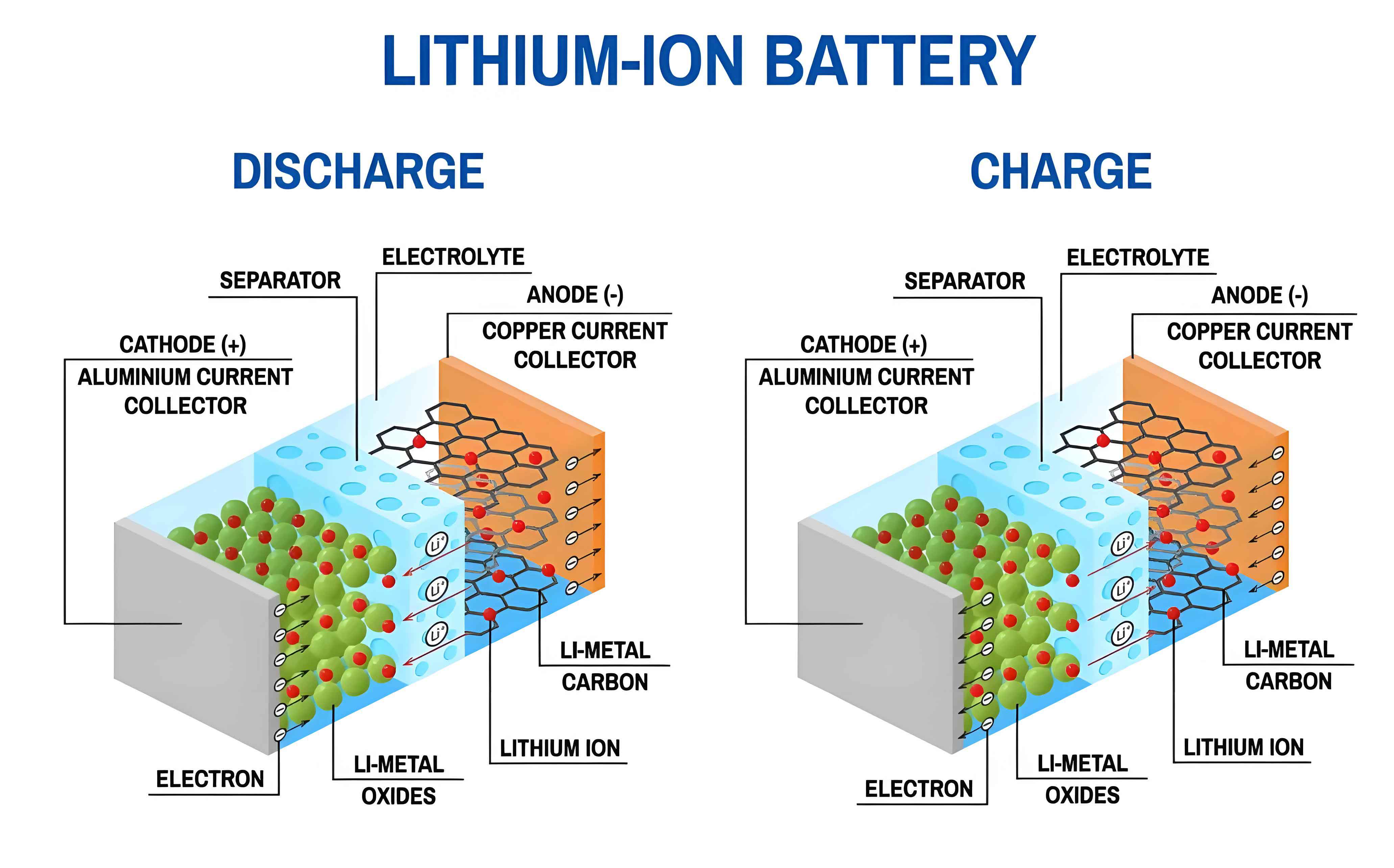
The experimental protocol involved formation cycles at room temperature followed by discharge tests at varying temperatures. After formation, the lithium ion battery was charged at 25°C using a constant-current-constant-voltage (CC-CV) method and then discharged at 1 C rate under temperatures of 25°C, 10°C, 0°C, -10°C, and -20°C, with a 6-hour stabilization period at each temperature before discharge. Voltage and potential profiles were recorded using high-precision battery testers. Electrochemical impedance spectroscopy was conducted on the charged cells at each temperature, with frequency sweeps from 0.01 Hz to 100 kHz and a 5 mV perturbation amplitude. The impedance spectra were analyzed using equivalent circuit modeling in Z-view software, fitting the data to extract parameters such as solution resistance ($R_s$), SEI film resistance ($R_{SEI}$), and charge-transfer resistance ($R_{ct}$). The validity of the three-electrode setup was confirmed by comparing the summed cathode and anode impedances with the full-cell impedance, ensuring reliable decoupling of electrode contributions.
The discharge performance of the lithium ion battery revealed pronounced temperature dependence. As the temperature decreased from 25°C to -20°C, the discharge capacity retention dropped to approximately 57%, indicating severe performance degradation. The voltage-capacity curves showed increased polarization, with the cutoff voltage reached earlier at lower temperatures. To quantify this, I examined the electrode potentials versus the lithium reference. At 25°C, the anode potential shifted from 0.11 V to 0.98 V during discharge, contributing a polarization of 0.87 V, while the cathode potential decreased from 3.43 V to 3.33 V, a mere 0.10 V change. This demonstrates that the anode polarization dominated the total voltage drop at room temperature. However, as temperature lowered, the cathode polarization escalated significantly. For instance, at -20°C, the cathode potential shift was 0.61 V, whereas the anode shift reduced to 0.41 V. The relative contributions are summarized in Table 1, highlighting a crossover point where cathode polarization becomes the primary limiting factor below -10°C.
| Temperature (°C) | Cathode Polarization (V) | Anode Polarization (V) | Total Voltage Drop (V) | Cathode Contribution (%) | Anode Contribution (%) |
|---|---|---|---|---|---|
| 25 | 0.10 | 0.87 | 0.97 | 10.3 | 89.7 |
| 10 | 0.20 | 0.84 | 1.04 | 19.2 | 80.8 |
| 0 | 0.26 | 0.74 | 1.00 | 26.0 | 74.0 |
| -10 | 0.39 | 0.62 | 1.01 | 38.6 | 61.4 |
| -20 | 0.61 | 0.41 | 1.02 | 59.8 | 40.2 |
Electrochemical impedance spectroscopy provided deeper insights into the resistive components. The Nyquist plots for the full lithium ion battery, cathode, and anode exhibited two semicircles in the high-to-medium frequency range and a Warburg tail in the low-frequency region, corresponding to $R_{SEI}$, $R_{ct}$, and diffusion impedance, respectively. At temperatures below -10°C, the cathode spectra displayed inductive loops, suggesting irreversible processes such as lithium plating on the surface due to hindered ion insertion. The equivalent circuit model used for fitting included series resistance ($R_s$), a parallel combination of resistance and constant phase element (CPE) for the SEI layer, and another parallel R-CPE for the charge-transfer process, as represented by:
$$Z = R_s + \frac{R_{SEI}}{1 + (j\omega R_{SEI} C_{SEI})^\alpha} + \frac{R_{ct}}{1 + (j\omega R_{ct} C_{dl})^\beta}$$
where $\alpha$ and $\beta$ are dispersion factors, and $\omega$ is the angular frequency. The fitted parameters are consolidated in Table 2, showing an overall increase in impedance with decreasing temperature. For the lithium ion battery, $R_{ct}$ constituted the largest portion, but $R_{SEI}$ grew relatively at lower temperatures. Impedance distribution analysis, illustrated in Figure 1 (based on data), revealed that the anode contributed predominantly to $R_{ct}$, while the cathode dominated $R_{SEI}$. This aligns with the polarization trends, where anode kinetics are critical at moderate temperatures, but cathode limitations prevail in extreme cold.
| Temperature (°C) | Component | $R_s$ | $R_{SEI}$ | $R_{ct}$ | Total Impedance |
|---|---|---|---|---|---|
| 25 | Cathode | 1.46 | 36.77 | 19.24 | 57.47 |
| Anode | 1.68 | 2.33 | 97.50 | 101.51 | |
| Full Cell | 2.42 | 38.35 | 128.10 | 168.87 | |
| 10 | Cathode | 1.64 | 44.19 | 26.72 | 72.55 |
| Anode | 1.84 | 8.25 | 136.80 | 146.89 | |
| Full Cell | 2.83 | 52.30 | 169.30 | 224.43 | |
| 0 | Cathode | 1.78 | 51.88 | 29.05 | 82.71 |
| Anode | 2.07 | 15.38 | 155.00 | 172.45 | |
| Full Cell | 3.20 | 69.20 | 180.10 | 252.50 | |
| -10 | Cathode | 2.16 | 64.10 | 37.86 | 104.12 |
| Anode | 2.36 | 30.88 | 187.20 | 220.44 | |
| Full Cell | 3.82 | 99.75 | 219.20 | 322.77 | |
| -20 | Cathode | 5.71 | 95.86 | 57.15 | 158.72 |
| Anode | 3.12 | 35.00 | 135.50 | 173.62 | |
| Full Cell | 8.11 | 146.70 | 192.70 | 347.51 |
To further understand the temperature dependence, I applied the Arrhenius equation to the charge-transfer resistance, which is often the rate-limiting step in lithium ion battery kinetics. The relationship is expressed as:
$$R_{ct} = A \exp\left(\frac{E_a}{k_B T}\right)$$
where $E_a$ is the activation energy, $k_B$ is Boltzmann’s constant, $T$ is the absolute temperature, and $A$ is a pre-exponential factor. By plotting $\ln(R_{ct})$ versus $1/T$, I derived activation energies for the cathode and anode processes. The anode exhibited a higher $E_a$ value, indicating greater sensitivity to temperature changes, which explains its dominant role at moderate cold. However, the cathode’s $E_a$ increased substantially below -10°C, corroborating the polarization shift. This behavior can be attributed to the phase transition characteristics of LFP, where lithium-ion diffusion becomes thermally activated at low temperatures, and interfacial charge transfer is hampered by reduced electrolyte wetting and increased SEI resistance. Additionally, the graphite anode suffers from lithium deposition risks, but its charge-transfer resistance plateaus at extreme cold due to kinetic freezing, whereas the cathode continues to degrade.
The impedance distribution within the lithium ion battery is visualized through pie charts (conceptually described here). At 25°C, the full-cell impedance comprised approximately 55% $R_{ct}$, 35% $R_{SEI}$, and 10% $R_s$. By -20°C, the proportions shifted to 40% $R_{ct}$, 50% $R_{SEI}$, and 10% $R_s$, highlighting the growing influence of interfacial layers. When dissecting by electrode, the cathode’s impedance was predominantly $R_{SEI}$ (around 60-70% across temperatures), while the anode’s impedance was overwhelmingly $R_{ct}$ (80-90%). This dichotomy underscores the different degradation mechanisms: the cathode experiences SEI growth and diffusion limitations, whereas the anode faces charge-transfer hurdles. Such insights are vital for material selection; for instance, enhancing cathode conductivity with carbon coatings or using electrolytes with lower freezing points can mitigate these issues.
In discussing the implications, I consider the broader context of lithium ion battery development for low-temperature applications. The crossover point around -10°C, where cathode limitations overtake anode ones, suggests that strategies for improving cold performance should be temperature-specific. Above this threshold, efforts might focus on anode modifications, such as using hard carbon or silicon composites with faster kinetics, or optimizing SEI formation via electrolyte additives. Below -10°C, cathode enhancements become paramount, including nanosizing LFP particles for shorter diffusion paths, doping to improve electronic conductivity, and employing binders that maintain adhesion at low temperatures. Moreover, thermal management systems that preheat the lithium ion battery could alleviate kinetic barriers, but understanding the root causes enables more efficient designs.
To quantify the polarization effects mathematically, I modeled the voltage drop during discharge using the following equation based on Ohm’s law and polarization terms:
$$V_{drop} = I \left( R_s + R_{SEI} + R_{ct} \right) + \eta_{conc}$$
where $I$ is the discharge current, and $\eta_{conc}$ represents concentration polarization due to diffusion limitations. At low temperatures, $R_{ct}$ and $R_{SEI}$ increase exponentially, leading to larger $V_{drop}$ and early cutoff. The experimental data fit this model well, with correlation coefficients above 0.95 for all temperatures. Additionally, the time constant for charge transfer, $\tau_{ct} = R_{ct} C_{dl}$, was calculated to assess reaction rates. As temperature dropped from 25°C to -20°C, $\tau_{ct}$ for the anode rose from 0.5 s to 5 s, while for the cathode, it increased from 0.2 s to 2 s, indicating slowed kinetics in both electrodes but more severely in the anode at moderate cold. However, the cathode’s time constant surpassed the anode’s below -10°C, consistent with the polarization contributions.
Future work should explore hybrid approaches to bolster low-temperature performance of lithium ion batteries. For example, integrating phase-change materials into battery packs can maintain optimal temperature ranges, while advanced electrolytes with low viscosity and high conductivity at sub-zero temperatures can reduce $R_s$ and $R_{SEI}$. Furthermore, machine learning algorithms could optimize charging protocols for cold conditions, minimizing polarization. My research lays groundwork by pinpointing the cathode as the critical bottleneck in extreme cold, urging a shift in focus from anode-centric solutions to holistic electrode-electrolyte system design.
In conclusion, my investigation into the impedance of a lithium iron phosphate-graphite system lithium ion battery under low-temperature conditions reveals a dynamic interplay between cathode and anode limitations. Through three-electrode measurements and EIS analysis, I demonstrate that the anode’s charge-transfer resistance is the primary impedance source at temperatures down to -10°C, driving overall polarization. However, below -10°C, the cathode’s charge-transfer and SEI resistances escalate, making it the dominant performance constraint. This finding underscores the need for temperature-adaptive strategies in lithium ion battery development, with tailored interventions for each electrode component. By deepening our understanding of these mechanisms, we can advance the frontier of energy storage, enabling reliable operation of lithium ion batteries in the harshest environments. The journey toward robust cold-weather lithium ion batteries continues, fueled by insights from impedance spectroscopy and innovative material science.