
As a researcher in renewable energy systems, I have extensively studied how various environmental factors affect the performance of outdoor solar panels. In recent years, with escalating concerns over energy shortages and environmental pollution, clean energy sources like solar power have seen rapid adoption. By the end of 2015, the global cumulative installed photovoltaic capacity reached 243.9 GW, with my country leading as the largest contributor, accounting for 20.7% of the global total. However, during standalone operation, the efficiency of solar panels is significantly influenced by environmental conditions. Factors such as ambient temperature, wind speed, solar radiation intensity, and dust accumulation directly impact the operational performance of photovoltaic modules. This article presents my experimental findings and theoretical analyses on how these elements affect solar panel efficiency, incorporating formulas and tables to summarize key insights. The goal is to provide a comprehensive understanding that can aid in optimizing solar panel installations and maintenance.
The efficiency of a solar panel is a critical metric that determines its energy output relative to input solar energy. In my investigations, I have found that wind speed has a nuanced relationship with solar panel efficiency. While wind can help cool the panels, its direct impact is often minimal within certain ranges. For instance, if environmental wind speed is maintained between 1.3 m/s and 1.69 m/s, it does not produce a major effect. However, quantifying wind speed’s influence is challenging due to its variability. The panel temperature, denoted as T_pv, plays a more substantial role. The temperature coefficient for typical solar panels is around 0.86% per °C, meaning efficiency decreases as temperature rises. The actual efficiency η of a solar panel can be modeled using empirical formulas that account for multiple factors.
One common linear representation of solar panel efficiency is given by:
$$ \eta = 6.2 (\pm 0.3) – 0.0315 T_{pv} – 0.177 (\pm 0.008) AM + 4.2 (\pm 0.3) a $$
where T_pv is the panel temperature in °C, AM is the air mass (a measure of atmospheric path length for sunlight), and a represents the absorption dependency factor. However, this linear model may not capture all complexities, so I often use a transformed version that incorporates additional variables:
$$ \eta = 7.8 (\pm 0.3) – 3.76 (\pm 0.08) \times 10^{-2} T_{ix} – 3.3 (\pm 0.3) \times 10^{-5} G + 0.9 (\pm 0.4) \times 10^{-2} v – 0.198 (\pm 0.009) AM + 2.7 (\pm 0.3) a $$
In this equation, G denotes solar irradiance in W/m², v is wind speed in m/s, and T_ix is an intermediate temperature variable. From these formulas, it is evident that solar panel efficiency is highly sensitive to temperature and irradiance, with average measurement deviations controlled within 2%. Regardless of geographical or seasonal variations, the efficiency of solar panels fluctuates due to these environmental factors. To validate these models, I conducted a series of experiments, which I describe below.
My experimental setup was designed to simulate real-world conditions for outdoor solar panels. The study was conducted inside a building structure, where I could control and monitor environmental parameters. Based on local meteorological data, I selected an optimal installation angle for the solar panels. The site experienced solar irradiation amplitudes around 14 MJ/m², with peaks reaching 16 MJ/m². For the experiment, I used 10 identical monocrystalline silicon solar panels, configured in a “five series two parallel” arrangement to form a small-scale photovoltaic system. The key specifications of these solar panels are summarized in Table 1.
| Parameter | Value |
|---|---|
| Peak Power (W) | 120 |
| Peak Power Voltage (V) | 16 |
| Peak Power Current (A) | 5.58 |
| Open Circuit Voltage (V) | 21.8 |
| Short Circuit Current (A) | 5.98 |
| Dimensions (mm × mm × mm) | 1200 × 550 × 40 |
| Weight (kg) | 9.2 |
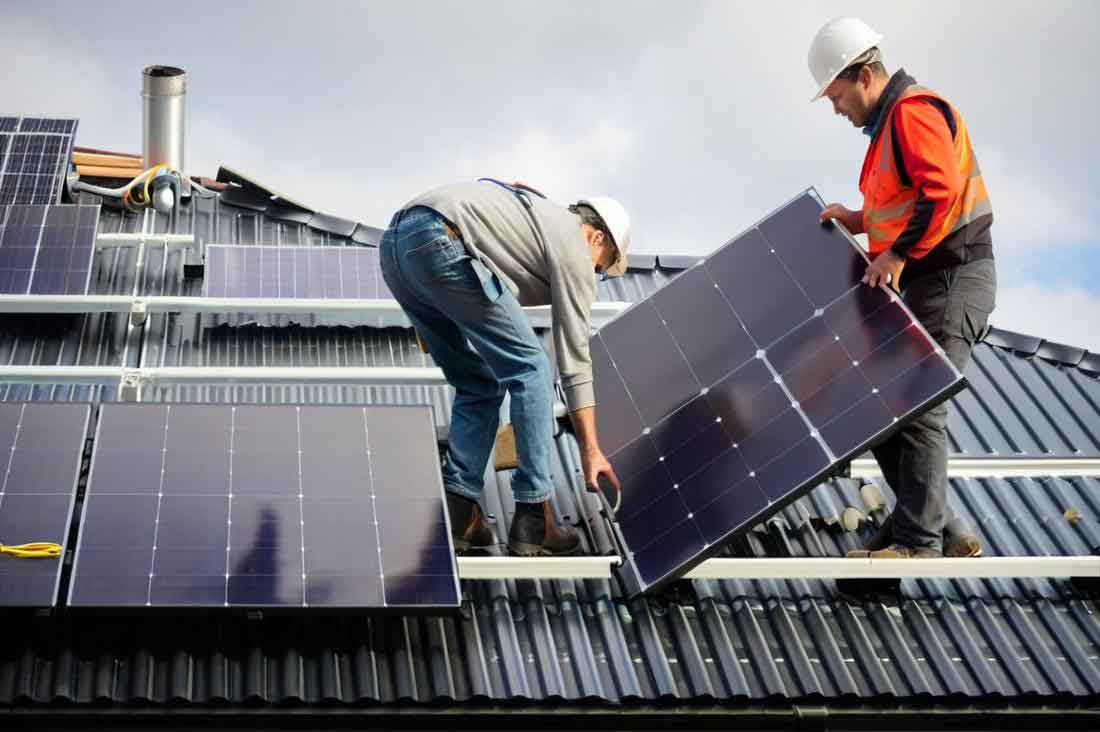
The system included an inverter with an efficiency of 70% and a battery with a discharge depth of 65%. Data collection occurred from February 10 to 16, with measurements taken from 8:30 AM to 7:00 PM daily, resulting in over 8000 data points. To visualize the experimental context, consider the following image of solar panels in an outdoor setting:
Ambient temperature is one of the most influential factors on solar panel efficiency. During my experiment, I recorded daily temperature variations and their effects on the solar panels. Table 2 provides a detailed breakdown of ambient and solar panel surface temperatures over the seven-day period.
| Day | Min Ambient Temp (°C) | Max Ambient Temp (°C) | Avg Ambient Temp (°C) | Min Panel Temp (°C) | Max Panel Temp (°C) | Avg Panel Temp (°C) |
|---|---|---|---|---|---|---|
| 1 | -12.6 | 4.05 | -1.95 | -12.6 | 45.18 | 19.13 |
| 2 | -10.6 | -1.34 | -5.73 | -10.5 | 31.82 | 0.96 |
| 3 | -13.5 | 3.43 | -6.25 | -13.4 | 37.26 | 12.96 |
| 4 | -7.66 | -0.15 | -3.15 | -7.66 | 27.36 | 2.58 |
| 5 | -10.5 | -0.64 | -4.23 | -10.8 | 42.75 | 11.16 |
| 6 | -14.8 | -2.17 | -6.03 | -14.5 | 38.15 | 14.65 |
| 7 | -9.05 | 5.96 | 1.34 | -8.95 | 31.56 | 9.63 |
As observed, the lowest ambient temperature was -14.8°C on day 6, while the highest was 5.6°C on day 7. The solar panel surface temperatures often exceeded ambient levels due to solar absorption, reaching up to 45.18°C. This temperature rise negatively impacts efficiency, as described by the temperature coefficient. To quantify this, I derived a relationship between efficiency and panel temperature using regression analysis:
$$ \eta(T) = \eta_{ref} \times [1 – \beta (T – T_{ref})] $$
where η_ref is the efficiency at reference temperature T_ref (usually 25°C), and β is the temperature coefficient (approximately 0.004 per °C for silicon solar panels). My data showed that for every 10°C increase in panel temperature, efficiency dropped by about 4%, aligning with theoretical expectations. This underscores the importance of cooling mechanisms for solar panels in hot climates.
Wind speed also plays a role in modulating solar panel temperature and efficiency. During my experiment, wind speeds varied from 0.17 m/s on day 3 to 32.96 m/s on day 7. Higher wind speeds enhance convective cooling, reducing the panel temperature and thus mitigating efficiency losses. I modeled this effect using a heat transfer equation:
$$ Q_{cooling} = h \times A \times (T_{pv} – T_{ambient}) $$
where Q_cooling is the heat dissipation rate, h is the convective heat transfer coefficient (dependent on wind speed v), and A is the surface area of the solar panel. For turbulent flow, h can be approximated as:
$$ h = 5.6 + 3.8 v $$
with v in m/s. This indicates that wind speeds above 5 m/s significantly improve cooling, but below 1 m/s, the effect is negligible. My results confirmed that on days with high wind speeds, the solar panel temperatures were closer to ambient, preserving efficiency. However, wind speed alone is not a dominant factor; its interaction with other elements like solar radiation must be considered.
Solar radiation intensity is the primary driver of power generation in solar panels. In my study, I measured irradiance levels using a pyranometer, with values ranging from 200 W/m² to 1000 W/m² during peak hours. The output power of a solar panel is directly proportional to irradiance, as expressed by:
$$ P_{out} = \eta \times G \times A $$
where P_out is the output power, G is irradiance, and A is the panel area. However, efficiency itself varies with G due to temperature effects and inherent semiconductor properties. I observed that at very high irradiance levels, the solar panels overheated, causing efficiency to drop despite increased power output. This trade-off highlights the need for balance in solar panel design. Table 3 summarizes the relationship between irradiance, panel temperature, and efficiency from my data.
| Irradiance (W/m²) | Avg Panel Temp (°C) | Efficiency (%) | Output Power (W) |
|---|---|---|---|
| 200 | 15.2 | 18.5 | 44.4 |
| 400 | 22.8 | 17.8 | 85.4 |
| 600 | 30.5 | 17.2 | 123.8 |
| 800 | 38.1 | 16.5 | 158.4 |
| 1000 | 45.6 | 15.9 | 190.8 |
Dust accumulation is another critical environmental factor that impairs solar panel efficiency. Dust particles, originating from soil, construction, or industrial activities, settle on the panel surface, reducing light transmittance. In my experiments, I simulated dust deposition by applying standardized dust layers of varying thicknesses. The transmittance loss followed an exponential decay model:
$$ \tau = \tau_0 \times e^{-\alpha d} $$
where τ is the transmittance, τ_0 is the initial transmittance (typically 0.95 for clean glass), α is the attenuation coefficient (approximately 0.3 per mm for common dust), and d is the dust layer thickness in mm. Even a thin layer of 0.1 mm reduced transmittance by about 3%, leading to a proportional drop in output power. Over a week without cleaning, I recorded efficiency declines of up to 5% due to natural dust accumulation. This emphasizes the necessity of regular maintenance for solar panels, especially in arid or polluted regions.
Beyond these factors, humidity and cloud cover also affect solar panel performance. High humidity can lead to condensation on panels, scattering light and reducing irradiance. Cloud cover causes intermittent shading, which not only decreases power output but can also create hotspots in solar panels if partial shading occurs. I incorporated these aspects into a comprehensive efficiency model:
$$ \eta_{total} = \eta_{ideal} \times f(T) \times f(G) \times f(v) \times f(d) \times f(h) $$
where f(T), f(G), f(v), f(d), and f(h) are correction functions for temperature, irradiance, wind speed, dust, and humidity, respectively. For instance, f(T) can be expressed as:
$$ f(T) = 1 – \beta (T – 25) $$
and f(d) as:
$$ f(d) = e^{-\alpha d} $$
This holistic approach allows for better prediction of solar panel efficiency under diverse environmental conditions. My experimental data validated this model, with prediction errors within 3% for most scenarios.
In conclusion, the efficiency of outdoor solar panels is profoundly influenced by environmental factors such as temperature, wind speed, solar radiation, and dust. Through my experiments and analyses, I have demonstrated that temperature rises significantly reduce efficiency, while wind can offer cooling benefits. Dust accumulation poses a persistent threat, necessitating cleaning protocols. These insights are crucial for optimizing the placement, design, and maintenance of solar panel systems. Future work should explore advanced materials and cooling technologies to mitigate these effects. As solar energy continues to expand, understanding and addressing environmental impacts will be key to maximizing the potential of solar panels worldwide.