
With the rapid development of global economies, solar energy has emerged as a critical solution to energy scarcity and environmental challenges. This paper explores the grid-connection technology for residential solar photovoltaic (PV) systems, focusing on system architecture, inverter design, and advanced control methodologies.
1. System Architecture and Operational Principles
A typical home solar PV system comprises three core components:
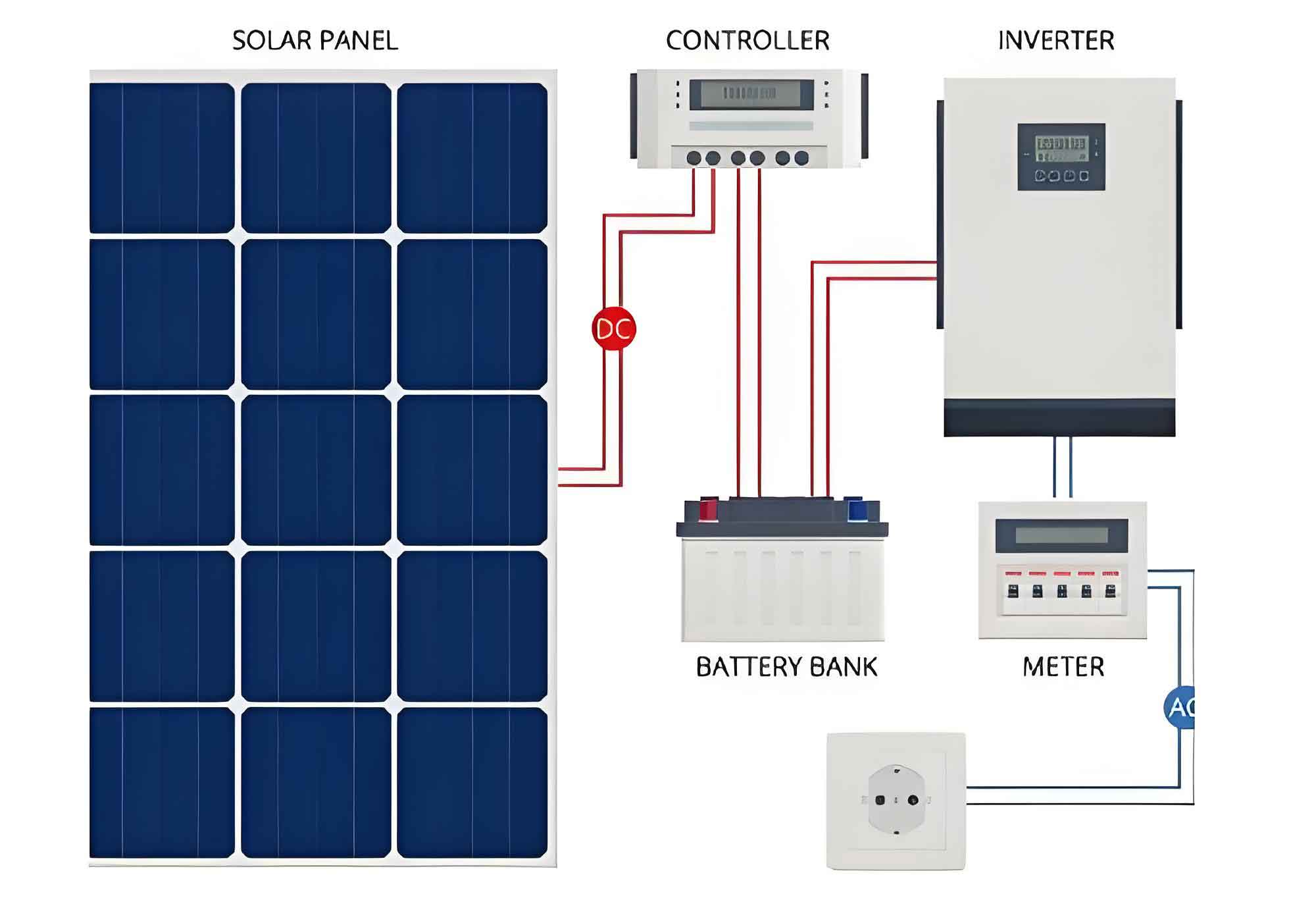
| Component | Function | Key Parameters |
|---|---|---|
| PV Array | Converts sunlight to DC power | $$V_{oc} = 35-45V$$ per panel |
| Charge Controller | Regulates battery charging | MPPT efficiency >98% |
| Solar Inverter | DC/AC conversion & grid synchronization | THD < 3% |
2. Inverter Operation and Grid Integration
The solar inverter performs critical DC-AC conversion using full-bridge topology:
$$v_{ac}(t) = V_{dc} \cdot \sum_{n=1}^{\infty} \frac{4}{n\pi} \sin(n\omega t)$$
Key grid synchronization requirements:
- Frequency matching: $$f_{inv} = f_{grid} \pm 0.1\,\mathrm{Hz}$$
- Phase synchronization: $$\theta_{inv} – \theta_{grid} < 2^\circ$$
- Voltage regulation: $$V_{inv} = V_{grid} \pm 2\%$$
3. Advanced Control Strategies
Modern solar inverters implement dual-loop control:
| Control Loop | Function | Typical Algorithm |
|---|---|---|
| Inner Current Loop | Fast dynamic response | $$G_i(s) = K_p + \frac{K_i}{s}$$ |
| Outer Voltage Loop | Steady-state regulation | PR controller: $$G_v(s) = K_p + \frac{2K_i\omega_c s}{s^2 + 2\omega_c s + \omega_0^2}$$ |
Maximum Power Point Tracking (MPPT) efficiency is crucial:
$$\eta_{MPPT} = \frac{P_{\text{actual}}}{P_{\text{max\_theoretical}}} \times 100\%$$
4. Grid-Connection Standards and Protection
Key protection mechanisms in solar inverters:
- Anti-islanding protection: $$V_{grid} < 0.88V_{\text{nom}} \rightarrow \text{Trip within 2s}$$
- Frequency protection: $$f_{grid} > 50.5\,\mathrm{Hz} \rightarrow \text{Ramp-down in 60s}$$
- Harmonic compliance: $$\sum \text{THD} < 5\%$$
5. Performance Comparison of Inverter Topologies
| Type | Efficiency | Cost | Scalability |
|---|---|---|---|
| Central Inverter | 96-98% | $$ \$0.25/\mathrm{W} $$ | Low |
| String Inverter | 97-98.5% | $$ \$0.30/\mathrm{W} $$ | Medium |
| Microinverter | 94-96% | $$ \$0.45/\mathrm{W} $$ | High |
6. Future Development Trends
Emerging technologies in solar inverters:
- Hybrid topologies: $$ \eta_{\text{target}} > 99\% $$
- AI-enhanced MPPT: $$\Delta P_{\text{improvement}} \approx 3-5\%$$
- Blockchain-enabled peer-to-peer energy trading
This comprehensive analysis demonstrates that modern solar inverters form the technological backbone of residential PV systems, enabling efficient energy conversion and smart grid integration. Continued innovation in power electronics and control algorithms will further enhance the viability of home solar installations in global energy markets.