
The relentless pursuit of higher energy density and improved safety in energy storage systems has positioned the li ion battery at the forefront of technological innovation for applications ranging from portable electronics to electric vehicles and grid-scale storage. The commercial dominance of graphite anodes, while reliable, is fundamentally limited by a modest theoretical specific capacity of approximately 372 mAh g−1. This bottleneck has spurred intensive global research into alternative anode materials capable of storing more lithium ions. Among the myriad of candidates, iron-based oxides, particularly hematite (α-Fe2O3), have emerged as exceptionally promising due to their high theoretical capacity (∼1007 mAh g−1), natural abundance, low cost, and environmental benignity. This article details a comprehensive investigation from my own research into the synthesis, characterization, and electrochemical evaluation of nanostructured iron-based oxides as high-performance anodes for li ion battery technology.
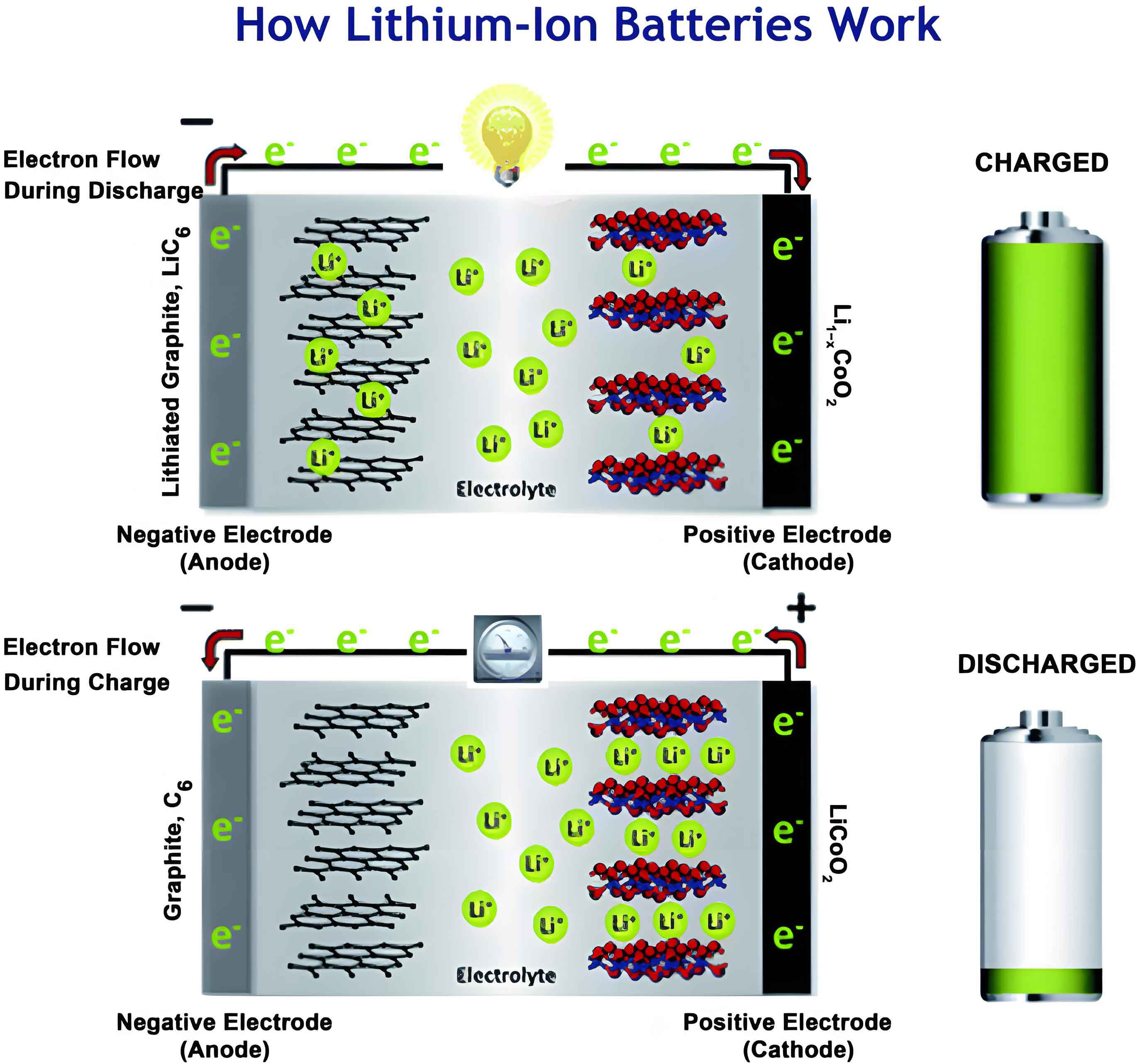
The primary challenge associated with iron oxide anodes in a li ion battery is their significant volume expansion (>200%) during lithiation (discharge) and the associated poor electronic conductivity. These factors typically lead to rapid pulverization of the active material, loss of electrical contact, and consequent severe capacity fading. To mitigate these issues, my approach focuses on engineering the material’s morphology and composition at the nanoscale. The synthesis begins with inexpensive commercial iron powder as the precursor. This powder is consolidated into a cylindrical pellet and subjected to a direct current (DC) arc plasma process under a controlled argon-hydrogen atmosphere. This high-energy technique effectively produces ultra-fine, chain-like agglomerates of nano-iron particles. Subsequent thermal oxidation in air at precisely controlled temperatures—250°C, 350°C, and 450°C—transforms this nano-iron into the desired iron-based oxide composites. This two-step method is pivotal for creating a unique microstructure that enhances performance in the li ion battery.
The phase composition and crystallinity of the oxides obtained at different temperatures were first analyzed using X-ray diffraction (XRD). The results, summarized qualitatively below, reveal a strong temperature-dependent phase evolution.
| Oxidation Temperature (°C) | Dominant Phases Identified | Crystallinity Trend |
|---|---|---|
| 250 | Fe, γ-Fe2O3, α-Fe2O3 | Low crystallinity for oxides |
| 350 | α-Fe2O3 (strong), γ-Fe2O3 & Fe (weak) | Increased α-Fe2O3 crystallization |
| 450 | α-Fe2O3 (pure, highly crystalline) | High, single-phase crystallinity |
The diffraction patterns clearly show that the relative intensity of metallic iron (Fe) and maghemite (γ-Fe2O3) peaks diminishes with increasing temperature, while the signatures of hematite (α-Fe2O3) become dominant. At 450°C, the product is phase-pure, well-crystallized α-Fe2O3. Transmission electron microscopy (TEM) observations further revealed that the initial nano-iron chains undergo significant morphological transformation upon oxidation, contracting and sintering into larger, porous aggregates. Notably, the local structure exhibits considerable variation; for instance, lattice fringes corresponding to interplanar spacings as large as 3.7 nm were observed in the 350°C sample, indicating the presence of disordered or strained regions that could be beneficial for lithium-ion diffusion in the subsequent li ion battery cell.
The electrochemical performance of these materials as anodes in a li ion battery was rigorously evaluated using coin-type cells with lithium metal as the counter/reference electrode. Cyclic voltammetry (CV) provides critical insights into the redox reactions occurring during cycling. For the material oxidized at 350°C, the first cathodic scan revealed a sharp reduction peak near 0.5 V, corresponding to the irreversible reduction of Fe3+ to metallic Fe0 and the formation of a solid-electrolyte interphase (SEI). This is described by the conversion reaction:
$$ \text{Fe}_2\text{O}_3 + 6\text{Li}^+ + 6e^- \rightarrow 2\text{Fe} + 3\text{Li}_2\text{O} $$
The subsequent anodic scan showed a broad peak around 1.75 V, attributed to the oxidation of Fe0 to Fe2+ and further to Fe3+. In the second and subsequent cycles, the reduction peak shifts to a higher potential (~1.0 V) and the curve shapes stabilize, indicating a transition to a highly reversible electrochemical process. This stabilization is a key indicator of the material’s adaptability for use in a reliable li ion battery.
Galvanostatic charge-discharge cycling is the ultimate test for any li ion battery anode material. The voltage profiles for the initial cycles of the 350°C sample are characteristic of conversion-type materials. The first discharge exhibits a long plateau around 0.8 V, contributing to the high initial capacity. The charge profile, however, is a sloping curve without a distinct plateau. From the second cycle onward, both charge and discharge profiles become more sloping and overlapping, signifying good reversibility. A critical performance metric is the cycling stability at a fixed current density. The following table compares the discharge capacity retention of samples prepared at different temperatures over extended cycling.
| Oxidation Temperature (°C) | Initial Discharge Capacity (mAh g-1) | Discharge Capacity at Cycle 30 (mAh g-1) | Discharge Capacity at Cycle 150 (mAh g-1) | Capacity Retention (Cycle 150/Cycle 1) |
|---|---|---|---|---|
| 250 | 628 | ~400 | 274 | 43.6% |
| 350 | 960 | ~470 | 351 | 36.6% |
| 450 | 1288 | ~352 | 518 | 40.2% |
The data reveals complex, non-monotonic behavior. While the 350°C sample delivers a robust initial capacity and good mid-term cycling, the 450°C sample exhibits the most intriguing performance. After an initial rapid decay, its capacity begins to *increase* significantly after approximately 25 cycles, a phenomenon often observed in nanostructured conversion materials. This “rising capacity” can be attributed to the electrochemical activation of the material, possibly involving the gradual generation of a polymeric/gel-like layer on the metal nanoparticles that contributes additional reversible capacity, and/or the progressive electrolyte decomposition catalyzed by the in-situ formed nano-iron metal. This activation effect ultimately allows the 450°C sample to achieve the highest capacity after 150 cycles, surpassing 500 mAh g−1, which is substantially higher than that of commercial graphite and even many commercial nano-iron oxides when tested under analogous conditions. This highlights the superior structural stability afforded by our synthesis method for a li ion battery anode.
To probe the reaction mechanism in the stabilized state, ex-situ XRD was performed on electrodes at different states of charge after multiple cycles. After 25 charge-discharge cycles, the XRD pattern of the fully charged (3.0 V) electrode showed clear peaks for metallic Fe and weaker, broader peaks for γ-Fe2O3. The presence of γ-Fe2O3 instead of α-Fe2O3 after charging suggests a phase transformation during long-term cycling. The electrochemical reaction in the stabilized state can thus be more accurately represented as a reversible conversion between γ-Fe2O3 and Fe:
$$ \gamma\text{-Fe}_2\text{O}_3 + 6\text{Li}^+ + 6e^- \rightleftharpoons 2\text{Fe} + 3\text{Li}_2\text{O} $$
The broadening of the Fe and oxide peaks indicates the particles remain in a nano-crystalline or amorphous state, which is crucial for accommodating strain and maintaining cyclability in the li ion battery.
Rate capability, which defines how well a li ion battery performs under fast charging or discharging conditions, was also investigated. The materials demonstrated a reasonable tolerance to increased current densities. Although capacity dropped with increasing rate due to kinetic limitations, a significant portion of the capacity was recovered when the current density was returned to its initial value, demonstrating the robustness of the electrode structure. Electrochemical impedance spectroscopy (EIS) was employed to understand the kinetic aspects. The Nyquist plots typically consist of a depressed semicircle in the medium-frequency region, associated with the charge-transfer resistance (Rct) at the electrode/electrolyte interface, and a sloping line in the low-frequency region, representing Li+ ion diffusion within the solid electrode (Warburg diffusion). A key finding was that the diameter of the semicircle (Rct) for the 350°C sample decreased after 25 cycles compared to the first cycle. This reduction in interfacial resistance is likely due to the electrochemical milling and activation process that creates a more favorable and stable interface for charge transfer, a positive evolution for the longevity of the li ion battery.
The superior performance of these arc-plasma-synthesized iron oxides compared to commercially sourced nano-Fe2O3 can be summarized in the following comparative analysis:
| Performance Parameter | This Work (350°C sample) | Typical Commercial Nano-Fe2O3 | Advantage |
|---|---|---|---|
| Initial Discharge Capacity | 960 mAh g-1 (at 200 mA g-1) | ~1000-1400 mAh g-1 (often at lower current) | Comparable high capacity |
| Capacity at Cycle 30 | ~470 mAh g-1 | Often <150 mAh g-1 (rapid decay) | Dramatically improved cycling stability |
| Electrode Composition (Active:Binder:Conductor) | 10:2:1 (High active material content) | Often requires high conductive additive (e.g., 8:2:3) | Higher practical energy density |
| Long-Term Behavior (150 cycles) | Stable or increasing capacity trend | Continuous decay to very low values | Superior long-term viability |
The enhanced performance is attributed to the unique nanostructure inherited from the DC arc plasma process. The chain-like precursor and the resulting porous, partially disordered oxide aggregates provide: (i) short diffusion paths for Li+ ions, (ii) ample void space to accommodate volume changes during cycling, and (iii) a robust network that maintains electrical connectivity even as individual nanoparticles undergo repeated expansion and contraction. This structural integrity is the cornerstone of its success as a li ion battery anode.
In conclusion, this investigation demonstrates a highly effective and scalable synthesis route for producing nanostructured iron-based oxide anodes. The DC arc plasma method combined with controlled thermal oxidation yields materials with tailored phase composition and a resilient, active morphology. These materials exhibit high specific capacity, excellent cycling stability—particularly at an oxidation temperature of 450°C where a unique activation behavior leads to rising long-term capacity—and satisfactory rate performance. The electrochemical reaction evolves into a highly reversible conversion between nano-iron and γ-Fe2O3, facilitated by the stable nanostructure. By directly addressing the chronic issues of volume expansion and capacity fade, this work presents iron-based oxides not merely as a laboratory curiosity, but as a technologically viable and economically attractive alternative anode material. The significant performance leap over commercial counterparts underscores the critical importance of tailored nanofabrication techniques in advancing the next generation of high-energy-density, durable, and cost-effective li ion battery systems for the sustainable energy future.