
As a researcher in the field of power electronics and renewable energy systems, I have extensively studied the challenges associated with grid-connected solar inverters, particularly in large-scale photovoltaic (PV) applications. Series-connected solar inverters are widely used due to their cost-effectiveness and high efficiency. However, when multiple solar inverters operate in parallel within a cluster, resonance issues arise due to interactions between LCL filters and system circuits, compromising grid current quality and system stability. In this article, I propose a hierarchical cooperative control strategy to address these resonance problems, leveraging simulations and experiments to validate its effectiveness. The strategy focuses on enhancing damping and reshaping impedance to suppress resonance, ensuring reliable operation of solar inverters in weak grid conditions.
The structure of a series-connected solar inverters cluster typically includes PV arrays, DC-DC converters, DC-AC inverters, LCL filters, and a weak grid. Each solar inverter is connected to the grid through an LCL filter, and their outputs converge at a common coupling point (PCC). The interaction between multiple solar inverters and grid impedance can lead to harmonic resonance, which degrades power quality. To illustrate this, consider the system diagram where solar inverters are paralleled. The key components are the inverter-side inductor \(L_1\), grid-side inductor \(L_2\), filter capacitor \(C_f\), and grid impedance represented by \(L_g\). The grid voltage is denoted as \(U_g\), and currents include inverter-side current \(i_{i}\), grid-side current \(i_g\), and total grid-connected current \(i_{grid}\).
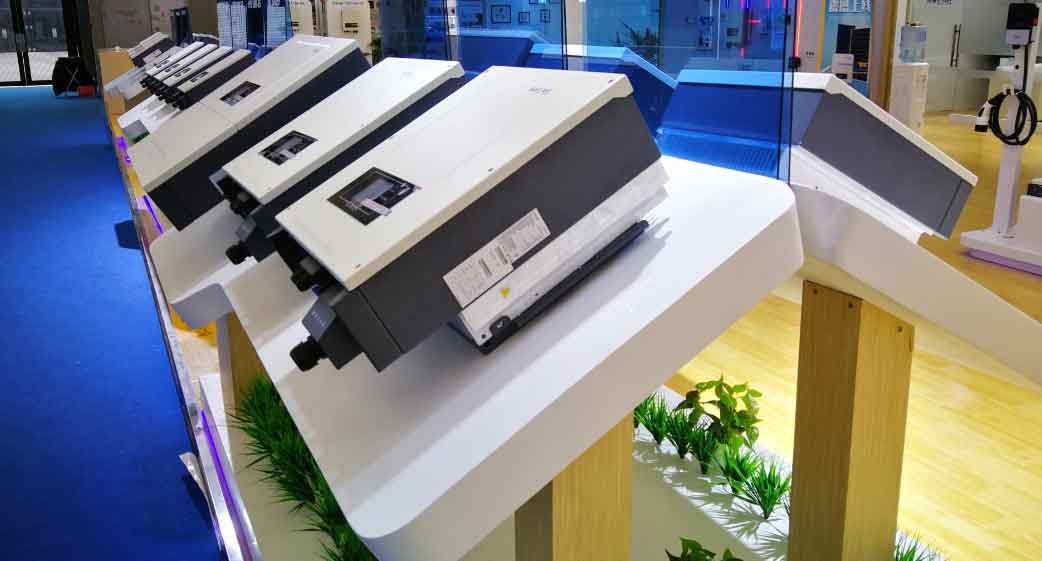
In traditional control strategies for solar inverters, the current loop is critical for stability. However, under weak grid conditions with purely inductive impedance, resonance frequencies shift due to multiple solar inverters operating in parallel. The open-loop transfer function of the current control system can be expressed as:
$$G_{open}(s) = \frac{G_{Z1}(s)G_c(s)G_{PR}(s)}{1 + G_{Z1}(s)G_{Z2}(s)G_c(s)G_{PR}(s) + (G_{Z1}(s) + G_{Z2}(s))G_g(s)}$$
where \(G_{Z1}(s) = 1/(sL_1)\), \(G_{Z2}(s) = 1/(sL_2)\), \(G_c(s) = 1/(sC_f)\), \(G_g(s) = 1/(sL_g)\), and \(G_{PR}(s)\) is a quasi-PR controller given by:
$$G_{PR}(s) = K_p + \frac{2K_i\omega_c s}{s^2 + 2\omega_c s + \omega_0^2}$$
Here, \(K_p\) is the proportional gain, \(K_i\) is the integral coefficient, \(\omega_0\) is the resonant angular frequency, and \(\omega_c\) is the bandwidth. The resonance frequencies are derived as:
$$f_{r1} = \frac{1}{2\pi}\sqrt{\frac{L_1 + L_2}{L_1 L_2 C_f}}$$
$$f_{r2} = \frac{1}{2\pi}\sqrt{\frac{L_1 + L_2 + nL_g}{L_1 L_2 C_f n L_g}}$$
where \(n\) represents the number of parallel solar inverters. As \(n\) increases, \(f_{r2}\) decreases, indicating resonance frequency偏移 and increased risk of harmonic instability. This poses a significant challenge for solar inverters in clusters.
To mitigate these issues, I propose a hierarchical cooperative control strategy for solar inverters. This approach divides the control into two layers: the first layer enhances local damping within each solar inverter, and the second layer addresses global resonance between the solar inverters cluster and the grid. The strategy aims to optimize grid-connected current quality and suppress resonance effectively.
In the first layer, a virtual resistor and capacitor are connected in parallel with the LCL filter’s capacitor. This adds active damping to the solar inverter without increasing hardware costs or losses. The current through the virtual branch in the s-domain is:
$$I_v(s) = \frac{sC_v}{s^2 T_f^2 + sT_f + 1} U_c(s)$$
where \(C_v\) is the virtual capacitance, \(T_f\) is the filter time constant, and \(U_c(s)\) is the capacitor voltage. By adjusting parameters, this method suppresses parallel resonance among solar inverters. Since capacitor voltage is already sampled in three-phase solar inverters, no additional sensors are needed, making it cost-effective for solar inverters.
The second layer introduces PCC voltage feedforward and an equivalent virtual inductance to reshape the grid impedance and suppress resonance between the solar inverters cluster and the grid. The equivalent virtual inductance transfer function is:
$$G_h(s) = \frac{s\omega_h^2}{s^2 + \omega_h s + \omega_h^2}$$
where \(\omega_h\) is the resonant angular frequency. This ensures low-frequency gain stability and high-frequency attenuation, improving system robustness for solar inverters. The overall control structure combines these elements, as shown in the block diagram. The closed-loop transfer function becomes:
$$G_{cl}(s) = \frac{(R_v C_f s + 1)K_{pwm}G_{PR}(s)}{E(R_v C_f s^2 + F s + 1) – G_g(s)G_h(s)}$$
where \(E = G_{Z1}(s)[G_{Z2}(s) + G_g(s)]\), \(F = G_c(s) + C_f s\), and \(K_{pwm}\) is the PWM gain. This formulation enhances stability for solar inverters under varying grid impedances.
To analyze stability, I performed Bode plot and pole-zero analyses. The hierarchical cooperative control strategy reduces resonance peaks and maintains sufficient phase margin. For instance, with grid impedance \(L_g\) ranging from 1 mH to 2 mH, the system remains stable, as poles stay in the left-half plane. This demonstrates the effectiveness of the strategy for solar inverters in dynamic grid conditions.
Simulations and experiments were conducted to validate the hierarchical cooperative control strategy for solar inverters. The parameters used are summarized in the table below:
| Parameter | Value | Description |
|---|---|---|
| \(U_{dc}\) | 750 V | DC-link voltage |
| \(L_1\) | 0.2 mH | Inverter-side inductor |
| \(L_2\) | 1.5 mH | Grid-side inductor |
| \(C_f\) | 6.8 μF | Filter capacitor |
| \(L_g\) | 2.5 mH | Grid impedance |
| Switching frequency | 10 kHz | PWM frequency |
| \(K_p\) | 163.5 | Proportional gain |
| \(K_i\) | 150 | Integral coefficient |
| \(\omega_0\) | 314 rad/s | Resonant frequency |
| \(\omega_c\) | 500 rad/s | Bandwidth |
In simulations, the total harmonic distortion (THD) of the grid-connected current was compared between traditional control and the proposed hierarchical cooperative control for solar inverters. The results are summarized below:
| Control Strategy | THD (%) | Reduction (%) |
|---|---|---|
| Traditional Control | 4.43 | – |
| Hierarchical Cooperative Control | 0.17 | 96.2 |
The THD decreased from 4.43% to 0.17%, a reduction of 96.2%, highlighting the strategy’s efficacy for solar inverters. Experimental waveforms further confirmed these findings. Under traditional control, grid current exhibited significant harmonics, while with hierarchical cooperative control, the current became smooth and stable. Dynamic performance was also tested by varying grid impedance from 2 mH to 1 mH. With the proposed strategy, solar inverters quickly stabilized within 0.01 s, whereas traditional control led to sustained oscillations.
The hierarchical cooperative control strategy offers several advantages for solar inverters. First, it minimizes sensor requirements by leveraging existing measurements, reducing costs for solar inverters. Second, it enhances robustness against grid impedance variations, crucial for solar inverters in weak grids. Third, the cooperative approach optimizes both local and global resonance suppression, ensuring high power quality for solar inverters clusters. These benefits make the strategy suitable for large-scale PV integration, where solar inverters play a pivotal role.
In conclusion, the hierarchical cooperative control strategy effectively addresses resonance issues in series-connected solar inverters clusters. By integrating virtual damping and impedance reshaping, it improves stability and reduces THD significantly. Simulations and experiments validate its feasibility, demonstrating a 96.2% reduction in harmonic distortion. This strategy represents a advancement for solar inverters, enabling reliable operation in renewable energy systems. Future work could explore adaptive tuning for varying operating conditions of solar inverters, further enhancing their performance and integration capabilities.