
In the field of radiation detection, precise measurement of dose response and signal integrity is crucial for applications in medical monitoring, environmental safety, and personal dosimetry. Traditional detectors, such as thermoluminescent dosimeters and Geiger-Muller counters, often suffer from limitations in portability, real-time monitoring, and adaptability to flexible environments. With the advent of flexible electronics, there is a growing interest in developing wearable devices that can conform to surfaces and provide accurate measurements under dynamic conditions. Our research focuses on leveraging perovskite materials, which have shown exceptional promise in optoelectronic applications, including perovskite solar cells, due to their high absorption coefficients, tunable bandgaps, and solution-processability. In this work, we designed a signal detection system tailored for flexible perovskite-based x/γ detectors, integrating charge integration circuits to handle微弱 current signals typically in the picoampere range. The system aims to address challenges such as environmental noise, motion artifacts, and the need for high precision in radiation sensing.
The core of our system lies in the charge integration approach, which allows for continuous acquisition of low-level currents generated by perovskite detectors under radiation exposure. Perovskite solar cells have inspired the development of radiation detectors due to their similar material properties, such as high charge carrier mobility and sensitivity to ionizing radiation. However, the transition from rigid to flexible substrates introduces additional complexities, including signal degradation from mechanical stress and electromagnetic interference. Our design incorporates a flexible printed circuit (FPC) with electromagnetic shielding to form a Faraday cage, effectively minimizing external noise. Additionally, we implemented a reference signal channel to subtract environmental and motion-induced artifacts, enhancing the signal-to-noise ratio (SNR). The analog signal processing unit utilizes dual time-shared charge integration circuits to achieve a current resolution of 0.3 pA, while the software component, developed in C#, enables real-time data visualization and storage for up to 64 channels. This integrated system not only improves measurement accuracy but also paves the way for portable, wearable radiation monitors in various fields.
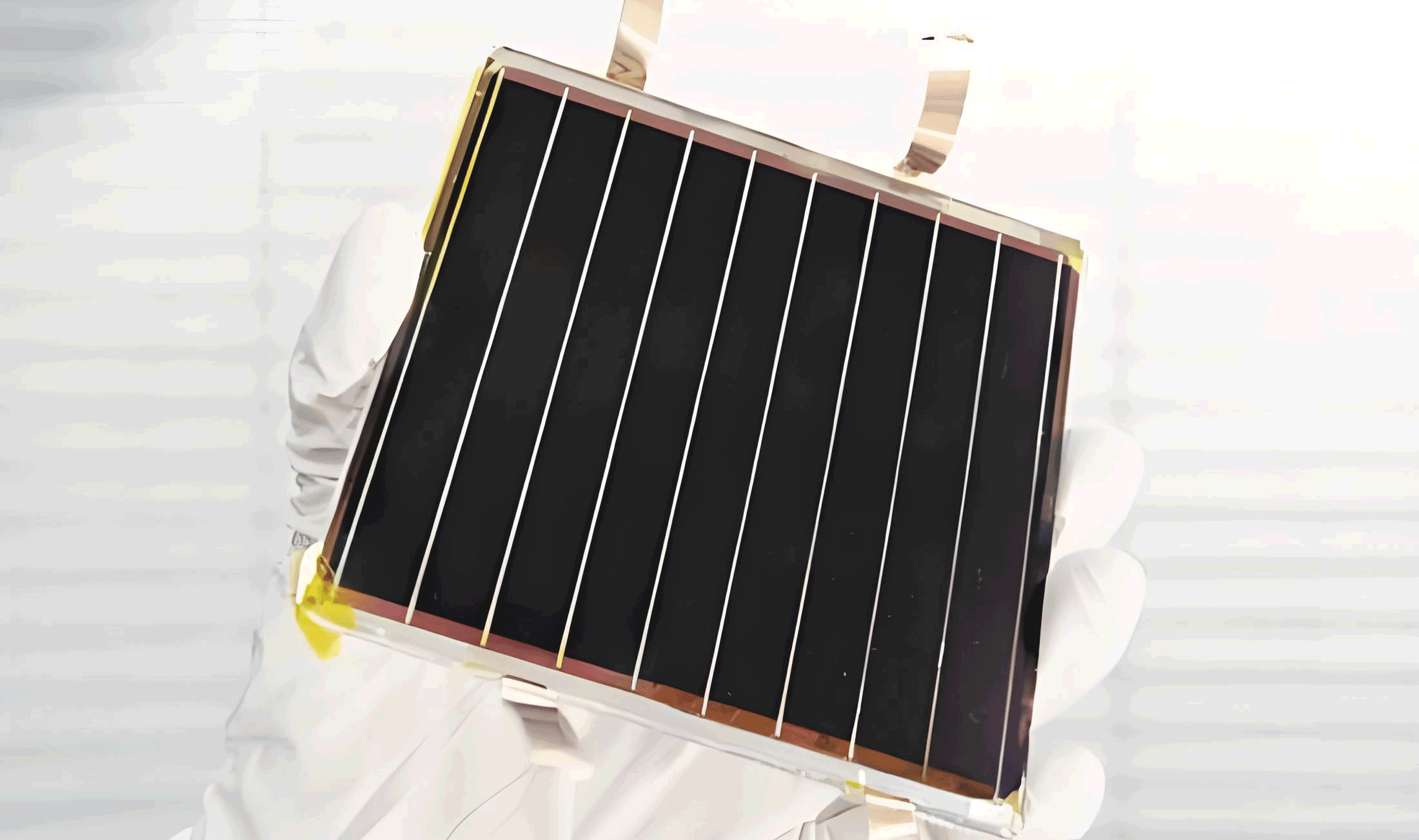
To elaborate on the methodology, the flexible acquisition circuit was fabricated using an FPC substrate with layered electromagnetic shielding films. This design ensures durability and flexibility, making it suitable for skin-contact applications without signal compromise. The circuit includes two main components: a signal acquisition path for the perovskite detector and a reference path with a capacitor to capture noise. The perovskite detector, based on a material similar to those used in perovskite solar cells, features interdigitated electrodes with optimized geometry for enhanced contact and signal transmission. The electrode channels are 0.06 mm wide, with finger lengths of 2.74 mm and pad dimensions of 1 mm by 2.02 mm. This configuration minimizes resistance and improves the detector’s response to radiation. The entire assembly is coated with a 5 μm aluminum layer, serving as both a Faraday cage and a compensation layer for dose measurement. The analog signal processing unit employs charge integration circuits with a feedback capacitor of 33 pF, enabling current measurements up to 330 nA and a charge capacity of 132 pC. The circuit’s output voltage is amplified using operational amplifiers with gain determined by resistor values, as shown in the equation:
$$ V_{out} = \left(1 + \frac{R_2}{R_1}\right) \left(V_{input} – V_{ref}\right) $$
where \( R_1 \), \( R_2 \), \( R_3 \), and \( R_4 \) are precision resistors. The switching mechanism between the two integration paths allows for continuous sampling, while a 20-bit Δ-Σ ADC digitizes the signals at a rate of 2500 samples per second. This high sampling rate is essential for capturing rapid response times characteristic of perovskite materials, akin to those in perovskite solar cells. The software interface, built on the .NET 8.0 framework, processes data packets received via USB at 250 packets per second, each containing 10 frames of 166 bytes. It provides real-time graphing, baseline adjustment, and data export to Excel for further analysis. This comprehensive design ensures that the system can handle the low-current outputs typical of perovskite-based detectors, which are often influenced by factors similar to those affecting perovskite solar cells, such as environmental stability and noise.
For experimental validation, we conducted a series of tests to assess the system’s accuracy, SNR, linearity, energy response, and angular dependence. The circuit verification involved generating square waves with amplitudes ranging from 2 mV to 10 mV using a Tektronix AFG31000 waveform generator and passing them through precision resistors from 100 kΩ to 10 GΩ. This produced reference currents from 100 nA down to 0.2 pA, which were measured simultaneously with our system and a commercial Keysight B2901 source measure unit. The error was calculated as the percentage deviation from the theoretical value, and results were tabulated to demonstrate precision. The SNR was evaluated using the formula:
$$ \text{SNR} = 10 \log_{10} \left( \frac{P_s}{P_n} \right) $$
where \( P_s \) is the signal power, computed as the average of squared signal values over time, and \( P_n \) is the noise power derived from the difference between the raw signal and its baseline. Linear response tests were performed in a Co-60 radiation field with dose rates from 16.87 mGy/h to 5.579 Gy/h, measuring the current output of the perovskite detector. Energy response experiments used an X-ray source at 430 μGy/h with energies from 33 keV to 208 keV, while angular response tests involved irradiating the detector at angles from -60° to 60° with a fixed dose rate of 29.8 mGy/h at 48 keV. Each test was repeated three times to ensure reliability, and data from both our system and the commercial device were compared.
| Current Level (pA) | Theoretical Current (pA) | Measured Current (pA) – Our System | Error (%) – Our System | Measured Current (pA) – Commercial | Error (%) – Commercial |
|---|---|---|---|---|---|
| 100000 | 100000 | 99950 | 0.05 | 100100 | 0.10 |
| 10000 | 10000 | 9990 | 0.10 | 10020 | 0.20 |
| 1000 | 1000 | 998 | 0.20 | 1005 | 0.50 |
| 100 | 100 | 99.5 | 0.50 | 101 | 1.00 |
| 10 | 10 | 9.95 | 0.50 | 10.1 | 1.00 |
| 1 | 1 | 0.98 | 2.00 | 1.02 | 2.00 |
| 0.2 | 0.2 | 0.195 | 2.50 | 0.205 | 2.50 |
The results from the circuit verification showed that our system achieved an average error of 1.90% across the current range, with errors below 1% for currents between 10 nA and 10 pA. This highlights the precision of our charge integration design, which is critical for applications involving perovskite solar cells and detectors where low-current signals are common. The SNR analysis revealed that our system had an average SNR of 49.98 dB, outperforming the commercial device’s 41.45 dB. This improvement is attributed to the noise cancellation through the reference channel and the robust shielding. A comparison of raw and processed signals demonstrated a significant reduction in noise, as illustrated by waveform plots where environmental fluctuations were minimized. In linear response tests, the relationship between dose rate and charge accumulation was highly linear, with a coefficient of determination (R²) of 0.994, indicating reliable performance across varying radiation intensities. The energy response curve peaked at 48 keV, consistent with expectations for perovskite materials, and showed good agreement between our system and the commercial unit. Angular response tests confirmed symmetry in detection efficiency, with minimal variation up to ±45°, making it suitable for wearable applications where detector orientation may change.
| Current Level (pA) | SNR (dB) – Our System | SNR (dB) – Commercial |
|---|---|---|
| 100000 | 55.2 | 48.1 |
| 10000 | 52.8 | 45.3 |
| 1000 | 50.5 | 42.7 |
| 100 | 48.3 | 40.2 |
| 10 | 46.0 | 37.8 |
| 1 | 43.5 | 35.4 |
| 0.2 | 41.0 | 33.1 |
In discussion, the effectiveness of our system stems from the synergistic integration of flexible electronics, advanced signal processing, and perovskite material properties. The charge integration circuit, with its high resolution and continuous sampling capability, addresses the challenges of measuring微弱 currents in noisy environments. This is particularly relevant for perovskite solar cells, which often exhibit similar signal characteristics under low-light or radiation conditions. The use of a reference channel for noise subtraction is a novel approach that enhances SNR, as evidenced by the experimental data. The linear and energy response results validate the system’s accuracy and reliability, with performance comparable to commercial instruments. Moreover, the flexibility and portability of the design open up new possibilities for real-time, wearable radiation monitoring in fields like healthcare, where personalized dose assessment is essential. The software component further enhances usability by providing intuitive data management and analysis tools. Overall, this system represents a significant step forward in adapting perovskite-based technologies for practical applications, building on the foundations laid by research in perovskite solar cells.
In conclusion, we have developed a flexible perovskite detector signal detection system based on charge integration that achieves high precision in current measurement, excellent noise immunity, and robust performance under various radiation conditions. The system’s design incorporates key elements from perovskite solar cell technology, such as material sensitivity and flexible substrate compatibility, to create a versatile tool for radiation detection. Experimental results confirm its superiority over commercial devices in terms of SNR and error rates, particularly in the critical picoampere range. Future work will focus on optimizing the detector geometry for enhanced sensitivity and integrating multiple detectors into arrays for spatial dose mapping. This advancement not only contributes to radiation safety but also underscores the potential of perovskite materials in emerging electronic applications, echoing the innovations seen in perovskite solar cells.