
In recent years, the rapid expansion of the electronics industry and advancements in battery technology have led to a surge in demand for li-ion batteries. These batteries are prized for their high energy density, compact size, long cycle life, and minimal environmental impact, making them ubiquitous in smartphones, wearable devices, electric vehicles, and energy storage systems. However, the flammable nature of the electrolyte within li-ion batteries poses significant fire risks. Thermal runaway—triggered by short circuits, overcharging, mechanical damage, or external heat—can lead to intense fires and even explosions, releasing toxic gases and dense smoke. This makes firefighting in li-ion battery warehouses exceptionally challenging, necessitating tailored strategies that address unique hazards like explosive atmospheres and massive smoke production. In this article, I explore the characteristics of li-ion battery fires, analyze灭火救援难点, and propose evidence-based approaches centered on large-scale water application and enhanced ventilation.
The combustion behavior of li-ion batteries is distinct from conventional materials, as revealed through controlled burning tests I conducted. In these experiments, li-ion batteries at 50% state of charge (SOC) were ignited using an external heat source. The setup involved a stainless steel fire pan with dimensions 28 cm × 36 cm × 10 cm, equipped with thermocouples on a wire mesh above to monitor temperature changes. Batteries were grouped in sets of 5, 7, and 12 to simulate varying fire loads. Upon heating to approximately 150°C, the li-ion batteries entered thermal runaway, characterized by violent burning, copious black smoke, and flame intensification due to the release of combustible gases from electrolyte decomposition. The process can be modeled using a simplified heat release equation: $$ \dot{Q} = \dot{m}_{fuel} \cdot \Delta H_c $$ where $\dot{Q}$ is the heat release rate, $\dot{m}_{fuel}$ is the mass loss rate of the electrolyte, and $\Delta H_c$ is the heat of combustion. The temperature surge during thermal runaway follows an exponential trend, often described as: $$ T(t) = T_0 + A e^{kt} $$ where $T_0$ is the initial temperature, $A$ is a constant, and $k$ is the thermal runaway rate constant. This underscores that temperature is the primary driver of sustained combustion in li-ion batteries, necessitating cooling as a core灭火 strategy.
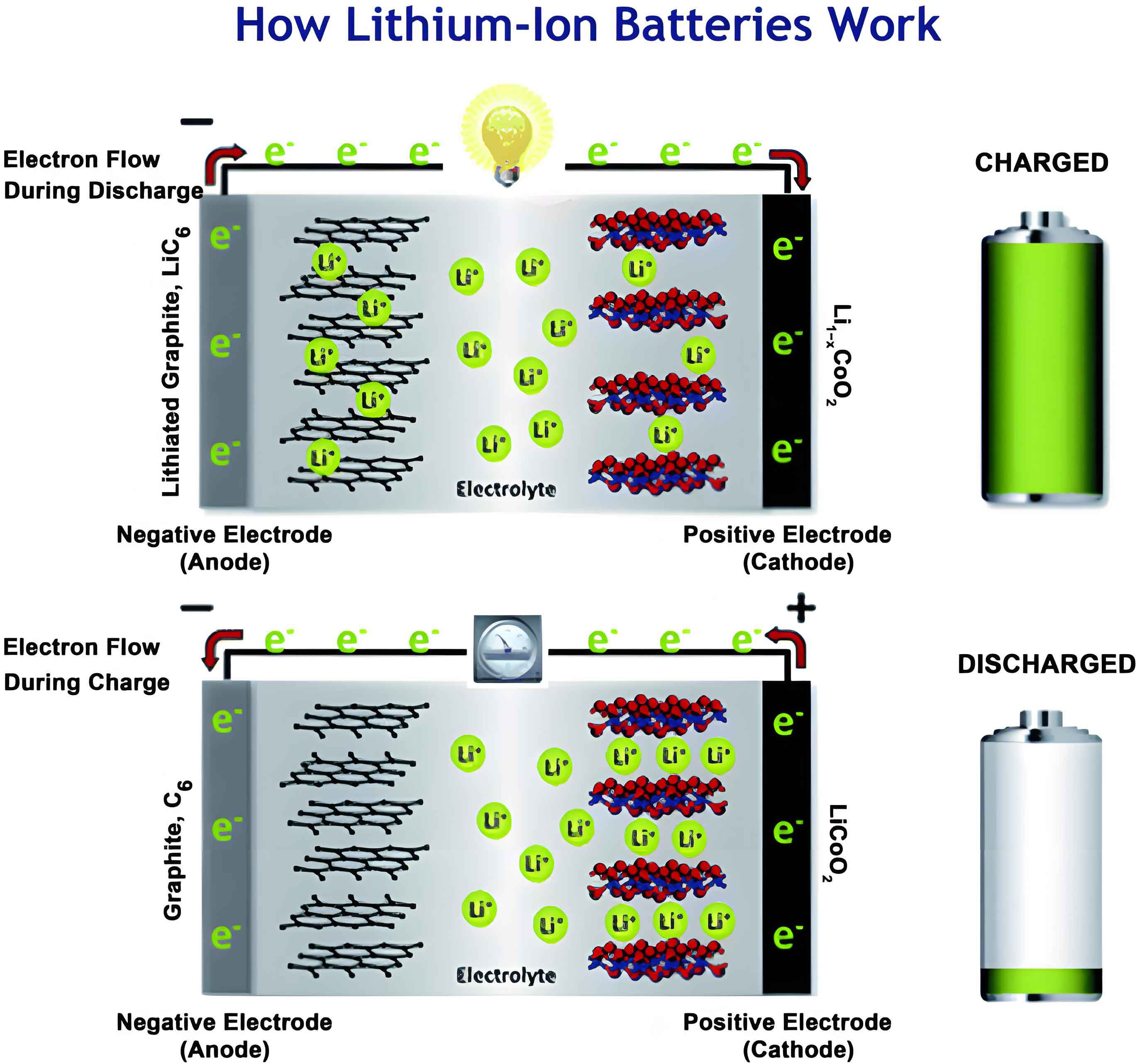
Li-ion battery warehouse fires exhibit several critical features that complicate灭火救援. Based on test results and historical incidents, I have summarized these characteristics in Table 1. The high energy density of li-ion batteries means that even a single cell can initiate a chain reaction, leading to rapid fire spread across stacked inventories. Moreover, the electrolyte—typically a mixture of organic carbonates—decomposes under heat to produce flammable gases like hydrogen (H₂), ethylene (C₂H₄), and propane (C₃H₈). When confined in warehouse spaces, these gases can form explosive mixtures, with lower explosion limits (LEL) around 4% for hydrogen. The risk is exacerbated by the release of oxygen from cathode materials at elevated temperatures; for instance, lithium cobalt oxide (LCO) and nickel-cobalt-manganese (NCM) batteries release oxygen at 200°C, while lithium iron phosphate (LFP) does so at 800°C. This self-sustaining oxidation reaction intensifies fires, as shown by the stoichiometric equation: $$ 2 LiCoO_2 \rightarrow Li_2O + CoO + O_2 $$ The massive smoke output—comprising soot, toxic fumes, and electrolyte vapor—reduces visibility, hampers rescue efforts, and accelerates heat transfer via radiation, often described by the Stefan-Boltzmann law: $$ q” = \epsilon \sigma (T_f^4 – T_s^4) $$ where $q”$ is the radiative heat flux, $\epsilon$ is emissivity, $\sigma$ is the Stefan-Boltzmann constant, $T_f$ is the flame temperature, and $T_s$ is the surface temperature of adjacent batteries.
| Characteristic | Description | Impact on Firefighting |
|---|---|---|
| High Heat Release Rate | Rapid energy discharge during thermal runaway, with peak temperatures exceeding 800°C. | Requires intensive cooling; conventional灭火剂 may be ineffective. |
| Massive Smoke Production | Dense black smoke from incomplete combustion of electrolytes and separators. | Reduces visibility; complicates interior attacks; increases toxicity. |
| Explosive Gas Generation | Flammable gases (e.g., H₂, CH₄) released, creating爆炸性环境. | Risk of flashovers or explosions; necessitates ventilation. |
| Oxygen Release from Cathodes | Certain li-ion battery types emit oxygen at high temperatures, fueling fires. | Self-sustaining combustion; undermines smothering tactics. |
| Rapid Fire Spread | Chain reaction of thermal runaway among packed batteries. | Fast escalation; large-scale water deluge needed. |
The灭火救援 challenges in li-ion battery warehouses are multifaceted. First, the sheer volume of batteries in storage—often in large, open-plan warehouses with minimal防火分区—can lead to fire loads exceeding 500 MJ/m², far above typical industrial limits. This demands immense water supplies for cooling, as the heat capacity of water ($c_w \approx 4.18 \, \text{kJ/kg·K}$) must absorb substantial energy to lower battery temperatures below the thermal runaway threshold, roughly 150–200°C. The required water mass can be estimated using: $$ m_w = \frac{Q_{total}}{c_w \Delta T_w} $$ where $Q_{total}$ is the total heat released from the li-ion battery inventory, and $\Delta T_w$ is the permissible temperature rise of water. Second, smoke management is critical; without effective ventilation, smoke accumulation not only obscures firefighting but also concentrates flammable gases, elevating explosion risks. The smoke production rate in li-ion battery fires can be modeled as: $$ \dot{m}_s = Y_s \cdot \dot{m}_{fuel} $$ where $Y_s$ is the smoke yield coefficient, typically high for polymer electrolytes. Third, the potential for爆炸性环境 necessitates continuous gas monitoring and rapid intervention, as gas concentrations can reach LEL within minutes in enclosed spaces.
To address these challenges, I propose a灭火救援 strategy centered on two pillars: massive water application and forced ventilation. Water is the most practical灭火剂 for li-ion battery fires due to its high specific heat capacity, availability, and cost-effectiveness. Experimental验证, such as submerging burning li-ion batteries in water tanks, confirms that immersion extinguishes flames by cooling cells below ignition points. However, for warehouse-scale fires, surface cooling alone is insufficient; penetration into battery stacks is essential. This can be achieved using high-flow water streams, such as those from monitors delivering 160 L/s at 120 m range, which provide both cooling and dilution of gases. The cooling effectiveness of water on a li-ion battery pack can be expressed as: $$ \frac{dT}{dt} = -\frac{hA}{mc} (T – T_w) $$ where $h$ is the heat transfer coefficient, $A$ is the surface area, $m$ and $c$ are the mass and specific heat of the battery, and $T_w$ is the water temperature. Concurrently, ventilation must be enhanced to remove smoke and flammable gases. Forced排烟 using high-power mobile fans can maintain gas concentrations below LEL, preventing explosions. The ventilation rate required to dilute gases to safe levels is given by: $$ Q_v = \frac{\dot{V}_{gas}}{C_{LEL} – C_0} $$ where $\dot{V}_{gas}$ is the volumetric gas production rate, $C_{LEL}$ is the lower explosive limit, and $C_0$ is the ambient concentration.
Implementing this strategy requires robust应急供水 and排烟 capabilities. Many municipalities lack the infrastructure to supply the thousands of liters per minute needed for li-ion battery warehouse fires. I recommend pre-planning应急取水点 from nearby water bodies and deploying remote供水 systems, which can pump water over long distances at rates up to 300 L/s. Additionally, onsite water storage tanks or dedicated fire ponds can supplement supply. For排烟, warehouses should be designed with mechanical smoke exhaust systems, but retrofits may involve strategic破拆 of walls or roofs to create natural ventilation paths. Mobile鼓风机 with capacities exceeding 50,000 m³/h can then be used to direct smoke outward. A comparative analysis of供水 and排烟 options is presented in Table 2, highlighting their suitability for li-ion battery fire scenarios.
| Solution Type | Description | Advantages | Limitations |
|---|---|---|---|
| Remote Water Supply Systems | Portable pumps and hoses drawing from lakes, rivers, or reservoirs. | High flow rates (200–400 L/s); independent of municipal grids. | Setup time; requires accessible water sources. |
| Onsite Water Tanks | Dedicated storage tanks with capacity > 100,000 L. | Immediate availability; reliable pressure. | High cost; space requirements. |
| Mechanical Smoke Exhaust | Fixed fans or vents integrated into warehouse design. | Automated operation; effective for normal smoke. | May fail under intense heat; inadequate for explosive gases. |
| Mobile Ventilation Units | Large鼓风机 deployed at火灾现场 to force air exchange. | Flexible placement; high airflow (up to 80,000 m³/h). | Power dependency; may spread fire if misdirected. |
| Structural破拆 | Controlled opening of roofs or walls to release smoke and gases. | Creates natural draft; low-tech. | Safety risks; property damage. |
In practice,灭火救援 operations for li-ion battery warehouses must be dynamic and informed by real-time火情探测. Thermal imaging cameras and gas detectors can identify hot spots and monitor flammable gas levels, enabling战术 adjustments. For instance, if gas concentrations approach 20% of LEL, firefighters should prioritize ventilation before interior attacks. The choice between internal offense and external suppression depends on the fire stage; early-phase fires may allow for localized cooling with handheld lines, while fully developed fires necessitate exterior deluge guns to achieve a knockdown effect. Mathematical models can aid decision-making, such as using the N-gas model to predict toxicity: $$ \text{Fractional Effective Dose} = \sum \frac{C_i}{LC_{50,i}} $$ where $C_i$ is the concentration of toxic gas $i$ (e.g., CO, HF from li-ion battery decomposition), and $LC_{50,i}$ is the lethal concentration for 50% exposure. Additionally, the risk of explosion can be assessed via the爆炸指数 $K_{st}$, calculated from pressure rise rates in confined spaces: $$ K_{st} = \left( \frac{dP}{dt} \right)_{max} \cdot V^{1/3} $$ where $V$ is the enclosure volume. For li-ion battery gases, $K_{st}$ values can range 150–300 bar·m/s, indicating severe explosion hazards.
Beyond immediate灭火, preventive measures are vital for li-ion battery仓库. These include segregating battery storage into smaller防火分区 with fire-resistant barriers, installing automatic sprinkler systems designed for high-challenge fires, and incorporating explosion venting panels to relieve pressure. Regular inspections for damaged li-ion batteries and strict controls on charging states in storage can mitigate ignition sources. Research into advanced灭火剂, such as water additives or vaporizing liquids, may offer future improvements, but water remains the benchmark due to its cooling prowess. The economic impact of li-ion battery fires also underscores the need for investment in防护; a single warehouse incident can incur losses exceeding millions, not counting environmental cleanup from electrolyte leaks.
In conclusion, li-ion battery warehouse fires present unique challenges due to intense heat release, massive smoke, and explosive gas generation. My analysis confirms that temperature control through large-scale water application is the most effective灭火 mechanism, supported by forced ventilation to mitigate爆炸风险. Emergency供水 systems must be bolstered to deliver high volumes, while排烟 tactics should combine structural modifications and mechanical fans. Real-time monitoring and adaptive tactics are essential to safeguard responders and property. As the use of li-ion batteries expands across industries, integrating these strategies into fire safety codes and training programs will be crucial for reducing the frequency and severity of such incidents. Future work should focus on optimizing water delivery methods and developing smart ventilation systems tailored to li-ion battery fire dynamics.
The persistent evolution of li-ion battery technology, including solid-state designs, may alter fire behaviors, but the core principles of cooling and ventilation will likely remain relevant. By prioritizing these strategies, we can enhance preparedness for li-ion battery warehouse emergencies, ultimately protecting lives and critical infrastructure. The公式 and tables provided herein offer a framework for quantifying risks and planning responses, emphasizing the scientific approach needed to tackle these complex fires.