
The large-scale deployment of electrochemical energy storage systems is accelerating globally as a core pillar of the energy transition. In China, under the “dual carbon” goals, the cumulative installed capacity of new energy storage systems is projected to reach 313.9 GW by 2030, with a compound annual growth rate of 37.1% from 2024 to 2030. Lithium-ion batteries dominate this market, accounting for over 90% of the share. However, the safety of these energy storage systems, particularly the risk of thermal runaway in prefabricated battery cabins, has become a critical bottleneck limiting further expansion. The fundamental contradiction lies in the fact that the internal self-oxygen-supplying reaction of lithium-ion batteries renders conventional fire suppression methods ineffective. This paper focuses on the standard construction of fire-fighting systems for electrochemical energy storage battery cabins, systematically analyzes the challenges, reviews the current state of national and local standards, and proposes targeted optimization pathways.
The chain disaster mechanism of electrochemical energy storage systems involves a multi-field coupling of electrochemistry, heat, and gas generation. When an internal short circuit is triggered by overcharging, mechanical damage, or ambient high temperature, the solid electrolyte interphase (SEI) film decomposes, initiating a chain reaction. The electrolyte decomposes to produce combustible gases such as H2, CO, C2H4, and toxic gases like HF. Simultaneously, the cathode material releases oxygen, which intensifies the combustion. Historical accidents, such as the 2021 Fengtai, Beijing, energy storage station explosion and the 2024 Gateway energy storage system fire in California, USA, illustrate these risks. In the latter case, three explosions occurred within 12 minutes of thermal runaway, shattering windows 200 meters away. These incidents underscore the critical need for robust standard systems for these energy storage systems.
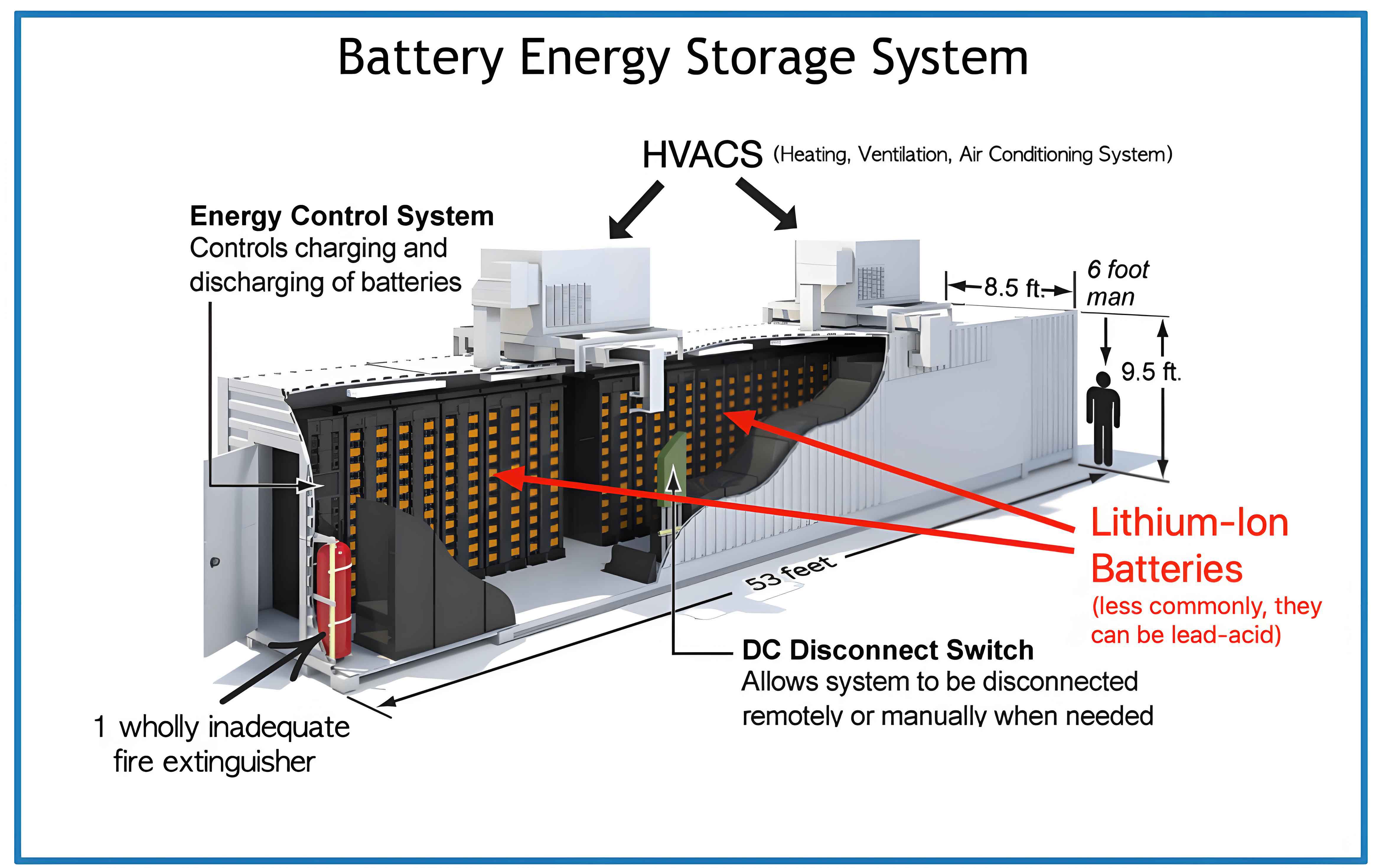
Fire Evolution Mechanisms and Suppression Challenges
The fire evolution in an energy storage system battery cabin presents three compounded characteristics that challenge traditional firefighting frameworks. The first is deep-seated combustion. The internal chain reaction within the battery cell can maintain temperatures exceeding 800°C without relying on external oxygen, rendering standard suffocation-based suppression methods ineffective. The second is a high risk of re-ignition. Residual heat from thermal runaway can cause a continuous temperature rise, leading to secondary thermal runaway even after the visible flame is extinguished. The third is the risk of explosion. The accumulation of combustible gases within the sealed cabin creates an explosive atmosphere. When these gases mix with oxygen and encounter an ignition source, such as an electrical spark, a detonation can occur. The energy density and configuration of modern energy storage systems amplify these risks.
| Challenge Dimension | Specific Conflict | Impact on Energy Storage Systems |
|---|---|---|
| Early Warning vs. Signals | Weak characteristic signals (gas, temperature, sound) in the early stage of thermal runaway are difficult for sensors to distinguish from ambient noise. | Delayed detection prevents timely disconnection and activation of the fire suppression system, allowing thermal runaway to propagate. |
| Suppression vs. Thermal Runaway | Traditional agents fail to cool the core of the battery pack. The reaction is self-sustaining and does not require external oxygen. | High probability of re-ignition after suppression. Gas agents lack cooling capacity; solid agents cause contamination and have low heat capacity. |
| System Integration vs. Validation | “Focus on components, ignore system” leads to poor interoperability between detection, alarm, and suppression subsystems. | Lack of full-scale fire testing validation for integrated systems results in theoretical standards that do not match practical performance. |
The mathematical modeling of heat generation in an energy storage system is complex. The total heat generated during thermal runaway can be expressed as the sum of contributions from different exothermic reactions within the cell:
$$Q_{gen} = Q_{SEI} + Q_{anode} + Q_{cathode} + Q_{electrolyte}$$
Where \( Q_{SEI} \) is the heat from SEI film decomposition, \( Q_{anode} \) from the reaction of the anode with the electrolyte, \( Q_{cathode} \) from oxygen release, and \( Q_{electrolyte} \) from electrolyte combustion. For effective suppression, the cooling capacity of the agent must exceed this heat generation to prevent propagation:
$$\eta_{cooling} = \frac{C_{p,agent} \cdot m_{agent} \cdot \Delta T}{\int Q_{gen} dt} > 1$$
This equation highlights why traditional agents often fail. Gas agents have a low \( C_{p} \) and mass \( m_{agent} \) available for cooling, while water-based agents, despite high \( C_{p} \), face challenges related to conductivity and volume. Furthermore, the gas generation rate is critical for explosion risk assessment:
$$\frac{dP}{dt} \propto \frac{\dot{V}_{gas} \cdot R \cdot T}{V_{cabin}}$$
Current State of Standard Systems for Energy Storage System Fire Safety
Standardization for electrochemical energy storage systems has evolved rapidly. At the national level, multiple standards govern different lifecycle phases of the energy storage system. GB 51048 was an early standard that classified lithium battery fire hazard as “Class E” (low risk), which led to insufficient fire separation and ventilation requirements. Later standards have begun to address these gaps.
| Standard ID | Scope & Governing Body | Key Fire Safety Specifications |
|---|---|---|
| GB/T 42288 (2022) | EESS Station Safety (SAC/TC 550) | Mandates gas, smoke, and heat detectors. Requires automatic fire suppression at the battery module level. Suppression medium must have high insulation and cooling performance. |
| GB/T 44026 (2024) | Prefabricated Cabin Energy Storage System | Applicable to systems \(\ge 100kW\) and \(\ge 200kWh\). Requires automatic alarm and suppression systems aligned with GB/T 42288. |
| GB 51048 (Under Revision) | EESS Design (MOHURD) | Original version had vague fire safety clauses. Revision aims to address hazard classification and suppression specifics. |
| GB 44240 (2024) | Battery Cell Safety | Dictates no fire or explosion under impact, crush, nail penetration, thermal abuse tests. No thermal propagation within the battery pack. |
Local government standards have been pioneering the gap left by national frameworks. These local standards are crucial for adapting general principles to specific regional risks and technological realities of energy storage systems.
- Beijing (DB11/T 1893): Reclassified the fire hazard of lithium batteries from “Class E” to “Class A/B” for power energy storage systems, mandating stricter fire separation distances and enhanced structural fire protection.
- Jiangsu (DB32/T 4682): A landmark standard for prefabricated cabin lithium iron phosphate (LFP) energy storage systems. It explicitly requires that the fixed automatic fire suppression system must be validated through module-level real fire tests conducted by a qualified third-party agency.
- Qinghai (DB63/T 2286): Emphasizes the multifunctional role of the suppression system. It requires the system to have combined cooling, explosion suppression, and fire extinguishing capabilities, validated again by physical fire testing.
- Fujian (DB35/T 2145) & Shaanxi (DB61/T 1757): Focus on the risk assessment and risk management aspects of the energy storage system lifecycle, providing frameworks for evaluating fire risk based on intrinsic safety, existing facilities, and management level.
Proposed Optimization Pathways for Standard Construction
To move from “general provisions” to “scenario-based technical details,” the evolution of standards for these energy storage systems must follow three key optimization pathways.
1. Standardization of New Energy Fire Prevention and Control Technologies
The unique fire characteristics of lithium-ion batteries require a deep scientific understanding translated into engineering practice. Standards must incorporate:
- Scenario-based Test Models: Develop standardized test models that cover various failure modes (overcharge, internal short circuit, thermal abuse) and environmental conditions (high temperature, humidity). These models must quantify the response efficacy of the fire suppression system. For example, the critical heat flux required to prevent propagation can be a key performance indicator.
- Multi-parameter Fusion Detection: Move beyond single-threshold detection (e.g., smoke density). Future standards should specify the integration of gas concentration (\( H_2, CO \)), temperature rise rate (\( dT/dt \)), and acoustic emissions to create a reliable early warning signature. The warning time \( t_{warn} \) must be optimized:
$$t_{warn} \propto \frac{C_{threshold} – C_{noise}}{k_{gas} \cdot SR_{battery}}$$
where \( C_{threshold} \) is the alarm threshold, \( C_{noise} \) is the background noise level, and \( SR_{battery} \) is the generation rate of the signature gas.
2. Construction of a System-Level Fire Safety Performance Validation System
A critical gap in current standards is the lack of a holistic validation methodology. Standards must evolve to demand performance testing at the system level, not just component level.
This involves developing a “fire module” for full-scale tests that simulates a realistic thermal runaway scenario. The validation criteria for an energy storage system suppression system should include:
- Detection and Actuation Time: The time from the onset of thermal runaway to the activation of the suppression system \( t_{act} \).
- Flame Suppression Time: The time required to extinguish the open flame,
- Cooling and Re-ignition Prevention: The ability to cool the battery surface below the thermal runaway threshold temperature \( T_{TR} \) and prevent re-ignition for a specified period \( t_{hold} \).
The overall system performance \( S_{sys} \) can be evaluated as a composite index:
$$S_{sys} = w_1 \cdot \frac{1}{t_{act}} + w_2 \cdot \frac{1}{t_{ext}} + w_3 \cdot \Delta T_{cool} + w_4 \cdot t_{hold}$$
Where \( w_i \) are weighting factors based on the specific risk profile of the energy storage system. This performance-based approach allows for innovation in agent and design, provided the final system meets the safety metric.
3. Improvement of the Whole Lifecycle Management and Control Mechanism
Fire safety of an energy storage system is not a static design feature but a lifecycle property. Standards must enforce requirements across the entire value chain of the energy storage system.
| Lifecycle Phase | Standard Requirements | Technical Implementation |
|---|---|---|
| Design & Planning | Quantitative risk assessment. Hazard classification alignment. | Define fire zones, safe distances, ventilation for deflagration. Use models to predict \( P_{max} \) from gas buildup. |
| Construction & Commissioning | Verification of system integration. | Factory acceptance tests (FAT) and site acceptance tests (SAT) for the integrated detection + suppression loop. |
| Operation & Maintenance | Real-time monitoring of battery consistency. Ageing management for 2nd life batteries. | BMS integration with fire panel. Threshold limits for SOC and SOH. Digital twin for dynamic risk prediction. |
| Decommissioning | Safe handling and disposal of damaged cells. | Protocols for discharging and inerting cells before transport. |
The standardization of testing protocols is essential. For example, a standard module-level fire test for an energy storage system might involve inducing thermal runaway in a specific cell and monitoring the performance of the suppression system. The criteria for success should be strictly defined, including maximum allowable temperature rise and concentration of flammable gases outside the module. The flaw of current standards is they often test the extinguishing agent on an open fire, not on an actual battery module undergoing thermal runaway. This ignores the complex internal reactions of the energy storage system.
Conclusion
The construction of standards for fire-fighting systems in electrochemical energy storage battery cabins is a critical defense line for national energy security. The inherent characteristics of lithium-ion battery fires—deep-seated combustion, high re-ignition risk, and explosion potential—present challenges that existing fire protection frameworks cannot adequately address. While significant progress has been made in national standards like GB/T 42288 and pioneering local standards, a fundamental gap remains in system-level performance validation and lifecycle management.
To bridge this gap, future standard development for energy storage systems must focus on three key areas. First, accelerating the translation of multi-parameter detection and new suppression technologies into actionable standards. Second, constructing a rigorous, standardized, and full-scale fire testing validation system for entire energy storage systems. Third, integrating a lifecycle perspective into the standard framework, from design and operation to decommissioning. By evolving from general provisions to precise, scenario-based technical details, standardized development can provide the robust theoretical basis and practical guidance needed for the safe, robust, and sustainable development of the global electrochemical energy storage industry. This will ensure that energy storage systems can fulfill their critical role in the future energy mix without compromising safety.