
The rapid development of lithium-ion battery energy storage systems (ESS) has revolutionized renewable energy integration, yet their inherent fire risks demand rigorous safety protocols. This article explores the technical challenges, fire suppression strategies, and emerging solutions for ensuring ESS safety in modern power infrastructure.
1. Thermal Runaway Mechanisms and Fire Dynamics
Thermal runaway in lithium batteries follows distinct phases characterized by:
- Pre-ignition stage: Internal short circuits or external heating triggers temperature rise (150–250°C) with gas venting.
- Combustion phase: Exothermic reactions accelerate, reaching temperatures exceeding 600°C.
- Propagation: Chain reactions spread through battery modules at rates up to 2 m/s.
The thermal dynamics can be modeled using:
$$ \frac{dT}{dt} = \frac{1}{\rho C_p} \left( \dot{q}_{chem} + \dot{q}_{elec} – hA(T – T_{amb}) \right) $$
Where:
\( \rho \) = Battery density (kg/m³)
\( C_p \) = Specific heat capacity (J/kg·K)
\( \dot{q}_{chem} \) = Chemical reaction heat (W/m³)
\( \dot{q}_{elec} \) = Electrical heat generation (W/m³)
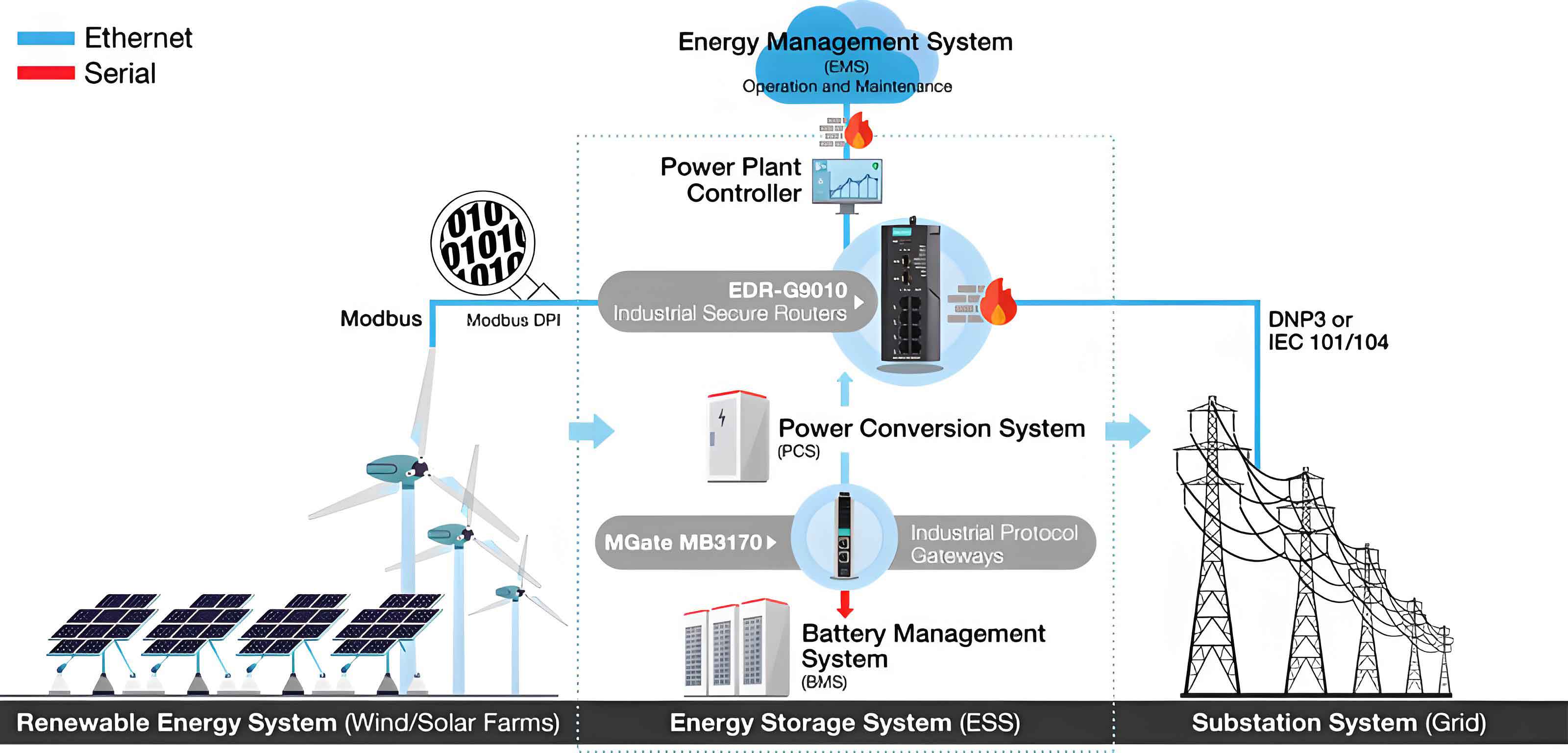
2. Fire Suppression Agent Performance
| Agent | Heat Capacity (J/mol·K) | ODP | Toxicity (LC50 ppm) | Minimum Design Concentration (%) |
|---|---|---|---|---|
| HFC-227ea | 128 | 0 | >80,000 | 7.3 |
| FK-5-1-12 | 282 | 0 | >100,000 | 4.2 |
| CO₂ | 37 | 0 | 50,000 | 34 |
3. Multi-Stage Protection Architecture
Modern energy storage system protection employs a layered approach:
| Tier | Detection Method | Response Time | Suppression Action |
|---|---|---|---|
| 1 (Cell Level) | ΔV/ΔT monitoring | <500 ms | Localized gas injection |
| 2 (Rack Level) | Laser smoke detection | <3 s | Compartment flooding |
| 3 (System Level) | Thermal imaging | <10 s | Hybrid water mist + chemical |
4. Advanced Cooling Strategies
The cooling efficiency of immersion systems follows:
$$ \dot{Q}_{removed} = \dot{m}_{coolant} C_{p,c} (T_{out} – T_{in}) $$
Where dielectric fluid properties significantly impact performance:
| Fluid Type | Thermal Conductivity (W/m·K) | Viscosity (cSt) | Fire Point (°C) |
|---|---|---|---|
| Mineral Oil | 0.12 | 18 | 160 |
| Synthetic Ester | 0.16 | 32 | >300 |
| Fluorocarbon | 0.09 | 2.5 | Non-flammable |
5. Smart Fire Prediction Models
Machine learning algorithms enhance early warning capabilities:
$$ P_{failure} = \frac{1}{1 + e^{-(\beta_0 + \beta_1X_1 + \cdots + \beta_nX_n)}} $$
Where predictive features (X₁–Xₙ) include:
– Cell impedance spectroscopy data
– Thermal gradient variance
– Gas composition ratios
6. System Design Optimization
Ventilation requirements for energy storage system enclosures:
$$ A_{vent} = \frac{\dot{m}_{gas} R T}{P \sqrt{2 \rho \Delta P}} $$
Key parameters:
\( \dot{m}_{gas} \) = Maximum gas generation rate (kg/s)
\( \Delta P \) = Pressure differential (Pa)
The evolution of energy storage system safety technologies demonstrates significant progress in addressing lithium battery fire risks. Through integrated thermal management, advanced detection algorithms, and multi-agent suppression systems, modern ESS installations achieve fire containment probabilities exceeding 99.7% while maintaining operational efficiency. Future developments in solid-state electrolytes and AI-driven predictive maintenance promise to further enhance the safety profile of grid-scale energy storage systems.