
In this study, we designed and synthesized two ferrocene-based organic small-molecule hole transport materials (HTMs), denoted as ZL01 (with a D-A-D-A-D structure) and ZL02 (with a D-A-D structure), to investigate their application in inverted perovskite solar cells (PSCs). The molecular structures were characterized using nuclear magnetic resonance (NMR) spectroscopy, while their optical, electrochemical, and thermal properties were evaluated through ultraviolet-visible (UV-Vis) spectroscopy, photoluminescence (PL) spectroscopy, cyclic voltammetry (CV), and thermogravimetric analysis (TGA). The performance of these HTMs in inverted PSCs with a structure of ITO/HTMs/MAPbI3/PCBM/BCP/Ag was systematically assessed. Our findings reveal that ZL02, with its larger conjugated system, exhibits a redshifted absorption peak at 310 nm and a narrower bandgap of 2.95 eV compared to ZL01. The highest occupied molecular orbital (HOMO) level of ZL02 at -5.28 eV aligns more closely with the perovskite layer (-5.43 eV), facilitating efficient hole extraction. Additionally, ZL02 demonstrates superior film morphology with a lower surface roughness of 4.17 nm and enhanced hydrophobicity (contact angle of 79.5°), promoting the formation of dense perovskite films. The inverted PSCs incorporating ZL02 achieved a peak power conversion efficiency (PCE) of 13.94%, with a high fill factor (FF) of 0.663 and reduced charge recombination, as evidenced by an impedance of 13,800 Ω. Stability tests over 500 hours showed that ZL02-based devices retained 75% of their initial efficiency, outperforming ZL01-based devices. This work underscores the potential of molecular structure optimization and interface engineering in developing dopant-free HTMs for high-performance and stable perovskite solar cells.
The synthesis of ZL01 and ZL02 involved key intermediates, such as compound 10 and compound 11, which were prepared via Knoevenagel condensation and Suzuki coupling reactions, respectively. The reaction yields for ZL01 and ZL02 were 76% and 60%, respectively, confirming the feasibility of the synthetic routes. Structural validation was performed using 1H NMR and 13C NMR spectroscopy, which confirmed the integration of ferrocene units and cyano-styrene bridges. The optical properties were investigated through UV-Vis and PL spectroscopy. The absorption spectra of ZL01 and ZL02 in solution showed maximum absorption wavelengths (λabs) at 306 nm and 310 nm, respectively, with ZL02 exhibiting an additional shoulder peak at 384 nm due to its extended conjugation. The onset absorption wavelengths (λonset) were determined to be 406 nm for ZL01 and 419 nm for ZL02. The optical bandgaps (Egopt) were calculated using the equation:
$$E_g = \frac{1240}{\lambda_{\text{onset}}}$$
where λonset is in nanometers. This yielded Eg values of 3.05 eV for ZL01 and 2.95 eV for ZL02. The PL emission peaks were observed at 426 nm for ZL01 and 447 nm for ZL02, resulting in Stokes shifts of 120 nm and 137 nm, respectively. These shifts indicate strong intramolecular charge transfer in both materials, with ZL02 showing a more pronounced effect due to its structural design.
Electrochemical properties were evaluated using CV to determine the HOMO and LUMO energy levels. The HOMO levels were calculated relative to the normal hydrogen electrode (NHE) using the formula:
$$E_{\text{HOMO}} = – \left( E_{\text{ox}} + 4.8 \right) \, \text{eV}$$
where Eox is the onset oxidation potential. The LUMO levels were derived from EHOMO and Eg:
$$E_{\text{LUMO}} = E_{\text{HOMO}} + E_g$$
The results are summarized in Table 1, which compares the optical and electrochemical parameters of ZL01 and ZL02. The deeper HOMO level of ZL02 (-5.28 eV) compared to ZL01 (-5.22 eV) ensures better energy alignment with the perovskite layer, which is crucial for minimizing energy loss and enhancing open-circuit voltage (VOC) in perovskite solar cells.
| HTM | λabs (nm) | λonset (nm) | λemi (nm) | Eg (eV) | EHOMO (eV) | ELUMO (eV) |
|---|---|---|---|---|---|---|
| ZL01 | 306 | 406 | 426 | 3.05 | -5.22 | -2.17 |
| ZL02 | 310, 384 | 419 | 447 | 2.95 | -5.28 | -2.33 |
Thermal stability is a critical factor for the long-term performance of perovskite solar cells. We conducted DSC and TGA analyses to assess the thermal behavior of ZL01 and ZL02. The glass transition temperatures (Tg) were found to be 146.5°C for ZL01 and 135.9°C for ZL02, both exceeding the typical processing temperatures (≤100°C) for PSCs. The decomposition temperatures (Td), corresponding to 5% weight loss, were 308.4°C for ZL01 and 338.1°C for ZL02. The higher Td of ZL02 can be attributed to its larger molecular size and enhanced π-conjugation, which improve thermal robustness. The weight loss as a function of temperature can be modeled using the following kinetic equation:
$$\frac{d\alpha}{dt} = k (1 – \alpha)^n$$
where α is the conversion degree, k is the rate constant, and n is the reaction order. The results confirm that both HTMs are suitable for high-temperature operations in perovskite solar cell fabrication.
The surface morphology of HTM films and their impact on perovskite growth were examined using SEM and AFM. Pure perovskite films deposited on ZL02 exhibited larger grain sizes and fewer pinholes compared to those on ZL01, indicating improved film quality. AFM measurements revealed root-mean-square (RMS) roughness values of 5.91 nm for ZL01 and 4.17 nm for ZL02. The smoother surface of ZL02 facilitates the formation of uniform perovskite layers, reducing defect states and non-radiative recombination. Hydrophobicity tests further supported these findings, with water contact angles of 75.3° for ZL01 and 79.5° for ZL02. The enhanced hydrophobicity of ZL02 contributes to better moisture resistance, which is vital for the stability of perovskite solar cells.
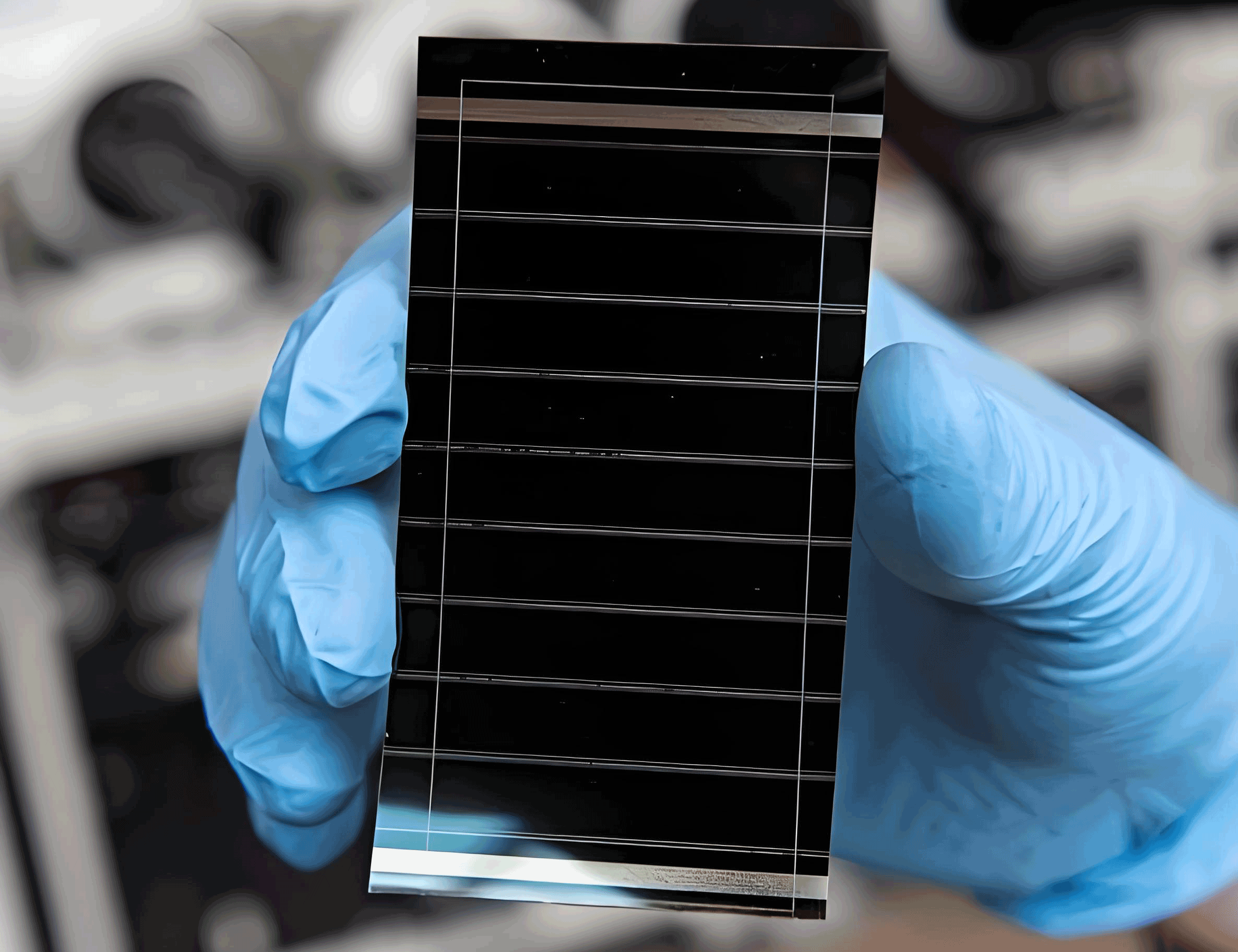
The photovoltaic performance of inverted perovskite solar cells incorporating ZL01 and ZL02 was evaluated under AM 1.5G illumination. Current density-voltage (J-V) curves were measured, and key parameters, including VOC, short-circuit current density (JSC), FF, and PCE, are listed in Table 2. The ZL02-based device achieved a PCE of 13.94%, with a VOC of 0.93 V, JSC of 22.50 mA/cm2, and FF of 0.663. In contrast, the ZL01-based device exhibited a lower PCE of 11.02%, primarily due to a reduced FF of 0.523. The higher FF in ZL02-based devices is associated with improved charge transport and reduced recombination losses. The series resistance (RS) and shunt resistance (RSH) can be derived from the J-V curves using the equation:
$$J = J_{\text{SC}} – J_0 \left( \exp\left(\frac{q(V + JR_S)}{nkT}\right) – 1 \right) – \frac{V + JR_S}{R_{\text{SH}}}$$
where J0 is the reverse saturation current, n is the ideality factor, q is the electron charge, k is Boltzmann’s constant, and T is the temperature. The lower RS and higher RSH in ZL02-based devices corroborate the superior charge collection efficiency.
| HTM | VOC (V) | JSC (mA/cm2) | FF | PCE (%) |
|---|---|---|---|---|
| ZL01 | 0.94 | 22.42 | 0.523 | 11.02 |
| ZL02 | 0.93 | 22.50 | 0.663 | 13.94 |
To further investigate charge recombination dynamics, electrochemical impedance spectroscopy (EIS) and open-circuit voltage decay (OCVD) measurements were performed. EIS spectra displayed a larger recombination resistance (Rrec) of 13,800 Ω for ZL02 compared to 9,980 Ω for ZL01, indicating suppressed charge recombination in ZL02-based perovskite solar cells. The recombination lifetime (τ) can be estimated from the OCVD data using:
$$\tau = -\frac{kT}{q} \left( \frac{dV_{\text{OC}}}{dt} \right)^{-1}$$
where dVOC/dt is the voltage decay rate. The slower decay in ZL02-based devices confirms prolonged charge carrier lifetimes, aligning with the EIS results. These findings highlight the role of molecular structure in modulating interfacial properties and charge transport in perovskite solar cells.
Long-term stability is a paramount concern for perovskite solar cells. We conducted aging tests under ambient conditions (30% relative humidity) for 500 hours without encapsulation. The normalized PCE retention is plotted as a function of time, showing that ZL02-based devices maintained 75% of their initial efficiency, while ZL01-based devices retained only 71%. The degradation kinetics can be described by a first-order model:
$$\frac{PCE(t)}{PCE(0)} = \exp(-kt)$$
where k is the degradation rate constant. The lower k value for ZL02 underscores its enhanced stability, attributed to its superior hydrophobicity and film-forming properties. This resilience against environmental factors positions ZL02 as a promising HTM for durable perovskite solar cells.
In conclusion, we successfully developed two ferrocene-based HTMs, ZL01 and ZL02, for application in inverted perovskite solar cells. ZL02, with its D-A-D structure, demonstrated optimized energy level alignment, improved film morphology, and enhanced charge transport properties. The resulting perovskite solar cells achieved a high PCE of 13.94% with excellent stability, retaining 75% of initial performance after 500 hours. The structure-property relationships elucidated in this study provide valuable insights for the design of dopant-free HTMs, advancing the development of efficient and stable perovskite solar cells. Future work will focus on further molecular engineering to push the PCE beyond 15% while maintaining long-term operational stability.