
As a researcher deeply invested in the field of energy storage and system safety, I find the rapid evolution of lithium-ion battery technology both exhilarating and demanding. The widespread adoption of lithium-ion batteries in electric vehicles, portable electronics, and grid storage is a testament to their superior energy density and cycle life. However, this very success amplifies the critical importance of addressing their inherent safety vulnerabilities. My work focuses on understanding and mitigating these risks. The operational lifecycle of a lithium-ion battery system is fraught with potential failure modes, ranging from internal electrochemical degradation to external hardware faults, any of which can compromise performance, accelerate aging, or, in worst-case scenarios, lead to catastrophic events like thermal runaway. Therefore, developing robust, accurate, and real-time fault diagnosis and fault-tolerant control (FTC) strategies is not merely an academic pursuit but a fundamental engineering imperative for ensuring the reliability and safety of modern energy systems.
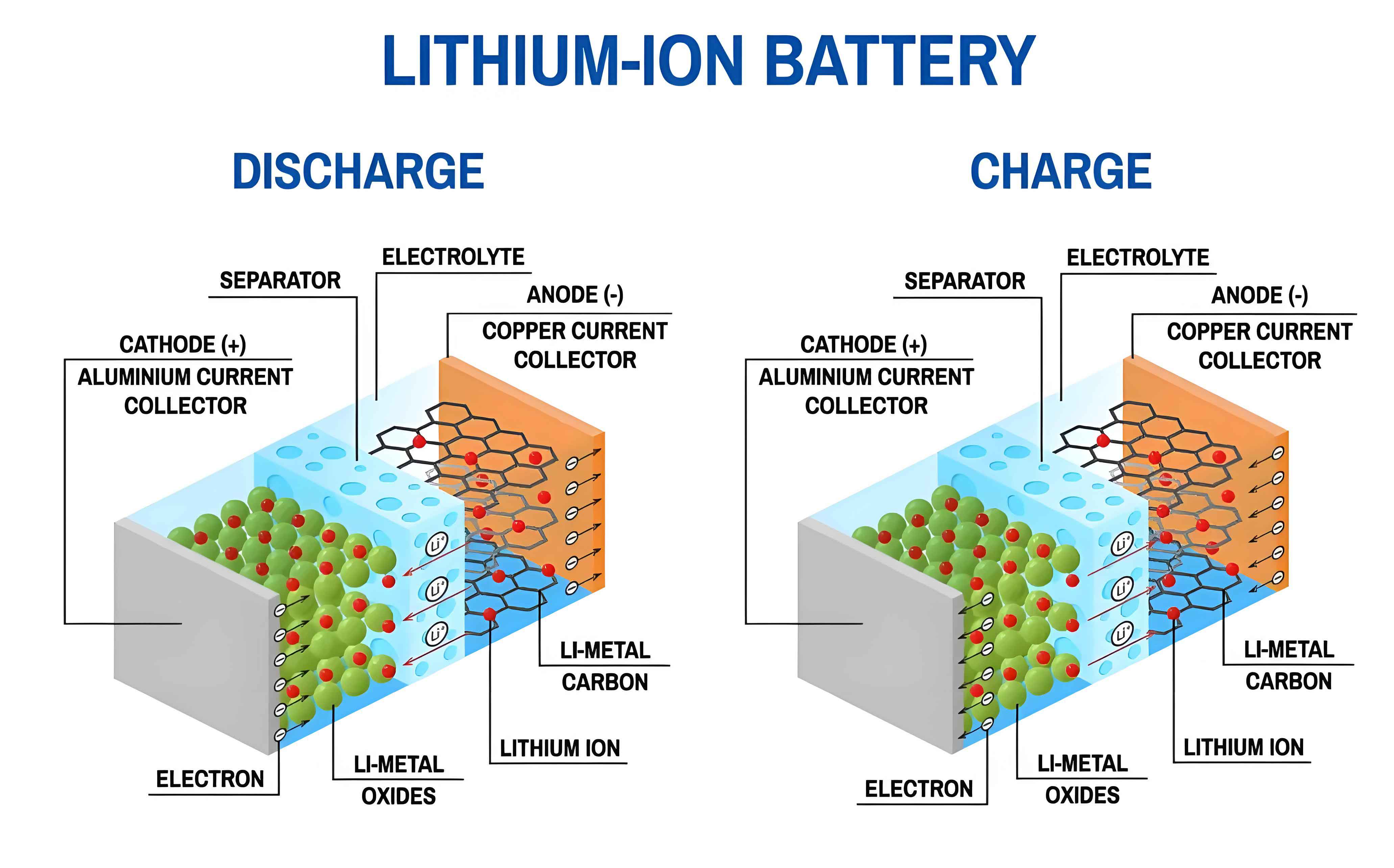
The core of my diagnostic approach hinges on the extraction and intelligent analysis of electrical signal features. Parameters like terminal voltage, current, and derived characteristics such as impedance spectra or incremental capacity (IC) curves serve as the primary health indicators for a lithium-ion battery. Subtle deviations in these signals often precede major failures. My review synthesizes the current state-of-the-art, systematically examining fault mechanisms, detection methodologies, and容错控制architectures, while also charting a course for future research to overcome existing limitations.
1. Taxonomy and Mechanisms of Faults in Lithium-Ion Battery Systems
Faults in a lithium-ion battery system can be categorically divided into internal faults, originating from the electrochemical cell itself, and external faults, associated with the peripheral hardware and management system. Understanding their root causes is the first step toward effective diagnosis.
1.1 Internal Faults
Internal faults are directly related to the electrochemical and structural integrity of the lithium-ion battery cell.
1.1.1 Internal Short Circuit (ISC) An ISC occurs when an electronic conduction path is established between the anode and cathode inside the cell, bypassing the intended ionic pathway through the electrolyte. This creates a parasitic discharge loop. The severity is often characterized by the internal short-circuit resistance, $R_{isc}$. A low $R_{isc}$ (hard short) leads to rapid self-discharge and heat generation, while a high $R_{isc}$ (soft or micro-short) is more subtle but can progressively degrade the lithium-ion battery.
1.1.2 External Short Circuit (ESC) An ESC involves a direct, low-resistance connection between the cell’s external terminals. This causes an extremely high discharge current, governed by Ohm’s law where the current $I_{esc} \approx V_{oc} / R_{ext}$, with $V_{oc}$ being the open-circuit voltage and $R_{ext}$ the negligible external resistance. The massive $I^2R$ heating can rapidly trigger thermal runaway in the lithium-ion battery.
1.1.3 Overcharge and Over-discharge These are voltage-boundary violations. Overcharge pushes the cathode to high potentials, leading to electrolyte oxidation and irreversible structural changes. Over-discharge drives the anode potential so low that the copper current collector can dissolve ($Cu \rightarrow Cu^{2+} + 2e^-$), risking subsequent dendrite formation. Both conditions permanently damage the lithium-ion battery chemistry.
1.1.4 Cell Inconsistency In a pack, variations in capacity, internal resistance, and self-discharge rate among individual lithium-ion battery cells lead to imbalance. This inconsistency causes uneven stress during cycling, forcing some cells into overcharge/over-discharge states sooner than others, thereby accelerating overall pack degradation.
| Fault Type | Primary Cause | Key Electrical Signature | Potential Outcome |
|---|---|---|---|
| Internal Short Circuit | Mechanical abuse, separator defect, Li-dendrite growth | Unexplained voltage drop, capacity fade, self-discharge | Local heating, thermal runaway |
| External Short Circuit | Physical damage to terminals, insulation failure | Sudden high current, rapid voltage collapse | Extreme heating, thermal runaway |
| Overcharge | BMS failure, charger malfunction, cell imbalance | Voltage exceeding upper cutoff ($V > V_{max}$) | Electrolyte decomposition, gas generation, thermal runaway |
| Over-discharge | BMS failure, deep discharge, cell imbalance | Voltage falling below lower cutoff ($V < V_{min}$) | Copper dissolution, SEI breakdown, capacity loss |
| Cell Inconsistency | Manufacturing tolerance, uneven aging, thermal gradients | Voltage divergence among series cells during relaxation | Reduced pack capacity, accelerated aging, induced overcharge/over-discharge |
1.2 External Faults
External faults compromise the system’s ability to correctly monitor and manage the lithium-ion battery pack.
1.2.1 Sensor Faults Voltage, current, and temperature sensors are the “eyes and ears” of the Battery Management System (BMS). Faults include offset (bias), gain error, and complete failure. A faulty current sensor, for instance, corrupts State of Charge (SOC) estimation, jeopardizing the entire management strategy for the lithium-ion battery pack.
1.2.2 Connection Faults Loose or corroded busbars, welds, or connectors introduce an abnormal contact resistance, $R_{contact}$. This leads to anomalous $I^2R_{contact}$ heating at the connection point and can cause a voltage drop that mimics an internal short in the lithium-ion battery cell.
1.2.3 BMS and Actuator Faults Failures within the BMS hardware (e.g., microcontroller, communication bus) or its actuators (e.g., balancing switches, contactors) can lead to loss of control, improper balancing, or failure to isolate a faulted lithium-ion battery.
2. Fault Diagnostic and Detection Methodologies
The diagnostic process for a lithium-ion battery system follows a structured pipeline: data acquisition from sensors, feature extraction, fault diagnosis and isolation, risk assessment, and finally, triggering a容错控制response. The core diagnostic paradigms are compared below.
| Paradigm | Sub-categories | Core Principle | Advantages | Disadvantages |
|---|---|---|---|---|
| Model-Based | State Estimation (KF, EKF), Parameter Estimation, Parity Space | Compare actual measurements with predictions from a mathematical model (e.g., Equivalent Circuit Model) to generate residuals. | Strong physical interpretability, can be very accurate with a good model. | Highly dependent on model accuracy; complex to design for nonlinear systems; sensitive to parameter uncertainty. |
| Knowledge-Based | Expert Systems, Fuzzy Logic, Rule-Based Systems | Apply pre-defined rules and expert knowledge to map observed symptoms to known faults. | Intuitive, no complex model needed; good for encapsulating expert experience. | Knowledge acquisition bottleneck; poor adaptability to new or unforeseen faults; scalability issues. |
| Data-Driven | Machine Learning (SVM, NN, RF), Statistical Analysis, Signal Processing | Learn the mapping between raw/processed sensor data and fault conditions directly from historical datasets. | High adaptability and potential accuracy; can detect complex, non-linear fault patterns; less reliant on first-principles models. | Requires large, high-quality, labeled datasets; risk of overfitting; “black-box” nature reduces interpretability. |
2.1 Detecting Specific Internal Faults
Internal Short Circuit Detection: Model-based methods often estimate an ISC resistor $R_{isc}$ in a modified equivalent circuit model. For example, using a state estimator to track SOC discrepancy: $SOC_{cc} – SOC_{est} = f(R_{isc}, I)$, where $SOC_{cc}$ is from Coulomb counting and $SOC_{est}$ from a voltage-based model. Data-driven methods analyze features like voltage relaxation curve or IC peak shifts. For a lithium-ion battery, early micro-ISC detection remains a significant challenge.
External Short Circuit & Connection Fault Detection: ESCs are often detected by extreme current values. Differentiating a connection fault from an internal short is tricky, as both cause localized heat and voltage anomalies. Advanced methods use inter-cell voltage correlation analysis or graph-based models of pack topology to isolate the fault location within the lithium-ion battery string.
Overcharge/Over-discharge Detection: Primary detection is via voltage limits ($V > V_{max}$ or $V < V_{min}$). Advanced, early-warning methods look for precursors: changes in the constant-voltage (CV) charging time, curvature in the voltage plateau, or specific features in the electrochemical impedance spectrum (EIS) of the lithium-ion battery. For instance, the imaginary part of impedance at mid-frequencies may show characteristic changes during early overcharge.
Inconsistency and Fade Detection: Statistical measures like the standard deviation of cell voltages $\sigma_V$ or capacity $\sigma_C$ are simple indicators. More sophisticated methods use clustering algorithms or health indicator fusion (e.g., combining estimated internal resistance and capacity) to quantify the inconsistency level of a lithium-ion battery pack. Data-driven models can predict future divergence based on historical cycling data.
The dynamics of a lithium-ion battery cell can be approximated by a first-order Equivalent Circuit Model (ECM):
$$
V_t = V_{oc}(SOC) – I \cdot R_0 – V_{rc}
$$
$$
\dot{V}_{rc} = -\frac{1}{R_1 C_1} V_{rc} + \frac{1}{C_1} I
$$
where $V_t$ is terminal voltage, $V_{oc}$ is open-circuit voltage (a function of SOC), $I$ is current, $R_0$ is ohmic resistance, and $R_1 C_1$ models the polarization dynamics. Faults like ISC or increased resistance manifest as deviations in these parameters from their nominal values.
2.2 Detecting External and Multi-Fault Scenarios
Sensor Fault Detection: Often employs hardware redundancy (multiple sensors) or analytical redundancy (model-based consistency checks). For example, the sum of voltages across all series-connected lithium-ion battery cells should equal the total pack voltage measured independently; a discrepancy indicates a sensor fault.
Multi-Fault Diagnosis: This is the ultimate challenge, as faults can interact and mask each other. Hybrid methods combining model-based residuals with data-driven classifiers (e.g., SVM or neural networks) show promise. The diagnostic system must isolate whether an anomaly stems from the lithium-ion battery cell itself, a sensor, or a connection. This requires a system-level model that incorporates both electrochemical and electrical network dynamics.
3. Fault-Tolerant Control (FTC) Strategies for Lithium-Ion Battery Systems
Once a fault is diagnosed, the system must respond to maintain safety and, if possible, operational capability. FTC strategies are designed to tolerate faults without catastrophic failure.
| FTC Type | Operating Principle | Typical Techniques | Pros for Lithium-Ion Battery Systems | Cons for Lithium-Ion Battery Systems |
|---|---|---|---|---|
| Passive FTC (PFTC) | Uses robust control design to be inherently tolerant to a predefined set of faults. No explicit fault diagnosis or controller reconfiguration. | Sliding Mode Control, $H_\infty$ Control, Lyapunov-based robust control. | Fast response; simple, reliable architecture; no fault diagnosis delay. | Conservative performance; limited fault tolerance scope; cannot handle severe or unforeseen faults optimally. |
| Active FTC (AFTC) | Relies on a real-time Fault Detection and Isolation (FDI) module. The controller is reconfigured or adjusted based on the FDI output. | Control reallocation, model following, adaptive control, preview control. | Can handle a wider range of faults; can optimize post-fault performance; more adaptive. | Complex design; dependent on FDI accuracy and speed; risk of incorrect reconfiguration. |
| Hybrid FTC (HFTC) | Combines PFTC and AFTC. PFTC handles immediate stabilization, while AFTC performs slower, optimal reconfiguration. | Switched systems, integrated PFTC/AFTC schemes. | Balances speed and optimality; provides graceful degradation. | Most complex to design and implement; tuning of switching logic is critical. |
3.1 FTC Applications in Battery Systems
Tolerance to Cell Faults (e.g., ISC): An AFTC strategy might involve isolating a severely faulted lithium-ion battery cell from the string using contactors or semiconductor switches (hardware redundancy) and recalculating the available pack energy and power limits for the vehicle or device. A PFTC approach might involve designing current limits and thermal management to be inherently safe even if a small ISC develops.
Tolerance to Sensor Faults: This is a key application. AFTC can use observer-based or data-driven algorithms to reconstruct a missing or faulty sensor signal. For example, if a voltage sensor fails on one lithium-ion battery cell, its voltage can be estimated using a model and the measurements from adjacent cells and the pack current, allowing the BMS to continue operation.
Tolerance to Actuator/Connection Faults: Inactive cell balancing can be tolerated by an AFTC system that reassigns the balancing task to other available circuits. A loose connection might be handled by derating the maximum allowed current (a form of PFTC) to prevent overheating while alerting for maintenance.
The design of a sliding mode controller, a popular PFTC technique, for lithium-ion battery current regulation can be formulated as follows. Define a sliding surface $s$ based on the current tracking error:
$$
s = I_{ref} – I_{bat}
$$
The control law (e.g., duty cycle of a converter) $u$ is designed to drive $s$ to zero despite model uncertainties $\Delta$ representing potential faults:
$$
u = u_{eq} + K \cdot sign(s)
$$
where $u_{eq}$ is the equivalent control for the nominal system and the discontinuous term $K \cdot sign(s)$ provides robustness against faults and disturbances bounded by $|\Delta| < K$.
4. Persistent Challenges and Future Research Directions
Despite significant progress, my analysis identifies several critical gaps in the field of lithium-ion battery fault diagnosis and FTC.
Challenge 1: Detection of Incipient and Micro-Faults. The most elusive target is the early-stage fault, such as a micro-short or initial SEI degradation, which presents minimal signal deviation buried within noise. Future work must leverage ultra-sensitive feature extraction, perhaps from electrochemical impedance spectroscopy (EIS) or acoustic sensing, combined with advanced signal processing and AI models trained on high-fidelity data.
Challenge 2: Diagnosis Under Real-World, Dynamic Conditions. Most algorithms are validated under controlled laboratory cycling. Real-world operation involves highly dynamic loads, wide temperature swings, and aging. Diagnostic models must be adaptive and robust to these conditions. Transfer learning and lifelong learning algorithms that allow a model trained in the lab to adapt to a specific vehicle’s usage pattern will be crucial for the lithium-ion battery management system.
Challenge 3: Co-occurring and Coupling Faults. Faults rarely occur in isolation. An overcharge event might accelerate aging and induce inconsistency. A sensor fault can mask a developing ISC. Research must move beyond single-fault scenarios to develop system-level diagnostic graphs and causal inference models that can disentangle coupled fault effects in a complex lithium-ion battery pack.
Challenge 4: Prognostics and Risk-Aware FTC. Moving from diagnosis (what is faulty now) to prognostics (how long until failure) is the next frontier. Predicting the remaining useful life (RUL) under a fault condition would enable truly risk-aware容错控制. The FTC system could then decide between immediate shutdown, derated operation, or scheduling maintenance based on the predicted severity and timeline.
Future Direction: Integration with Digital Twin and Cloud-Edge Architectures. The future lies in creating a high-fidelity digital twin of the physical lithium-ion battery pack. This virtual model, continuously updated with real-time data, can run multiple diagnostic and prognostic algorithms in parallel, simulate the consequences of different FTC actions, and implement the optimal response. Cloud computing can provide vast computational resources for complex models, while edge computing on the BMS ensures real-time, safety-critical responses.
In conclusion, securing the future of lithium-ion battery technology demands a holistic and increasingly intelligent approach to system management. The path forward integrates advanced model-based and data-driven diagnostics with sophisticated, adaptive容错控制architectures. By deepening our understanding of fault mechanisms through electrical and multi-physics signatures, and by embracing new computational paradigms like the digital twin, we can develop lithium-ion battery systems that are not only high-performing but also inherently safe, reliable, and durable throughout their entire service life.