
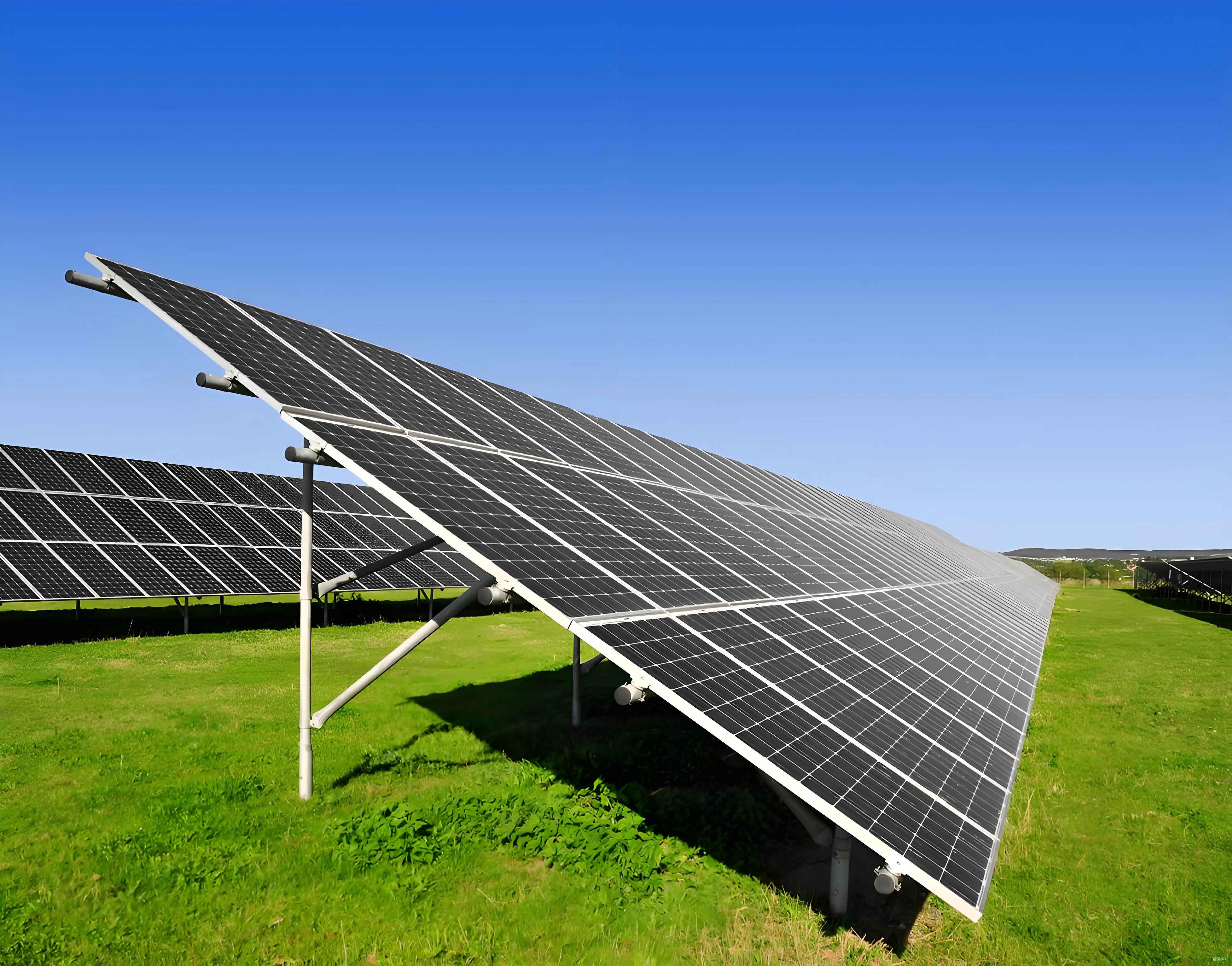
With the rapid development of renewable energy, photovoltaic power generation has gained significant attention worldwide. Solar panels, particularly those used in large-scale arrays, are often lightweight structures that can be vulnerable to wind-induced damage. Understanding the wind load characteristics of these photovoltaic systems is crucial for ensuring their structural integrity and longevity. In this study, we focus on dual-slope solar panels, a novel configuration in ground-mounted photovoltaic installations, which differs from traditional single-slope designs in terms of wind load distribution. The objective is to investigate how various parameters, such as wind direction, inclination angle, and spacing between panels, influence the wind pressure and shape coefficients of dual-slope photovoltaic arrays. Through rigid model wind tunnel pressure tests, we aim to provide insights that can inform the design and optimization of these structures, ultimately enhancing their resilience to wind forces.
Wind loads on solar panels are a critical consideration in structural design, as they can lead to local or global failures if not properly accounted for. Previous research has primarily examined single-slope photovoltaic panels, highlighting factors like array arrangement, inclination, and spacing. However, dual-slope configurations, which are increasingly used in applications such as photovoltaic carports and building-integrated systems, present unique challenges due to their geometry. These structures resemble double-slope roofs but lack comprehensive design guidelines in current codes. For instance, the Chinese “Load Code for the Design of Building Structures” provides basic values for similar shapes, but they may not fully capture the complexities of dual-slope photovoltaic arrays. Therefore, we conducted a series of wind tunnel experiments to bridge this gap, analyzing the effects of key variables on wind load characteristics and comparing our findings with international standards.
The wind tunnel tests were performed using a rigid model scaled at 1:10, representing a dual-slope photovoltaic component consisting of two identical panels: a windward panel (Panel A) and a leeward panel (Panel B). Each photovoltaic panel measured 2,750 mm in length, 365 mm in width, and 10 mm in thickness, constructed from ABS material to simulate real-world conditions. A total of 360 pressure taps were installed symmetrically on the upper and lower surfaces of the panels to capture detailed wind pressure distributions. The tests considered multiple parameters: wind direction angles (θ) ranging from 0° to 90° in 15° increments, inclination angles (β) of 5°, 10°, 15°, and 20°, and spacings between panels (L0) of 15 mm and 65 mm. The model was positioned at a height of 200 mm above the tunnel floor to simulate typical ground-mounted installations. The experiments were conducted under A-class terrain conditions, corresponding to open, flat areas like deserts or rural regions, with a roughness index of 0.12. A reference wind speed of 10 m/s was maintained at the mid-height of the panels, and data were sampled at 330 Hz over 60-second intervals for each test case. Passive simulation techniques, including spires and roughness elements, were employed to replicate the target wind profile, ensuring that the mean velocity and turbulence intensity matched standard specifications.
Data processing involved calculating the net wind pressure coefficient for each tap using the formula: $$ C_{pi} = \frac{p_{up,i} – p_{down,i}}{0.5 \rho U_{ref}^2} $$ where \( C_{pi} \) is the net pressure coefficient at point i, \( p_{up,i} \) and \( p_{down,i} \) are the pressures on the upper and lower surfaces, respectively, \( \rho \) is the air density (1.225 kg/m³), and \( U_{ref} \) is the reference wind speed at the panel’s mid-height. From this, the local shape coefficient \( \mu_{si} \) was derived as: $$ \mu_{si} = C_{pi} \left( \frac{10}{z_i} \right)^{2\gamma} $$ where \( z_i \) is the height of the measurement point, and \( \gamma \) is the terrain roughness exponent. The overall shape coefficient \( \mu_s \) for each photovoltaic panel was then computed by integrating local values over the surface area: $$ \mu_s = \frac{\sum_{i=1}^{n} \mu_{si} \cdot A_i}{A} $$ where \( A_i \) is the tributary area of tap i, and A is the total area of the panel. This approach allowed us to analyze both localized and global wind load effects on the dual-slope solar panels.
The influence of wind direction on the wind load characteristics of dual-slope photovoltaic panels was examined first. For instance, at a 0° wind direction, the pressure distribution was relatively symmetric, with the windward panel experiencing positive pressure that decreased from the leading edge to the trailing edge, while the leeward panel was subjected to suction due to flow separation. At oblique angles, such as 15° to 60°, extreme local shape coefficients occurred at the windward corners of the panels, indicating areas of high positive pressure on Panel A and high suction on Panel B. This is critical for design, as these regions may require reinforcement in photovoltaic installations. The table below summarizes the extreme local shape coefficients for different wind directions and inclination angles, highlighting the most critical conditions.
| Wind Direction (°) | Inclination Angle (°) | Extreme μsi (Panel A) | Extreme μsi (Panel B) |
|---|---|---|---|
| 0 | 5 | 0.12 | -0.25 |
| 15 | 5 | 0.90 | -1.33 |
| 30 | 5 | 0.45 | -0.95 |
| 45 | 5 | 0.30 | -0.70 |
| 60 | 5 | 0.18 | -0.50 |
| 0 | 15 | 0.35 | -0.60 |
| 15 | 15 | 1.29 | -1.61 |
| 30 | 15 | 0.80 | -1.20 |
| 45 | 15 | 0.55 | -0.90 |
| 60 | 15 | 0.40 | -0.75 |
As shown, the 15° wind direction produced the highest local shape coefficients, with values increasing as the inclination angle grew. For example, at β = 15°, Panel A reached a maximum μsi of 1.29, while Panel B experienced a minimum of -1.61. This underscores the importance of considering oblique wind angles in the design of photovoltaic arrays to mitigate potential damage. Contour plots of local shape coefficients further illustrated these trends, revealing gradient changes and vortex-induced pressures at the windward edges, which could be attributed to conical vortices forming over the panels. Such detailed analyses help in identifying critical zones where wind loads are concentrated, enabling targeted improvements in photovoltaic panel support systems.
Next, the effect of inclination angle on the overall shape coefficients was analyzed. The results indicated that wind loads on the solar panels generally increased with higher inclination angles. For Panel A, the most unfavorable overall shape coefficient occurred at 0° wind direction, with values rising from -0.08 at β = 5° to 0.59 at β = 20°. This shift from negative to positive coefficients suggests that steeper panels are more prone to wind pressure, which could lead to uplift or overturning moments. Panel B, on the other hand, consistently experienced suction, with the overall shape coefficient decreasing from -0.33 at β = 5° to -0.72 at β = 20° under 0° wind. The relationship between inclination and wind load can be expressed using a linear approximation for design purposes: $$ \mu_s = k \cdot \beta + c $$ where k and c are constants derived from experimental data. For instance, for Panel A at 0° wind, k ≈ 0.03 and c ≈ -0.1, indicating a steady increase in wind pressure with inclination. The table below provides a comprehensive overview of overall shape coefficients for different inclination angles and wind directions, emphasizing the need for angle-specific design values in photovoltaic applications.
| Inclination Angle (°) | Wind Direction (°) | μs (Panel A) | μs (Panel B) |
|---|---|---|---|
| 5 | 0 | -0.08 | -0.33 |
| 15 | 0.06 | -0.30 | |
| 30 | 0.04 | -0.25 | |
| 45 | 0.02 | -0.20 | |
| 10 | 0 | 0.13 | -0.58 |
| 15 | 0.10 | -0.55 | |
| 30 | 0.07 | -0.50 | |
| 45 | 0.05 | -0.45 | |
| 15 | 0 | 0.38 | -0.65 |
| 15 | 0.30 | -0.60 | |
| 30 | 0.25 | -0.55 | |
| 45 | 0.20 | -0.50 | |
| 20 | 0 | 0.59 | -0.72 |
| 15 | 0.45 | -0.68 | |
| 30 | 0.35 | -0.63 | |
| 45 | 0.28 | -0.58 |
Spacing between the photovoltaic panels also played a significant role in wind load distribution. For smaller inclination angles (e.g., β = 5°), variations in spacing had minimal impact on the overall shape coefficients. However, at larger angles like β = 15°, increasing the spacing from 15 mm to 65 mm led to a noticeable rise in wind pressure on Panel A, while Panel B remained relatively unaffected. This sensitivity can be explained by flow dynamics: larger gaps allow more wind to pass through, enhancing the velocity and pressure on the windward panel’s lower surface. For instance, at 0° wind and β = 15°, Panel A’s μs increased from 0.38 to 0.45 when spacing was widened, whereas Panel B’s coefficient changed negligibly from -0.65 to -0.64. This suggests that in the design of photovoltaic arrays with steep inclinations, spacing should be optimized to reduce wind loads on the windward components. The following equation models the spacing effect for Panel A: $$ \Delta \mu_s = m \cdot (L_0 – L_{0,base}) $$ where m is a slope factor (e.g., m ≈ 0.001 for β = 15°), and L0,base is a reference spacing. Contour comparisons further confirmed that spacing alterations primarily affected the windward panel’s leading edge, reinforcing the need for detailed aerodynamic assessments in photovoltaic system layouts.
Comparing our experimental results with international standards revealed important discrepancies. For example, the Chinese “Load Code for the Design of Building Structures” specifies shape coefficients for double-slope roofs that are generally higher than our values for windward panels but lower for leeward panels at inclinations above 15°. Specifically, at β = 20°, the code gives μs = -0.55 for leeward surfaces, whereas our tests recorded -0.72, indicating a 31% underestimation. Similarly, American (ASCE/SEI 7-16) and Japanese (JIS C8955-2017) standards provided conservative estimates for leeward panels but overestimated windward loads. The table below summarizes this comparison, highlighting areas where current codes may need revision for dual-slope photovoltaic applications.
| Inclination Angle (°) | Panel | Experimental μs | GB 50009-2012 | ASCE/SEI 7-16 | JIS C8955-2017 |
|---|---|---|---|---|---|
| 5 | A | -0.08 | 1.30 | 0.75 | 0.61 |
| B | -0.33 | -0.70 | -0.60 | -1.08 | |
| 10 | A | 0.13 | 1.30 | 0.93 | 0.85 |
| B | -0.58 | -0.70 | -0.85 | -1.28 | |
| 15 | A | 0.38 | 1.38 | 1.10 | 1.06 |
| B | -0.65 | -0.63 | -1.10 | -1.46 | |
| 20 | A | 0.59 | 1.45 | 1.17 | 1.25 |
| B | -0.72 | -0.55 | -0.90 | -1.61 |
Based on these findings, we recommend adopting revised shape coefficients for dual-slope photovoltaic panels, particularly for leeward surfaces at high inclinations. For instance, at β ≥ 15°, a minimum μs of -0.70 could be used for Panel B to account for increased suction forces. Additionally, designers should consider wind direction effects, with 15° being a critical angle for local reinforcements. The integration of these insights into photovoltaic design practices can enhance safety and reliability, reducing the risk of wind-related failures in solar energy systems.
In conclusion, this experimental study demonstrates that wind loads on dual-slope solar panels are significantly influenced by wind direction, inclination angle, and spacing. The 15° wind direction emerged as the most critical for local shape coefficients, with extreme values occurring at the windward corners. Overall, wind loads increased with higher inclinations, and spacing effects were more pronounced for steep panels, especially on the windward side. Comparisons with standards revealed that current codes may underestimate leeward panel loads for inclinations above 15°, underscoring the need for updated guidelines. These results provide valuable data for optimizing the design of photovoltaic arrays, ensuring that they can withstand wind forces in various environmental conditions. Future work could explore computational fluid dynamics simulations to complement experimental data and extend the analysis to larger arrays or different terrain types.