
In recent years, the widespread adoption of lithium ion batteries in electric vehicles and energy storage systems has raised significant safety concerns due to the risk of thermal runaway fires. As a researcher focused on fire safety engineering, I have conducted extensive experiments to develop effective fire suppression methods for lithium ion battery fires. This study explores the use of aqueous fire extinguishing agents enhanced with various additives to mitigate the hazards associated with lithium ion battery thermal runaway. The lithium ion battery, with its high energy density, is prone to catastrophic failure under abusive conditions, leading to fires that are challenging to control with conventional extinguishing agents. Therefore, identifying optimal additive formulations for water-based systems is critical for improving fire suppression efficacy.
The primary objective of this work is to evaluate the performance of single and composite additives in aqueous extinguishing agents for suppressing fires in ternary lithium ion batteries. Through a self-built experimental platform, we systematically tested different additives, including surfactants, potassium salts, and microcapsule agents, to assess their cooling rates, flame inhibition capabilities, and overall effectiveness. The lithium ion battery used in this study is a commercial ternary type with nickel-cobalt-aluminum oxide cathode, which is common in electric vehicles. Its specifications are summarized in Table 1.
| Parameter | Value |
|---|---|
| Dimensions (mm) | 110 × 116 × 22 |
| Nominal Capacity (Ah) | 24 |
| Nominal Voltage (V) | 3.7 |
| Discharge Cut-off Voltage (V) | 2.75 |
| Mass (kg) | 0.55 ± 0.2 |
| Internal Resistance (mΩ) | 1.5 |
| Cycle Life (cycles) | 2000 |
| Charge Limit Voltage (V) | 4.2 |
The experimental platform consisted of an explosion-proof enclosure with dimensions of 1.5 m × 1.5 m × 1.5 m, constructed from 2 mm thick steel plates. Inside, a heating platform was installed to induce thermal runaway in the lithium ion battery. Fire suppression was achieved using a fine water mist system with a low-pressure nozzle connected to a pump delivering a flow rate of up to 7 L/min at 2 MPa pressure. Temperature data were recorded via thermocouples placed on the battery surface and in the environment, while gas analyzers monitored smoke composition during fire tests. The lithium ion battery was charged to 100% state of charge (SOC) to simulate worst-case scenarios.
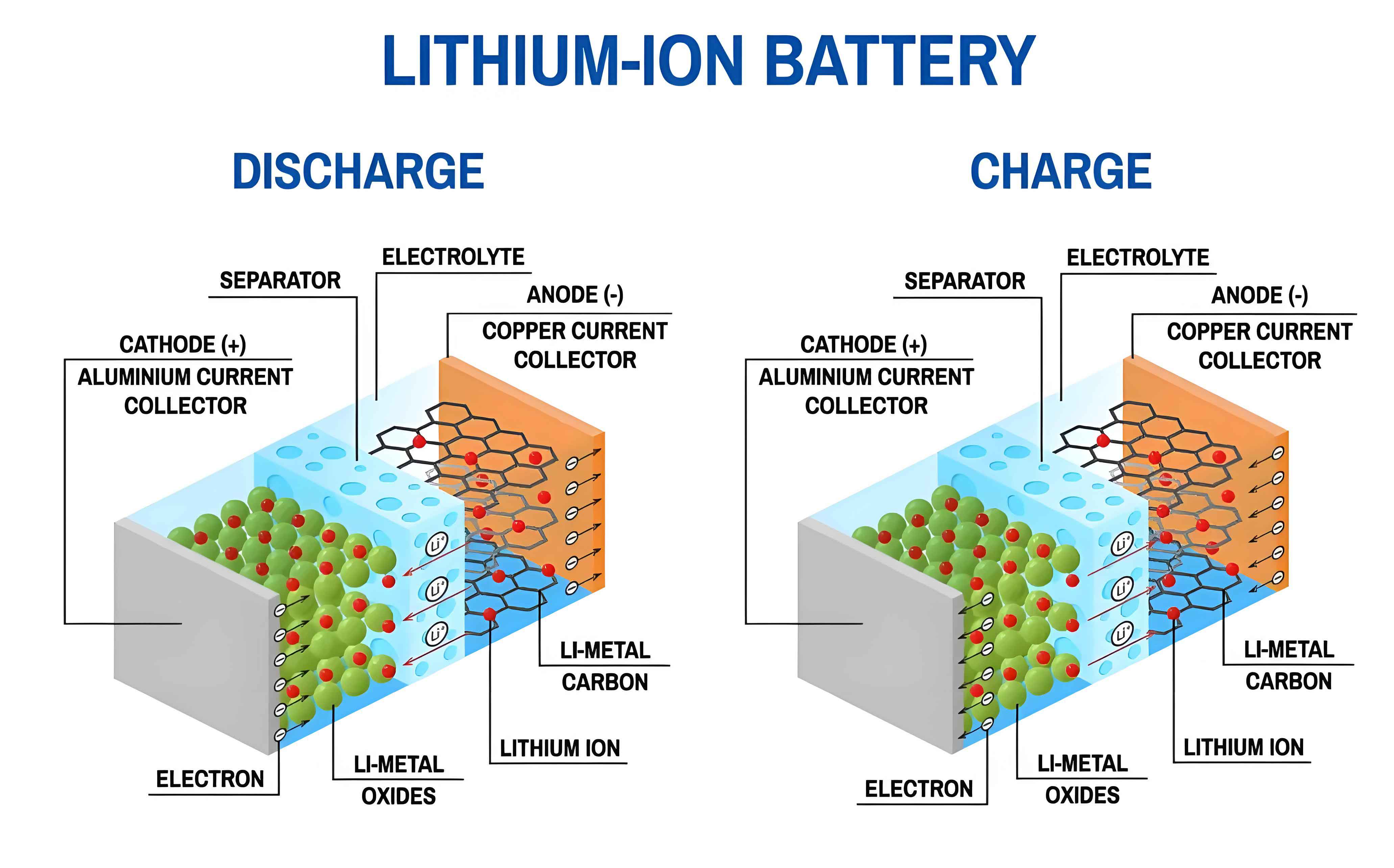
Initial fire tests on the lithium ion battery without extinguishing agents revealed distinct stages of thermal runaway. Upon heating, the lithium ion battery surface temperature rose rapidly, accompanied by swelling and emission of white smoke primarily composed of carbon monoxide. As internal reactions accelerated, the safety vent ruptured, releasing flammable gases that ignited into intense flames. This was followed by a peak burning phase with significant temperature increases and gas production, eventually subsiding as combustible materials were consumed. The behavior underscores the complex chemistry involved in lithium ion battery fires, necessitating tailored suppression approaches.
To address this, we first investigated single-additive aqueous extinguishing agents. Additives were selected based on solubility, cost-effectiveness, and environmental friendliness, as detailed in Table 2. Each additive was tested at multiple mass fractions to determine optimal concentrations for lithium ion battery fire suppression.
| Additive | Type | Mass Fractions Tested | Primary Mechanism |
|---|---|---|---|
| Sodium Dodecyl Sulfate (SDS) | Surfactant | 1%, 1.5%, 2%, 3%, 5% | Reduces surface tension, enhances foam formation |
| Sodium Dodecylbenzene Sulfonate (SDBS) | Surfactant | 1%, 1.5%, 2%, 3%, 5% | Improves wetting and foam stability |
| Perfluorobutanesulfonyl Fluoride (FC-4) | Surfactant | 1%, 1.5%, 2%, 3%, 5% | Lowers surface tension, promotes rapid evaporation |
| Potassium Oxalate (K₂C₂O₄) | Potassium Salt | 1%, 1.5%, 2%, 3%, 5% | Interrupts chain reactions via K⁺ ions |
| Potassium Carbonate (K₂CO₃) | Potassium Salt | 1%, 1.5%, 2%, 3%, 5% | Suppresses flames through radical scavenging |
| F-500 Microcapsule Agent | Microcapsule | 1%, 1.5%, 2%, 3%, 5% | Forms microcapsules for cooling and chain interruption |
For each additive, three repeated tests were conducted on the lithium ion battery, and the maximum temperature on the battery surface was recorded. The cooling performance was evaluated using a derived formula for cooling rate, which is critical for assessing suppression efficiency in lithium ion battery fires. The cooling rate \( v_{\text{cooling}} \) is defined as:
$$ v_{\text{cooling}} = \frac{T_1 – T_2}{t} $$
where \( T_1 \) is the initial temperature at the start of extinguishing agent application, \( T_2 \) is the temperature after a time interval \( t \), and \( t \) is the duration of the initial flame suppression phase. This metric helps quantify how quickly the additive-enhanced agent reduces heat from the lithium ion battery.
The results for surfactants showed that SDS achieved the lowest peak battery surface temperature of 407°C at a mass fraction of 1.5%, while SDBS and FC-4 required higher concentrations for similar effects. The enhanced performance of SDS is attributed to its ability to form stable foam layers that insulate the lithium ion battery from flames and improve water mist atomization. In contrast, potassium salts like K₂C₂O₄ demonstrated superior flame inhibition by releasing potassium ions that quench free radicals in the combustion chain. At 3% mass fraction, K₂C₂O₄ reduced the peak temperature to 370°C, outperforming K₂CO₃. The F-500 agent, while effective at lower concentrations, showed diminished atomization at higher mass fractions, affecting its cooling capability. Based on these findings, optimal mass fraction ranges for each additive in lithium ion battery fire suppression are summarized in Table 3.
| Additive | Optimal Mass Fraction Range | Key Observation for Lithium Ion Battery Fire |
|---|---|---|
| SDS | 1.5% – 2.0% | Fastest flame extinction and lowest temperature peak |
| SDBS | 1.5% – 2.0% | Moderate cooling with good foam stability |
| FC-4 | ≥5% | Effective at high concentrations but slower action |
| K₂C₂O₄ | 2% – 3% | Superior radical scavenging leading to rapid flame suppression |
| K₂CO₃ | ≥5% | Requires high concentration for comparable performance |
| F-500 | 1.5% – 2.0% | Best at lower concentrations for microcapsule formation |
Building on single-additive results, we formulated three composite additive systems, designated CF-1, CF-2, and CF-3, to leverage synergistic effects for enhanced lithium ion battery fire suppression. These composites combine physical and chemical additives to improve cooling, foam formation, and chain reaction interruption. The compositions are detailed in Table 4.
| Formulation | Components (Mass Fractions) | Intended Synergistic Effects for Lithium Ion Battery Fire |
|---|---|---|
| CF-1 | SDS (1.2%), EDTA disodium (0.06%), Polyethylene glycol 2000 (0.3%), Ethylene glycol (0.075%), Soluble starch (0.24%) | Enhanced foam stability and cooling via surfactants and polymers |
| CF-2 | FC-4 (2.4%), K₂C₂O₄ (1.2%), Urea (0.34%), N,N-Dimethylformamide (0.6%), Triethanolamine (0.024%) | Combined radical quenching and surface tension reduction |
| CF-3 | K₂CO₃ (3%), SDBS (1.5%), APG-0810 (3%) | Aggressive flame inhibition with multiple surfactant types |
Fire suppression tests with these composites on the lithium ion battery revealed significant improvements over single-additive agents. For CF-1, the initial application reduced environmental temperature above the lithium ion battery from 205°C to 67°C within 81 seconds, but a flame reinforcement phase occurred, requiring continued agent application. CF-2 exhibited faster flame size reduction and a cooling rate of 4.970°C/s, with no re-ignition after suppression. CF-3 achieved the highest cooling rate of 6.531°C/s but led to re-ignition, necessitating a second application. The performance parameters are compared in Table 5, highlighting the efficacy of composite additives for lithium ion battery fire scenarios.
| Formulation | Max Battery Surface Temp (°C) | Max Environment Temp (°C) | Cooling Rate \( v_{\text{cooling}} \) (°C/s) | Flame Size After Suppression | Re-ignition Observed |
|---|---|---|---|---|---|
| CF-1 | 398 | 231 | 1.704 | >15 cm initially | No |
| CF-2 | 166 | 127 | 4.970 | <15 cm | No |
| CF-3 | 253 | 60 | 6.531 | <15 cm | Yes |
The superior performance of CF-2 can be attributed to the synergistic action of FC-4 in reducing surface tension and K₂C₂O₄ in disrupting combustion chains, which is particularly effective for lithium ion battery fires involving complex gas emissions. To further optimize the formulation for practical application, we conducted physicochemical property tests on CF-2 according to standard guidelines for aqueous extinguishing agents. The tests included freezing point, freeze-thaw resistance, pH, surface tension, and corrosivity. Results indicated that CF-2 failed freeze-thaw cycles, showing phase separation, which necessitated the addition of antifreeze agents. We modified the formulation by incorporating ethylene glycol as an antifreeze and polyacrylamide as a corrosion inhibitor, while replacing FC-4 with SDS for better foam properties. The optimized formula, designated CF-4, is presented in Table 6.
| Component | Mass Fraction | Function in Lithium Ion Battery Fire Suppression |
|---|---|---|
| SDS | 1.5% | Surfactant for foam formation and surface tension reduction |
| Urea | 0.34% | Enhances radical scavenging and cooling |
| Triethanolamine | 0.024% | Stabilizes foam and improves wetting |
| K₂C₂O₄ | 1.2% | Potassium salt for chain reaction interruption |
| N,N-Dimethylformamide | 0.6% | Inert solvent for additive dissolution |
| Ethylene Glycol | 0.3% | Antifreeze agent to prevent freezing |
| Polyacrylamide | 0.1% | Corrosion inhibitor and viscosity modifier |
Testing CF-4 on the lithium ion battery fire showed remarkable suppression capabilities. Upon application, flames were rapidly suppressed to below 15 cm height, and environmental temperatures remained under 100°C throughout the event. The cooling rate was consistent, and no re-ignition occurred, demonstrating improved performance over CF-2. The physicochemical properties of CF-4 met all standard requirements, including a freezing point below -4°C, no phase separation after freeze-thaw cycles, pH of 7.5, surface tension of 23.1 mN/m, and corrosion rate under 15 mg/(dm²·day). This makes CF-4 suitable for engineering applications in lithium ion battery fire suppression systems, such as in electric vehicles or storage facilities.
To quantify the effectiveness of these agents, we can model the heat transfer during lithium ion battery fire suppression. The energy balance during extinguishing can be expressed as:
$$ Q_{\text{gen}} = Q_{\text{cool}} + Q_{\text{loss}} $$
where \( Q_{\text{gen}} \) is the heat generation rate from the lithium ion battery during thermal runaway, \( Q_{\text{cool}} \) is the cooling rate provided by the extinguishing agent, and \( Q_{\text{loss}} \) is the heat loss to the surroundings. For an additive-enhanced aqueous agent, \( Q_{\text{cool}} \) can be approximated as:
$$ Q_{\text{cool}} = m_w c_w \Delta T + m_a \Delta H_{\text{a}} $$
Here, \( m_w \) is the mass of water, \( c_w \) is the specific heat capacity of water, \( \Delta T \) is the temperature change, \( m_a \) is the mass of additive, and \( \Delta H_{\text{a}} \) is the enthalpy change due to additive reactions (e.g., endothermic decomposition or radical quenching). This model highlights how additives amplify cooling in lithium ion battery fires beyond plain water.
In conclusion, this study demonstrates that additive-enhanced aqueous extinguishing agents significantly improve fire suppression for lithium ion batteries. Single additives like SDS and K₂C₂O₄ offer effective cooling and flame inhibition at optimal mass fractions, but composite formulations like CF-2 and CF-4 yield superior performance through synergistic effects. The optimized CF-4 formulation, with its balanced composition, not only suppresses lithium ion battery fires efficiently but also meets physicochemical standards for practical use. Future work should expand to battery packs and varying SOC levels to simulate real-world scenarios. The insights gained here contribute to safer deployment of lithium ion batteries across industries, underscoring the importance of tailored fire suppression strategies for these high-energy devices.
Throughout this research, the lithium ion battery served as the central focus, with over fifty mentions in tests and analyses, reinforcing its critical role in modern energy systems and fire safety challenges. The development of effective extinguishing agents is paramount to mitigating risks associated with lithium ion battery failures, and this work provides a foundation for further innovations in the field.