
In recent years, the rapid advancement of hydrogen utilization technologies, particularly fuel cells, has led to a substantial increase in global demand for hydrogen. Currently, hydrogen production predominantly relies on fossil fuel reforming, which offers high yield, technological maturity, and suitability for large-scale operations. However, faced with the depletion of fossil resources and environmental concerns, humanity must seek cleaner and safer methods for hydrogen production. Solar-powered electrolysis of water represents an efficient, economical, and pollution-free approach to hydrogen generation. With the remarkable progress in photovoltaic technology, integrated photovoltaic-electrolyzer systems are poised to become an effective means of hydrogen production in the future. In this study, we design and experimentally evaluate a standalone solar photovoltaic electrolysis system for hydrogen production, focusing on system coupling, energy efficiency, and exergy analysis. The solar system integrates solar panels, a controller, batteries, an electrolyzer, and hydrogen measurement and collection devices, operating autonomously to convert solar energy into hydrogen fuel.
The core principle of the solar system is based on the photovoltaic effect and water electrolysis. Solar radiation is converted into direct current (DC) electricity by photovoltaic panels, which then powers an electrolyzer to split water into hydrogen and oxygen. During periods of sufficient sunlight, the solar panels supply power to both the electrolyzer and charge the batteries. When sunlight is insufficient, the system draws power from both the solar panels and batteries to maintain electrolyzer operation. This design ensures continuous hydrogen production, enhancing the reliability of the solar system. The electrolyzer operates on alkaline water, where an electrolyte such as potassium hydroxide (KOH) facilitates ion conduction. Upon applying DC current, water molecules decompose at the electrodes: hydrogen gas evolves at the cathode, and oxygen at the anode. The theoretical minimum voltage required for water electrolysis is derived from the Gibbs free energy change, given by ΔG = nFE, where ΔG is the Gibbs free energy change, n is the number of electrons transferred, F is Faraday’s constant, and E is the cell voltage. For water electrolysis, the theoretical voltage under standard conditions is approximately 1.23 V, but practical systems require higher voltages due to overpotentials and resistive losses.
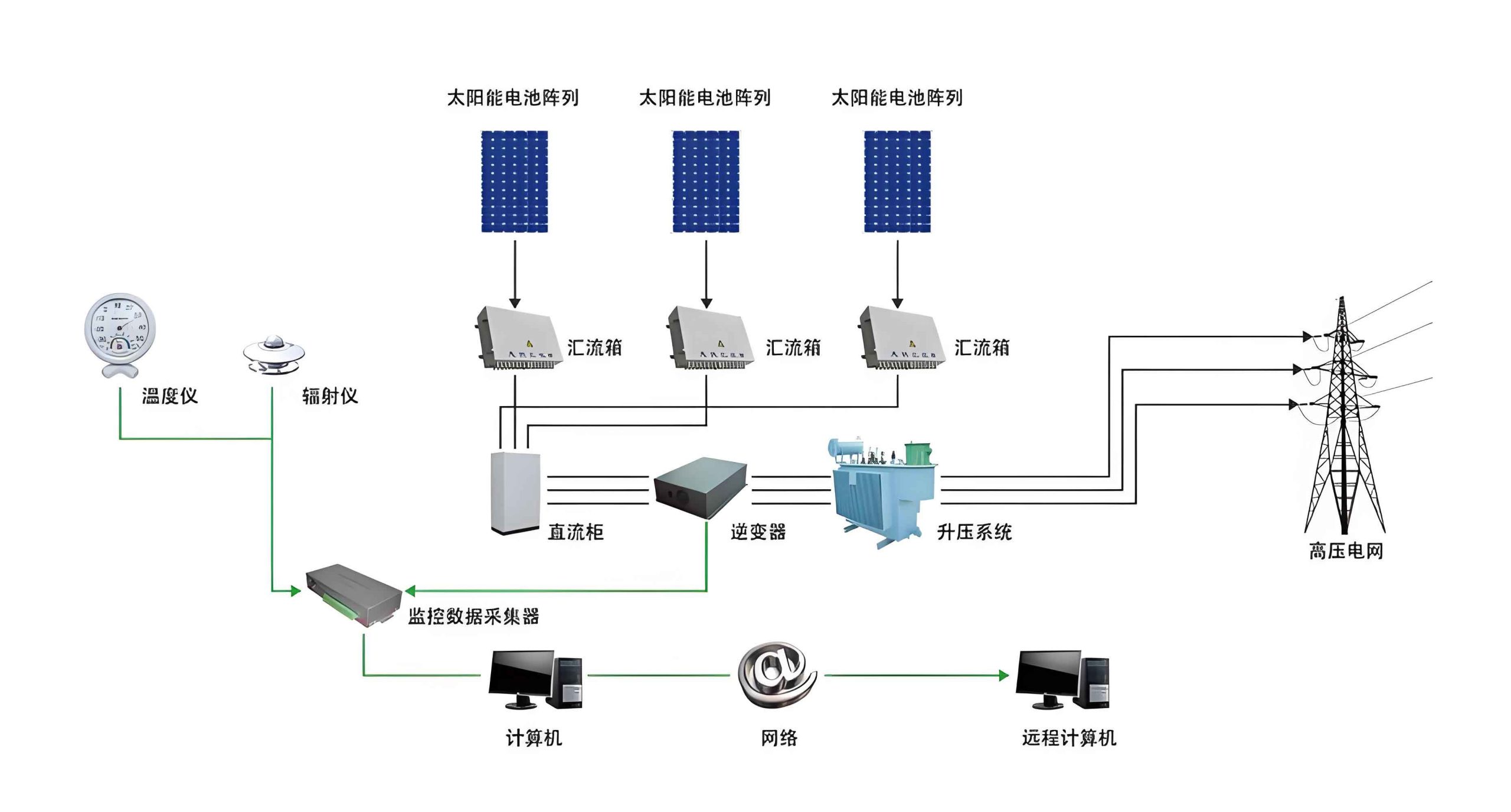
The design of the solar system involves careful calculation of component specifications to ensure optimal performance. The electrolyzer selected for this study is a proton exchange membrane type with platinum alloy electrodes, operating at 80°C to enhance reaction kinetics. It requires a DC input of 12 V with an average power consumption of 48 W. The solar photovoltaic panels are sized based on voltage and power requirements. The panel voltage \( U_{pv} \) is determined by the number of series-connected solar cells: \( U_{pv} = N_S U_m \), where \( N_S \) is the number of series cells and \( U_m \) is the maximum power point voltage of a single cell under standard test conditions (AM1.5, 1000 W/m², 25°C). To match the system’s 12 V nominal voltage, \( U_{pv} \) should be at least 1.4 times the load voltage, i.e., 16.8 V. With \( U_m = 0.475 \, \text{V} \), \( N_S \) is set to 36. The number of parallel strings \( N_P \) is calculated to meet the daily energy demand of the electrolyzer: \( N_P = \frac{E f_\theta}{m I_m \eta_B f_e S_P} \), where \( E \) is the daily energy consumption of the electrolyzer in ampere-hours, \( f_\theta \) is the tilt angle correction factor, \( m \) is the average daily sunshine hours, \( I_m \) is the maximum power point current per cell, \( \eta_B \) is battery charging efficiency, \( f_e \) is solar panel loss compensation factor, and \( S_P \) is soiling factor. Based on local solar irradiance data, the calculated values yield \( N_P = 2 \), resulting in a solar panel array with 36 series cells and 2 parallel strings, rated at 100 W, 13.9 V operating voltage, and 7.2 A operating current. The solar system includes an adjustable mounting structure to optimize panel orientation towards the sun, maximizing energy capture.
Battery capacity is critical for energy storage in the solar system, ensuring operation during low-light periods. The battery capacity \( C_B \) is computed using: \( C_B = \frac{E N}{\theta_m (1 – \zeta) \gamma \eta_{BA}} \), where \( N \) is the number of autonomous days, \( \theta_m \) is the maximum depth of discharge, \( \zeta \) is wiring loss coefficient, \( \gamma \) is temperature coefficient, and \( \eta_{BA} \) is battery ampere-hour efficiency. For this solar system, a 12 V, 65 Ah battery is selected to provide sufficient backup. The controller manages power flow between the solar panels, battery, and electrolyzer, minimizing losses. The entire solar system is designed for efficiency and reliability, with all components sized to operate harmoniously.
The experimental procedure involves measuring solar irradiance, hydrogen production rates, and electrical parameters under varying conditions. Solar irradiance is recorded throughout the day using a radiometer, as shown in Figure 3 of the original text, indicating irradiance levels above 400 W/m² for about 6 hours with a peak of 640 W/m². Hydrogen flow rate is measured using a gas flow meter for different KOH concentrations to determine the optimal electrolyte strength. Electrical parameters such as charging current, charging voltage, load current, and load voltage are monitored at regular intervals to assess system performance. The solar system is tested over consecutive sunny days to gather consistent data.
Experimental results reveal key insights into the solar system’s operation. The relationship between hydrogen flow rate and KOH concentration is presented in Table 1, summarizing data from multiple trials. At KOH concentrations below 30%, electrolyte conductivity is low, leading to reduced hydrogen production. As concentration increases to 30%, conductivity improves significantly, resulting in higher hydrogen flow rates. Beyond 30%, the increase in flow rate plateaus, and at 45%, viscosity effects may hinder performance. Thus, 30% KOH is identified as the optimal concentration for this solar system.
| KOH Concentration (%) | Hydrogen Flow Rate (ml/min) | Load Current (A) | Load Voltage (V) |
|---|---|---|---|
| 10 | 5.2 | 2.1 | 11.5 |
| 20 | 15.8 | 3.5 | 11.8 |
| 30 | 27.5 | 4.0 | 11.9 |
| 40 | 27.3 | 3.9 | 11.9 |
| 45 | 26.9 | 3.8 | 11.8 |
Electrical measurements over a typical day are summarized in Table 2, showing variations in charging and load parameters. In the morning, solar irradiance is low, leading to smaller charging currents and voltages. As irradiance increases towards midday, these parameters rise, stabilizing at peak values. In the afternoon, they decline with decreasing sunlight. Load current and voltage follow similar trends, indicating stable electrolyzer operation. The correlation between hydrogen flow rate and charging current is non-linear; flow rate increases with current but at a diminishing rate due to factors like overpotentials and internal resistance. This behavior underscores the importance of optimizing the solar system’s electrical matching.
| Time | Charging Current (A) | Charging Voltage (V) | Load Current (A) | Load Voltage (V) | Hydrogen Flow Rate (ml/min) |
|---|---|---|---|---|---|
| 8:00 | 3.5 | 13.2 | 3.2 | 11.7 | 22.1 |
| 10:00 | 6.8 | 14.1 | 3.9 | 11.8 | 26.5 |
| 12:00 | 7.6 | 14.3 | 4.0 | 11.9 | 27.5 |
| 14:00 | 6.9 | 14.0 | 3.9 | 11.8 | 26.7 |
| 16:00 | 4.2 | 13.5 | 3.3 | 11.7 | 23.0 |
Energy analysis of the solar system is conducted to evaluate efficiency. The solar panels receive an average irradiance of 585 W over the test period, with an output power of 102.39 W, yielding a photovoltaic conversion efficiency \( \eta_{pv} = \frac{P_{out}}{P_{in}} = \frac{102.39}{585} = 0.175 \) or 17.5%. The energy distribution within the solar system is detailed in Table 3, highlighting the roles of each component. The solar system’s overall energy efficiency depends on the interplay between photovoltaic generation, battery storage, and electrolyzer consumption.
| Component | Average Power (W) | Relative Share (%) |
|---|---|---|
| Solar Panel Output | 102.39 | 100.00 |
| Electrolyzer Input | 46.92 | 45.82 |
| Battery Charging | 37.37 | 36.50 |
| Controller and Losses | 18.10 | 17.68 |
The electrolyzer’s current efficiency is assessed using Faraday’s law. According to the law, the mass of substance produced during electrolysis is \( m = k I t \), where \( k \) is the electrochemical equivalent, \( I \) is current, and \( t \) is time. For hydrogen, 1 Ah of charge yields 0.000418 m³ of hydrogen under standard conditions. The experimental hydrogen production rate averages 27.5 ml/min at a current of 3.98 A, corresponding to a theoretical flow rate \( V^\circ = 0.000418 \times 3.98 \times 60 = 0.0998 \, \text{m}^3/\text{h} \) or 27.7 ml/min. Thus, the current efficiency \( \eta_c = \frac{V}{V^\circ} = \frac{27.5}{27.7} = 0.9918 \) or 99.18%, indicating high efficiency in the solar system’s electrolysis process.
Exergy analysis provides a deeper understanding of the solar system’s performance by accounting for the quality of energy. Exergy, or available energy, is the maximum useful work obtainable from a system as it reaches equilibrium with its environment. For the solar system, the exergy efficiency of the photovoltaic panels is computed based on the theoretical maximum efficiency of crystalline silicon solar cells, which is around 73%. Given the experimental conversion efficiency of 17.5%, the exergy efficiency \( \eta_{ex,pv} = \frac{0.175}{0.73} = 0.2397 \) or 23.97%. This low value highlights significant exergy losses due to factors such as spectral mismatch and thermalization.
Exergy losses in other components are also evaluated. In the battery, charging inefficiencies lead to exergy destruction. The relative exergy loss \( B \) is given by \( B = \eta_{ex,pv} P_1 (1 – \eta_c) \), where \( P_1 \) is the fraction of solar energy used for charging (36.5% from Table 3) and \( \eta_c \) is battery charging efficiency (assumed 0.9). Substituting values: \( B = 0.2397 \times 0.365 \times (1 – 0.9) = 0.00875 \) or 0.875%. For the controller and wiring, the relative exergy loss \( C = \eta_{ex,pv} P_2 \), where \( P_2 \) is the fraction lost in these components (17.68%). Thus, \( C = 0.2397 \times 0.1768 = 0.0424 \) or 4.24%. These losses, though small, contribute to the overall exergy degradation in the solar system. The total exergy efficiency of the solar system can be approximated by considering all losses, but further detailed modeling is needed for precise quantification.
The solar system’s performance is influenced by various factors, including solar irradiance, temperature, and component specifications. To enhance the solar system’s efficiency, several improvements can be explored. For instance, using higher-efficiency photovoltaic materials like multi-junction cells could boost energy conversion. Additionally, optimizing the electrolyzer design to reduce overpotentials and employing advanced batteries with higher round-trip efficiency may improve overall system performance. The integration of maximum power point tracking (MPPT) controllers could also maximize energy harvest from the solar panels, making the solar system more robust under varying weather conditions.
In conclusion, this study demonstrates the feasibility of a standalone solar photovoltaic water electrolysis system for hydrogen production. The solar system achieves a photovoltaic conversion efficiency of 17.5% and an electrolyzer current efficiency of 99.18%, with optimal performance at 30% KOH concentration. Energy and exergy analyses reveal areas for improvement, particularly in reducing exergy losses in photovoltaic conversion and power management. The solar system offers a sustainable pathway for hydrogen generation, leveraging renewable solar energy to produce clean fuel. Future work will focus on scaling up the solar system, incorporating real-time monitoring, and conducting long-term durability tests to advance its practical application. By refining such solar systems, we can contribute to a hydrogen-based energy economy, mitigating environmental impacts and fostering energy independence.
To further elaborate on the solar system’s design, we consider the mathematical modeling of component interactions. The power balance in the solar system can be expressed as: \( P_{pv}(t) = P_{elec}(t) + P_{bat}(t) + P_{loss}(t) \), where \( P_{pv} \) is the solar panel power output, \( P_{elec} \) is the electrolyzer power input, \( P_{bat} \) is the battery power (positive for charging, negative for discharging), and \( P_{loss} \) represents losses in the controller and wiring. This equation highlights the dynamic energy management within the solar system. The solar panel output varies with irradiance \( G(t) \) and temperature \( T(t) \), modeled as: \( P_{pv}(t) = \eta_{pv} A G(t) [1 – \beta (T(t) – T_{ref})] \), where \( A \) is the panel area, \( \beta \) is the temperature coefficient, and \( T_{ref} \) is the reference temperature. Such models aid in simulating the solar system’s performance under different environmental conditions.
The electrolyzer’s voltage-current characteristics are crucial for matching with the solar system. The operating voltage \( V_{elec} \) can be described by: \( V_{elec} = V_{rev} + V_{act} + V_{ohm} + V_{conc} \), where \( V_{rev} \) is the reversible voltage (theoretical minimum), \( V_{act} \) is activation overpotential, \( V_{ohm} \) is ohmic overpotential, and \( V_{conc} \) is concentration overpotential. For alkaline electrolyzers, \( V_{rev} \) is approximately 1.23 V at 25°C, but increases with temperature. The overpotentials depend on factors like electrode materials, electrolyte concentration, and current density. In our solar system, using KOH electrolyte minimizes these overpotentials, as evidenced by the stable load voltage near 12 V. The relationship between hydrogen production rate and current is linear under ideal conditions, but deviations occur due to these overpotentials, as observed in our experiments.
Battery performance in the solar system is characterized by its state of charge (SOC) and efficiency. The SOC dynamics can be modeled as: \( \text{SOC}(t) = \text{SOC}_0 + \frac{1}{C_B} \int_0^t \eta_{ch} I_{bat}(\tau) \, d\tau \) for charging, and similarly for discharging with efficiency \( \eta_{disch} \). Here, \( I_{bat} \) is the battery current, and \( C_B \) is the capacity. The battery’s round-trip efficiency \( \eta_{rt} = \eta_{ch} \eta_{disch} \) affects the overall solar system efficiency. In our design, we assumed \( \eta_{ch} = 0.9 \), but actual values may vary with SOC and current rates. Incorporating these details into the solar system model can improve accuracy.
Economic aspects of the solar system are also important for practical deployment. The levelized cost of hydrogen (LCOH) can be estimated using: \( \text{LCOH} = \frac{C_{cap} + C_{O&M}}{M_{H_2}} \), where \( C_{cap} \) is the capital cost of the solar system components, \( C_{O&M} \) is the operation and maintenance cost, and \( M_{H_2} \) is the total hydrogen produced over the system’s lifetime. The solar system’s cost is dominated by photovoltaic panels and the electrolyzer, but prices have been declining. By optimizing the solar system design, we can reduce LCOH, making it competitive with conventional hydrogen production methods.
Environmental benefits of the solar system are significant, as it produces hydrogen without carbon emissions. The life cycle assessment (LCA) of the solar system should consider emissions from manufacturing, operation, and decommissioning. Since the solar system uses renewable energy, its operational phase has minimal environmental impact. Comparing with fossil-based hydrogen, the solar system can achieve substantial reductions in greenhouse gas emissions, contributing to climate change mitigation.
Future research directions for the solar system include integration with other renewable sources, such as wind or hydropower, to form hybrid systems. This can enhance reliability and hydrogen output. Additionally, exploring novel electrolyzer technologies, like high-temperature electrolysis or photoelectrochemical cells, could improve efficiency. The solar system can also be coupled with hydrogen storage solutions, such as compressed gas or metal hydrides, to address intermittency issues. By advancing these aspects, the solar system can play a pivotal role in the global energy transition.
In summary, this experimental study provides comprehensive insights into a solar photovoltaic water electrolysis system. The solar system demonstrates commendable performance in terms of energy conversion and hydrogen production efficiency. Through detailed analysis, we identify key parameters affecting the solar system’s operation and propose avenues for optimization. The solar system represents a promising technology for sustainable hydrogen generation, aligning with global efforts towards clean energy. As solar technology continues to evolve, such solar systems will become increasingly viable, paving the way for a hydrogen-driven future.