
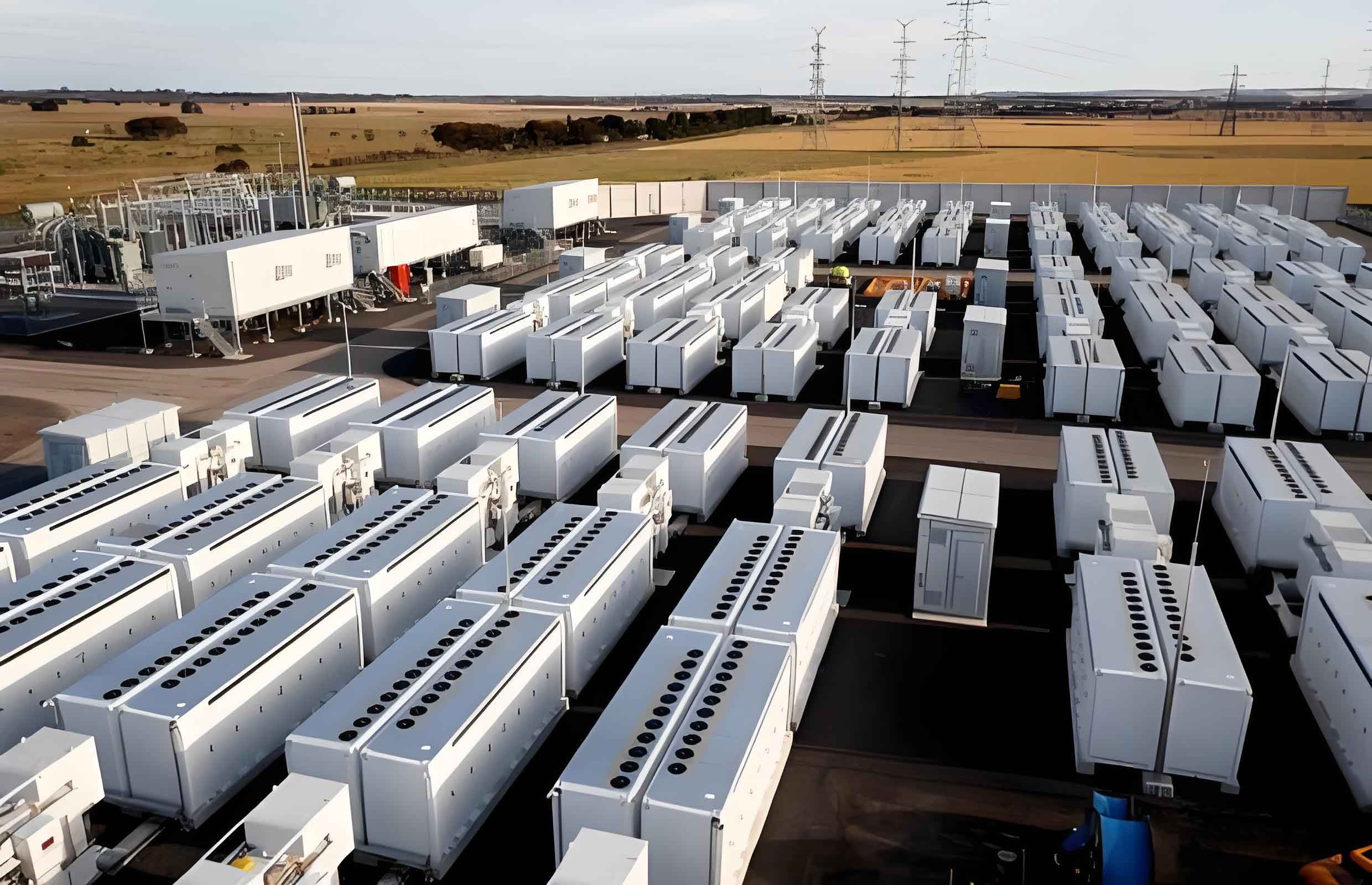
In recent years, industrial and commercial energy storage systems have emerged as rapidly developing, convertible high-quality resources, playing a critical role in addressing the growing energy conversion capacity gaps in power grids and enhancing the efficient utilization of renewable energy. Energy storage power stations enable high-efficiency energy applications, categorized by energy form into mechanical, electrochemical, and electromagnetic storage. Among these, electrochemical energy storage systems, particularly those utilizing lithium-ion batteries, have gained prominence due to their relatively low investment costs, short construction cycles, high energy density, excellent cycling efficiency, and rapid response times. However, to meet high-capacity demands, numerous energy storage cells are often densely arranged in series and parallel configurations within confined spaces. This high-density packing compromises heat dissipation, increasing the risk of thermal runaway events that can lead to fires or explosions, thereby posing significant safety challenges.
Lithium-ion energy storage cells, widely adopted for their high energy density, long cycle life, and cost-effectiveness, are susceptible to thermal runaway when subjected to external stressors such as mechanical damage, electrical faults, or abnormal ambient temperatures. This process involves the rapid release of heat accompanied by the emission of flammable gases like hydrogen, carbon monoxide, and methane, which can ignite and propagate into severe fires. From an emergency response perspective, thermal runaway in energy storage cells can be divided into three distinct phases: the initial stage, characterized by rising cell temperature and abnormal charge-discharge currents; the intermediate stage, involving cell deformation and the release of pyrolytic gases; and the final stage, marked by dense smoke, flames, and potential explosions. Prefabricated container-based energy storage stations, typically composed of multiple containerized units housing battery clusters with numerous modules, rely on integrated fire detection and suppression systems to mitigate these risks. Conventional detection systems employ composite sensors to monitor parameters such as smoke density, ambient temperature, carbon monoxide (CO) concentration, volatile organic compounds (VOC), and hydrogen levels. While water-based suppression systems offer effective cooling, their poor insulation properties can cause short circuits and further damage to energy storage cells. In contrast, gas-based suppression systems, which preserve equipment integrity, are more suitable for early and intermediate stages of thermal runaway. Commonly used agents like heptafluoropropane and perfluorohexanone are deployed in enclosed spaces, with the latter gaining attention for its lower toxicity and reduced global warming potential. However, the effectiveness of perfluorohexanone in suppressing fires involving high-density energy storage cell arrays, particularly under high-temperature conditions where decomposition may occur, requires further investigation.
In this study, we developed an experimental platform to simulate thermal runaway in energy storage cells, focusing on a lithium iron phosphate (LiFePO4) battery pack with dimensions of 1000 mm × 800 mm × 240 mm. The experiment was conducted within a standard 20-foot shipping container, where a simulated battery cluster was constructed with the energy storage cell pack fixed at the middle tier. Thermal runaway was induced by internal overheating using two 1 kW heating elements positioned inside the battery module enclosure. Electrical connections were routed through sealed ports with fire-resistant clay to ensure safety. The interior of the energy storage cell module was equipped with 17 temperature sensors strategically placed to monitor thermal gradients, as illustrated in the layout diagram. Additionally, 10 composite fire detectors—capable of measuring CO, VOC, smoke, and temperature—were distributed throughout the battery cluster. Detector 1 was placed inside the energy storage cell pack, while detectors 2–10 were evenly spaced across the upper, middle, and lower sections of the cluster. Upon verifying the experimental setup, heating element 1 was activated until thermal runaway was confirmed by detector alarms and visible smoke emission, at which point heating ceased and timing records were initiated.
The experimental results revealed distinct phases of thermal runaway. Within 10 minutes and 59 seconds, detector alarms were triggered, followed by cell bulging and audible cracking sounds at 37 minutes and 25 seconds, accompanied by minor smoke emission. By 39 minutes and 27 seconds, intense smoke production and open flames were observed, with the fire intensifying rapidly. The gas suppression system, utilizing perfluorohexanone, was activated upon fire confirmation, leading to a noticeable reduction in flames. After multiple application cycles, the fire was completely extinguished at 51 minutes and 31 seconds, with no re-ignition events occurring thereafter. Data from detector 1 indicated an early CO concentration of 194 ppm, reaching the low alarm threshold at 190 ppm, while the ambient temperature was recorded at 6°C and VOC levels at 1.814 V, without smoke triggering alarms. At the level 3 alarm stage, CO concentrations surged to 831 ppm (exceeding the high alarm threshold of 500 ppm), with VOC readings at 2.469 V and ambient temperature at 5°C, coinciding with smoke detector activation. Peak CO levels approached 1511 ppm (sensor saturation), and VOC values peaked at 3.1 V, indicating severe gas release during thermal runaway.
Comparative analysis of CO concentrations across detectors showed that detector 1, located inside the energy storage cell pack, detected electrolytic leakage earlier than others. Following its level 3 alarm, remaining detectors registered rapidly escalating CO levels, correlating with smoke and flame emergence. Temperature data from the 10 detectors indicated that only detector 4, positioned directly above the ignition point, exceeded the 80°C threshold for a level 4 alarm at 39 minutes and 41 seconds, prompting gas suppression activation. Other detectors recorded temperatures below 20°C, suggesting that timely intervention contained heat spread within the cluster. Internal temperature sensor data from the energy storage cell pack revealed localized heating, with sensors U1, U2, U11, U4, U5, U7, U12, U15, and U17 experiencing rapid temperature rises above 300°C during thermal runaway, while sensors U8, U9, and U10 remained below 30°C, confirming that the event was confined to the right section of the pack.
To quantitatively summarize the temperature variations, we applied a thermal model describing the energy storage cell behavior during runaway. The temperature rise can be approximated using an exponential growth function:
$$ T(t) = T_0 + A \cdot e^{k(t – t_0)} $$
where \( T(t) \) is the temperature at time \( t \), \( T_0 \) is the initial temperature, \( A \) is the amplitude factor, \( k \) is the rate constant, and \( t_0 \) is the onset time of thermal runaway. For instance, sensor U1 data fitted this model with \( k \approx 0.15 \, \text{s}^{-1} \) during the heating phase.
The gas concentration dynamics, particularly for CO, followed a similar trend, which can be modeled as:
$$ C_{CO}(t) = C_0 + B \cdot (1 – e^{-\lambda t}) $$
where \( C_{CO}(t) \) is the CO concentration at time \( t \), \( C_0 \) is the baseline concentration, \( B \) is the maximum increase, and \( \lambda \) is the time constant. From detector 1 data, \( \lambda \approx 0.02 \, \text{s}^{-1} \) during the initial release phase.
The effectiveness of perfluorohexanone in suppressing fires involving energy storage cells can be partially described by its heat absorption capacity. The cooling effect is given by:
$$ Q = m \cdot c_p \cdot \Delta T + m \cdot L_v $$
where \( Q \) is the heat absorbed, \( m \) is the mass of agent vaporized, \( c_p \) is the specific heat capacity, \( \Delta T \) is the temperature change, and \( L_v \) is the latent heat of vaporization. In this experiment, the rapid evaporation of perfluorohexanone contributed to temperature reduction in the container, though the exact dosage was not quantified.
Table 1 summarizes the key parameters recorded by the composite fire detectors during the thermal runaway event. The data highlights the early detection capabilities of CO and VOC sensors, emphasizing their role in preemptive fire warning systems for energy storage cells.
| Detector ID | Location | CO Peak (ppm) | VOC Peak (V) | Max Temperature (°C) | Alarm Level |
|---|---|---|---|---|---|
| 1 | Inside Energy Storage Cell | 1511 | 3.1 | 20 | 3 |
| 2 | Upper Cluster | 980 | 2.8 | 18 | 2 |
| 3 | Upper Cluster | 1050 | 2.9 | 19 | 2 |
| 4 | Upper Cluster | 1100 | 3.0 | 80 | 4 |
| 5 | Middle Cluster | 920 | 2.7 | 17 | 2 |
| 6 | Middle Cluster | 950 | 2.8 | 16 | 2 |
| 7 | Middle Cluster | 1000 | 2.9 | 18 | 2 |
| 8 | Lower Cluster | 890 | 2.6 | 15 | 2 |
| 9 | Lower Cluster | 910 | 2.7 | 16 | 2 |
| 10 | Lower Cluster | 930 | 2.7 | 17 | 2 |
Table 2 provides a detailed overview of temperature sensor data from the energy storage cell pack, illustrating the spatial temperature distribution during thermal runaway. The values underscore the localized nature of the event, with significant heating concentrated in specific regions of the energy storage cell assembly.
| Sensor ID | Location Description | Initial Temp (°C) | Peak Temp (°C) | Time to Peak (min:sec) |
|---|---|---|---|---|
| U1 | Near Heating Element 1 | 25 | 251 | 18:30 |
| U2 | Adjacent to U1 | 24 | 280 | 19:05 |
| U3 | Central Region | 23 | 150 | 19:06 |
| U4 | Right Section | 24 | 320 | 19:05 |
| U5 | Right Section | 25 | 310 | 19:05 |
| U6 | Central Region | 23 | 140 | 19:06 |
| U7 | Right Section | 24 | 300 | 19:05 |
| U8 | Left Section | 22 | 28 | N/A |
| U9 | Left Section | 23 | 27 | N/A |
| U10 | Left Section | 22 | 26 | N/A |
| U11 | Right Section | 24 | 290 | 19:05 |
| U12 | Right Section | 25 | 310 | 19:05 |
| U13 | Central Region | 23 | 130 | 19:06 |
| U14 | Central Region | 24 | 120 | 19:06 |
| U15 | Right Section | 25 | 305 | 19:05 |
| U16 | Central Region | 23 | 110 | 19:06 |
| U17 | Right Section | 24 | 315 | 19:05 |
The early detection of CO and VOC emissions proved instrumental in providing advance warning of thermal runaway in the energy storage cells. Detector 1’s CO low alarm occurred over 18 minutes before open flames appeared, underscoring the potential of integrated gas sensing for early fire detection in energy storage systems. However, current battery pack designs often limit the feasibility of installing internal detectors in every energy storage cell, suggesting a need for standardized implementation to enhance预警 efficiency. Transverse comparison of CO data from the 10 detectors indicated that detectors outside the energy storage cell pack registered elevated concentrations only after intense reactions had begun, coinciding with smoke and flame emergence. Temperature profiles across the cluster demonstrated that prompt gas suppression effectively contained heat spread, with only detector 4 reaching critical thresholds due to its proximity to the ignition source. Internal temperature data confirmed that thermal runaway onset involved rapid heat generation, exceeding 300°C and igniting battery materials almost instantaneously.
Perfluorohexanone, as a substitute for heptafluoropropane, offers advantages in toxicity reduction and environmental protection. In this experiment, timely application within the 20-foot container achieved complete fire suppression and temperature mitigation, though the lack of dosage measurements precludes precise efficacy quantification. Nonetheless, the results affirm that sufficient perfluorohexanone deployment can extinguish fires originating from energy storage cell thermal runaway. Future work should focus on optimizing agent distribution and concentration parameters for varied energy storage cell configurations to ensure reliable safety protocols. The findings emphasize the critical role of continuous monitoring and rapid response mechanisms in safeguarding energy storage infrastructures against thermal hazards, thereby supporting the sustainable expansion of electrochemical energy storage solutions.
In conclusion, this experimental study delineates the characteristic parameters of thermal runaway in lithium-based energy storage cells, highlighting the significance of early gas detection and the efficacy of gaseous suppression agents like perfluorohexanone. While the data are specific to the tested energy storage cell sample and a single event, they provide valuable insights for improving fire safety standards in energy storage systems. The integration of advanced sensing technologies and environmentally friendly suppressants will be pivotal in mitigating risks associated with high-density energy storage cell deployments, ultimately fostering the secure and efficient utilization of energy storage technologies in modern grid applications.