
The challenge of utilizing low-temperature irrigation water, particularly during early spring in arid and semi-arid regions, presents a significant constraint to crop establishment and yield. Chilled water can induce cold stress, damage seedlings, and impede root development. Simultaneously, the energy demand for pumping and managing water in modern agriculture continues to rise. To address these dual challenges, I developed and tested an integrated solar system designed specifically to elevate irrigation water temperature while concurrently generating electrical energy. This approach aims to mitigate the adverse effects of cold irrigation on crops and offset a portion of the energy consumption inherent to agricultural operations.
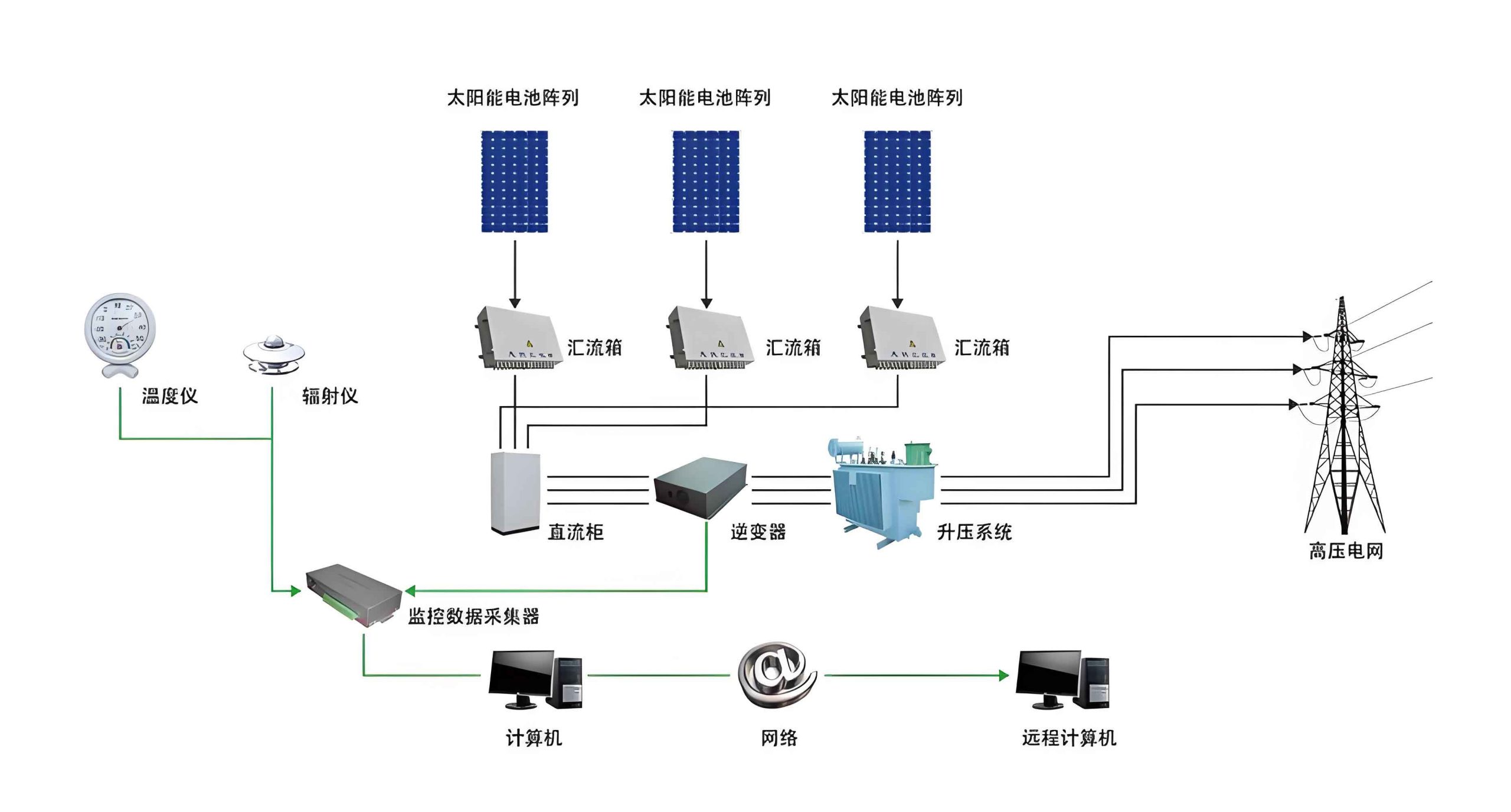
The core of this innovation is a hybrid photovoltaic-thermal (PV/T) collector. This solar system component is engineered to simultaneously convert solar radiation into both electricity and useful heat. The PV/T collector employed was a water-cooled, flat-plate type with a tube-and-sheet absorber design. Its key construction features and materials are summarized below.
| Component | Material & Specifications |
|---|---|
| Glazing | Low-iron textured glass (2550 mm × 808 mm) |
| Absorber Plate | Aluminum, coated with black chrome (2460 mm × 750 mm × 0.4 mm) |
| Absorber Tubes | 6 Copper tubes (φ8×0.6 mm), laser-welded |
| Photovoltaic Module | Monocrystalline silicon cells, 160 W nominal power |
| Insulation | Rock wool (20 mm) & rubber-plastic foam (40 mm) at the rear |
The operational principle of the overall solar system is straightforward. Cold irrigation water is stored in an initial insulated tank. A submerged pump, whose flow rate is precisely controlled via a variable frequency drive (VFD), circulates the water. The water first passes through a filtration unit and then enters the manifold of the PV/T collector. As it flows through the copper tubes bonded to the absorber plate, it extracts waste heat from the photovoltaic cells, thereby cooling them and improving their electrical efficiency while itself gaining thermal energy. The warmed water is then discharged into a second insulated tank, ready for irrigation. The electricity generated by the PV module can be used to power the system’s pump or other auxiliary devices, enhancing the solar system‘s sustainability.
To evaluate the performance of this integrated solar system, a comprehensive indoor test platform was established. Tungsten halogen lamp arrays were used to simulate solar irradiance at three controlled levels: Low (avg. 320 W/m²), Middle (avg. 465 W/m²), and High (avg. 650 W/m²). The initial temperature of the irrigation water was set at three levels: 5.0°C, 7.5°C (representative of local spring water), and 10.0°C. For each combination of irradiance and inlet temperature, the water mass flow rate per unit collector area was varied across eight steps, from 0.01 to 0.08 kg/(s·m²). This resulted in 72 unique test conditions. Key parameters including inlet/outlet water temperature, PV module temperature, flow rate, irradiance, and electrical output were meticulously recorded using Pt100 sensors, a flow meter, a pyranometer, and a data acquisition system.
The performance of the solar system was assessed using several key metrics. The primary thermal output is characterized by the outlet water temperature ($T_{out}$) and the temperature rise ($\Delta T$):
$$\Delta T = T_{out} – T_{in}$$
where $T_{in}$ is the inlet water temperature. The energy conversion performance is evaluated through photovoltaic efficiency ($\eta_{pv}$), thermal efficiency ($\eta_{th}$), and a practical combined efficiency ($\eta_{practical}$) that accounts for the pump’s parasitic energy consumption. These are defined as:
$$\eta_{pv} = \frac{\int P_{pv} \, dt}{\tau A_c \int G \, dt}$$
$$\eta_{th} = \frac{\int \dot{m} c_p \Delta T \, dt}{A_c \int G \, dt}$$
$$\eta_{practical} = \eta_{th} + \frac{\int (P_{pv} – P_{pump}) \, dt}{\eta_{power} A_c \int G \, dt}$$
Here, $P_{pv}$ is the electrical power generated, $P_{pump}$ is the pump power consumption calculated based on VFD frequency and system hydraulics, $G$ is irradiance, $\dot{m}$ is mass flow rate, $c_p$ is specific heat capacity of water, $A_c$ is collector area, $\tau$ is PV cell transmittance, and $\eta_{power}$ is the conventional power plant efficiency factor (taken as 0.38) to equate electrical and thermal energy grades.
The impact of varying the flow rate through the solar system was first investigated under a fixed reference condition (Middle irradiance, 7.5°C inlet). The results, detailed in the table below, reveal clear trends. As the flow rate increases, the residence time of water in the collector decreases, leading to a lower temperature rise and thus a lower outlet temperature. Conversely, higher flow rates improve both photovoltaic and thermal efficiencies because they enhance heat removal from the PV cells, lowering their operating temperature. The combined practical efficiency, however, exhibits a non-monotonic behavior. Initially, it increases with flow rate as the gains in thermal and electrical output outweigh the rising pump power. After reaching an optimum, further increases in flow rate cause the pump power to dominate, reducing the net practical efficiency.
| Mass Flow Rate (kg/(s·m²)) | Tout (°C) | ΔT (°C) | ηpv | ηth | ηpractical |
|---|---|---|---|---|---|
| 0.01 | 20.9 | 12.5 | 0.086 | 0.262 | 0.408 |
| 0.02 | 16.4 | 7.9 | 0.089 | 0.284 | 0.472 |
| 0.03 | 14.3 | 5.8 | 0.091 | 0.294 | 0.484 |
| 0.04 | 13.1 | 4.6 | 0.092 | 0.299 | 0.479 |
| 0.05 | 12.3 | 3.8 | 0.093 | 0.303 | 0.469 |
| 0.06 | 11.7 | 3.2 | 0.093 | 0.305 | 0.458 |
| 0.07 | 11.3 | 2.8 | 0.094 | 0.307 | 0.445 |
| 0.08 | 10.9 | 2.4 | 0.094 | 0.310 | 0.432 |
The initial temperature of the irrigation water significantly influences the solar system‘s operation. Lower inlet temperatures create a larger temperature difference between the PV cells and the coolant, driving more intense heat transfer. Consequently, while the absolute outlet temperature remains highest for the warmest inlet water, the temperature rise (ΔT) is greatest for the coldest inlet water. This more effective cooling for colder inlet flow also leads to higher photovoltaic and thermal efficiencies. As flow rate increases, the ΔT values for different inlet temperatures converge because the limited heat exchange time equalizes the energy absorbed per unit mass of water.
Solar irradiance is the driving force of the solar system. Higher irradiance delivers more energy to the collector, resulting in significantly higher outlet water temperatures and temperature rises, especially at lower flow rates. However, this effect diminishes as flow rate increases; at very high flow rates (e.g., 0.08 kg/(s·m²)), the outlet temperatures under different irradiance levels converge as the system becomes more adiabatic. Interestingly, the photovoltaic and thermal efficiencies are inversely related to irradiance. This is because at high irradiance, although total energy capture is higher, a greater proportion is lost as higher-temperature thermal radiation and convection from the collector surface, and PV cell efficiency intrinsically decreases with temperature. The trend for practical combined efficiency is more complex, depending on the balance between increased energy yield and increased pump power at different flow rates.
The promising results from the experimental solar system prototype warrant a preliminary assessment of its application potential. A life-cycle cost (LCC) analysis was conducted, comparing the proposed PV/T-based water-warming system against a conventional greenhouse-mounted photovoltaic system that only generates electricity. The analysis considered initial investment, annual operation and maintenance (O&M), inflation, and the value of generated electricity over a 15-year lifespan. A critical advantage of the integrated solar system is its dual output, which enhances the utilization of the collected solar energy per unit area.
| Parameter | Proposed PV/T Water-Warming System | Traditional PV Roof System |
|---|---|---|
| Annual Electricity Generation (kWh) | 235.71 | 201.34 |
| Initial Investment Cost | $500 | $450 |
| 15-year Total O&M Cost | $1,130.08 | $1,017.07 |
| Net Life-Cycle Cost (LCC) | $89.04 | $108.03 |
The analysis indicates that while the initial investment for the PV/T solar system is approximately 11% higher, its superior annual energy yield (combined thermal and electrical) results in a lower net life-cycle cost—a reduction of about 17.6% compared to the PV-only system. This financial benefit, coupled with the agronomic value of delivering warmer irrigation water for improved crop yield and quality, underscores the viability of this approach. The scalability of such a solar system is straightforward; the required installation area would be determined by the desired volume of warmed water, the available solar resource, and the target temperature increase.
In conclusion, the experimental investigation of this hybrid photovoltaic-thermal solar system demonstrates its effectiveness in warming irrigation water and generating electricity simultaneously. Key findings confirm that performance is a strong function of operating parameters: flow rate, inlet water temperature, and solar irradiance. An optimal flow rate exists that maximizes the net useful energy output when accounting for pumping energy. The system performs more efficiently with colder inlet water and, interestingly, exhibits higher photovoltaic/thermal conversion efficiencies under moderate irradiance rather than peak sunlight. The proposed solar system offers a technically sound and economically promising solution to mitigate cold-water irrigation stress in agriculture while contributing to energy sustainability. Future work will focus on field implementation under real weather conditions, long-term reliability testing, and detailed agronomic impact studies to fully quantify the benefits of this integrated technology.