
The rapid growth of solar photovoltaic (PV) installations, particularly in utility-scale projects, has propelled innovations in solar inverter technologies. As solar power becomes a dominant player in global energy systems, inverters must evolve to address challenges such as grid stability, cost efficiency, and adaptability to harsh environments. This article explores the technological advancements driving the next generation of solar inverters, supported by quantitative analyses and system-level evaluations.
Current Challenges in Large-Scale PV Deployment
Modern solar farms face three primary technical hurdles:
- Grid synchronization in weak grid conditions
- LCOE (Levelized Cost of Energy) reduction demands
- Reliability under extreme environmental stress
The performance requirements for solar inverters can be quantified using the following efficiency equation:
$$ \eta = \frac{P_{out}}{P_{in}} \times 100\% $$
Where \( \eta \) represents conversion efficiency, \( P_{in} \) is DC input power, and \( P_{out} \) is AC output power. Leading manufacturers now achieve efficiencies exceeding 99% under optimal conditions.
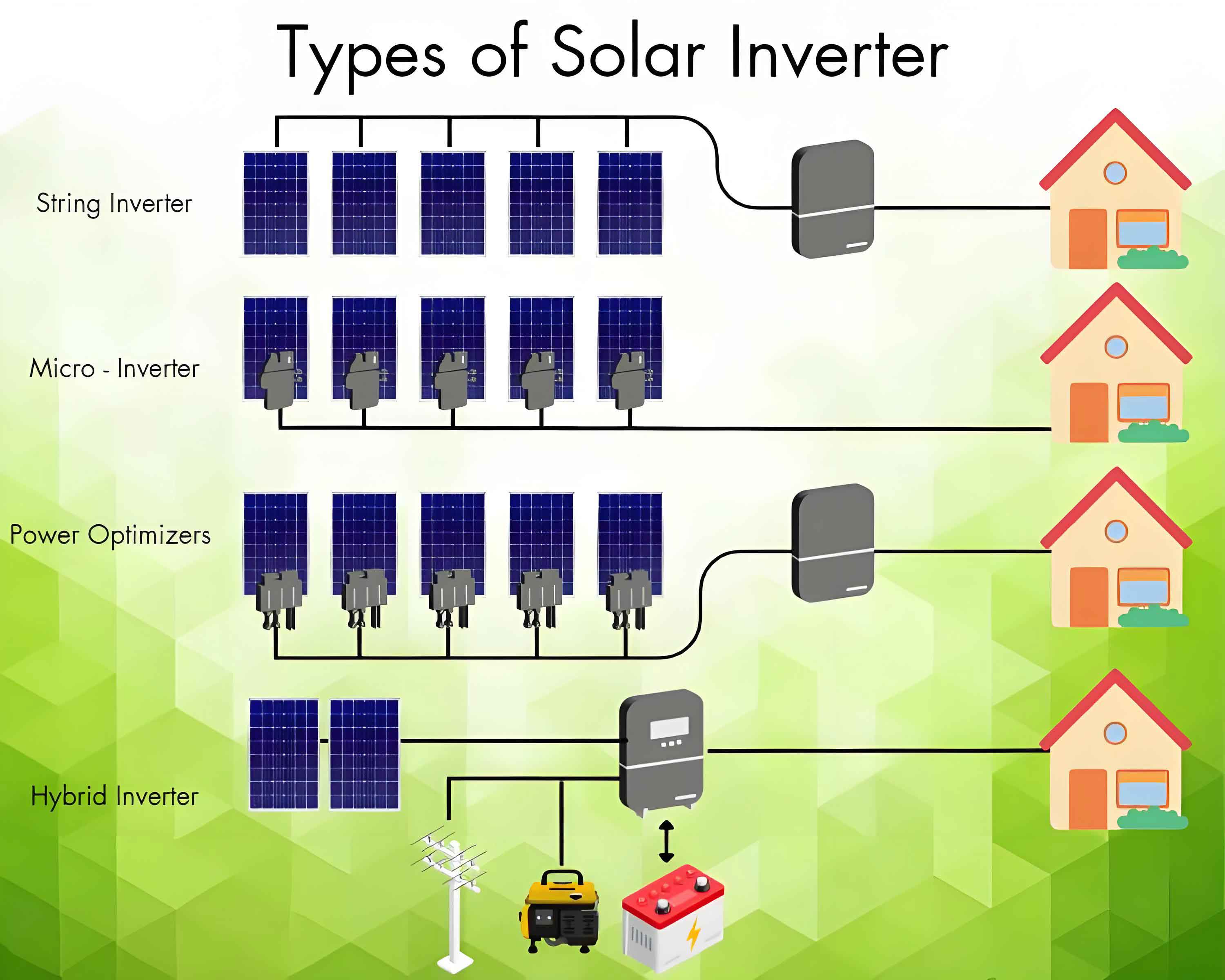
Modular Solar Inverter Architectures
The “1+X” modular design represents a breakthrough in solar inverter technology, combining the advantages of centralized and string topologies:
| Parameter | Centralized | String | Modular (1+X) |
|---|---|---|---|
| Power Rating | 2-8 MW | 50-300 kW | 1.1-8.8 MW |
| CAPEX Reduction | Baseline | 5-8% higher | 12-15% lower |
| O&M Efficiency | 0.75 | 0.85 | 0.92 |
| Grid Compliance | IEEE 1547-2018 | IEEE 1547-2018 | IEC 63027 |
The modular approach enables:
$$ LCOE = \frac{C_{capex} + C_{opex}}{E_{annual}} $$
Where \( C_{capex} \) = capital costs, \( C_{opex} \) = operational costs, and \( E_{annual} \) = annual energy output. Field data shows 18-22% LCOE reduction compared to traditional configurations.
Advanced Functionalities for Future Grids
Next-generation solar inverters integrate three critical capabilities:
1. Active Grid Support:
Implementing virtual synchronous machine (VSM) technology:
$$ J\frac{d\omega}{dt} = P_m – P_e – D(\omega – \omega_0) $$
Where \( J \) = virtual inertia, \( \omega \) = angular frequency, \( P_m \) = mechanical power, \( P_e \) = electrical power, and \( D \) = damping coefficient.
2. Intelligent Fault Management:
Using machine learning algorithms for predictive maintenance:
$$ RUL = \int_{t_0}^{t_f} \lambda(t)dt $$
Where RUL = remaining useful life, \( \lambda(t) \) = failure rate function derived from operational data.
3. Multi-Port Integration:
Hybrid inverters enabling DC-coupled storage:
$$ \frac{\partial P}{\partial V} = \frac{2V}{R} $$
Facilitating seamless energy transfer between PV arrays, batteries, and grid connections.
Key Performance Metrics Comparison
| Technology | Efficiency (%) | Response Time (ms) | THD (%) | Cyclic Lifetime |
|---|---|---|---|---|
| Traditional Centralized | 98.2 | 120 | 3.2 | 25,000 |
| Advanced Modular | 99.1 | 45 | 1.8 | 50,000 |
| Grid-Forming | 98.7 | 20 | 1.2 | 40,000 |
Emerging Trends in Solar Inverter Development
The industry is converging on four technological vectors:
- High-Power Density: Achieving >1 W/cm³ through advanced cooling and SiC/GaN semiconductors
- Adaptive Topology: Reconfigurable converter circuits for varying irradiance conditions
- Cyber-Physical Security: Quantum-resistant encryption for grid communication
- Multi-Energy Coordination: Holistic control of PV-wind-storage hybrids
The power density metric illustrates progress:
$$ \rho = \frac{P_{rated}}{V_{enclosure}} $$
Where \( \rho \) = power density (W/m³), \( P_{rated} \) = nominal power, \( V_{enclosure} \) = inverter volume. Modern designs achieve 2.4 MW/m³ compared to 0.8 MW/m³ a decade ago.
Conclusion
Solar inverter innovation remains pivotal for enabling high renewable penetration grids. Through modular architectures, intelligent control algorithms, and advanced power electronics, next-generation inverters will provide:
- 30-40% reduction in balance-of-system costs
- Sub-100 ms fault ride-through capability
- Plug-and-play interoperability with diverse energy assets
The evolution of solar inverter technologies demonstrates how power electronics continue to redefine the boundaries of sustainable energy systems, ensuring reliable and cost-effective integration of photovoltaic generation at scale.