
The optimization and safe application of battery energy storage systems (BESS) fundamentally rely on a deep understanding of the electrical behavior of individual cells and their combinations. For grid-scale storage, where high voltage and capacity are required, lithium iron phosphate (LiFePO4) batteries are a prominent choice due to their inherent safety, long cycle life, and stability. This study focuses on developing and analyzing equivalent circuit models (ECMs) for single LiFePO4 battery cells and their series, parallel, and hybrid configurations. The primary goal is to simulate and elucidate the electrical dynamics within a battery module under realistic conditions of cell-to-cell inconsistencies, such as variations in internal resistance, capacity, and initial State of Charge (SOC).
The accuracy of a battery pack model is contingent upon the precision of its constituent single-cell model. An ECM uses electrical components like resistors and capacitors in specific arrangements to simulate the battery’s external electrical characteristics, such as the relationship between terminal voltage, current, SOC, and temperature. Among various models, the Thevenin model (or first-order RC model) effectively captures key dynamic behaviors like ohmic response and polarization, making it suitable for simulating LiFePO4 battery cells. This model, as shown in the conceptual diagram below, forms the cornerstone of our analysis for more complex pack configurations.
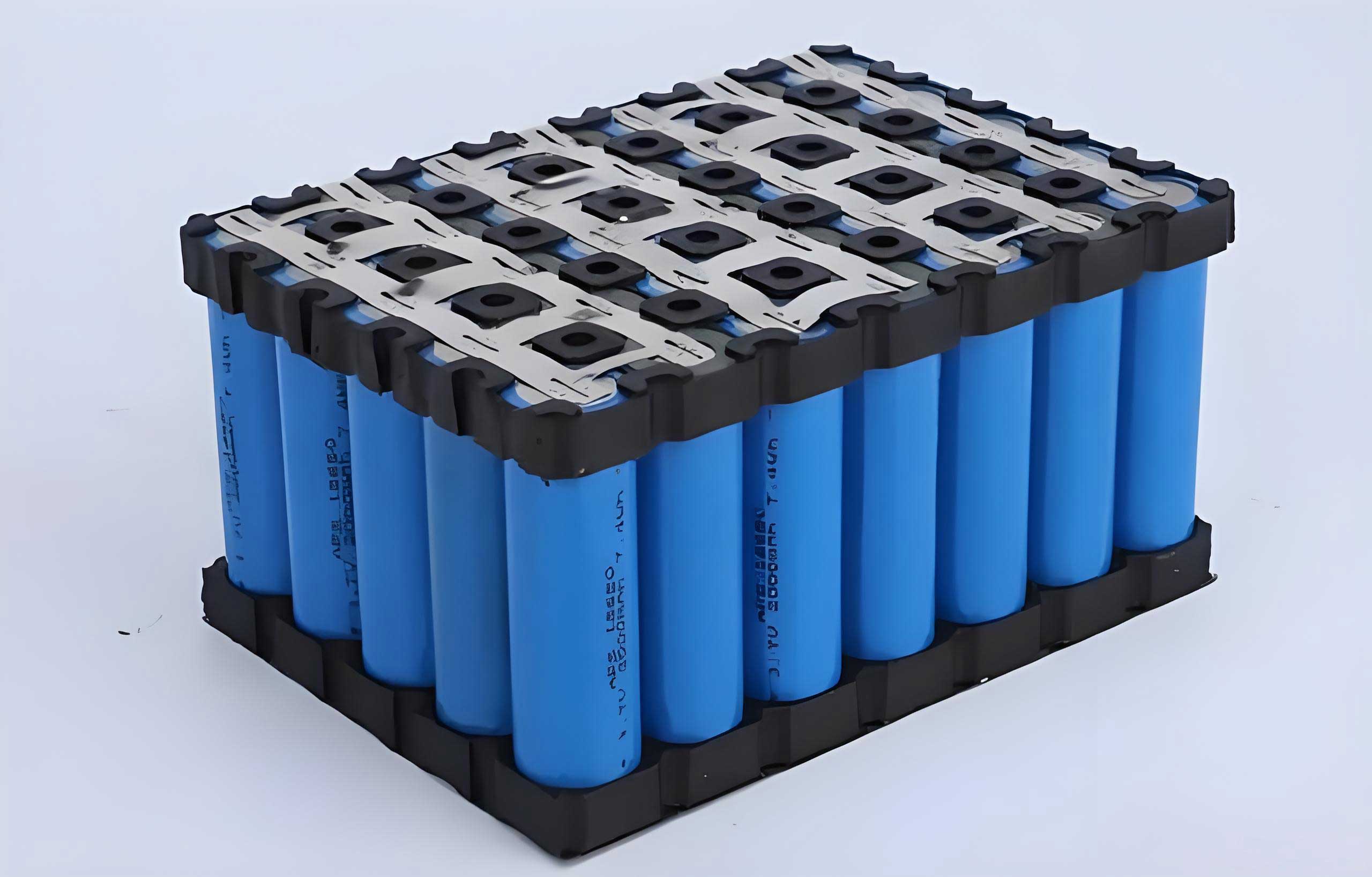
The core Thevenin model for a single LiFePO4 battery cell comprises an ideal voltage source representing the open-circuit voltage (OCV, $$U_{ocv}$$), a series ohmic resistor ($$R_{\Omega}$$), and a parallel RC branch (with polarization resistance $$R_p$$ and capacitance $$C_p$$) accounting for transient voltage changes due to polarization effects. The governing state-space equations for this LiFePO4 battery model are:
State equation for the polarization voltage ($$u_p$$):
$$ \frac{du_p}{dt} = -\frac{1}{C_p R_p} u_p + \frac{I}{C_p} $$
Output equation for the terminal voltage ($$U_o$$):
$$ U_o = U_{ocv} + I R_{\Omega} + u_p(0) \cdot e^{-\frac{t}{R_p C_p}} + I R_p \left(1 – e^{-\frac{t}{R_p C_p}}\right) $$
where $$I$$ is the cell current (positive for discharge, negative for charge), and $$u_p(0)$$ is the initial polarization voltage. The OCV ($$U_{ocv}$$) is a known function of the cell’s SOC, which is itself calculated by Coulomb counting: $$SOC(t) = SOC(0) – \frac{1}{C_{nom}} \int_0^t I(\tau) d\tau$$, where $$C_{nom}$$ is the nominal capacity of the LiFePO4 battery.
Modeling and Simulation of Parallel-Connected LiFePO4 Battery Cells
To increase the capacity (Ah) of a module, LiFePO4 battery cells are connected in parallel. In a parallel configuration, all cells share the same terminal voltage, while the total current is the sum of the currents through each branch. However, this simple principle leads to complex current distributions when cell parameters are not identical.
For a system with $$k$$ parallel branches (each branch being a single LiFePO4 cell model), we have $$k$$ unknown branch currents ($$I_1, I_2, …, I_k$$) and $$k$$ unknown polarization voltages ($$u_{p1}, u_{p2}, …, u_{pk}$$). The system is described by the following set of equations derived from Kirchhoff’s laws and the Thevenin model dynamics:
1. Voltage Equality: The terminal voltage for each parallel branch must be equal. This gives $$k-1$$ independent equations of the form:
$$ R_{\Omega i} I_i – R_{\Omega j} I_j = -u_{pi} + u_{pj} + U_{ocv,j}(SOC_j) – U_{ocv,i}(SOC_i) $$
for branches $$i$$ and $$j$$.
2. Current Summation: The sum of all branch currents equals the total pack current ($$I_{total}$$):
$$ I_1 + I_2 + … + I_k = I_{total} $$
3. State Equations: Each branch has its own polarization dynamics:
$$ \frac{du_{pi}}{dt} = -\frac{1}{C_{pi} R_{pi}} u_{pi} + \frac{I_i}{C_{pi}}, \quad \text{for } i = 1, 2, …, k $$
This results in a system of $$2k$$ equations for $$2k$$ unknowns, which can be solved numerically. For computational efficiency, the algebraic constraints (voltage equality and current sum) can be arranged in a matrix form. For instance, for two parallel LiFePO4 cells, the matrix equation to solve for currents at each time step is:
$$
\begin{bmatrix}
R_{\Omega1} & -R_{\Omega2} \\
1 & 1
\end{bmatrix}
\begin{bmatrix}
I_1 \\
I_2
\end{bmatrix}
=
\begin{bmatrix}
-u_{p1} + u_{p2} + U_{ocv2} – U_{ocv1} \\
I_{total}
\end{bmatrix}
$$
Simulations reveal significant impacts of parameter inconsistency on current sharing in parallel-connected LiFePO4 battery packs.
| Simulation Case | Condition | Key Observation during 1C Discharge/Charge | Implication for LiFePO4 Battery Pack |
|---|---|---|---|
| Case 1: Internal Resistance Mismatch | $$R_{\Omega2} = 1.25 \times R_{\Omega1}$$, identical capacity & initial SOC. | Constant current imbalance throughout the cycle. The cell with lower resistance carries a higher current. | Sustained uneven stress leads to divergent aging. The higher-current cell degrades faster. |
| Case 2: Severe Resistance Mismatch | $$R_{\Omega2} = 5 \times R_{\Omega1}$$ | Dramatic current imbalance. The low-resistance cell may experience current far exceeding the intended 1C rate. | High risk of local overheating and potential thermal runaway in the LiFePO4 battery carrying over-current. |
| Case 3: Capacity Mismatch | $$C_{nom2} = 0.9 \times C_{nom1}$$, identical resistance & initial SOC. | Dynamic current imbalance. The larger-capacity cell provides more current initially. Imbalance changes as SOC diverges. | Inefficient use of total capacity. The pack stops when the weakest (smallest) cell is empty/full. |
| Case 4: Initial SOC Mismatch | $$SOC_1(0) = 0.8, SOC_2(0)=0.7$$, identical R & C. | At start, the higher-SOC cell charges the lower-SOC cell internally. Currents equalize only after SOCs converge. | Energy loss due to internal balancing currents. Initial transient can cause unexpected high currents. |
| Case 5: Combined Mismatches | Mismatches in R, C, and initial SOC. | Complex, highly uneven, and time-varying current distribution. Effects are additive and often exacerbate imbalance. | Most realistic and dangerous scenario. Extremely difficult to manage, high risk of over-current/over-voltage conditions. |
For a parallel module with a larger number of cells (e.g., 8 LiFePO4 batteries), the current distribution problems are magnified. The spread in currents at the beginning and end of discharge becomes more severe with greater parameter spreads, as illustrated in the table above. This simulation underscores a critical flaw: a Battery Management System (BMS) typically measures the voltage of the parallel group as a whole and cannot monitor the current or voltage of individual cells within the parallel cluster. Therefore, an over-current condition in one cell within a parallel “logical unit” can go undetected until it potentially leads to a failure.
Modeling and Simulation of Series-Connected LiFePO4 Battery Cells
To achieve the required system voltage, LiFePO4 battery cells are connected in series. In a series configuration, the same current flows through all cells, but the voltages across each cell can differ significantly due to parameter variations.
The model for a series string of $$n$$ LiFePO4 cells is simpler in terms of current but complex in managing voltage limits. The pack current $$I_{pack}$$ is common to all cells. The terminal voltage of each cell $$i$$ is given by:
$$ U_{o,i} = U_{ocv,i}(SOC_i) + I_{pack} R_{\Omega i} + u_{pi} $$
The total pack voltage is $$U_{pack} = \sum_{i=1}^{n} U_{o,i}$$.
The state equations for each cell’s polarization voltage remain:
$$ \frac{du_{pi}}{dt} = -\frac{1}{C_{pi} R_{pi}} u_{pi} + \frac{I_{pack}}{C_{pi}} $$
The critical challenge in a series string of LiFePO4 batteries is voltage divergence during operation. Consider a string of 4 cells with mismatched capacity and initial SOC. During a 1C charge, all cells experience the same current. The cell with the smallest capacity (or highest initial SOC) will reach its maximum voltage (e.g., 3.65V for LiFePO4) first. To prevent this cell from overcharging, the entire string must stop charging, leaving the other cells undercharged. The usable capacity of the pack is thus limited by the weakest cell. This phenomenon is described by the following constraint for charge termination:
$$ \text{Stop Charge if } \max(U_{o,1}, U_{o,2}, …, U_{o,n}) \geq U_{charge\_max} $$
Similarly, during discharge, the cell with the smallest capacity (or lowest initial SOC) will reach its minimum voltage first, forcing the entire string to stop discharging and leaving energy unused in the other cells:
$$ \text{Stop Discharge if } \min(U_{o,1}, U_{o,2}, …, U_{o,n}) \leq U_{discharge\_min} $$
This highlights the absolute necessity of a competent BMS with cell balancing functionality for any series string of LiFePO4 batteries. While series connection avoids the hidden over-current risk of parallel connections, it introduces a clear over/under-voltage management challenge that is, however, directly measurable and manageable on a per-cell basis.
Modeling and Simulation of Hybrid (Series-Parallel) LiFePO4 Battery Packs
Practical battery packs for energy storage often employ hybrid topologies, combining series and parallel connections to meet both voltage and capacity requirements. These configurations inherit the challenges of both pure parallel and pure series strings, often in complex, coupled ways.
We analyze two common hybrid configurations. The first is “parallel-first”: several cells are connected in parallel to form a logical unit of higher capacity, and then these units are connected in series to build voltage. The second is “series-first”: cells are connected in series to form a module of desired voltage, and then these modules are connected in parallel to increase capacity.
Configuration A (Parallel-First): Consider 8 LiFePO4 cells arranged as 4 parallel pairs (2P) connected in series (4S). If cells have inconsistent internal resistance and initial SOC, the simulation shows that the currents in the four parallel branches are unequal and vary throughout the discharge. More critically, at the end of discharge, one cell in one parallel pair hits the lower voltage limit first, forcing the entire pack to stop. This results in significant under-utilization of the total energy stored in the other cells.
Configuration B (Series-First): Now consider an arrangement of 8 LiFePO4 cells as 2 series strings (4S each) connected in parallel at the pack terminals (2P). This is modeled by applying the parallel pack modeling principles to two sub-packs, where each sub-pack is itself a 4S string governed by the series model equations. The matrix for solving the two string currents ($$I_{str1}, I_{str2}$$) becomes:
$$
\begin{bmatrix}
R_{eq1} & -R_{eq2} \\
1 & 1
\end{bmatrix}
\begin{bmatrix}
I_{str1} \\
I_{str2}
\end{bmatrix}
=
\begin{bmatrix}
-U_{str1} + U_{str2} + (U_{ocv,str2} – U_{ocv,str1}) \\
I_{total\_pack}
\end{bmatrix}
$$
where $$R_{eqi}$$ and $$U_{stri}$$ are the equivalent internal resistance and terminal voltage of the entire i-th series string, and $$U_{ocv,stri}$$ is the sum of the OCVs in that string.
Simulating this 4S2P configuration with moderate parameter mismatches at a high discharge rate (e.g., 4C for a 100Ah LiFePO4 battery) reveals a dangerous phenomenon. Due to voltage differences between the two series strings at the start of discharge, one string can begin to forcibly charge the other string through the parallel bus. This leads to one string discharging at an extremely high rate (e.g., 600A, equivalent to 6C for its constituent cells) while the other string is being charged. This severe current imbalance, driven by string-level voltage mismatch, can immediately push individual cells in the high-current string into an over-current and over-temperature condition, creating a severe safety hazard for the LiFePO4 battery pack.
| Topology Strategy | Description | Advantages | Disadvantages & Risks |
|---|---|---|---|
| Parallel-First (Cells in parallel, then series) | Cells are paralleled to form a logical unit, then these units are series-connected. | Simple BMS can monitor only the parallel unit voltage. Easier wiring for capacity expansion. | Critical: Hidden current imbalance within parallel unit. BMS cannot monitor/balance individual parallel cells. High risk of undetected over-current and thermal runaway in a LiFePO4 cell. |
| Series-First (Cells in series, then parallel) | Cells are series-connected to form a full-voltage module, then these modules are paralleled. | BMS can monitor and balance every individual cell in each series string. Current imbalance occurs at the module level, which is more manageable and detectable. | Requires more BMS channels and wiring. Module-level voltage mismatch can cause large inter-module balancing currents at high power, but this is a measurable system-level issue. |
| Proposed Topology for Safety | Cells → Series Module → Series String/Cluster → Parallel at AC inverter side. | Maximizes individual cell monitoring and control via BMS. Eliminates DC-side parallel connection of battery strings, removing the path for dangerous DC circulating currents. Current sharing is managed by grid-tied inverters on the AC side, a mature and reliable technology. | Higher system cost due to multiple power conversion stages (inverters). Requires sophisticated system-level energy management. |
Conclusion and System Topology Implications
Based on the comprehensive equivalent circuit modeling and simulation of LiFePO4 battery packs, a clear and critical conclusion emerges regarding system topology for large-scale energy storage. The common practice of connecting cells in parallel within a module to form a “logical cell” of higher capacity, before series connection, harbors significant hidden risks. As simulations consistently show, inherent inconsistencies in internal resistance, capacity, and initial SOC among LiFePO4 battery cells lead to uneven current distribution within these parallel groups. This imbalance can be severe, causing individual cells to operate at currents substantially higher than the pack average, leading to localized overheating and dramatically increasing the risk of thermal runaway. Furthermore, a standard BMS is blind to the conditions of individual cells within a parallel group, making this risk undetectable through conventional voltage monitoring.
Therefore, to ensure safety and longevity, the system topology must prioritize the ability to monitor and manage each and every LiFePO4 battery cell. The recommended strategy is a series-first architecture: connect cells in series to form a complete module or string at the desired system DC voltage. These series strings (or clusters) are then managed by a BMS capable of monitoring the voltage of every single cell and performing active or passive balancing. To increase system power capacity, multiple such independent strings are connected not in parallel on the DC side, but rather through their own dedicated power conversion systems (PCS) which are paralleled on the AC side of the inverter. This approach transfers the current-sharing responsibility from the electrochemical cells to the power electronics, a domain where precise and reliable current control is well-established.
In summary, while equivalent circuit models like the Thevenin model provide invaluable tools for understanding the complex interactions within LiFePO4 battery packs, the ultimate safeguard lies in a system design that acknowledges and mitigates these interactions. By avoiding DC-side paralleling of battery strings and ensuring per-cell BMS visibility, the safety and reliability of grid-scale lithium iron phosphate battery energy storage systems can be fundamentally enhanced.