
The integration of renewable energy sources is paramount in addressing global energy and environmental challenges. As the penetration level of these distributed generators increases, the traditional assumption of a stiff, ideal grid becomes invalid. The combined effect of line impedances and the widespread use of power electronic loads results in a non-negligible grid impedance, characterized by a decreasing Short Circuit Ratio (SCR). This condition defines a “weak grid,” posing significant stability challenges for grid-connected systems. The utility interactive inverter, as the essential interface between the distributed generation unit and the utility grid, must maintain stable and high-quality power injection under these adverse conditions.
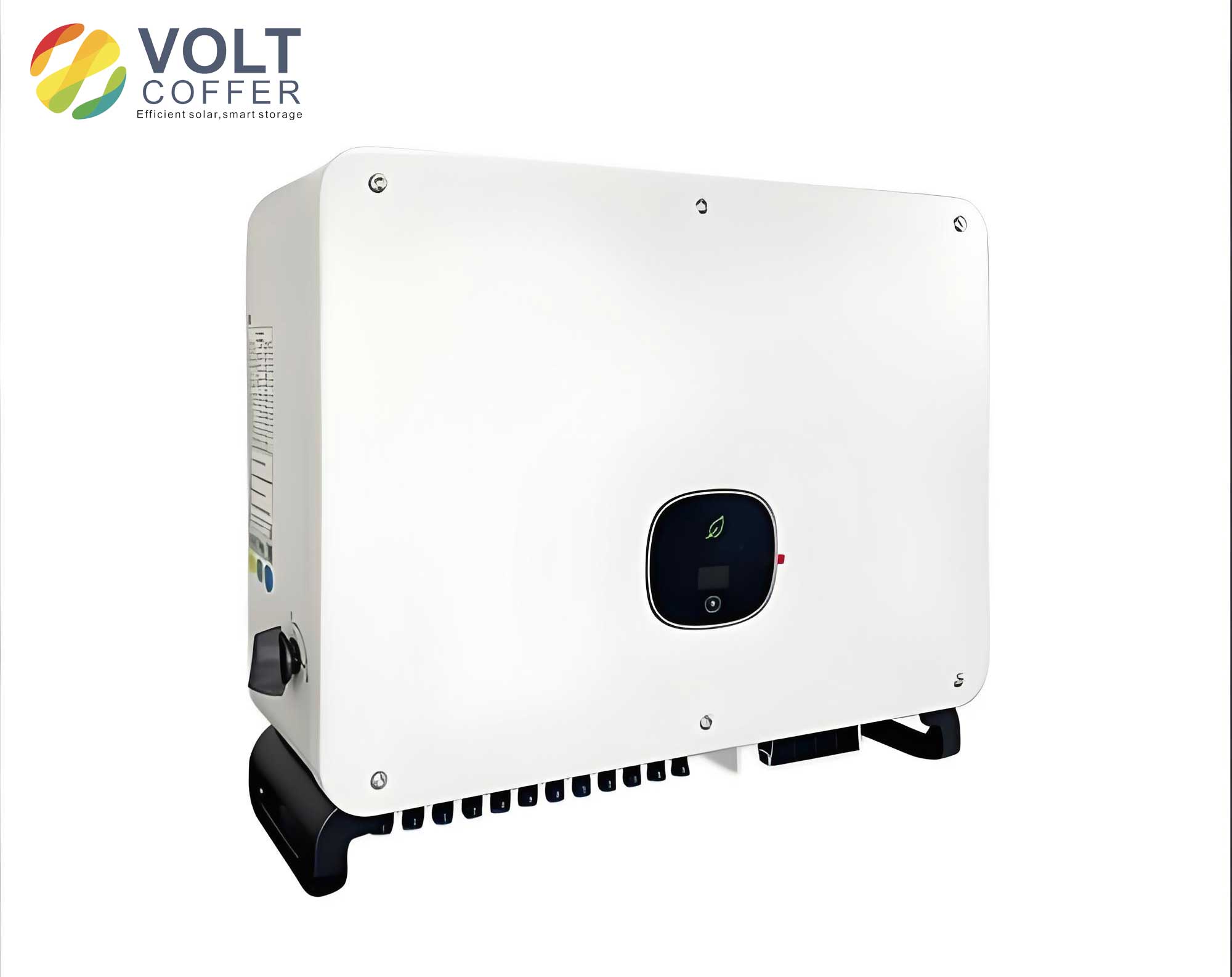
A critical component in the control of a grid-following utility interactive inverter is the Phase-Locked Loop (PLL), which synchronizes the inverter’s current injection with the grid voltage. However, in weak grids, the dynamics of the PLL interact detrimentally with the grid impedance, often reducing the system’s stability margin and potentially leading to oscillations or instability. While common solutions involve modifying the PLL structure or bandwidth, these can compromise dynamic performance or add complexity. This paper analyzes the destabilizing mechanism introduced by the PLL and proposes a novel, easily implementable grid voltage feedforward strategy based on multi-objective constraints to robustly enhance the stability of utility interactive inverters.
1. Stability Analysis of Utility Interactive Inverters with PLL in Weak Grids
1.1 Impedance Modeling of a Single-Phase LCL-Type Inverter
To analyze stability, the impedance-based approach is employed. The system under study is a single-phase, grid-following utility interactive inverter with an LCL output filter. The current controller is a quasi-Proportional Resonant (PR) controller, and a transport delay-based PLL is used for synchronization. The inverter’s output impedance, which dictates its interaction with the grid impedance, is derived.
The current controller transfer function is:
$$G_c(s) = k_{prp} + \frac{2\omega_{pr} k_{prr} s}{s^2 + 2\omega_{pr} s + \omega_n^2}$$
where $\omega_n = 100\pi$ rad/s. The PLL transfer function can be linearized and expressed in a simplified form for analysis. The plant transfer functions, considering the LCL filter and active damping via capacitor current feedback ($H_i$), are:
$$G_{X1}(s) = \frac{K_{PWM}}{s^2 L_1 C + s K_{PWM} C H_i + 1}$$
$$G_{X2}(s) = \frac{s^2 L_1 C + s K_{PWM} C H_i + 1}{s^3 L_1 L_2 C + s^2 L_2 K_{PWM} C H_i + s(L_1 + L_2)}$$
The open-loop gain is $T_o(s) = G_c(s)G_{X1}(s)G_{X2}(s)$.
Without the PLL influence, the output impedance $Z_{out}(s)$ seen from the grid side is:
$$Z_{out}(s) = \frac{1 + T_o(s)}{G_{X2}(s)}$$
When the PLL is considered, it introduces an additional current reference component proportional to the Point of Common Coupling (PCC) voltage. The complete model can be represented by a Norton equivalent circuit. The total output impedance $Z_{out\_PLL}(s)$ and the equivalent impedance contributed by the PLL loop $Z_{PLL}(s)$ are derived as:
$$
Z_{out\_PLL}(s) = \frac{1 + T_o(s)}{G_{X2}(s) – T_o(s) I_m^* G_{PLL}(s)} = \left( \frac{1}{Z_{PLL}(s)} + \frac{1}{Z_{out}(s)} \right)^{-1}
$$
where
$$Z_{PLL}(s) = -\frac{1 + T_o(s)}{T_o(s) I_m^* G_{PLL}(s)}$$
The negative sign in $Z_{PLL}(s)$ is critical, indicating its potential to introduce negative resistance or phase characteristics.
1.2 Destabilizing Effect of the PLL and Stability Criterion
According to the impedance-based stability criterion, a system remains stable if the ratio of the grid impedance $Z_g(s)$ to the inverter output impedance satisfies the Nyquist criterion. A common simplification for an inductive grid ($Z_g(s) = sL_g$) states that the phase margin (PM) at the frequency where magnitudes intersect is:
$$PM = 90^\circ + \angle Z_{out\_PLL}(j2\pi f_z)$$
Thus, stability requires $\angle Z_{out\_PLL}(j2\pi f_z) > -90^\circ$.
The key destabilizing effect of the PLL is revealed through a Bode plot analysis of $Z_{out}(s)$ and $Z_{out\_PLL}(s)$. In the frequency range of 100-750 Hz, where impedance crossover typically occurs in weak grids, $Z_{out\_PLL}(s)$ exhibits a significant phase drop compared to $Z_{out}(s)$. This phase reduction directly erodes the system’s phase margin. As the grid weakens (larger $L_g$), the crossover frequency decreases into this critical region. If the phase drop is severe enough to violate the criterion, the utility interactive inverter becomes unstable. The analysis confirms that the term $-T_o(s) I_m^* G_{PLL}(s)$ in the denominator of $Z_{out\_PLL}(s)$ is responsible for this detrimental phase characteristic.
| Parameter | Symbol | Value |
|---|---|---|
| Rated Power | $P_N$ | 5 kW |
| Grid Voltage (RMS) | $U_g$ | 220 V |
| DC Bus Voltage | $U_{dc}$ | 400 V |
| Inverter-side Inductor | $L_1$ | 2.5 mH |
| Grid-side Inductor | $L_2$ | 0.8 mH |
| Filter Capacitor | $C$ | 10 µF |
| PR Controller Proportional Gain | $k_{prp}$ | 0.09 |
| PR Controller Resonant Gain | $k_{prr}$ | 4.4 |
| Active Damping Coefficient | $H_i$ | 0.15 |
| PLL Proportional Gain | $k_p$ | 6 |
| PLL Integral Gain | $k_i$ | 2600 |
2. Proposed Multi-Objective Constrained Voltage Feedforward Strategy
2.1 Principle of PLL Effect Cancellation via Feedforward
The analysis shows that $Z_{PLL}(s)$ acts as a negative impedance path in parallel with $Z_{out}(s)$. The proposed strategy aims to cancel this effect by introducing an intentionally designed feedforward of the PCC voltage. Conceptually, this adds an equivalent positive impedance $Z_{c\_eq}(s)$ in parallel, such that $Z_{c\_eq}(s) \approx -Z_{PLL}(s)$. Through block diagram manipulation, the required feedforward transfer function $F_3(s)$, added at the modulator input, is derived as:
$$F_3(s) = I_m^* G_c(s) G_{PLL}(s)$$
Implementing $F_3(s)$ directly is impractical due to its high complexity (4th order) and the presence of $(s – j\omega_n)$ terms from the PLL.
2.2 Simplified Feedforward Design with Multi-Objective Constraints
To achieve a practical and implementable solution, a simplified approximate equivalent function $F_{3\_eq}(s)$ is designed. The goal is for $F_{3\_eq}(s)$ to match the frequency response of $F_3(s)$ in the critical 100-750 Hz range, while having minimal impact at the fundamental frequency (50 Hz) to avoid interfering with the primary current control. The structure is chosen as:
$$F_{3\_eq}(s) = I_m^* \cdot k_{prp} \cdot G_{PLL\_eq}(s)$$
where $k_{prp}$ (the proportional gain of the PR controller) approximates $G_c(s)$ in the mid-frequency range, and $G_{PLL\_eq}(s)$ is a simplified, real-coefficient approximation of $G_{PLL}(s)$. A second-order lead-lag form is selected for $G_{PLL\_eq}(s)$:
$$G_{PLL\_eq}(s) = k_{eq} \frac{s + X}{s^2 + Y s + Z}$$
The parameters $k_{eq}, X, Y, Z$ are determined by imposing multi-objective constraints on its frequency response relative to $G_{PLL}(s)$:
- Baseband Constraint: Zero phase shift at 50 Hz to avoid affecting fundamental synchronization: $$\angle G_{PLL\_eq}(j\omega_n) = 0^\circ \Rightarrow XY = Z – \omega_n^2$$
- Mid-Frequency Matching: Equal phase at a selected mid-frequency point (e.g., 400 Hz) to guide the shape: $$\angle G_{PLL\_eq}(j\cdot 800\pi) = \angle G_{PLL}(j\cdot 800\pi)$$
- Phase Deviation Bound: Limit phase deviation at the boundaries of the critical range (50 Hz and 750 Hz) to within a small tolerance (e.g., $\leq 2^\circ$).
- Magnitude Deviation Bound: Limit magnitude deviation at 50 Hz and 750 Hz to within a small tolerance (e.g., $\leq 0.8$ dB).
Solving these constraints yields a practical set of parameters. For the given system, the following parameters provide an excellent approximation:
$$X = 813, \quad Y = 2293, \quad Z = 1.962\times10^6, \quad k_{eq} = 3.4$$
Thus, the final, implementable feedforward law for the utility interactive inverter is:
$$F_{3\_eq}(s) = I_m^* \cdot k_{prp} \cdot 3.4 \cdot \frac{s + 813}{s^2 + 2293 s + 1.962\times10^6}$$
2.3 Stability Analysis with the Proposed Feedforward Strategy
With the proposed feedforward, the new output impedance $Z_{con}(s)$ of the utility interactive inverter becomes:
$$Z_{con}(s) = \frac{1 + T_o(s)}{G_{X2}(s) – G_{X1}(s)G_{X2}(s)\left[ I_m^*G_c(s)G_{PLL}(s) – F_{3\_eq}(s) \right]}$$
A Bode plot comparison reveals the effectiveness of the strategy. $Z_{con}(s)$ exhibits a significantly improved phase characteristic in the 100-750 Hz range compared to $Z_{out\_PLL}(s)$, while its magnitude at the fundamental frequency remains virtually unchanged. This results in a substantial increase in the phase margin for weak grid conditions, as calculated below:
| Grid Inductance $L_g$ | SCR | Phase Margin (Without Feedforward) | Phase Margin (With Proposed Feedforward) |
|---|---|---|---|
| 3.5 mH | 8.8 | 17.1° | 34.3° |
| 6.0 mH | 5.1 | 4.1° | 37.6° |
| 10.3 mH | 3.0 | -2° (Unstable) | 40.6° |
The table clearly demonstrates that the multi-objective constrained feedforward strategy not only enhances stability in moderately weak grids but can also stabilize a utility interactive inverter that would otherwise be unstable under very weak grid conditions (SCR=3).
3. Simulation and Experimental Validation
A detailed simulation model and a hardware-in-the-loop (HIL) experimental platform were developed to validate the proposed control strategy for the utility interactive inverter. The system parameters correspond to those in the analysis.
3.1 Simulation Results
Initially, without the feedforward, the utility interactive inverter operates stably at SCR=10.3 (THD=0.86%). As the grid weakens to SCR=7.7, severe oscillation occurs in the grid current, indicating instability. Upon enabling the proposed feedforward strategy at SCR=7.7, the current waveform immediately stabilizes with a low THD of 0.35%. The effectiveness is further tested under extremely weak grid conditions. At SCR=3, the utility interactive inverter with the proposed feedforward maintains a stable, high-quality current injection (THD=0.39%) and unity power factor operation. The dynamic performance is also verified; when the load steps from 100% to 50%, the current settles within half a cycle, demonstrating good transient response. The strategy remains effective even at an ultra-weak SCR=1, with current THD at 1.27%, still within acceptable limits.
3.2 Experimental Verification
Experimental results from the HIL platform corroborate the simulations. Without feedforward at SCR=8.1, the PCC voltage and grid current show severe instability. When the proposed feedforward is activated at SCR=3, the waveforms become clean and stable. The load step test at SCR=3 confirms excellent dynamic performance. Finally, operation at SCR=1 demonstrates that the utility interactive inverter retains stable operation with mildly distorted but controlled current waveforms, proving the robustness of the approach.
4. Conclusion
This paper has addressed the critical stability challenge faced by grid-following utility interactive inverters operating in weak grids, where the PLL introduces a destabilizing negative impedance effect. A systematic impedance model was developed to quantify this phenomenon. Rather than modifying the PLL itself, a novel grid voltage feedforward control strategy was proposed. The core idea is to design the feedforward path to equivalently synthesize a positive impedance that cancels the PLL’s negative impedance contribution.
The main contributions are: 1) A clear Norton equivalent model highlighting the PLL’s negative impedance characteristic. 2) The innovative feedforward-based cancellation approach, which preserves dynamic performance unlike bandwidth-limiting PLL modifications. 3) A practical design methodology using multi-objective constraints (baseband phase, mid-frequency matching, bounded phase/magnitude deviation) to derive a simple, second-order, real-coefficient feedforward transfer function $F_{3\_eq}(s)$ that is readily implementable in a digital controller.
Both simulation and experimental results consistently validate that the proposed multi-objective constrained voltage feedforward strategy dramatically enhances the stability margin of the utility interactive inverter. It enables stable, high-power-factor operation even under very weak grid conditions (SCR ≥ 1), significantly improving the grid adaptability of renewable energy systems. This method provides a valuable and practical solution for ensuring the reliable integration of utility interactive inverters in future power grids with high penetration of distributed generation.