
The widespread adoption of photovoltaic (PV) technology is a cornerstone of the global transition to sustainable energy. As a core component of any modern solar system, the efficiency of PV modules directly impacts energy yield and economic viability. A critical, well-documented challenge is the negative temperature coefficient of solar cells; their electrical conversion efficiency decreases as their operational temperature rises. A significant portion of incident solar irradiance, often exceeding 80%, is not converted into electricity but is dissipated as heat, further elevating the module temperature and creating a detrimental feedback loop. This fundamental issue necessitates the development of effective cooling strategies to suppress operating temperatures and thereby enhance the performance and longevity of the solar system.
Numerous cooling methodologies have been explored globally. These range from passive techniques like optimized natural convection channels to active systems involving air or liquid cooling on the rear side of the modules, or even hybrid photovoltaic/thermal (PV/T) collectors. This research focuses on a distinct approach: surface water cooling. This method involves flowing a thin water film directly over the front glass surface of standard PV modules. This technique promises a dual benefit: active cooling of the cell temperature and periodic cleaning of the glass surface from dust and debris, both of which are crucial for maintaining optimal performance in a practical solar system. This paper presents a comprehensive study, encompassing the development of a theoretical heat transfer model and extensive experimental testing, on the application characteristics of such a surface water-cooled PV system. A comparative analysis is conducted against an identical, fixed-tilt PV array to quantify the performance gains.
Theoretical Heat Transfer Model for the Water-Cooled Solar System
The proposed cooling configuration fundamentally alters the thermal boundary conditions of the PV module. The front surface experiences forced convection due to the flowing water film, while the rear surface is subject to natural convection with ambient air. To analyze this, a transient energy balance model is established. Considering the PV module as a control volume, the governing energy conservation equation is:
$$C_{\text{mod}} \frac{dT}{dt} = A(1 – \rho)I_s \tau – Q_c – Q_r – P_{\text{out}}$$
Where \(C_{\text{mod}}\) is the total heat capacity of the module (2918 J/K), \(T\) is the average module temperature (K), \(A\) is the module area (1.3 m²), \(\rho\) is the water film’s solar reflectance (0.1), \(\tau\) is its transmittance (0.8), \(I_s\) is the solar irradiance (W/m²), \(Q_c\) is the convective heat loss (W), \(Q_r\) is the radiative heat loss (W), and \(P_{\text{out}}\) is the electrical power output (W).
The convective heat loss \(Q_c\) is the sum of front-side forced convection to water and rear-side natural convection to air:
$$Q_c = A[h_{c,fo}(T – T_{\text{water}}) + h_{c,fe}(T – T_a)]$$
The forced convection coefficient \(h_{c,fo}\) for water flowing over the plate is calculated using the correlation for turbulent flow:
$$Nu = \frac{h_{c,fo} L}{\lambda} = 0.037 Re^{0.8} Pr^{1/3}$$
where \(Nu\), \(Re\), and \(Pr\) are the Nusselt, Reynolds, and Prandtl numbers for water, respectively, and \(\lambda\) is the thermal conductivity of water. The natural convection coefficient for the rear side is approximated as \(h_{c,fe} = 1.31(T – T_a)^{1/3}\).
The radiative heat loss \(Q_r\) accounts for exchange with the sky and the ground:
$$Q_r = A \sigma_0 \left( \varepsilon_{\text{mod}} T^4 – \frac{1 – \cos \beta}{2} \varepsilon_{\text{sky}} T_{\text{sky}}^4 – \frac{1 + \cos \beta}{2} \varepsilon_g T_g^4 \right)$$
where \(\sigma_0\) is the Stefan-Boltzmann constant, \(\varepsilon\) terms are emissivities, \(\beta\) is the tilt angle, and \(T_{\text{sky}}\) and \(T_g\) are the effective sky and ground temperatures.
The electrical output is modeled using a simplified fill-factor model:
$$P_{\text{out}} = C_{\text{FF}} \frac{I_s \ln(C I_s)}{T}$$
where \(C_{\text{FF}}\) and \(C\) are empirical constants.
Substituting all terms into the energy balance yields a differential equation for the module temperature \(T\). In practice, the temperature of the backsheet is often used as a robust proxy for the cell’s operating temperature within a solar system, as it is less susceptible to transient front-surface effects.
Experimental Solar System Design and Setup
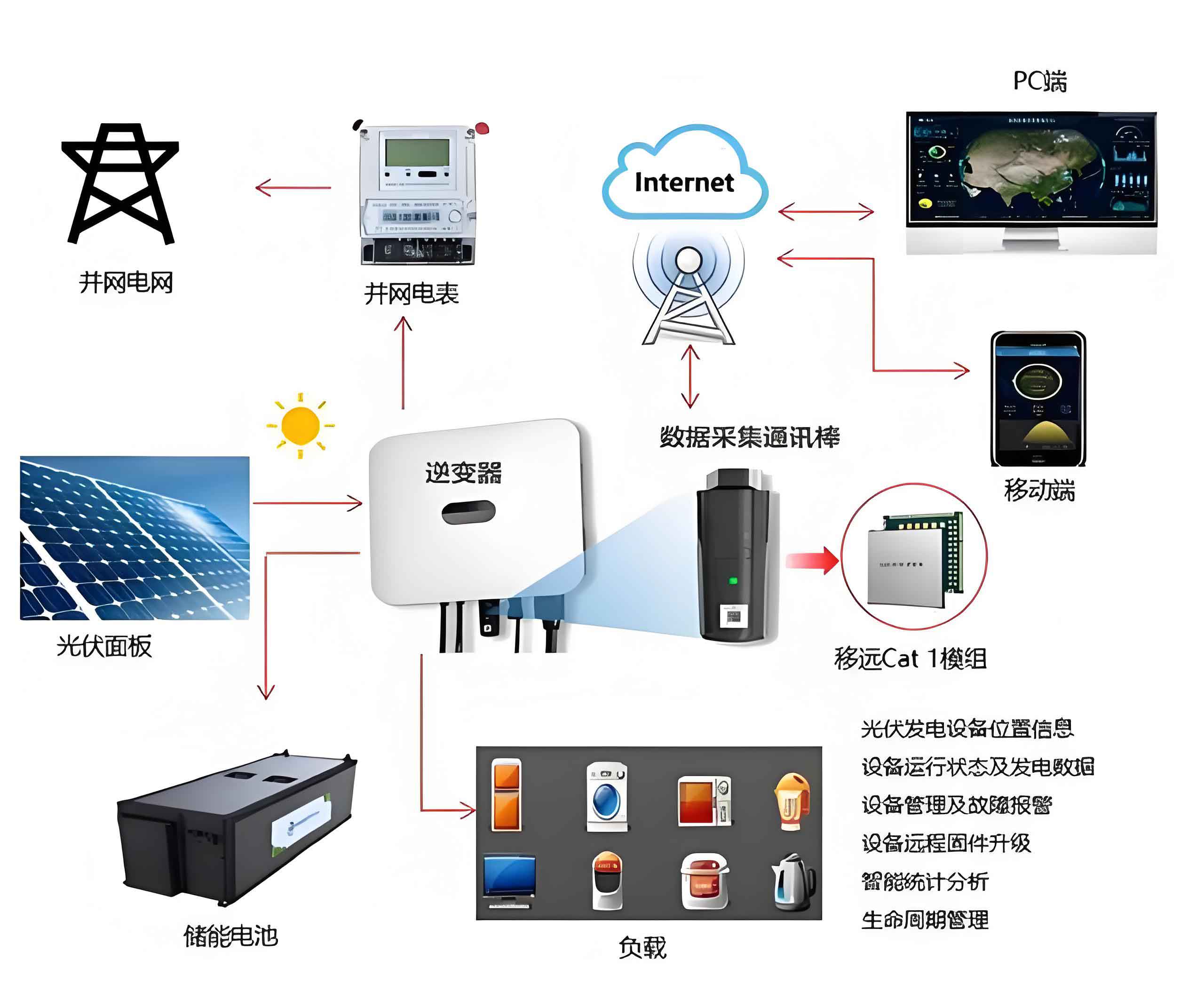
To validate the theoretical model and investigate practical performance, an experimental solar system was constructed. The core test setup consisted of two parallel arrays: the surface water-cooled PV system and a reference fixed-tilt PV (FTPV) system. Both arrays comprised seven polycrystalline silicon PV modules of identical make, model, and orientation (22° tilt).
The cooling infrastructure for the experimental solar system included a centrifugal pump, a water storage tank, a network of pipelines, and specifically selected spray nozzles. To ensure a uniform and stable water film across the 1.3 m² module surface, four full-cone spray nozzles were installed above each module. The total flow rate for the entire array was controlled and measured using an in-line flow meter. A collecting gutter at the base of the array channeled the runoff back to the storage tank, creating a closed-loop system. Precise calibration of each nozzle was performed prior to testing to guarantee even water distribution across all modules.
Results and Analysis: Performance of the Cooled Solar System
Optimization of Cooling Water Flow Rate
The cooling effect is intrinsically linked to the water flow rate. An optimal flow must be identified: too low, and the film is non-uniform, leading to inadequate cooling; too high, and the increased film thickness reduces optical transmittance, diminishing the irradiance reaching the cells. Experiments were conducted at flow rates of 0.7, 0.9, 1.1, 1.5, and 1.8 m³/h under similar irradiance conditions. The average backsheet temperature and conversion efficiency for both the cooled and reference systems were compared.
| Flow Rate (m³/h) | Avg. Back Temp. – Cooled (°C) | Avg. Back Temp. – Reference (°C) | Avg. Efficiency – Cooled (%) | Avg. Efficiency – Reference (%) | Efficiency Gain (%) |
|---|---|---|---|---|---|
| 0.7 | 38.2 | 48.3 | 14.7 | 13.5 | 1.2 |
| 0.9 | 36.5 | 48.1 | 15.1 | 13.8 | 1.3 |
| 1.1 | 36.8 | 48.0 | 14.9 | 14.0 | 0.9 |
| 1.5 | 37.1 | 48.4 | 14.6 | 14.1 | 0.5 |
| 1.8 | 37.4 | 48.7 | 14.3 | 14.0 | 0.3 |
The data clearly indicates that a flow rate of 0.9 m³/h yielded the highest average conversion efficiency and the most significant gain over the reference solar system. At this rate, visual inspection confirmed a continuous, uniform water film with an estimated thickness of approximately 1 mm, optimally balancing cooling performance with minimal light attenuation. This result underscores that the efficiency of a water-cooled solar system is not solely a function of temperature but is also influenced by the optical properties of the cooling film.
Influence of Cooling Water Temperature
The temperature of the cooling water itself is another critical parameter. Tests were performed on days with comparable irradiance but with the reservoir water maintained at average temperatures of 22°C and 27°C, using the optimal 0.9 m³/h flow rate.
| Parameter | Reservoir at 22°C | Reservoir at 27°C |
|---|---|---|
| Avg. Module Temp. Reduction (°C) | 11.8 | 9.5 |
| Avg. Electrical Efficiency (%) | 15.4 | 14.8 |
| Peak Efficiency Gain over Reference (%) | 1.5 | 1.1 |
The cooler water (22°C) provided a greater temperature differential, leading to more effective heat extraction, a lower average operating temperature, and consequently, a higher electrical conversion efficiency. This highlights the benefit of integrating a heat rejection mechanism for the cooling loop in a large-scale solar system to maintain a low coolant temperature, especially in high-insolation regions.
All-Day Operational Characteristics
A full-day experiment was conducted to observe the dynamic behavior of the solar system. The cooling system was activated mid-morning. Prior to activation, the temperatures of the cooled and reference modules tracked closely. Upon initiating water flow, the front surface temperature of the cooled module dropped rapidly by nearly 18°C within 15 minutes, demonstrating an immediate and powerful cooling effect. Throughout the day, the backsheet temperature of the cooled module remained significantly more stable and lower than that of the reference module. The backsheet temperature proved to be a more reliable indicator of the cell’s operational state than the front surface temperature, which was highly sensitive to the fluctuating coolant and irradiance levels. This stability is a key advantage for the power output consistency of the solar system.
Model Validation and Comparative Analysis
The theoretical model’s predictions were compared against measured data. The differential equation for module temperature was solved numerically using environmental and operational inputs (irradiance, ambient temperature, water temperature, flow rate).
Temperature Validation: The predicted backsheet temperature profile followed the trend of the measured data closely throughout the day. The model captured the cooling effect’s magnitude and the general response to changing irradiance. Some minor discrepancies were observed during rapid transients, attributable to model simplifications such as assuming a uniform temperature across the module layers and a perfectly uniform water film.
Efficiency Validation: The theoretical electrical efficiency, calculated from the predicted temperature using the temperature-dependent model, showed a similar trend to the measured efficiency but with a consistent offset. The average theoretical efficiency was approximately 15.8%, while the measured average was 18.4%. This divergence confirms the earlier assertion that efficiency is influenced by factors beyond just cell temperature in this configuration. The primary additional factor is the optical loss due to the water film’s reflectance and absorption, which reduces the effective irradiance (\(I_s\)) reaching the cells—an effect not fully decoupled in the simple fill-factor model used. A more complete model for a water-cooled solar system would require explicitly modeling the spectrally-dependent transmission of the water film.
Conclusion
This investigation comprehensively demonstrates the potential of surface water cooling as an effective method to enhance the performance of a photovoltaic solar system. The key findings are summarized as follows:
- Optimal Cooling Exists: An optimal cooling water flow rate was identified (0.9 m³/h for this specific setup), which maximizes the net efficiency gain by balancing thermal performance against optical losses from the water film.
- Coolant Temperature Matters: Lower coolant temperatures provide a greater cooling potential, leading to higher cell efficiencies. This points to the importance of thermal management of the cooling loop itself in a practical implementation.
- Backsheet Temperature is a Robust Metric: The backsheet temperature serves as a reliable and stable indicator of the PV module’s operating condition, more so than the highly variable front-surface temperature.
- Theoretical Model is Fundamentally Sound: The developed heat transfer model accurately predicts the thermal behavior and trends in electrical output, validating the underlying physics. The discrepancy in absolute efficiency values highlights the need to incorporate water film optical properties for precise electrical yield prediction in such a solar system.
- Dual Benefit: Beyond the demonstrated efficiency increase of 1.3+ percentage points, the system offers the ancillary benefit of automated surface cleaning, which mitigates soiling losses—a significant factor for solar system performance in many environments.
In conclusion, integrating a surface water cooling mechanism presents a viable approach to increase the energy yield and operational stability of photovoltaic installations. Future work should focus on optimizing the system economics, minimizing water consumption through advanced filtration and treatment, and developing integrated models that couple the optical, thermal, and electrical behaviors for perfect design and simulation of high-performance water-cooled solar systems.