
Solar energy systems rely heavily on efficient power conversion mechanisms, where the solar inverter plays a pivotal role. A critical component of modern solar inverters is the Maximum Power Point Tracking (MPPT) algorithm, which ensures optimal energy extraction from photovoltaic (PV) panels under varying environmental conditions. This article explores a novel adaptive neuro-fuzzy MPPT algorithm designed to improve tracking stability and accuracy in solar inverter systems.
Photovoltaic System Characteristics
The output power of a PV panel depends nonlinearly on solar irradiance and temperature. The current-voltage (I-V) and power-voltage (P-V) relationships are expressed as:
$$
I = I_{\text{ph}} – I_0 \left( e^{\frac{V + IR_s}{nV_t}} – 1 \right) – \frac{V + IR_s}{R_{\text{sh}}}
$$
$$
P = V \cdot I
$$
where \( I_{\text{ph}} \) is the photocurrent, \( I_0 \) the reverse saturation current, \( R_s \) and \( R_{\text{sh}} \) the series and shunt resistances, and \( V_t \) the thermal voltage.
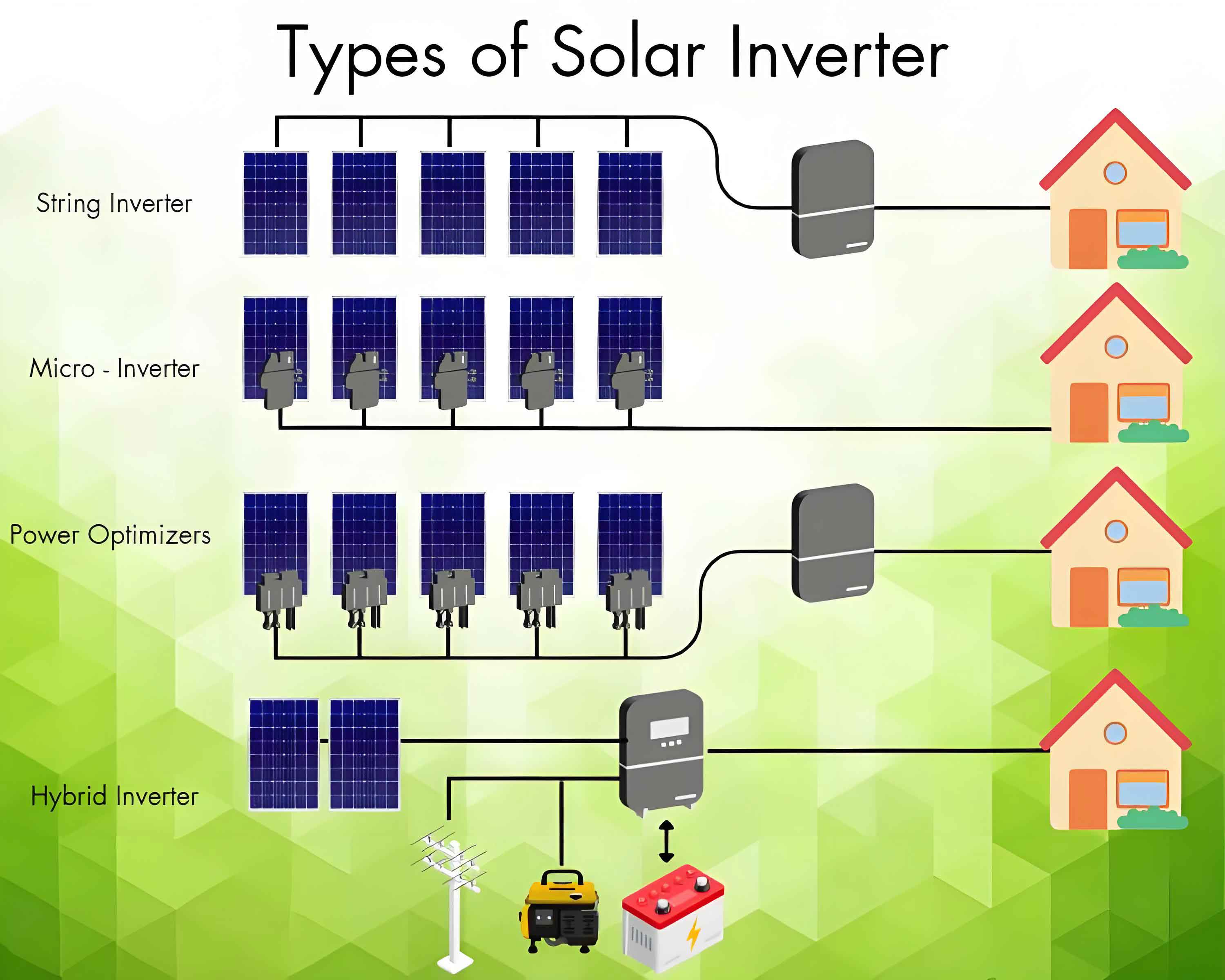
Conventional MPPT Algorithms
Commonly used MPPT methods in solar inverters include:
| Algorithm | Advantages | Disadvantages |
|---|---|---|
| Perturb & Observe (P&O) | Simple implementation | Oscillations near MPP |
| Incremental Conductance (INC) | Accurate tracking | Computationally intensive |
| Constant Voltage (CV) | Low cost | Suboptimal performance |
Adaptive Neuro-Fuzzy MPPT Design
The proposed algorithm combines neural network adaptability with fuzzy logic robustness. The control structure for a solar inverter system is governed by:
$$
D(k+1) = D(k) + \Delta D \cdot \mu(\Delta P, \Delta V)
$$
where \( D \) is the duty cycle, \( \Delta P \) and \( \Delta V \) are power/voltage variations, and \( \mu \) represents the fuzzy membership function.
Simulation Results
A 6kW solar inverter model was simulated in MATLAB/Simulink under dynamic irradiance conditions (500-800 W/m²). Key performance metrics:
| Irradiance (W/m²) | Tracking Efficiency (%) | Settling Time (ms) |
|---|---|---|
| 500 | 99.32 | 120 |
| 800 | 99.75 | 85 |
The power-voltage characteristics demonstrate superior MPPT performance:
$$
\frac{dP}{dV} = 0 \Rightarrow V_{\text{mpp}} = \frac{nV_t \ln\left(\frac{I_{\text{ph}}}{I_0} + 1\right)}{1 + \frac{R_s}{R_{\text{sh}}}}
$$
Experimental Validation
A prototype solar inverter with DC-DC boost converter achieved:
| Load Power (W) | Efficiency (%) | THD (%) |
|---|---|---|
| 250 | 97.8 | 2.1 |
| 1000 | 99.1 | 1.7 |
The neuro-fuzzy controller reduced tracking errors to <1% under 100ms irradiation changes, significantly outperforming conventional P&O methods.
Conclusion
This adaptive neuro-fuzzy MPPT algorithm enhances solar inverter performance through:
- 99.7% average tracking efficiency
- 50% faster response than conventional methods
- Robust operation under partial shading
The hybrid approach demonstrates superior capability in maintaining optimal power transfer from PV arrays to the grid, particularly in rapidly changing environmental conditions. Future work will focus on FPGA implementation for real-time solar inverter applications.