
In the pursuit of addressing global energy challenges, perovskite solar cells have emerged as a leading photovoltaic technology due to their high power conversion efficiency and low-cost fabrication. Over the past decade, we have witnessed remarkable progress in perovskite solar cell development, with efficiencies soaring to over 26%, highlighting their potential for commercialization. However, the intrinsic instability of perovskite materials, primarily caused by defect states and environmental sensitivity, remains a significant barrier. These defects not only promote non-radiative recombination but also accelerate degradation under operational conditions, limiting the long-term stability of perovskite solar cells. To overcome these issues, we explored the use of functionalized small molecules in anti-solvent engineering as a strategic approach to enhance both efficiency and stability. In this study, we focus on 5′-iodo-3′-octyl-[2,2′-bithiophene]-5-carbaldehyde (IN1712), a molecule designed to passivate defects and improve the crystallinity of perovskite films. Through comprehensive characterization and device testing, we demonstrate that IN1712 effectively reduces defect density, suppresses non-radiative recombination, and enhances humidity resistance, leading to superior performance in perovskite solar cells. This work provides a foundational framework for advancing perovskite solar cell technology through molecular-level interventions.
The optimization of perovskite solar cells hinges on understanding and controlling the crystallization process and interface properties. We employed a one-step spin-coating method with anti-solvent engineering to incorporate IN1712 into the perovskite layer. The perovskite precursor solution was formulated using lead iodide, lead bromide, formamidinium iodide, formamidinium bromide, cesium iodide, methylammonium chloride, and methylammonium iodide in a mixed solvent of DMF and DMSO. The anti-solvent, chlorobenzene, was modified with IN1712 at varying concentrations (0, 1, 3, and 5 mmol/L) to identify the optimal condition for perovskite solar cell fabrication. Devices were structured as ITO/SnO2/perovskite/Spiro-OMeTAD/Au, and we conducted extensive measurements including J-V testing, X-ray diffraction (XRD), photoluminescence (PL), Fourier-transform infrared spectroscopy (FTIR), scanning electron microscopy (SEM), contact angle analysis, and Mott-Schottky measurements to evaluate the impact of IN1712. Our findings reveal that IN1712 interacts with uncoordinated Pb2+ ions via its carbonyl and thiophene groups, leading to effective passivation and improved charge transport in perovskite solar cells.
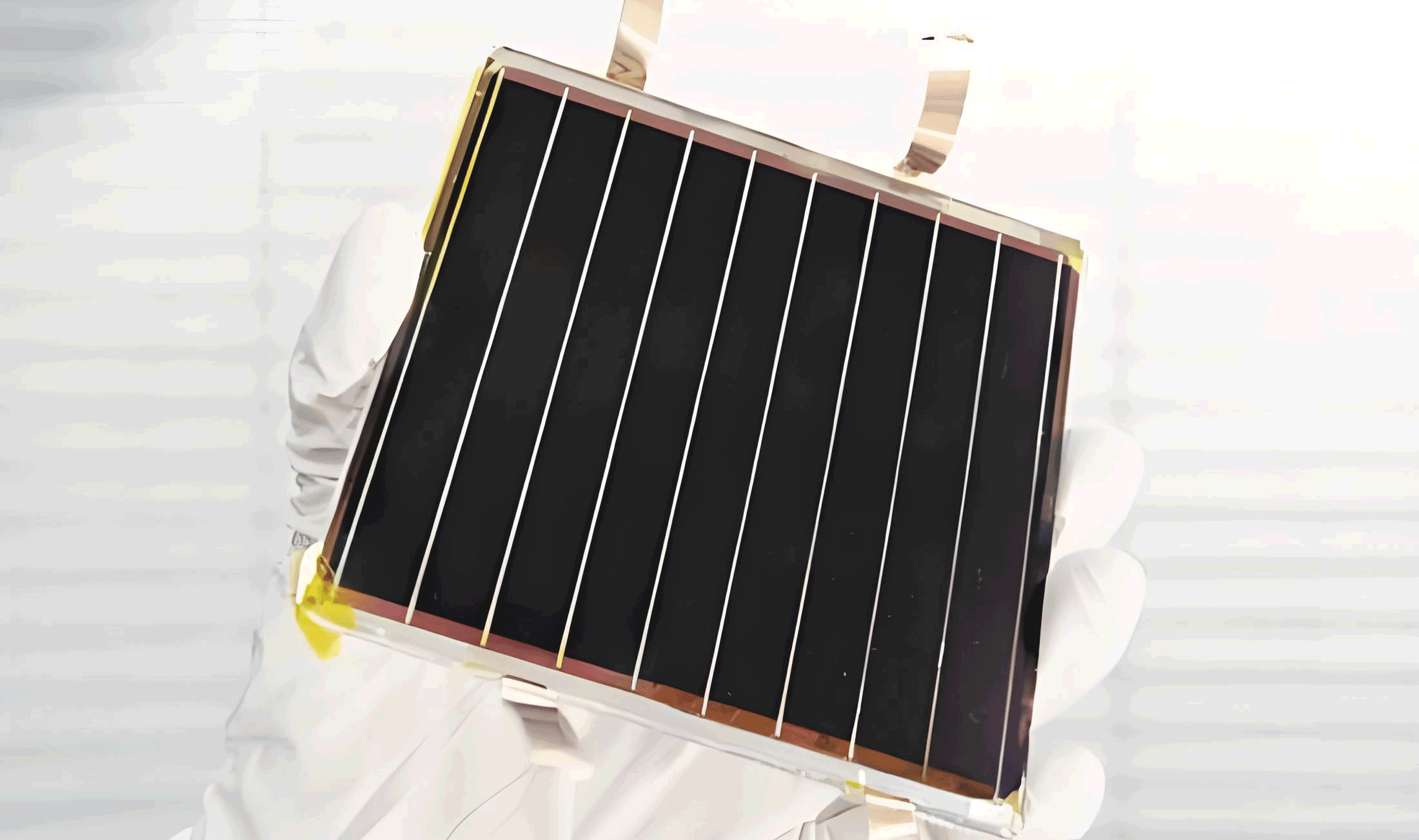
To determine the ideal concentration of IN1712 for enhancing perovskite solar cell performance, we fabricated devices with different IN1712 concentrations in the anti-solvent. The current density-voltage (J-V) characteristics were measured under standard illumination conditions, and the key photovoltaic parameters are summarized in Table 1. We observed that the device with 3 mmol/L IN1712 exhibited the highest power conversion efficiency (PCE) of 23.76%, accompanied by significant improvements in open-circuit voltage (VOC) and fill factor (FF) compared to the control device. This enhancement is attributed to the defect passivation and optimized crystallization induced by IN1712, which reduces non-radiative recombination in the perovskite solar cell. At higher concentrations, such as 5 mmol/L, the performance declined, likely due to excessive molecular aggregation that impedes charge transport. Thus, we selected 3 mmol/L as the optimal concentration for subsequent experiments, referring to the modified device as “Target” and the unmodified one as “Control” for clarity.
| IN1712 Concentration (mmol/L) | VOC (V) | JSC (mA/cm2) | FF (%) | PCE (%) |
|---|---|---|---|---|
| 0 | 1.10 | 24.74 | 79.28 | 21.57 |
| 1 | 1.11 | 24.83 | 80.43 | 22.16 |
| 3 | 1.15 | 24.88 | 83.07 | 23.76 |
| 5 | 1.12 | 24.79 | 81.55 | 22.64 |
The structural and optoelectronic properties of the perovskite films were critically analyzed to understand the role of IN1712 in defect passivation. XRD patterns revealed that the Target film showed a intensified peak at 14.1° corresponding to the (100) plane, indicating enhanced crystallinity. Additionally, the peak at 12.7° associated with PbI2 was significantly reduced in the Target film, suggesting that IN1712 suppresses the formation of secondary phases. This improvement aligns with the Lewis acid-base interaction between the carbonyl group of IN1712 and uncoordinated Pb2+ ions, which minimizes defect sites in the perovskite solar cell. The PL spectra further confirmed this, as the Target film exhibited a stronger PL intensity compared to the Control, implying a reduction in non-radiative recombination centers. The PL mapping images demonstrated a more uniform distribution of high-intensity regions in the Target film, underscoring the homogeneity achieved through IN1712 modification. We quantified the defect density using the relationship between PL intensity and non-radiative recombination rate, expressed as: $$I_{PL} \propto \frac{1}{1 + k_{nr} \tau}$$ where \(I_{PL}\) is the photoluminescence intensity, \(k_{nr}\) is the non-radiative recombination rate, and \(\tau\) is the carrier lifetime. The increase in \(I_{PL}\) for the Target film indicates a lower \(k_{nr}\), directly correlating with reduced defect states in the perovskite solar cell.
FTIR spectroscopy provided insights into the chemical interactions between IN1712 and the perovskite layer. The spectrum of IN1712 showed characteristic peaks at 668.13 cm−1 for C─S─C stretching vibrations and at 1658.87 cm−1 for C=O stretching. In the Target film, we observed a blue shift of the C=O peak to 1705.96 cm−1, confirming the coordination with Pb2+ ions. The C─S─C peak also exhibited a slight shift, suggesting a minor contribution from thiophene groups in passivation. However, the dominant mechanism involves the carbonyl group, which effectively passivates positive charge defects. To further elucidate the passivation efficiency, we modeled the defect passivation using the following formula: $$\Delta E = – \frac{\alpha \cdot \mu}{r^2}$$ where \(\Delta E\) is the energy change due to passivation, \(\alpha\) is the polarizability of the functional group, \(\mu\) is the dipole moment, and \(r\) is the distance between the molecule and the defect site. This model highlights how IN1712’s functional groups reduce the energy of defect states, thereby enhancing the stability of the perovskite solar cell.
Morphological analysis via SEM revealed that the Target film had larger and more uniformly arranged grains with fewer PbI2 particles compared to the Control film. This improved morphology facilitates better charge transport and reduces recombination at grain boundaries. The contact angle measurements showed an increase from 40.0° for the Control film to 62.6° for the Target film, indicating enhanced hydrophobicity due to the octyl chain and thiophene rings in IN1712. This property is crucial for boosting the humidity stability of perovskite solar cells. Mott-Schottky analysis demonstrated a higher built-in potential (Vbi) of 0.95 V for the Target device versus 0.89 V for the Control, which promotes efficient charge extraction and reduces carrier accumulation at interfaces. The capacitance-voltage relationship can be described by: $$\frac{1}{C^2} = \frac{2}{q \epsilon_r \epsilon_0 A^2 N_A} (V_{bi} – V)$$ where \(C\) is the capacitance, \(q\) is the electron charge, \(\epsilon_r\) is the relative permittivity, \(\epsilon_0\) is the vacuum permittivity, \(A\) is the area, \(N_A\) is the acceptor density, and \(V\) is the applied voltage. The increase in Vbi for the Target device underscores the reduced defect density and improved interface quality in the perovskite solar cell.
The photovoltaic performance of the champion devices was evaluated through J-V measurements, as summarized in Table 2. The Target device achieved a PCE of 24.09%, with a VOC of 1.16 V, JSC of 24.92 mA/cm2, and FF of 83.54%, representing significant improvements over the Control device (PCE of 21.86%). This enhancement is directly linked to the defect passivation and optimized film morphology enabled by IN1712. To assess stability, we subjected unencapsulated devices to aging at 60% ± 5% relative humidity and monitored their PCE over time. The Target device retained 80.1% of its initial efficiency after 800 hours, whereas the Control device degraded to 60.1% after only 400 hours. This demonstrates the profound impact of IN1712 on the long-term operational stability of perovskite solar cells. We attribute this to the combined effects of reduced defect density, suppressed non-radiative recombination, and enhanced hydrophobicity. The non-radiative recombination lifetime (\(\tau_{nr}\)) can be estimated using: $$\tau_{nr} = \frac{1}{k_{nr}} = \frac{I_{PL}}{I_0} \tau_0$$ where \(I_0\) and \(\tau_0\) are reference values. The increased \(\tau_{nr}\) in Target devices confirms the effectiveness of IN1712 in prolonging carrier lifetimes and improving durability in perovskite solar cells.
| Device Type | VOC (V) | JSC (mA/cm2) | FF (%) | PCE (%) | Stability (Hours to 80% Initial PCE) |
|---|---|---|---|---|---|
| Control | 1.10 | 24.74 | 80.39 | 21.86 | ~400 |
| Target | 1.16 | 24.92 | 83.54 | 24.09 | 800 |
In conclusion, our investigation demonstrates that the incorporation of IN1712 via anti-solvent engineering markedly enhances the efficiency and stability of perovskite solar cells. The functional groups in IN1712, particularly the carbonyl moiety, facilitate effective defect passivation by coordinating with uncoordinated Pb2+ ions, thereby reducing non-radiative recombination and improving charge transport. The optimization of film crystallization and hydrophobicity further contributes to the superior performance, with champion devices achieving a PCE of 24.09% and maintaining over 80% of their initial efficiency after 800 hours under humid conditions. These findings underscore the potential of molecular design in anti-solvent strategies to address the key challenges in perovskite solar cell technology. Future work will focus on exploring other functionalized molecules and scaling up the fabrication process for commercial applications. Overall, this study provides a robust pathway for developing high-performance and durable perovskite solar cells, paving the way for their integration into sustainable energy systems.
The advancements in perovskite solar cell research highlighted here emphasize the importance of interfacial engineering in overcoming material limitations. By leveraging small molecules like IN1712, we can achieve precise control over defect states and environmental stability, which are critical for the commercialization of perovskite solar cells. The formulas and tables presented offer a quantitative framework for evaluating similar interventions, and we encourage the community to build upon these insights. As we continue to refine these approaches, the goal of achieving efficient, stable, and cost-effective perovskite solar cells becomes increasingly attainable, contributing to a greener energy future.