
In my extensive research into advanced power sources for demanding applications, the challenge of reliable engine starting in extremely cold environments remains a critical engineering frontier. Traditional lead-acid batteries, the longstanding standard for starter batteries, suffer from a well-documented and severe performance degradation at low temperatures. The capacity of a lead-acid battery typically decreases by 1-2% for every 1°C drop in temperature. This is primarily due to the increased viscosity of the sulfuric acid electrolyte, which impedes its diffusion into the plate pores, drastically increasing internal resistance and reducing the available power precisely when it is needed most. Concurrently, at low temperatures, engine oil viscosity increases significantly, leading to a higher cranking torque requirement. This combination—reduced battery power and increased load demand—often results in failed start attempts, reduced engine reliability, and increased component wear. The quest for a starter solution with higher specific energy, superior specific power, and excellent low-temperature discharge performance is therefore of paramount practical importance. My work focuses on addressing this gap through the intelligent hybridization of li ion battery technology with supercapacitors.
The core of the challenge lies in the fundamental electrochemistry of power sources. A li ion battery stores energy through Faradaic reactions, where lithium ions intercalate into and de-intercalate from the crystal structures of the anode and cathode materials. This process, while energy-dense, is kinetically limited. At low temperatures, several detrimental effects converge:
1. The ionic conductivity of the electrolyte decreases exponentially.
2. The solid-state diffusion coefficient of Li⁺ within the active materials drops sharply.
3. The charge transfer kinetics at the electrode/electrolyte interface slow down dramatically.
These factors collectively lead to a substantial increase in the cell’s internal impedance, particularly the charge transfer resistance (Rct). During a high-current pulse, such as engine cranking, this elevated resistance causes a significant ohmic voltage drop (ΔV = I * Rinternal), which can pull the terminal voltage below the minimum required by the starter motor, causing a failure. While low-temperature li ion battery chemistries (e.g., using specialized electrolytes and electrode materials) have been developed, their instantaneous high-power discharge capability at temperatures like -40°C often remains insufficient for the peak demands of cranking a cold engine.
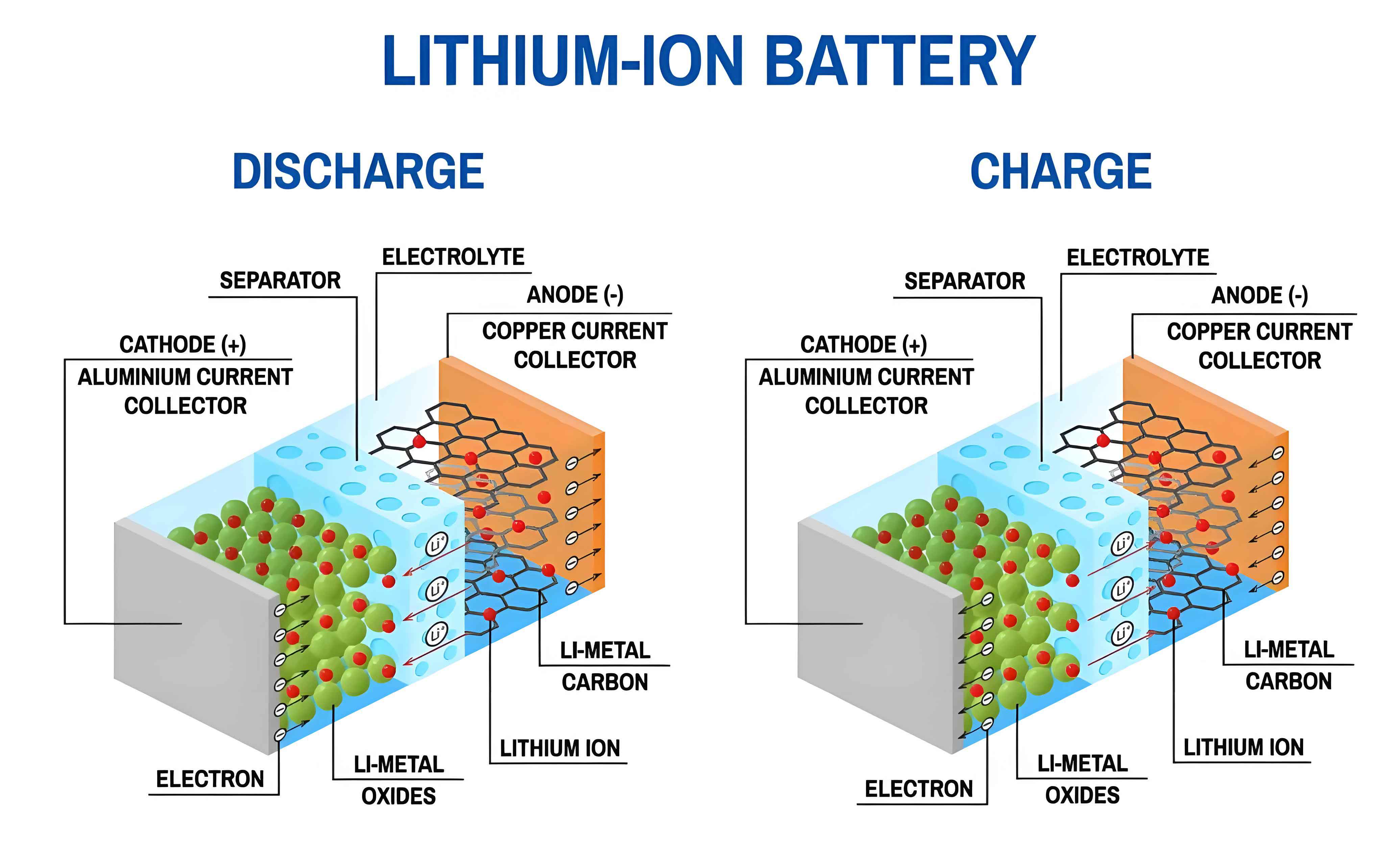
Supercapacitors, or electrochemical capacitors, offer a fundamentally different energy storage mechanism. They store charge electrostatically via ion adsorption at the interface between a high-surface-area electrode (typically activated carbon) and an electrolyte (the electrical double-layer mechanism), and sometimes through fast surface redox reactions (pseudocapacitance). This non-Faradaic or surface-Faradaic process is extremely rapid and exhibits much lower temperature dependence compared to bulk intercalation reactions. Consequently, supercapacitors maintain a high power density and low effective series resistance (ESR) even at very low temperatures. However, their Achilles’ heel is low energy density. The hybrid approach I propose ingeniously marries the high energy density of a li ion battery with the high power density and superior low-temperature performance of a supercapacitor. By connecting them in parallel, the supercapacitor acts as a high-power buffer. During a high-current pulse, it can supply a major portion of the instantaneous current, thereby “shielding” the li ion battery from the high discharge rate that causes its voltage to collapse. This synergistic relationship is the cornerstone of my investigation.
Theoretical Framework and System Modeling
To quantitatively understand the benefits of hybridization, we can model the system using equivalent circuits. A simplified model for a li ion battery includes an open-circuit voltage (OCV) source, an ohmic resistance (RΩ), and a parallel RC network representing polarization effects (charge transfer and diffusion). At low temperatures, the values of these resistive elements, especially the polarization resistance, increase significantly.
The terminal voltage of the li ion battery during discharge can be expressed as:
$$V_{bat}(t) = OCV(SOC) – I_{bat}(t) \cdot R_{\Omega, bat} – \eta_{polarization}(t, T, I_{bat})$$
Where $\eta_{polarization}$ is the overpotential, a strong function of temperature (T) and current ($I_{bat}$).
A supercapacitor can be simply modeled as a large capacitance (C) in series with a small equivalent series resistance (ESR). Its terminal voltage during discharge is:
$$V_{sc}(t) = V_{sc,0} – \frac{1}{C} \int_0^t I_{sc}(\tau) d\tau – I_{sc}(t) \cdot ESR_{sc}$$
Crucially, $ESR_{sc}$ is relatively insensitive to temperature compared to $R_{\Omega, bat} + R_{polarization}$ of the li ion battery.
When connected in parallel, the bus voltage is common, and the load current is shared:
$$V_{bus} = V_{bat} = V_{sc}$$
$$I_{load} = I_{bat} + I_{sc}$$
The current split is dynamically determined by the instantaneous impedance of each component. At the onset of a high-power pulse, the supercapacitor, with its lower impedance, delivers a larger portion of the current. This reduces $I_{bat}$, which in turn reduces the $\eta_{polarization}$ term in the li ion battery voltage equation, leading to a higher and more stable $V_{bus}$. This fundamental principle underpins the experimental methodology.
Experimental Methodology for Low-Temperature Performance Evaluation
My experimental design was formulated to simulate the harsh, real-world conditions of cold engine starting. The target specification was derived from military and heavy-duty vehicle requirements: the power source must, after being conditioned at -40°C for 24 hours, be capable of delivering a series of high-current pulses at room ambient temperature within one minute of removal from the cold chamber. The specific duty cycle was set to a 180A discharge for 2 seconds, followed by a 13-second rest, repeated for 10 cycles. The critical performance criterion was that the system voltage must not fall below 13V at any point during this sequence. Two distinct configurations were tested for comparison.
Configuration ①: Lithium Iron Phosphate (LFP) Li-Ion Battery Pack Alone.
I constructed a battery pack by connecting eight 20Ah cylindrical LFP li ion battery cells in series, resulting in a nominal voltage of 29.2V. This chemistry was chosen for its intrinsic safety and long cycle life. The pack was charged to its full capacity, then placed in an environmental chamber at -40°C for a 24-hour soak to ensure thermal equilibrium. It was then removed, briefly insulated with wool felt to minimize thermal shock from ambient air during connection, and connected to an electronic load programmed with the specified pulse profile. Voltage and temperature were monitored in real-time.
Configuration ②: Hybrid Power System (LFP Battery Pack + Supercapacitor Module).
A supercapacitor module was assembled by connecting twelve 350F, 2.7V cylindrical cells in series, yielding a module voltage of 29.7V. This module was pre-charged to 29.7V. The hybrid system was formed by connecting this supercapacitor module in parallel with the fully charged LFP li ion battery pack. The entire assembly underwent the same -40°C, 24-hour conditioning and subsequent testing procedure. In this test, I employed a clamp meter to directly measure the current flowing from the supercapacitor branch, allowing for a clear analysis of the current-sharing dynamics. The key parameters of both systems are summarized below.
| Component | Configuration Details | Nominal Voltage | Key Metric |
|---|---|---|---|
| LFP Battery Pack | 8S1P (20Ah cells) | 29.2 V | Energy: ~580 Wh |
| Supercapacitor Module | 12S1P (350F cells) | 29.7 V | Stored Energy: ~43 Wh @ 29.7V |
| Hybrid System | Parallel combination | ~29.4 V (initial) | Peak Power Capability |
Analysis of Experimental Results and Technical Discussion
The results from the two configurations were starkly different, powerfully illustrating the efficacy of the hybrid approach.
Performance of the Standalone LFP Li-Ion Battery Pack.
The voltage response of the standalone li ion battery pack under the 180A pulse load at low temperature was severely compromised. On the first pulse, the terminal voltage plummeted from an initial 29.20V down to 12.89V, far below the 13V cutoff threshold. This immediate failure can be attributed directly to the mechanisms described earlier. The low temperature caused a massive increase in the cell’s internal impedance, particularly the charge transfer resistance ($R_{ct}$). The voltage drop can be decomposed as:
$$ΔV_{drop} = I \cdot (R_Ω + R_{SEI} + R_{ct}) + η_{diffusion}$$
At -40°C, $R_{ct}$ dominates this sum. The 9C discharge rate (180A / 20Ah) imposed on the li ion battery created an unsustainable polarization overpotential.
| Pulse Cycle # | Starting Voltage (V) | Minimum Voltage (V) | Voltage Sag (V) |
|---|---|---|---|
| 1 | 29.20 | 12.89 | 16.31 |
| 2 | ~23.50* | >13.00 | ~10.50 |
| 10 | ~20.50* | >13.00 | ~7.50 |
* Estimated from recovery profile.
The temperature data provided further insight. The pack temperature rose sharply from -38.3°C to -12.1°C during the first pulse due to significant irreversible Joule heating ($P_{heat} = I^2R$). This self-heating improved the kinetics for subsequent pulses, reducing $R_{ct}$ and leading to smaller voltage sags, as seen in the table. However, this inherent self-heating was too slow and too late to prevent the initial start failure—the critical flaw of relying solely on a low-temperature li ion battery.
Superior Performance of the Hybrid Power System.
The behavior of the hybrid system was transformative. During the first 180A pulse, the bus voltage only dropped to 17.39V from an initial 28.34V, comfortably above the 13V limit and demonstrating successful start capability. The key to this performance was the dynamic current sharing revealed by the clamp meter measurement. The supercapacitor delivered a peak current of 127A, meaning the li ion battery only had to supply 53A. This lowered the discharge rate on the li ion battery from a crippling 9C to a manageable 2.65C.
We can quantify the benefit. The current share is inversely proportional to the branch impedance at the pulse frequency. The supercapacitor’s lower AC impedance allows it to shoulder most of the initial burden. The reduced current on the li ion battery dramatically lessens its polarization overpotential:
$$η_{polarization, hybrid} ∝ I_{bat} ≈ 53A$$
$$η_{polarization, solo} ∝ I_{bat} = 180A$$
The approximate 34.9% higher minimum voltage (17.39V vs. 12.89V) is a direct consequence of this reduced overpotential on the li ion battery branch.
| System | Peak Load Current | Battery Current (I_bat) | Battery C-rate | Supercapacitor Current (I_sc) | Min. Voltage (1st Pulse) |
|---|---|---|---|---|---|
| Solo Battery | 180 A | 180 A | 9.00 C | 0 A | 12.89 V |
| Hybrid System | 180 A | ~53 A | 2.65 C | ~127 A | 17.39 V |
The temperature profile of the hybrid system was remarkably flat, rising only about 4°C during the first pulse, compared to over 26°C for the solo pack. This confirms that the li ion battery experienced far less stressful operation, with minimal irreversible heating, because the supercapacitor handled the high-power transients efficiently. As the test progressed through 10 cycles, the voltages of the two systems gradually converged. This is because the self-heating of the solo battery pack eventually reduced its impedance, while in the hybrid system, the li ion battery, operating at a lower rate, warmed more slowly. The supercapacitor’s role was most crucial in overcoming the initial, highest chemical activation barrier at the coldest temperature.
Conclusion and Future Perspectives
My investigation conclusively demonstrates that a parallel hybrid configuration combining a lithium iron phosphate li ion battery pack with a supercapacitor module offers a robust and highly effective solution for low-temperature engine starting. The supercapacitor acts as a power-assist device, providing the instantaneous high current that the kinetically limited li ion battery cannot supply at extreme cold, thereby preventing the deep voltage sag that causes start failure. By reducing the effective discharge rate on the li ion battery from 9C to approximately 2.65C, the hybrid system increased the first-pulse discharge voltage by 34.9% at -40°C, meeting the stringent performance requirement where the solo li ion battery failed.
The implications of this work extend beyond the specific test parameters. The hybrid power system concept decouples the energy and power requirements of the application. The li ion battery provides the base energy storage for long-term vehicle electrical loads and can be optimized for energy density and cycle life, while the supercapacitor is optimized for power density and low-temperature performance. This is a more efficient and reliable architecture than trying to force a single device, like a low-temperature li ion battery, to excel at both roles.
Future work should focus on the system-level integration and management of this hybrid solution. Key research avenues include:
1. Developing an intelligent Battery Management System (BMS) that actively controls the power flow between the li ion battery, supercapacitor, and load, potentially incorporating algorithms for state-of-health monitoring and optimal pre-heating strategies.
2. Exploring circuit topologies beyond simple passive parallel connection, such as active or semi-active architectures using DC-DC converters, to allow for greater flexibility in voltage matching and energy utilization.
3. Investigating the long-term cycle life and reliability of the hybrid system under combined thermal and electrical stress profiles.
4. System-level optimization to reduce the size, weight, and cost of the supercapacitor module while still meeting the peak power requirements.
In conclusion, the hybridization of li ion battery technology with supercapacitors presents a technically sound and promising path toward achieving fast, reliable, and durable engine starting in the most challenging cold-climate conditions. It effectively leverages the complementary strengths of two distinct electrochemical energy storage technologies to create a system whose performance is greater than the sum of its parts.