
In recent years, the development of perovskite solar cells has garnered significant attention due to their potential for high efficiency and low-cost fabrication. Among these, inorganic perovskite solar cells (IPSCs) stand out because of their superior thermal and light stability compared to their organic-inorganic hybrid counterparts. However, a major challenge hindering the widespread adoption of inorganic perovskite solar cells is the significant open-circuit voltage (VOC) loss caused by severe non-radiative recombination at the interfaces. This issue becomes particularly critical when aiming for applications in tandem solar cells, where the performance of inorganic perovskite solar cells must match or exceed that of other technologies. In this study, we address this problem by employing an inorganic material, cobalt iodide (CoI2), to suppress interfacial non-radiative recombination. Our approach focuses on managing interface defects without introducing organic components, thereby enhancing both the efficiency and stability of inorganic perovskite solar cells. Through detailed experimental analysis, we demonstrate that CoI2 treatment leads to a remarkable improvement in photovoltaic parameters, achieving a champion efficiency of 19.50% with a VOC loss of only 447 mV. This work provides a novel strategy for optimizing inorganic perovskite solar cells, paving the way for their integration into next-generation photovoltaic systems.
The fundamental operation of perovskite solar cells relies on the efficient generation and collection of charge carriers upon light absorption. In inorganic perovskite solar cells, the active layer typically consists of materials like CsPbI3 or its derivatives, which exhibit suitable bandgaps for harvesting solar energy. However, the interfaces between the perovskite layer and charge transport layers often host numerous defects that act as recombination centers. These defects, such as iodine vacancies (VI), have low formation energies and dominate the non-radiative recombination processes. The resulting VOC deficit limits the overall performance of inorganic perovskite solar cells. To quantify this, the theoretical VOC can be expressed as:
$$V_{OC} = \frac{kT}{q} \ln\left(\frac{J_{SC}}{J_0} + 1\right)$$
where \( k \) is Boltzmann’s constant, \( T \) is temperature, \( q \) is the elementary charge, \( J_{SC} \) is the short-circuit current density, and \( J_0 \) is the reverse saturation current density. Non-radiative recombination increases \( J_0 \), thereby reducing \( VOC \). In our study, we aim to minimize this effect by passivating interface defects with CoI2, which fills iodine vacancies and reduces trap states.
Our experimental methodology involved fabricating n-i-p structured inorganic perovskite solar cells in an air environment, with careful control of humidity below 20%. The device structure comprised FTO/SnO2/CsPbI2.85Br0.15/Spiro-OMeTAD/Au, where the inorganic perovskite layer was deposited via spin-coating and annealed at 180°C. For the CoI2-treated samples, a solution of 0.5 mg/mL CoI2 in isopropanol was spin-coated onto the perovskite surface without additional annealing. This simple post-treatment process is crucial for enhancing the properties of inorganic perovskite solar cells. We characterized the films and devices using various techniques, including scanning electron microscopy (SEM), time-resolved photoluminescence (TRPL), current density-voltage (J-V) measurements, external quantum efficiency (EQE), electrochemical impedance spectroscopy (EIS), and stability tests. The results consistently showed that CoI2 treatment improves the morphological and electronic properties of the perovskite layer, leading to superior performance in inorganic perovskite solar cells.
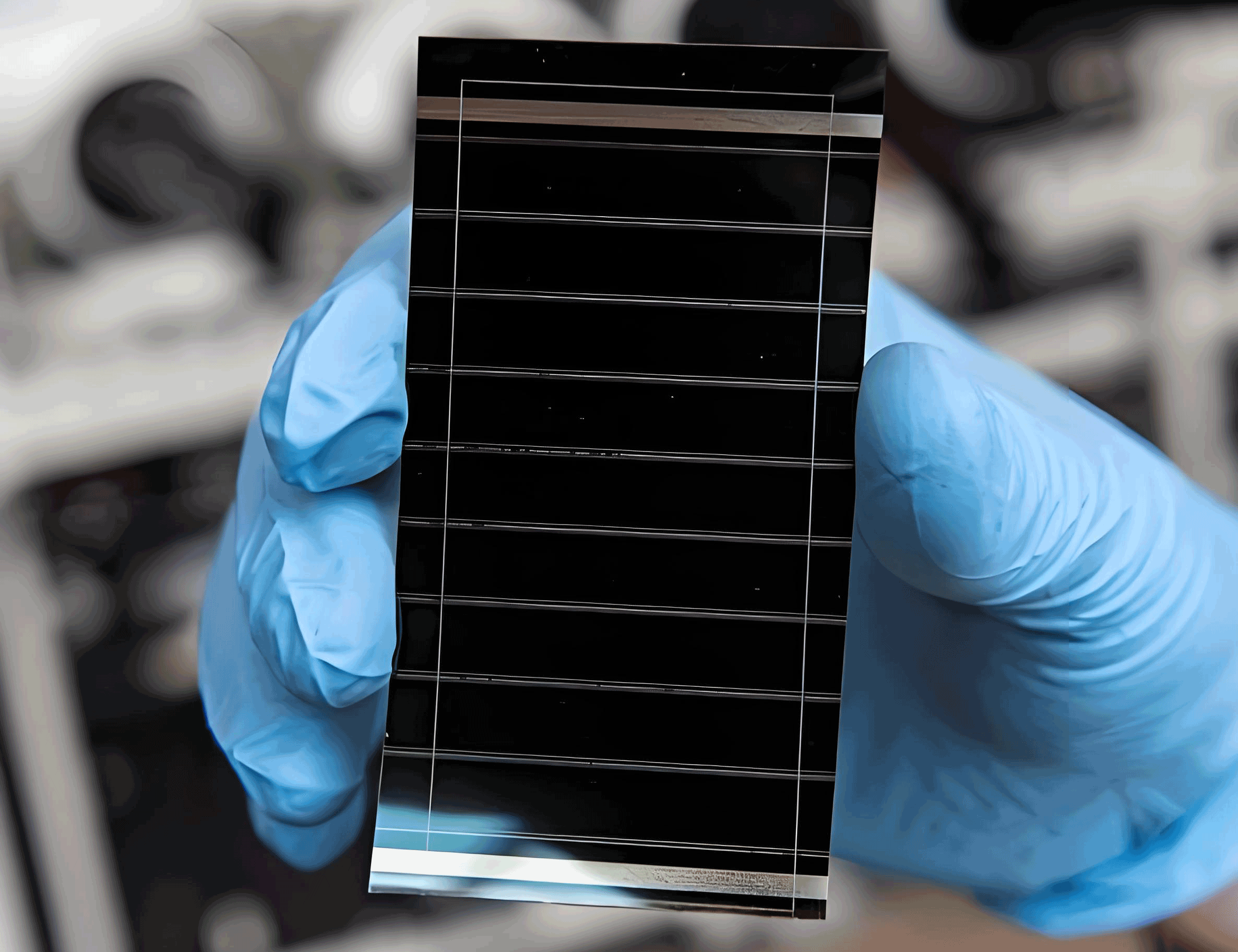
The morphological analysis revealed significant differences between control and CoI2-treated films. The control samples exhibited numerous pinholes and irregularities, which are known to exacerbate non-radiative recombination in perovskite solar cells. In contrast, the CoI2-treated films showed a more uniform and compact surface with reduced pinhole density. Statistical analysis of grain sizes indicated an increase in average grain size from approximately 0.4 μm to 0.6 μm after CoI2 treatment, suggesting that CoI2 promotes grain growth and reduces grain boundaries. This is beneficial for inorganic perovskite solar cells as larger grains minimize the number of recombination sites. The reduction in grain boundary area directly correlates with lower defect density, which is a key factor in enhancing the performance of perovskite solar cells. To further illustrate the impact of CoI2 on film quality, we performed water contact angle measurements. The control film had a contact angle of 55.5°, while the CoI2-treated film showed an increased angle of 60.72°, indicating improved hydrophobicity. This property is advantageous for the stability of perovskite solar cells, as it reduces moisture ingress and degradation.
The photovoltaic performance of the fabricated inorganic perovskite solar cells was evaluated under AM 1.5G illumination. The J-V curves for both control and CoI2-treated devices are summarized in Table 1, which highlights the key parameters. The control devices achieved a VOC of 1.213 V, JSC of 19.28 mA/cm², fill factor (FF) of 78.24%, and power conversion efficiency (PCE) of 18.30%. After CoI2 treatment, the VOC increased to 1.263 V, JSC to 19.40 mA/cm², FF to 79.56%, and PCE to 19.50%. This represents a significant reduction in VOC loss from about 530 mV to 447 mV, demonstrating the effectiveness of CoI2 in suppressing non-radiative recombination. The EQE spectra showed similar shapes for both devices, with integrated current densities matching the JSC values from J-V measurements, confirming the accuracy of our results. Additionally, steady-state power output (SPO) testing revealed that the CoI2-treated perovskite solar cells maintained an efficiency of 19.33% over 300 seconds, indicating excellent photostability. These findings underscore the potential of CoI2 interface engineering for achieving high-efficiency inorganic perovskite solar cells.
| Parameter | Control Device | CoI2-Treated Device |
|---|---|---|
| VOC (V) | 1.213 | 1.263 |
| JSC (mA/cm²) | 19.28 | 19.40 |
| FF (%) | 78.24 | 79.56 |
| PCE (%) | 18.30 | 19.50 |
| VOC Loss (mV) | ~530 | 447 |
To understand the mechanism behind the performance improvement, we conducted a series of electrochemical and optoelectronic characterizations. TRPL measurements were performed on glass/perovskite samples to assess carrier lifetime. The decay curves were fitted with a bi-exponential function, yielding two lifetime components: a fast component (τ1) related to trap-assisted recombination and a slow component (τ2) associated with radiative recombination. The average carrier lifetime (τavg) was calculated using the formula:
$$\tau_{avg} = \frac{A_1 \tau_1^2 + A_2 \tau_2^2}{A_1 \tau_1 + A_2 \tau_2}$$
where \( A_1 \) and \( A_2 \) are amplitudes. The control film had τavg of 85 ns, while the CoI2-treated film exhibited a prolonged τavg of 120 ns, indicating reduced non-radiative recombination. This is consistent with the enhanced VOC in CoI2-treated perovskite solar cells. Furthermore, we used the space-charge limited current (SCLC) method to estimate the trap density (Nt) in the films. The trap-filled limit voltage (VTFL) was derived from the J-V characteristics of electron-only devices with structure FTO/SnO2/perovskite/PCBM/Au. The trap density is given by:
$$N_t = \frac{2 \epsilon_0 \epsilon V_{TFL}}{q L^2}$$
where \( \epsilon_0 \) is vacuum permittivity, \( \epsilon \) is the relative permittivity (assumed as 32 for CsPbI2.85Br0.15), and \( L \) is the film thickness (~500 nm). The VTFL decreased from 1.26 V for control to 1.05 V for CoI2-treated devices, resulting in Nt values of 1.72 × 10¹⁶ cm⁻³ and 1.39 × 10¹⁶ cm⁻³, respectively. This reduction in trap density confirms that CoI2 effectively passivates defects in inorganic perovskite solar cells.
Dark J-V measurements provided additional insights into the recombination behavior. The CoI2-treated devices showed lower leakage currents at reverse biases, signifying suppressed shunt paths and reduced non-radiative recombination. This aligns with the higher FF and VOC observed in these perovskite solar cells. EIS analysis further supported these findings, with Nyquist plots revealing larger recombination resistance (Rrec) and smaller series resistance (Rs) for CoI2-treated devices. The equivalent circuit model consisted of Rs, Rrec, and a constant phase element (CPE). The extracted Rrec values were 15 kΩ for control and 20 kΩ for CoI2-treated perovskite solar cells, indicating better charge extraction and lower recombination. Moreover, Mott-Schottky analysis was used to determine the built-in potential (Vbi). The capacitance-voltage (C-V) curves were plotted as C⁻² vs. V, and Vbi was obtained from the x-intercept. The control devices had Vbi of 1.146 V, while CoI2-treated devices showed Vbi of 1.208 V. A higher Vbi implies a stronger internal electric field, which facilitates charge carrier separation and collection in perovskite solar cells, thereby improving VOC and FF.
The stability of perovskite solar cells is a critical factor for practical applications. We evaluated the environmental and thermal stability of both control and CoI2-treated inorganic perovskite solar cells. For humidity stability, devices were stored in air at ~25°C and 20-30% relative humidity for 500 hours. The normalized PCE retention was 72.75% for control and 84.78% for CoI2-treated devices. This enhanced stability can be attributed to the improved hydrophobicity and reduced defect density in CoI2-treated films. Thermal stability tests were conducted at 65°C in a nitrogen atmosphere for 1000 hours. The CoI2-treated perovskite solar cells retained 95.12% of their initial PCE, compared to 85.28% for control devices. This demonstrates that CoI2 treatment not only boosts efficiency but also enhances the long-term durability of inorganic perovskite solar cells. The use of an inorganic passivant like CoI2 avoids the volatility issues associated with organic materials, making it a robust strategy for stable perovskite solar cells.
In conclusion, our work demonstrates that cobalt iodide is an effective inorganic material for interface engineering in inorganic perovskite solar cells. By filling iodine vacancies and reducing trap states, CoI2 treatment suppresses non-radiative recombination, leading to a significant reduction in VOC loss and an increase in PCE. The champion device achieved an efficiency of 19.50% with a VOC loss of only 447 mV, which is among the highest reported for air-processed n-i-p structured inorganic perovskite solar cells. The improved morphological, electronic, and stability properties underscore the potential of this approach for advancing perovskite solar cell technology. Future work could explore the application of CoI2 in other perovskite compositions or device architectures to further enhance performance. Overall, this study provides a promising pathway for developing high-efficiency and stable inorganic perovskite solar cells, contributing to the broader goal of sustainable energy solutions.
To further elaborate on the significance of our findings, we can consider the general principles of defect passivation in perovskite solar cells. Defects in the perovskite lattice, such as vacancies and interstitials, create energy states within the bandgap that act as recombination centers. The defect density (Nt) influences the recombination rate (R) through the Shockley-Read-Hall model:
$$R = \frac{np – n_i^2}{\tau_p (n + n_t) + \tau_n (p + p_t)}$$
where \( n \) and \( p \) are electron and hole concentrations, \( n_i \) is the intrinsic carrier concentration, \( \tau_n \) and \( \tau_p \) are lifetimes, and \( n_t \) and \( p_t \) are parameters related to trap states. By reducing Nt, CoI2 treatment decreases R, leading to higher VOC and efficiency in perovskite solar cells. Additionally, the role of CoI2 in promoting grain growth can be understood in terms of surface energy reduction. During annealing, CoI2 molecules migrate to grain boundaries, lowering the energy barrier for grain coalescence. This results in larger grains and fewer boundaries, which are beneficial for charge transport in perovskite solar cells. The table below summarizes the key differences between control and CoI2-treated films based on various characterization techniques.
| Characterization Method | Control Film | CoI2-Treated Film |
|---|---|---|
| SEM Grain Size (μm) | 0.4 | 0.6 |
| Water Contact Angle (°) | 55.5 | 60.72 |
| TRPL Lifetime (ns) | 85 | 120 |
| Trap Density (cm⁻³) | 1.72 × 10¹⁶ | 1.39 × 10¹⁶ |
| Built-in Potential (V) | 1.146 | 1.208 |
| Recombination Resistance (kΩ) | 15 | 20 |
In terms of future perspectives, the integration of CoI2-treated inorganic perovskite solar cells into tandem configurations could yield even higher efficiencies. For instance, a tandem solar cell combining a wide-bandgap perovskite top cell with a silicon bottom cell has the potential to exceed the Shockley-Queisser limit. The efficiency of such a tandem device can be estimated using the formula:
$$\eta_{tandem} = \frac{J_{SC,top} V_{OC,top} FF_{top} + J_{SC,bottom} V_{OC,bottom} FF_{bottom}}{P_{in}}$$
where \( \eta_{tandem} \) is the tandem efficiency, and subscripts denote top and bottom cells. With the improved VOC and stability from CoI2 treatment, inorganic perovskite solar cells could serve as efficient top cells in tandem architectures. Moreover, the use of inorganic passivants aligns with the goal of developing all-inorganic perovskite solar cells for enhanced durability. In summary, our research highlights the importance of interface engineering in perovskite solar cells and provides a scalable method for achieving high-performance devices. The insights gained from this study could inspire further innovations in materials and processing techniques for perovskite solar cells, ultimately accelerating their commercialization.