
Perovskite solar cells have emerged as a promising photovoltaic technology due to their high power conversion efficiency, low-cost fabrication, and excellent optoelectronic properties. Among them, all-inorganic CsPbBr3-based perovskite solar cells offer superior thermal and humidity stability compared to their organic-inorganic hybrid counterparts. However, the fabrication of high-quality CsPbBr3 films remains challenging, primarily due to the difficulty in finding a universal solvent that can dissolve both PbBr2 and CsBr at high concentrations. Traditional methods often employ toxic solvents like methanol, which pose environmental and health risks. In this study, I explore a green approach by using water as the primary solvent for CsBr, supplemented with n-butanol (NBA) as an additive to improve film morphology and device performance. Through systematic optimization of parameters such as NBA volume fraction, pre-loading time, and annealing conditions, I achieve a significant enhancement in the photovoltaic performance of CsPbBr3 perovskite solar cells. The optimized devices demonstrate a power conversion efficiency of up to 9.92%, with improved open-circuit voltage, short-circuit current density, and fill factor. This work highlights the potential of solvent engineering in advancing the development of efficient and environmentally friendly perovskite solar cells.
The rapid advancement of perovskite solar cells has revolutionized the field of photovoltaics, with power conversion efficiencies soaring from initial values of around 3.8% to over 26% in recent years. This progress is attributed to the unique properties of perovskite materials, including long carrier lifetimes, tunable bandgaps, and high absorption coefficients. All-inorganic perovskite solar cells, particularly those based on CsPbBr3, have gained attention due to their enhanced stability under thermal and moisture stress. However, the fabrication of CsPbBr3 films typically involves multi-step spin-coating processes using solvents like methanol, which are not only environmentally hazardous but also lead to poor film quality with issues such as non-uniform coverage and phase impurities. To address these challenges, I focus on developing a green solvent strategy by utilizing water as the main solvent for CsBr, while incorporating NBA as an additive to optimize the film formation process. This approach not only reduces environmental impact but also improves the crystallinity and morphology of the CsPbBr3 layer, leading to superior device performance.
The fundamental working principle of perovskite solar cells relies on the efficient generation and extraction of charge carriers upon light absorption. In a typical device structure, photons are absorbed by the perovskite layer, generating electron-hole pairs that are separated at the interfaces with electron and hole transport layers. The performance of a perovskite solar cell is governed by key parameters such as the open-circuit voltage (VOC), short-circuit current density (JSC), fill factor (FF), and power conversion efficiency (PCE). These parameters can be expressed mathematically as follows: $$PCE = \frac{V_{OC} \times J_{SC} \times FF}{P_{in}}$$ where \(P_{in}\) is the incident light power density. For CsPbBr3-based devices, the bandgap energy (\(E_g\)) plays a critical role in determining the theoretical limits of VOC and JSC. The relationship between bandgap and VOC can be approximated by: $$V_{OC} \approx \frac{E_g}{q} – \frac{kT}{q} \ln\left(\frac{J_{00}}{J_{SC}}\right)$$ where \(q\) is the elementary charge, \(k\) is Boltzmann’s constant, \(T\) is temperature, and \(J_{00}\) is the reverse saturation current density. By optimizing the film quality and reducing defect densities, I aim to minimize non-radiative recombination losses and enhance these performance metrics.
In this study, I systematically investigate the effects of NBA additive on the properties of CsPbBr3 films and the corresponding perovskite solar cells. The experimental workflow involves depositing a TiO2 electron transport layer on FTO substrates, followed by the sequential deposition of PbBr2 and CsBr layers using a two-step spin-coating method. The CsBr solution is prepared with varying volume fractions of NBA in water, and parameters such as pre-loading time and annealing duration are optimized. The resulting films are characterized using techniques like scanning electron microscopy (SEM), X-ray diffraction (XRD), photoluminescence (PL) spectroscopy, and electrochemical impedance spectroscopy (EIS). Device performance is evaluated through current density-voltage (J-V) measurements under standard AM 1.5G illumination.
The addition of NBA to the CsBr aqueous solution significantly improves the wettability and spreading on the PbBr2 layer, leading to more uniform and dense CsPbBr3 films. This enhancement is attributed to the higher boiling point of NBA compared to water, which prolongs the contact time between CsBr and PbBr2 during annealing, facilitating complete reaction and crystal growth. The optimal conditions are determined to be a CsBr concentration of 1.175 mol L⁻¹, NBA volume fraction of 5%, pre-loading time of 15 s, and annealing at 250°C for 15 min. Under these conditions, the CsPbBr3 films exhibit larger grain sizes, reduced phase impurities, and lower defect densities, as confirmed by SEM and XRD analyses.
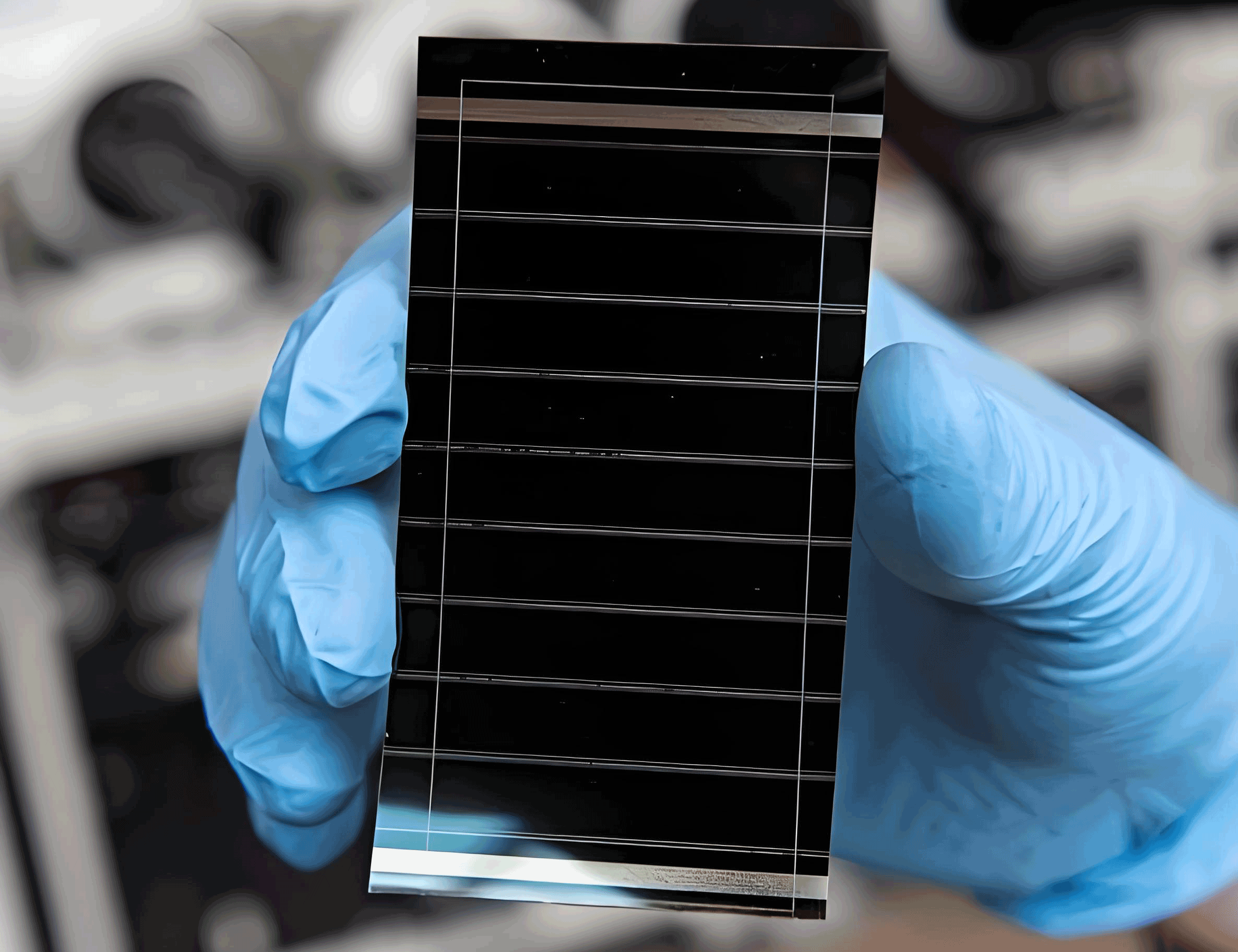
To quantify the impact of NBA additive on the optoelectronic properties of CsPbBr3 films, I perform UV-Vis absorption and steady-state PL measurements. The absorption spectra show increased light absorption in the visible range for NBA-modified films, indicating improved crystallinity and reduced scattering losses. The Tauc plot analysis reveals a direct bandgap of approximately 2.3 eV for both pristine and NBA-modified CsPbBr3, consistent with literature values. The PL intensity is significantly enhanced in the presence of NBA, suggesting suppressed non-radiative recombination. Time-resolved PL decay curves are fitted with a bi-exponential function: $$I(t) = A_1 \exp\left(-\frac{t}{\tau_1}\right) + A_2 \exp\left(-\frac{t}{\tau_2}\right)$$ where \(\tau_1\) and \(\tau_2\) represent the fast and slow decay lifetimes, respectively. The average carrier lifetime (\(\tau_{ave}\)) is calculated as: $$\tau_{ave} = A_1 \tau_1 + A_2 \tau_2$$ For the optimal NBA-modified film, \(\tau_{ave}\) increases from 9.32 ns to 10.29 ns, indicating reduced trap-assisted recombination.
Electrochemical impedance spectroscopy provides insights into the charge transport and recombination dynamics at the interfaces. The Nyquist plots exhibit a single semicircle, with the radius corresponding to the recombination resistance (\(R_{rec}\)). The NBA-modified devices show a higher \(R_{rec}\) value (1249.33 Ω) compared to the pristine devices (267.97 Ω), demonstrating inhibited charge carrier recombination. This is further supported by transient photovoltage and photocurrent measurements, where the NBA-modified devices exhibit shorter charge extraction lifetimes and longer recombination lifetimes, highlighting improved charge collection efficiency and reduced non-radiative losses.
The defect density in the CsPbBr3 films is estimated using the space-charge-limited current method from dark J-V characteristics. The trap-filled limit voltage (\(V_{TFL}\)) is determined from the kink in the log-log plot, and the defect density (\(n_{trap}\)) is calculated using: $$n_{trap} = \frac{2 \epsilon_0 \epsilon_r V_{TFL}}{e d^2}$$ where \(\epsilon_0\) is the vacuum permittivity, \(\epsilon_r\) is the relative permittivity of CsPbBr3, \(e\) is the elementary charge, and \(d\) is the film thickness. The NBA-modified films show a lower \(n_{trap}\) value of \(9.872 \times 10^{15}\) cm⁻³ compared to \(1.251 \times 10^{16}\) cm⁻³ for the pristine films, confirming the role of NBA in passivating defects and improving film quality.
The photovoltaic performance of the devices is summarized in the following tables, which detail the effects of various parameters on the key metrics. Table 1 presents the impact of different additives on device performance, while Table 2 shows the optimization of NBA volume fraction. Table 3 and Table 4 illustrate the influence of pre-loading time and annealing duration, respectively.
| Additive | VOC (V) | JSC (mA cm⁻²) | FF (%) | PCE (%) |
|---|---|---|---|---|
| H2O (pristine) | 1.38 | 4.91 | 77.34 | 5.24 |
| NBA | 1.49 | 5.74 | 82.08 | 7.02 |
| MPI | 1.32 | 4.13 | 75.34 | 4.11 |
| MeOH | 1.33 | 3.33 | 80.11 | 3.55 |
| EGME | 1.41 | 5.41 | 71.57 | 5.44 |
| NBA Volume Fraction (%) | VOC (V) | JSC (mA cm⁻²) | FF (%) | PCE (%) |
|---|---|---|---|---|
| 0 | 1.39 | 4.76 | 80.46 | 5.32 |
| 5 | 1.58 | 5.99 | 82.59 | 7.79 |
| 10 | 1.47 | 5.51 | 79.77 | 6.46 |
| 15 | 1.41 | 4.41 | 71.52 | 4.43 |
| Pre-loading Time (s) | VOC (V) | JSC (mA cm⁻²) | FF (%) | PCE (%) |
|---|---|---|---|---|
| 0 | 1.49 | 4.21 | 79.12 | 4.96 |
| 5 | 1.51 | 6.25 | 80.54 | 7.61 |
| 15 | 1.55 | 6.42 | 84.98 | 8.46 |
| 25 | 1.58 | 5.75 | 80.76 | 7.36 |
| Annealing Time (min) | VOC (V) | JSC (mA cm⁻²) | FF (%) | PCE (%) |
|---|---|---|---|---|
| 5 | 1.53 | 6.53 | 83.03 | 8.31 |
| 15 | 1.60 | 7.23 | 85.78 | 9.92 |
| 25 | 1.55 | 6.11 | 84.97 | 8.05 |
The stability of the perovskite solar cells is a critical factor for practical applications. I evaluate the long-term performance of both pristine and NBA-modified devices under ambient conditions (25°C, 20% relative humidity). The normalized photovoltaic parameters are monitored over 28 days, as shown in Table 5. The NBA-modified devices retain over 95% of their initial PCE, while the pristine devices degrade to below 90%. This enhanced stability is attributed to the improved film morphology and reduced defect density, which minimize moisture ingress and phase segregation.
| Device Type | Day 0 (%) | Day 7 (%) | Day 14 (%) | Day 21 (%) | Day 28 (%) |
|---|---|---|---|---|---|
| Pristine (H2O) | 100 | 95.2 | 92.1 | 89.5 | 87.3 |
| NBA-modified | 100 | 98.7 | 97.4 | 96.8 | 95.2 |
In conclusion, the incorporation of n-butanol as an additive in the CsBr aqueous solution effectively addresses the challenges associated with the fabrication of high-quality CsPbBr3 films for perovskite solar cells. The optimized conditions result in devices with a power conversion efficiency of 9.92%, which is among the highest reported for carbon-based all-inorganic CsPbBr3 perovskite solar cells. The improved performance is attributed to enhanced film morphology, reduced defect density, and suppressed non-radiative recombination. This green solvent strategy not only advances the development of efficient perovskite solar cells but also aligns with environmental sustainability goals. Future work will focus on scaling up the fabrication process and exploring other green additives to further boost the performance and stability of perovskite solar cells.
The success of this approach underscores the importance of solvent engineering in the optimization of perovskite solar cells. By carefully selecting additives that improve wettability and control crystallization, I can achieve films with superior optoelectronic properties. The insights gained from this study can be extended to other perovskite compositions and device architectures, contributing to the broader adoption of perovskite-based photovoltaics. As research in this field continues to evolve, the integration of green chemistry principles will play a pivotal role in realizing the commercial potential of perovskite solar cells.
Moreover, the fundamental understanding of charge carrier dynamics in these devices can be further elucidated through advanced characterization techniques and modeling. For instance, the relationship between film morphology and device performance can be described using models that account for grain boundary effects and interface recombination. The diode equation for a perovskite solar cell can be modified to include recombination losses: $$J = J_{ph} – J_0 \left[\exp\left(\frac{q(V + J R_s)}{n k T}\right) – 1\right] – \frac{V + J R_s}{R_{sh}}$$ where \(J_{ph}\) is the photocurrent density, \(J_0\) is the reverse saturation current density, \(n\) is the ideality factor, \(R_s\) is the series resistance, and \(R_{sh}\) is the shunt resistance. By minimizing \(R_s\) and maximizing \(R_{sh}\) through improved film quality, I can achieve higher fill factors and efficiencies in perovskite solar cells.
In summary, the use of n-butanol additive in CsBr solutions represents a significant step forward in the fabrication of high-performance CsPbBr3 perovskite solar cells. This work demonstrates that solvent engineering is a powerful tool for enhancing the properties of perovskite films and devices, paving the way for more sustainable and efficient photovoltaic technologies.